Dragonfly Facts: The 95% Killer With 30,000 Eyes
Of every ten flies a dragonfly chases through summer air, nine and a half end up dead — and the most interesting dragonfly facts start there, with that single ruthless number. A 95% kill rate puts this insect ahead of lions, sharks, and falcons as the most efficient hunter biologists have ever measured. The rest of its biology is almost as improbable.
Key Facts
- Up to 95% prey-capture success rate, measured in Stacey Combes’ biomechanics lab at UC Davis with researcher Rachel Crane — far above peregrine falcons (~47%) and lions (~25%).
- Each compound eye carries up to 30,000 ommatidia, giving a near-360° field of view and the ability to see ultraviolet light.
- Each of the four wings is driven by an independent muscle, allowing hover, reverse flight, and mid-air mating.
- Pantala flavescens, the globe skimmer, makes a multi-generational journey of roughly 18,000 km — the longest known insect migration on Earth.
- Meganeura, a 300-million-year-old relative, had a wingspan of about 70 cm — the largest flying insect ever to exist.
In short: Dragonflies are the most refined aerial predator ever evolved. Their eyes, brains, and four-wing flight system let them catch almost any prey they decide to chase. Their larvae are equally lethal underwater. And the family they belong to has been hunting flies, mosquitoes, and (once upon a time) small amphibians for roughly 300 million years.
Key Facts
- Dragonflies have up to a 95% prey-capture success rate, measured in Stacey Combes’ lab with researcher Rachel Crane—far above peregrine falcons (~47%) and lions (~25%).
- Each compound eye carries up to 30,000 ommatidia, giving a near-360° field of view and ultraviolet sensitivity.
- Each of the four wings is driven by an independent muscle, allowing hover, reverse flight and mid-air mating.
- Pantala flavescens, the globe skimmer, makes a multi-generational journey of roughly 18,000 km—the longest known insect migration.
- Meganeura, a 300-million-year-old relative, had a wingspan of about 70 cm—the largest flying insect ever.
In short: Dragonflies catch up to 95% of the prey they target—far above lions (~25%) or peregrine falcons (~47%)—making them the most efficient hunters measured. Each compound eye has up to 30,000 facets for near-360° UV vision, four independently powered wings, and a brain that predicts prey trajectories to intercept them.
The 95% Hunter: Why Dragonflies Out-Kill Lions, Sharks, and Falcons

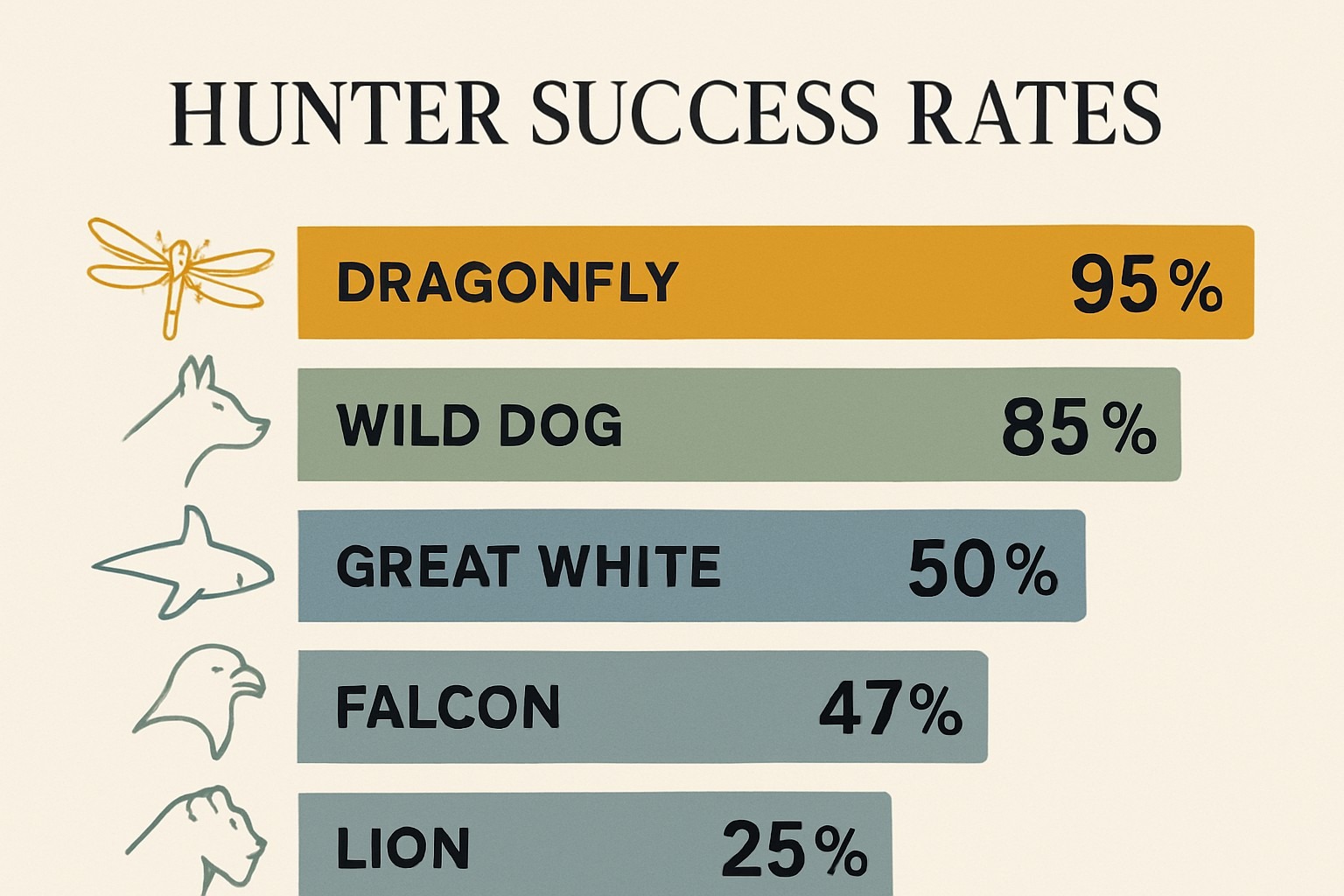
The headline number comes from a 2012 study by Stacey Combes’ biomechanics lab, then at Harvard and later at the University of California, Davis. Researcher Rachel Crane, working with Combes, later refined and confirmed the figure: dragonflies catch up to about 95% of the prey they target. Earlier work from the Howard Hughes Medical Institute occasionally pushes the rate toward 97% under ideal lab conditions. Either figure dwarfs the strike rates measured for nearly every other predator on the planet.
For perspective, here is how the dragonfly stacks up against the best-studied apex hunters:
| Predator | Approximate hunting success | Context |
|---|---|---|
| Dragonfly | ~95% | Lab measurements (UC Davis); ambushing flying prey |
| African wild dog (pack) | ~85% | Cooperative chase across open savanna |
| Great white shark | ~50% | Ambush on seals at Seal Island, South Africa |
| Peregrine falcon | ~47% | High-speed aerial stoops on birds |
| House cat (outdoor) | ~32% | Mostly small birds and rodents |
| Lion (pride) | ~25% | Group hunts on ungulates, mostly at night |
The pattern is consistent. Vertebrate predators average somewhere between 20% and 50%, and even cooperative pack hunters — wolves, lionesses, orcas — top out around 85%. A solitary insect the size of a paper clip outperforms all of them. The asymmetry has a single explanation: dragonflies do not chase. They intercept. Everything that follows is a tour of how that becomes possible.
30,000 Eyes That See What We Cannot
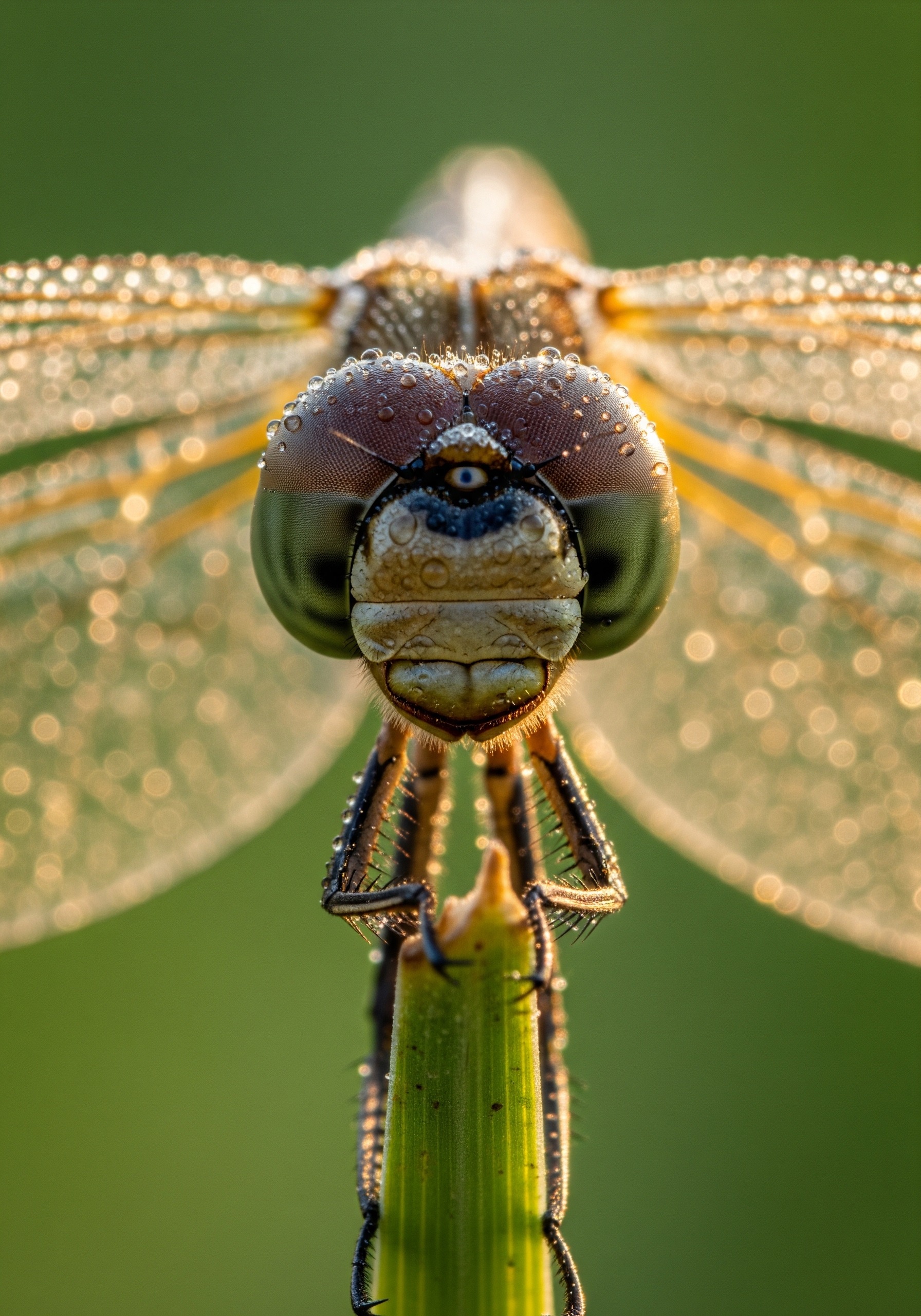
A dragonfly’s head is mostly eye. Two enormous compound eyes wrap around the skull, each built from up to 30,000 hexagonal facets called ommatidia. Each facet is a small optical unit, with its own lens and its own narrow slice of the world. The dragonfly’s brain stitches those 30,000 slices into a single panoramic image — one that covers, in most species, close to 360 degrees.
Three smaller simple eyes called ocelli sit on top of the head. They do not form an image. What they do is tell the dragonfly, in real time, how its body is tilted against the horizon — the same job the inner ear does in a human pilot. It is one reason a dragonfly can throw itself into sharp aerial maneuvers without losing track of which way is up.
The vision is also colourful in a way most animals never experience. Humans have three colour-sensing opsins. Day-flying dragonflies have between four and five, and a 2015 paper in PNAS by Ryo Futahashi and colleagues at Japan’s National Institute of Advanced Industrial Science and Technology found that some species carry as many as 30 different opsin genes — more than any other animal known. That gives them sensitivity to ultraviolet light and to wavelengths humans cannot perceive. To a dragonfly hunting over a pond, the surface of the water glows in patterns invisible to us.
{IMAGE_2}
The Brain That Forecasts Its Prey
Wide-angle vision alone does not deliver a 95% strike rate. What does is the way the dragonfly’s brain uses that vision — and here is where the trick gets genuinely interesting.
The circuit at the centre of it is a set of about sixteen target-selective descending neurons, or TSDNs, first described in dragonflies by neurobiologist Robert Olberg in the 1980s. The TSDNs connect what the dragonfly sees to how it moves its wings. Their job is to translate where the dragonfly sees prey into where it should fly to intercept it. In 2015, a paper in Nature by Matteo Mischiati and Anthony Leonardo of the Howard Hughes Medical Institute’s Janelia Research Campus took the work further: tracking dragonflies hunting in 3D, they showed that the insect’s brain holds an internal model of the prey — extrapolating its trajectory and adjusting flight toward a future interception point.
This is the same logic an outfielder uses to catch a fly ball, or an air-to-air missile uses to lock onto a fighter jet. It is called predictive interception, and dragonflies appear to have been the first animals on Earth to evolve a dedicated neural circuit for it. Strip away the breathless headlines that float around insect blogs, and the underlying biology is, if anything, more impressive than the slogans.
Four Wings, Four Independent Motors
Most flying insects beat both pairs of wings in sync. Dragonflies do not. Each of their four wings is attached to its own muscle and fires on its own schedule. Front and back pairs can move out of phase, in phase, or at different angles entirely.
That four-channel control is why dragonflies fly the way they do. They hover. They reverse. They make 90-degree turns inside a single wingbeat. They reach roughly 35 mph in level flight, fast enough to be among the quickest flying insects on record. They can also mate in mid-air — the male hovers in front of the female while both bodies hold position against a breeze, the four wings of each insect making continuous micro-corrections. No helicopter on Earth flies with that much agility.
The price is energetic. Driving four wings on independent muscles burns fuel, which is part of why most species spend the bulk of their lives in another form entirely.
The Underwater Years: A Catapult Jaw and a Jet Engine
The flying, photogenic adult is the brief, advertised version of the animal. The longer act happens underwater. Eggs are laid in or near water; the larva — sometimes called a nymph or naiad — hatches and then spends anywhere from a few months to about five years living on the bottom of a stream, pond, or lake. During that time, on its own scale, it is just as dangerous as the adult.
Two adaptations make the larva so effective. The first is its lower jaw, called the labium. At rest it folds under the head like a folded arm. When a tadpole, mosquito larva, worm, or even a small fish moves within reach, the labium fires forward with the speed of a catapult, hooks the prey on a pair of pincers, and pulls it back to the mandibles. A 2020 paper posted to bioRxiv documented that the strike uses a stored-energy mechanism — closer in principle to a crossbow than to a muscle contraction — which is how an insect manages to out-accelerate a fleeing tadpole.
The second adaptation is jet propulsion. Dragonfly larvae breathe through gills inside their rectum. By contracting the abdominal muscles, they expel that internal water in a high-pressure jet — and shoot forward as a result. They are the only insects known to swim by jet thrust. One larva can eat several hundred mosquitoes a day, which is most of the reason ponds with healthy dragonfly populations have so few biting insects above them.
The Globe Skimmer’s 18,000-km Migration
Among adult dragonfly facts, the most underrated belongs to a single species: Pantala flavescens, the globe skimmer or wandering glider. Biologist Charles Anderson, working from the Maldives, documented in a 2009 paper in the Journal of Tropical Ecology that swarms of globe skimmers were crossing the open Indian Ocean from India to East Africa each year, riding monsoon winds at altitudes of up to two kilometres. The full migratory circuit — completed across four successive generations — covers roughly 18,000 km. That is the longest migration of any insect on Earth, well past the much-publicised 4,000 km journey of the monarch butterfly.
A 2021 paper in Frontiers in Ecology and Evolution went further, modelling the energy reserves and wind speeds the dragonflies actually have available. The conclusion: a single globe skimmer can plausibly fly non-stop across thousands of kilometres of open ocean, gliding for long stretches to save fuel. By body-size-to-distance ratio, Pantala flavescens performs the longest known non-stop migration of any animal on the planet.
None of this requires the dragonflies to know where they are going. They follow the rain. Turns out the next generation simply lays eggs in puddles left behind by monsoon storms, and within a few weeks the cycle repeats.
Meganeura: When Dragonflies Had Hawk-Sized Wings
About 300 million years ago, during the Late Carboniferous, the air on Earth held roughly 30-35% oxygen — well above today’s 21%. Insects breathe through passive tracheal tubes; the more oxygen in the air, the larger an insect’s body can grow before its tubes can no longer keep up. Under that ancient sky, a relative of the dragonfly called Meganeura reached a wingspan of about 70 cm — roughly the size of a large hawk.
Meganeura was not, strictly speaking, a true dragonfly. It belonged to a closely related extinct order, Meganisoptera, whose members palaeontologists sometimes call “griffenflies” to keep the lineages clear. But the resemblance is unmistakable: long body, four broad predatory wings, large compound eyes. A 2018 paper in the Journal of Experimental Biology recalculated the engineering and put the body mass of the largest species somewhere between roughly 18 grams and 150 grams, depending on the reconstruction. By either estimate, it was the largest flying insect that ever lived.
It will not happen again unless atmospheric oxygen rises sharply, which is not in any forecast.
Interesting Dragonfly Facts for Kids — The Short Version
For younger readers — or for a parent reading aloud — here are the dragonfly facts worth knowing in plain language:
- A dragonfly has four wings, and each wing can move on its own. That is why it can hover, fly backwards, and turn around in mid-air.
- One dragonfly can eat hundreds of mosquitoes in a single day. They are friends to ponds, gardens, and people who don’t like being bitten.
- Their eyes are so big they cover almost the whole head. They can see in front, behind, above, and below — all at the same time.
- Baby dragonflies live underwater, sometimes for years, before they climb out, dry off, and grow wings.
- The oldest dragonfly-like fossils are about 300 million years old — older than the first dinosaurs.
Frequently Asked Questions
Q: Do dragonflies bite or sting humans?
A: Dragonflies do not sting — they have no stinger. The largest species can deliver a small pinch with their mandibles if you grip one tightly in your fingers, but the bite does not break human skin and carries no venom. They are harmless to people, pets, and livestock.
Q: How long does a dragonfly live?
A: The flying, photogenic adult lives only about one to four weeks for most species, with a few hardy ones reaching two months. The full life cycle, including the underwater larval stage, ranges from a few months to about five years, depending on the species and the climate.
Q: Are dragonflies good for the garden?
A: Yes, unambiguously. A single adult eats hundreds of small flying insects a day — including mosquitoes, midges, and gnats. A garden pond that supports dragonfly larvae will usually have noticeably fewer biting insects in the air around it.
Q: What is the difference between a dragonfly and a damselfly?
A: Both belong to the order Odonata. Two easy field marks separate them. A dragonfly rests with its wings held flat and out to the sides; a damselfly folds its wings back over the body. A dragonfly’s eyes also touch (or nearly touch) on the top of the head, while a damselfly’s eyes are clearly separated by a gap.
Sources
- Combes, S.A. et al. — prey capture biomechanics work, Harvard and University of California, Davis (Combes lab, with researcher Rachel Crane).
- Mischiati, M., Lin, H., Herold, P., Imler, E., Olberg, R., and Leonardo, A. — “Internal models direct dragonfly interception steering,” Nature, 2015 (HHMI Janelia Research Campus).
- Anderson, R.C. — “Do dragonflies migrate across the western Indian Ocean?”, Journal of Tropical Ecology, 2009.
- Hedlund, J.S.U. et al. — modelling of Pantala flavescens non-stop oceanic migration, Frontiers in Ecology and Evolution, 2021.
- Futahashi, R. et al. — opsin gene expansion in Odonata, PNAS, 2015.
- Cannell, A.E.R. — engineering of giant Carboniferous dragonflies, Journal of Experimental Biology, 2018.
- Smithsonian Magazine, Natural History Museum (London), and the U.S. National Park Service — public natural-history references on dragonfly biology and behaviour.
A 95% kill rate. Thirty thousand eyes. Four independent wings. A 300-million-year track record. The dragonfly you watched chasing midges over a summer pond is, by almost every metric biology can apply, the most refined small predator the planet has produced. The pond is its hunting ground. The air above it is its operating theatre. Watch carefully next time — they are usually finished before you have noticed they started.
Illustrations are AI-generated. Article fact-checked and human-edited. Our editorial standards.