How Fast Do Hummingbird Wings Beat? The Real Numbers
Hummingbird wing speed is one of those animal-fact greatest hits where the popular number — eighty beats per second — gets repeated everywhere and is almost always quoted out of context. A perched ruby-throat? Wings still. A male in a courtship dive? Triple digits. The truth lives in the range between, and high-speed cameras have only really pinned it down in the last fifteen years.
Key Facts
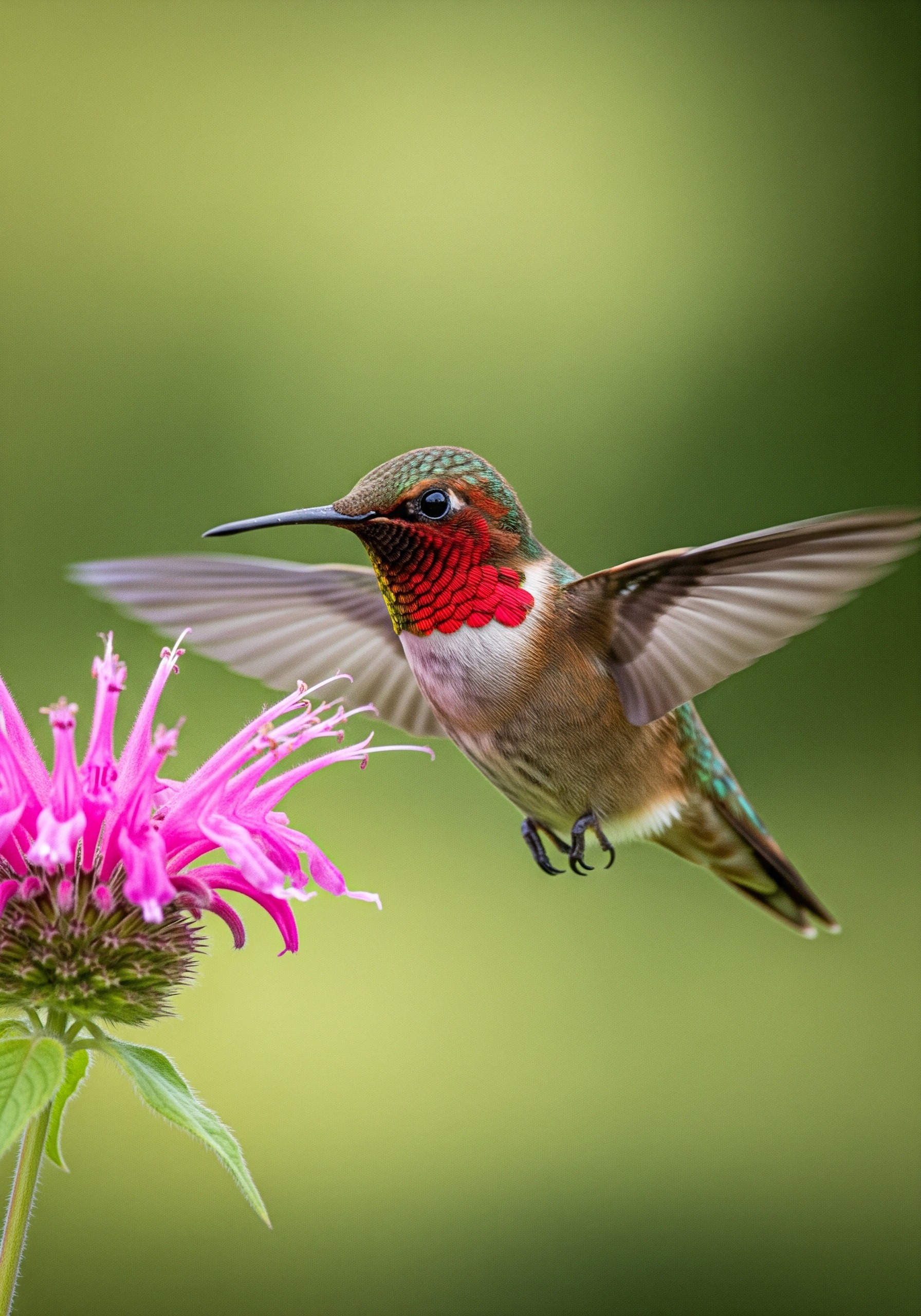
- Most hummingbirds beat their wings 50–80 times per second while hovering — not a fixed “80.”
- The giant hummingbird of the Andes (Patagona gigas) flaps roughly 10–15 times per second, slower than many songbirds.
- Guinness lists the ruby-throated hummingbird (Archilochus colubris) at up to 200 wing beats per second during courtship — the fastest wing-beat of any bird.
- Male Anna’s hummingbirds dive at 27.3 m/s — 385 body lengths per second, the highest length-specific velocity ever recorded for a vertebrate (Christopher Clark, UC Berkeley, 2009).
- Unlike most birds, hummingbirds produce lift on both the downstroke and the upstroke, in roughly a 75/25 split (Bret Tobalske, University of Montana).
In short: Hummingbird wing speed depends on which species you mean and what it’s doing. A typical hover for a medium-sized hummingbird sits between 50 and 80 beats per second. The fastest small species can hit 200 in a display flight. The largest species, the giant hummingbird, flaps slower than a robin.
Key Facts
- Most hummingbirds beat their wings 50-80 times per second while hovering, not a fixed 80.
- The giant hummingbird of the Andes (Patagona gigas) flaps roughly 10-15 times per second, slower than many songbirds.
- Guinness lists the ruby-throated hummingbird (Archilochus colubris) at up to 200 wing beats per second during courtship, the fastest wing-beat of any bird.
- Male Anna’s hummingbirds dive at 27.3 m/s, or 385 body lengths per second, the highest length-specific velocity ever recorded for a vertebrate (Christopher Clark, UC Berkeley, 2009).
- Unlike most birds, hummingbirds produce lift on both the downstroke and the upstroke, in roughly a 75/25 split (Bret Tobalske, University of Montana).
In short: Hummingbird wing speed depends on which species you mean and what it is doing. A typical hover for a medium-sized hummingbird sits between 50 and 80 beats per second, the fastest small species can hit 200 in a display flight, and the largest species, the giant hummingbird, flaps slower than a robin.
The number you’ve heard is only half true
Open any wildlife app and you’ll see it: “Hummingbirds flap their wings 80 times a second.” True for some. Misleading for most. The figure usually comes from peak hovering measurements on small species — bee hummingbirds, calliopes — under specific lab conditions. Spread that across the family of more than 360 hummingbird species, then across all the things one bird actually does in a day — perch, sip, transit, defend, display — and the famous eighty becomes one point on a much wider graph.
The cleanest way to think about hummingbird wing speed is two axes: which species, and what behavior. Plot those together and you stop chasing one magic number.
The figure-eight: how a hummingbird actually moves its wings
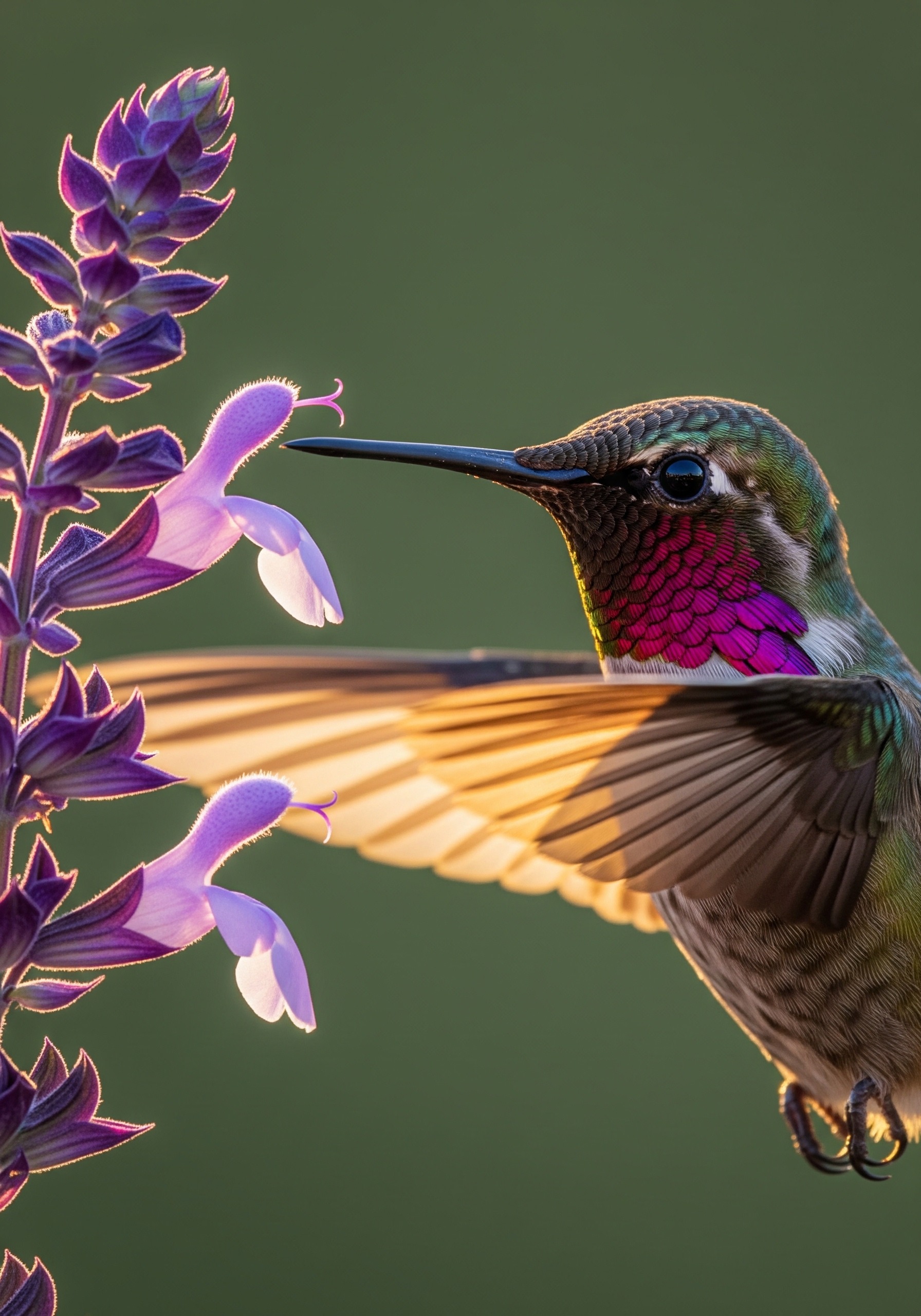
This is where hummingbirds split from the rest of the bird world. A robin or a swallow flaps mostly up and down, taking nearly all its lift from the downstroke. Hummingbird wings sweep forward and backward instead, tracing a flattened figure-eight in the air. The wing inverts at the top of each stroke — rotating roughly 180 degrees — so the leading edge cuts forward into the airflow whether the bird is pushing down or pulling up.
Bret Tobalske of the University of Montana has spent two decades inside high-speed-video labs working out the consequences. His measurements pinned the lift split at about 75 per cent on the downstroke and 25 per cent on the upstroke. That 25 is the trick. It’s why a hummingbird can hold its body absolutely still in mid-air for minutes while a sparrow can’t hover at all.
Here’s the thing: that motion is only possible because of an unusual shoulder. The humerus meets the shoulder in a near-spherical ball-and-socket joint, giving a range of rotation no other bird has. Without that joint, eighty figure-eights per second would tear a wing off.
{IMAGE_2}
Species changes everything
There is no single hummingbird wing speed. There’s a curve, and the curve runs from a robin-like flutter to numbers no other vertebrate matches.
Wing-beat rate during hover, by species
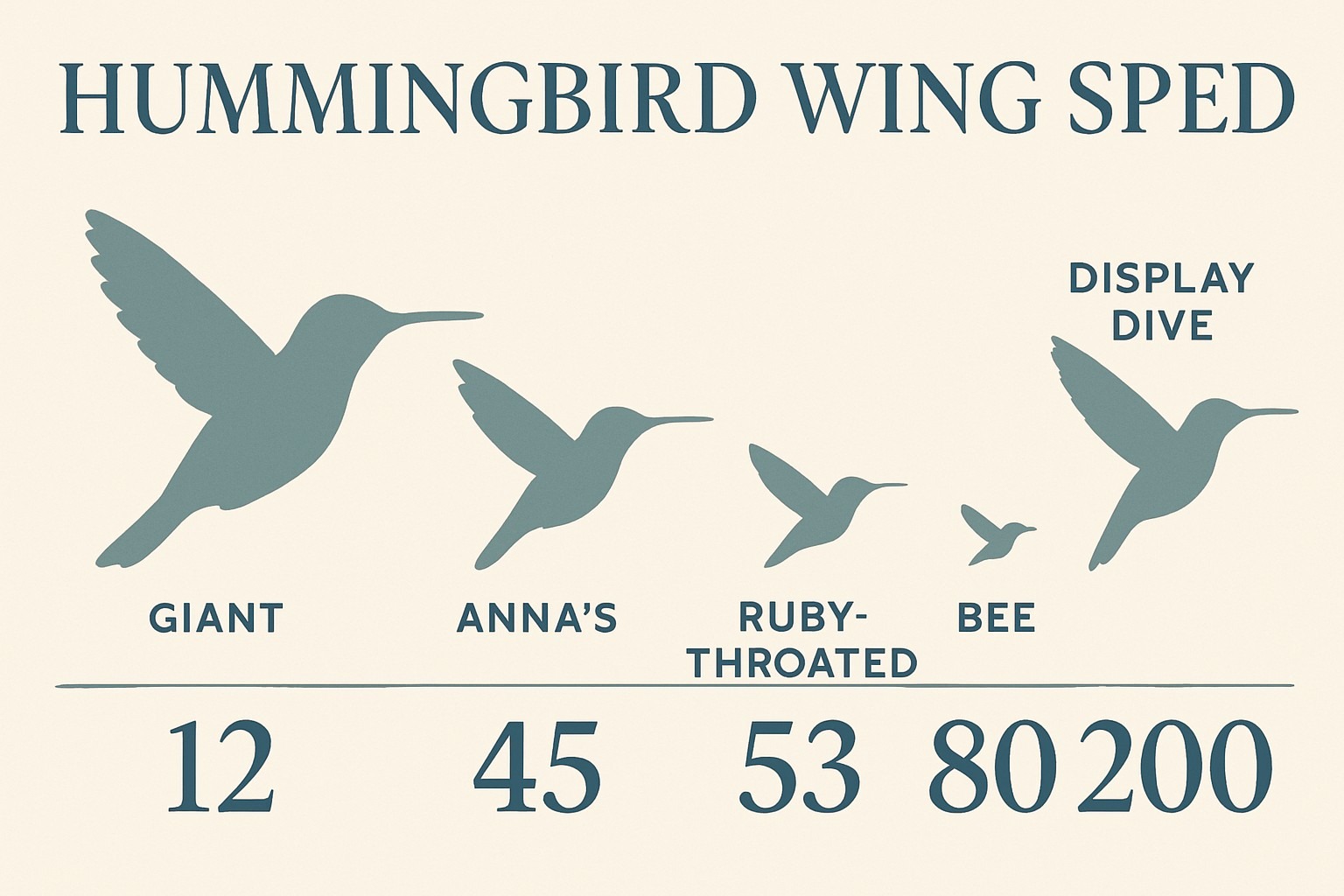
- Giant hummingbird (Patagona gigas) — about 10–15 beats per second
- Anna’s hummingbird (Calypte anna) — about 40–50 beats per second
- Ruby-throated hummingbird (Archilochus colubris) — about 53 beats per second
- Calliope hummingbird (Selasphorus calliope) — about 80 beats per second
- Bee hummingbird (Mellisuga helenae) — about 80 beats per second
- Ruby-throated, courtship display peak — up to 200 beats per second (Guinness World Records)
The pattern is clean: smaller body, faster flap. Bee hummingbirds weigh under two grams and beat their wings near the upper edge of anything ever measured in a bird. The giant hummingbird, at about 24 grams and roughly 20 centimetres long, sits down at songbird rates because it’s heavy enough that brute wing area carries it without the muscular shimmer.
Hover, cruise, dive — the three modes
Same bird, three very different wing speeds. Most articles collapse them into one figure; they’re not the same figure.
| Mode | Wing-beat rate | Body speed | Purpose |
|---|---|---|---|
| Hover at a flower | 50–80 / sec | 0 | Feeding |
| Cruising flight | ~20–40 / sec | up to 48 km/h (30 mph) | Travel |
| Courtship dive | up to ~55 / sec (powered phase) | 88–97 km/h (55–60 mph) | Display |
| Ruby-throat display peak | ~200 / sec | low | Visual / acoustic signal |
The cruising number surprises people. When a hummingbird is moving forward rather than hovering, the forward motion does part of the lift work for it the way an aeroplane wing is helped by airspeed, and the bird actually drops its beat rate. Hovering is the metabolic emergency. Cruising is comparatively cheap.
The 9-g dive that beats fighter pilots
In 2009, Christopher Clark — then at UC Berkeley, now at UC Riverside — parked six high-speed cameras around a California state park and recorded male Anna’s hummingbirds courting females. The numbers he pulled off those tapes are still the most extreme ever measured for a vertebrate.
Each male climbed to about thirty metres, oriented himself above the female, and dove. He powered the dive — wings flapping roughly 55 times per second — until peak velocity hit 27.3 metres per second, or about 60 miles per hour. In body lengths, that’s 385 per second. A peregrine falcon in a stoop manages around 200. A space shuttle on re-entry, 207. The hummingbird wins.
Then the pull-up. Clark measured centripetal accelerations close to 9 g — meaning the bird’s effective weight briefly multiplied ninefold. Fighter pilots in F-16s grey out routinely at that figure. A four-gram hummingbird does it on purpose, twenty or thirty times in an afternoon, to impress a female who may not even glance up.
That is, frankly, the most outrageous trick in vertebrate flight, and nothing else in the back yard comes close.
Where the hum actually comes from
For decades the hum itself was a black box. We knew it correlated with wing-beat rate — slow species hum lower, fast species higher — but the physics underneath were fuzzy.
A 2021 study from Eindhoven University of Technology, Stanford, and the acoustics firm Sorama finally cracked it. The team, led by David Lentink, filmed Anna’s hummingbirds with twelve high-speed cameras, six pressure plates, and 2,176 microphones arranged into an acoustic camera. The setup let them visualise sound as a heat-map overlaid on the moving wing.
Their answer: the hum is the audible pressure difference between the upper and lower wing surfaces, oscillating at the wing-beat frequency. Because hummingbirds produce lift on both halves of the stroke — that 75/25 split — each cycle gives two pressure peaks instead of one. That’s why the sound is smoother and more musical than a buzz. A mosquito’s wing essentially only pushes air down; it whines. A bee oscillates more evenly; it buzzes. A hummingbird is the only one of the three that gets a soft, almost tonal “hum,” and the overtones come straight from the asymmetry of its stroke.
The biology behind the blur
Eighty wing-beats a second is an enormous metabolic ask. Hummingbird bodies are basically tuned engines wrapped in feathers.
Their pectoral muscles — the breast muscles that drive both halves of the stroke — account for roughly a quarter to a third of total body weight. Most birds sit around 15 per cent. A secondary muscle, the supracoracoideus, fires the upstroke independently with comparable force to the main downstroke muscle, which is why both halves of the figure-eight can actually be powered. In most birds the upstroke is a recovery stroke; in hummingbirds it’s a second engine.
The cardiovascular system keeps up. A hovering hummingbird’s heart can exceed 1,200 beats per minute. Resting breathing rate runs around 250 breaths per minute. Their flight muscle is densely packed with mitochondria — among the highest mitochondrial densities ever measured in any vertebrate tissue — and is fed by a sugar-burning metabolism that switches between fructose and glucose, something even most mammals can’t do efficiently.
Run the mass-specific math and a human matching a hummingbird’s metabolic rate would need roughly 155,000 calories a day. They don’t, of course — they drink sugar water. The bird is a flying answer to the question, “How fast can a back-yard-scale vertebrate burn fuel?” And the honest reply from the research community is: we still don’t know the upper bound.
What we still don’t know
Plenty, actually. The 200-beat record for the ruby-throated hummingbird stands as a single Guinness-listed observation rather than a peer-reviewed kinematic study, and the rate during the loudest part of the display is still debated in the literature. Bee hummingbird hovering rates are hard to pin down because the species lives in Cuba and is rarely brought into flight labs. And for most of the family — the hundreds of tropical species nobody has filmed at 4,000 frames per second yet — the published wing-beat numbers are best estimates, not measurements. The honest version of this article is: we know the extremes very well, and we are still filling in the middle.
Frequently Asked Questions
Q: How many times does a hummingbird flap its wings per second?
A: It depends on the species and what it’s doing. Medium-sized hummingbirds beat their wings about 50–80 times per second while hovering at a flower. Tiny species like the bee hummingbird sit near the top of that range. The giant hummingbird beats only 10–15 times per second. During a male ruby-throated hummingbird’s display flight, brief peaks of about 200 beats per second have been documented.
Q: What is the fastest hummingbird wing-beat ever recorded?
A: Guinness World Records lists the ruby-throated hummingbird at roughly 200 wing beats per second during courtship — well above its normal hovering rate of around 53. No other bird matches it.
Q: How fast can a hummingbird actually fly?
A: Most species cruise around 30 mph (48 km/h). During courtship dives, male Anna’s hummingbirds reach roughly 60 mph (97 km/h). On a body-length basis that’s 385 lengths per second, the highest figure ever measured for a vertebrate.
Q: Why don’t hummingbirds get tired?
A: They do — most spend a large part of the day perched, conserving energy. While flying they sustain rates other birds couldn’t because their pectoral muscles can make up nearly a third of body mass and their hearts can hit 1,200 bpm. At night many species drop into torpor, lowering body temperature and slowing the heart to a few dozen beats per minute, to survive until morning.
Sources
- Warrick, D., Tobalske, B. et al. — “Aerodynamics of the hovering hummingbird,” Nature
- Clark, C.J. — “Courtship dives of Anna’s hummingbird offer insights into flight performance limits,” Proceedings of the Royal Society B (2009)
- Lentink, D. et al. — 2021 study on hummingbird wing acoustics, Eindhoven University of Technology / Stanford / Sorama
- Guinness World Records — “Fastest wing-beat of a bird”
- BBC Science Focus Magazine — feature on hummingbird flight biology
- Encyclopaedia Britannica — “How Fast Do Hummingbirds Fly?”
A hummingbird at a feeder looks like a small magic trick. It isn’t — it’s roughly four grams of muscle, joint, mitochondrion and oxygen, tuned for the one job most birds can’t do, by the only family of vertebrates that ever worked out how to fly backwards on purpose. Next time one hovers in front of you, count the seconds before it darts away. In that pause, somewhere between fifty and a hundred-and-twenty things just happened with its wings.
Illustrations are AI-generated. Article fact-checked and human-edited. Our editorial standards.