Owl Eye Facts: What Science Really Says About Night Vision
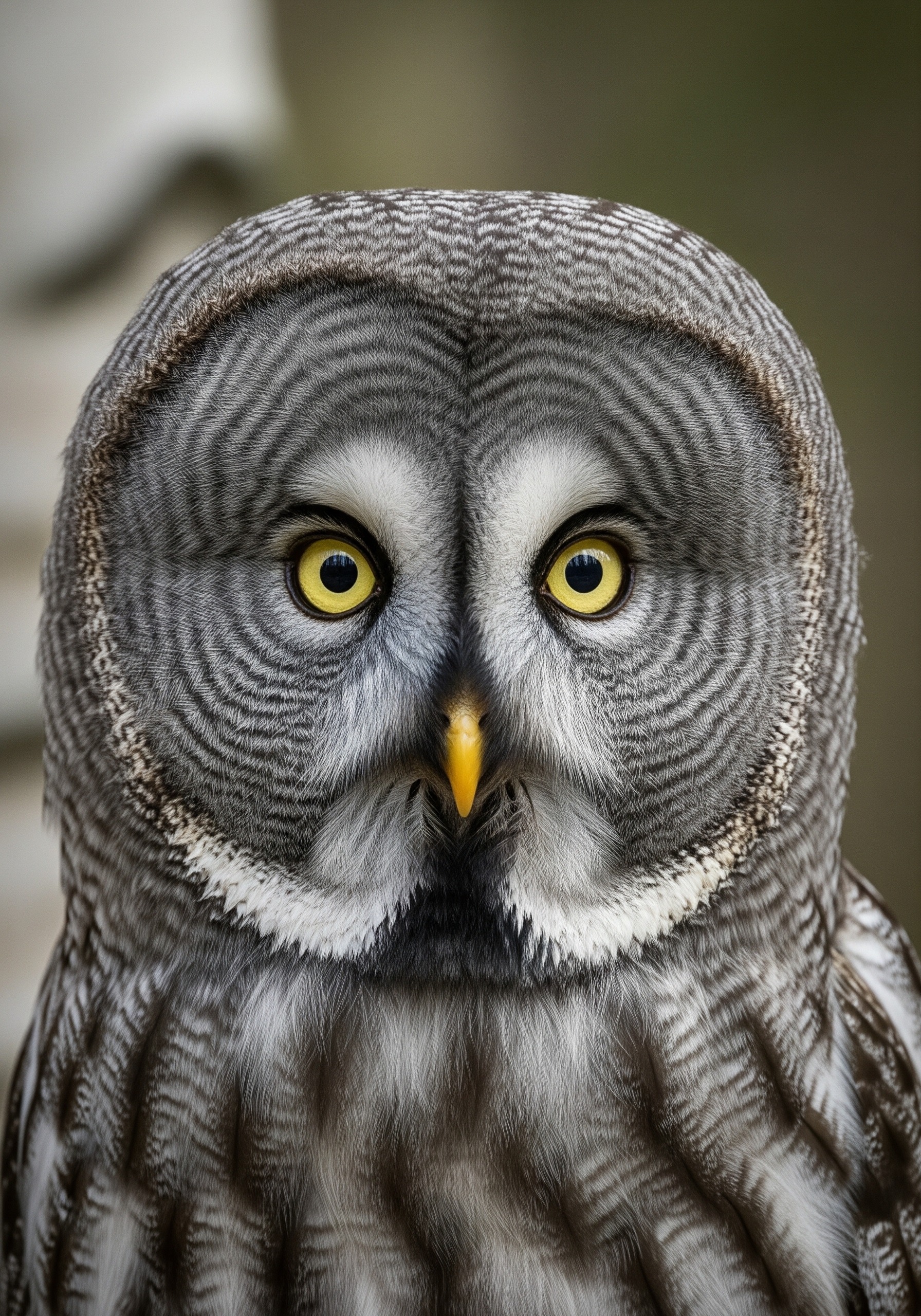
Few owl eye facts are stranger than this one: the bird famous for hunting in near-darkness cannot actually move its eyes. The huge yellow orbs you see staring back from the branch are locked solid into the skull, held in place by a ring of tiny bones. Everything else about owl vision — the 270-degree head twist, the silent glide, the predator’s calm — is downstream of that single anatomical fact.
Key Facts
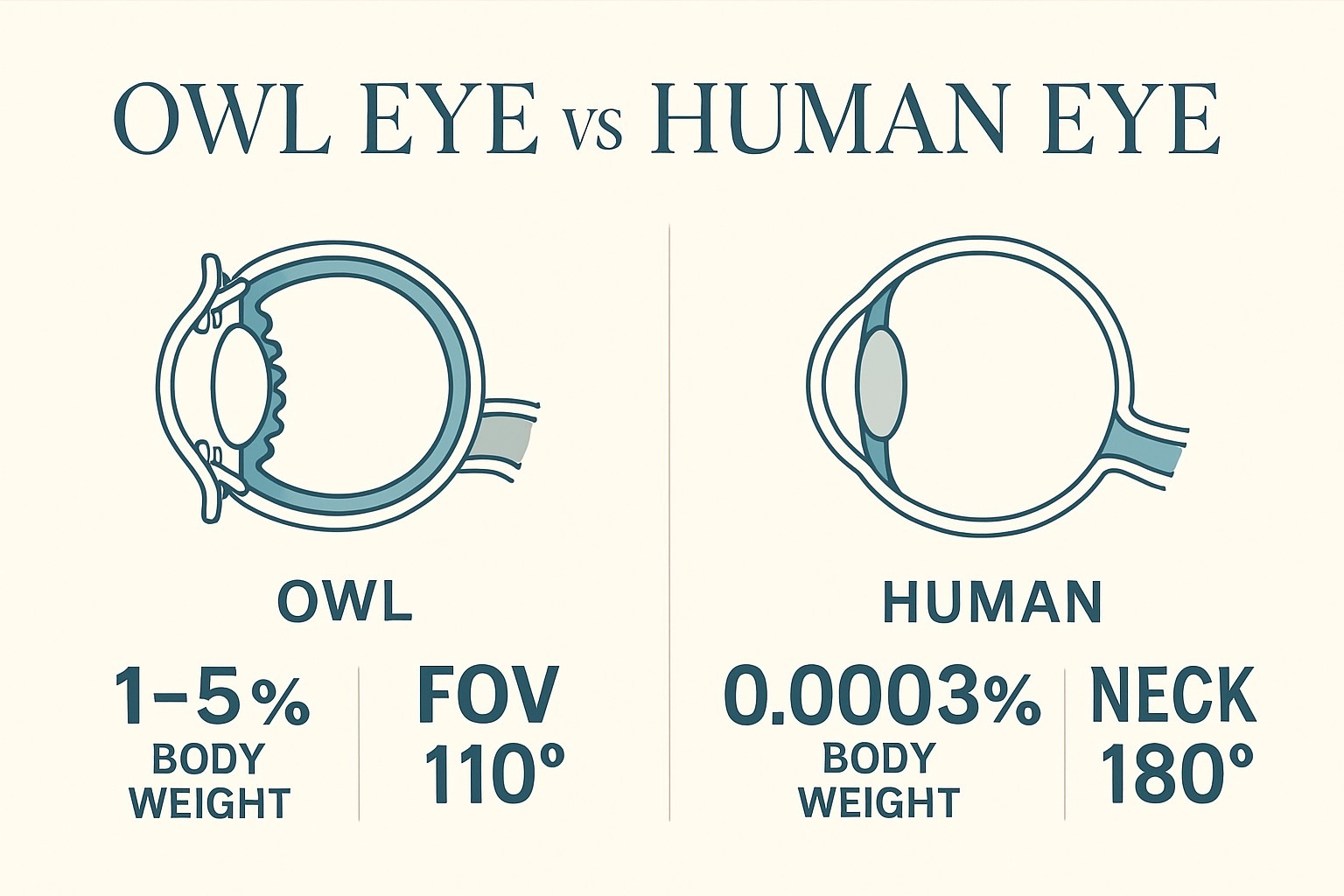
- An owl’s eyes can make up 1–5% of its body weight, depending on species. The human ratio is roughly 0.0003%.
- Owl eyes are not spheres. They are elongated tubes held by a ring of small bones — the sclerotic ring — inside the skull.
- The visual field is around 110 degrees, of which roughly 70 degrees is binocular (3D) overlap — narrower than ours but sharper where it counts.
- To compensate for fixed eyes, owls can swivel their heads through about 270 degrees.
- The famous claim that owl eyes are “100 times more sensitive” than human eyes is mostly an optical effect, not a retinal one — see below.
In short: Owls see in the dark the way a fast lens does — with a huge pupil and a wide-aperture optical design, not because their retinas are radically different from ours. Their eyes are also so big they had to be locked in place, which is why owls have those uncanny necks.
Key Facts
- An owl’s eyes can make up 1-5% of its body weight depending on species, compared with a human ratio of roughly 0.0003%.
- Owl eyes are not spheres but elongated tubes held by a ring of small bones, the sclerotic ring, inside the skull.
- An owl’s visual field is around 110 degrees, of which roughly 70 degrees is binocular 3D overlap.
- To compensate for eyes fixed in place, owls can swivel their heads through about 270 degrees.
- Graham Martin of the University of Birmingham calculated that the image inside a Tawny Owl’s (Strix aluco) eye is roughly 2.7 times brighter than inside a human eye viewing the same scene.
In short: Owls see in the dark the way a fast camera lens does, using a huge pupil and a wide-aperture optical design rather than a radically different retina. Their eyes are so large they had to be locked in place inside a ring of bone, which is why owls have such uncannily flexible necks.
Eyes Shaped Like Telescopes

Open an owl’s skull and the first thing you notice is that the eyes do not look like eyes. They look like binocular barrels. Each one is an elongated tube — wider at the front, narrower toward the retina — braced inside the skull by a ring of small overlapping bones called the sclerotic ring. Birds in general have these bones; owls have taken them to an extreme. The eyes are so large that, in some species, they occupy roughly 70% of the skull’s interior volume, leaving room for not much brain behind them.
That tube shape isn’t a quirk. It’s the whole point. By stretching the eye into a tube, an owl lengthens the distance from lens to retina, which makes the image on the retina bigger and brighter. It is the same trick a wildlife photographer uses with a long telephoto: more glass, more reach, more light delivered to the sensor. The British vision researcher Graham Martin, who spent decades at the University of Birmingham measuring exactly what owls can and cannot see, calculated that the image inside a Tawny Owl’s eye is roughly 2.7 times brighter than the image inside a human eye looking at the same scene.
Movement is the cost. A spherical eye sits in a socket and can rotate. A tube eye braced inside a bony ring cannot.
An owl staring at you is staring with its whole head, because that is the only option it has.
The Owl Eye Facts Most Articles Get Wrong
Almost every popular article about owls repeats the same line: their eyes are 100 times more sensitive in low light than ours. It’s a great line. It’s also misleading.
All those numbers trace back to Graham Martin’s work on the Tawny Owl (Strix aluco), published in Nature in 1977 and refined in the Journal of Comparative Physiology in 1982. Martin trained captive owls on a behavioural threshold task and measured the dimmest light they could reliably detect. His finding, in his own framing, is the surprise: at the level of the retina itself, the Tawny Owl is only modestly more sensitive than a human. The owl’s huge advantage in the dark comes mostly from optics — a giant cornea, a fat lens, and a pupil that opens far wider than ours — funnelling more photons onto a retina that is, biologically, not all that exotic.
The popular “100 times sharper than a human eye” line is the kind of clean factoid that travels fast and gets the science wrong, and owls deserve better. The honest version is more interesting. An owl’s nocturnal superpower is not a magical retina; it is a beautifully engineered lens system, packaged inside a skull that had to be redesigned around it.
{IMAGE_2}
How Owls Actually See in the Dark
So how do owls see in the dark? Three things working together.
First, that oversized optical front end. A wide pupil and a large cornea collect light the way a satellite dish collects radio waves. On a moonlit night, the difference between a human pupil (around 7 mm wide open) and a Great Horned Owl’s pupil (well over double that) is enormous.
Second, the retina is heavily weighted toward rod cells — the photoreceptors specialised for low-light, monochrome vision. Rod-to-cone ratio in an owl retina is roughly 30 to 1; in the human retina, it’s closer to 20 to 1. More rods means more sensitivity to motion in dim light, and less capacity for colour. It’s the bird-equivalent of a black-and-white film camera pushed to a very high ISO.
Third, behind the retina sits a mirror-like reflective layer called the tapetum lucidum. Any photon that slips past the rods without triggering them gets bounced back for a second pass. This is the same layer that makes a cat’s eyes glow green in a flashlight beam — and the same reason owl eyes, caught by a car’s headlights at the edge of a country road, shine back at you like coins.
Add those three together and you get an animal that can hunt by sight in light levels where a human would stumble over their own feet. What you do not get is vision in absolute blackness. No animal sees without photons. An owl in a sealed, lightless room is blind, just like you would be.
Three Eyelids, Three Jobs
Most birds have three eyelids. Owls use theirs with unusual specificity.
The upper eyelid drops downward when an owl blinks — same direction as yours, same reason: a normal, brief blink. The lower eyelid rises up to close the eye when the owl sleeps, which is why a roosting owl can look serenely shut without any of the wincing motion a mammal would make. And the third eyelid, the nictitating membrane, slides diagonally across the eye from the inner corner, sweeping it clean. It’s translucent, tough, and used as armour during high-risk moments: a strike on prey, a feeding chick, a flight through dense brush. The eye stays protected; vision stays mostly intact.
Watch a slow-motion video of a Great Horned Owl hitting a rabbit. In the last fraction of a second before impact, the nictitating membrane snaps across. The owl is, in effect, closing its eyes to attack — and trusting the geometry of the strike it already locked in.
The Real Cost of Tube Eyes
Locked eyes need to be compensated for, and owls compensate dramatically. The 270-degree head rotation that everyone has seen in nature documentaries is what makes the system work. (For the record, it’s not a full 360 — the bird does have to unwind.) Owl neck vertebrae have evolved with extra space around the arteries, so blood flow to the brain isn’t cut off when the head rotates beyond what a mammal could survive.
Here’s the thing about the visual field: at any one moment, an owl actually sees less of the world than you do. A pigeon sees nearly 340 degrees around itself. An owl sees about 110. What the owl gives up in panoramic coverage it buys back in binocular overlap — that 70-degree zone where both eyes see the same thing and the brain stitches it into depth. For an animal that has to judge the distance to a mouse in a half-second strike from a branch, depth perception matters more than peripheral coverage.
Can Owls See in Colour?
Mostly, no. Or rather: barely, and inconsistently.
Cone cells — the photoreceptors that handle colour — are sparse in owl retinas, especially in strictly nocturnal species like the Barn Owl. Anatomical and behavioural studies suggest most owls live in a world that’s largely tonal: shades of grey, with possibly some sensitivity in the blue end of the spectrum. Recent retinal work has found a limited set of cone types in several owl species, hinting at modest blue/violet awareness rather than the rich four-channel colour vision of a diurnal hawk. For a hunter that works the small hours, this is the right trade. There is no colour to see at midnight anyway.
Owl Eye vs. Human Eye — by the Numbers
- Share of body weight: Owl 1–5% · Human ~0.0003%
- Eye shape: Owl tubular (held by sclerotic ring) · Human spherical
- Field of view: Owl ~110° · Human ~180°
- Binocular overlap: Owl ~70° · Human ~120°
- Rod-to-cone ratio: Owl ~30:1 · Human ~20:1
- Retinal image brightness (Tawny Owl vs. human, same scene): ~2.7× brighter (Martin, 1982)
- Head rotation: Owl ~270° · Human ~180° (with effort)
When the Eyes Aren’t Enough — The Barn Owl’s Other Trick
One species deserves its own footnote. The Barn Owl (Tyto alba) hunts in conditions where even the best owl eyes give up. In a now-classic 1971 experiment at Rockefeller University, Roger Payne showed that a Barn Owl could strike and kill a mouse in a totally dark room — no light, no shadow, nothing for the eyes to work with. The owl was navigating purely by sound.
That trick is hearing, not vision. A Barn Owl’s facial disc funnels sound to ears placed asymmetrically on its skull, letting the bird triangulate a mouse’s footsteps in three dimensions. The eyes are along for the ride. Most owls would starve in Payne’s blacked-out room; the Barn Owl ate just fine. It’s a clean reminder that “owls have great night vision” is a generalisation, not a rule. Different species have solved the same problem — finding small things in the dark — with very different sensory budgets.
Frequently Asked Questions
Q: Can owls really see in total darkness?
A: No. No vertebrate can. Owls see beautifully in very low light, but they need at least some photons — moonlight, starlight, a distant porch lamp — to form an image. The Barn Owl is the only species known to hunt successfully in true pitch blackness, and it does so by ear, not by eye.
Q: Why can’t owls move their eyes?
A: Because the eyes are not round. They’re elongated tubes braced by a ring of small bones in the skull (the sclerotic ring). There is no room for the muscles a spherical eye would need to swivel. The 270-degree neck rotation is the evolutionary workaround.
Q: Are owls blind during the day?
A: No — this is a persistent myth. Owl pupils contract sharply in bright light, just as ours do, and most species can see perfectly well in daylight. Many owls are simply inactive then because they have evolved to hunt rodents that come out at night, not because sunlight blinds them.
Q: Do owls see in colour?
A: Very little. Their retinas are dominated by rod cells, which detect light and movement but not colour, with comparatively few cones. Most owls likely see the world in shades of grey, with possibly some sensitivity to blue. For a nocturnal hunter, that is the right trade-off.
Sources
- Martin, G. R. (1977). “Absolute visual threshold and scotopic spectral sensitivity in the Tawny Owl Strix aluco.” Nature.
- Martin, G. R. (1982). “An owl’s eye: schematic optics and visual performance in Strix aluco L.” Journal of Comparative Physiology A.
- Payne, R. S. (1971). “Acoustic location of prey by Barn Owls (Tyto alba).” Journal of Experimental Biology.
- British Trust for Ornithology — Owl Vision.
- American Bird Conservancy — Amazing Facts About Owl Eyes.
Owls have always carried a sense of mystery — the silent flight, the unblinking stare, the head that turns farther than it should. The science only deepens it. What looks like a supernatural pair of eyes is, on closer reading, a piece of beautifully honest engineering: take a normal vertebrate retina, mount it behind a vast optical front end, lock the whole thing into the skull, and rebuild the neck so the bird can still look around. Once you know that, the next great gray owl you meet on a winter dusk will look less like a phantom and more like a quietly brilliant machine — and somehow, more remarkable for it.
Illustrations are AI-generated. Article fact-checked and human-edited. Our editorial standards.