How Do Birds Sleep? Standing, Floating, and Half-Awake
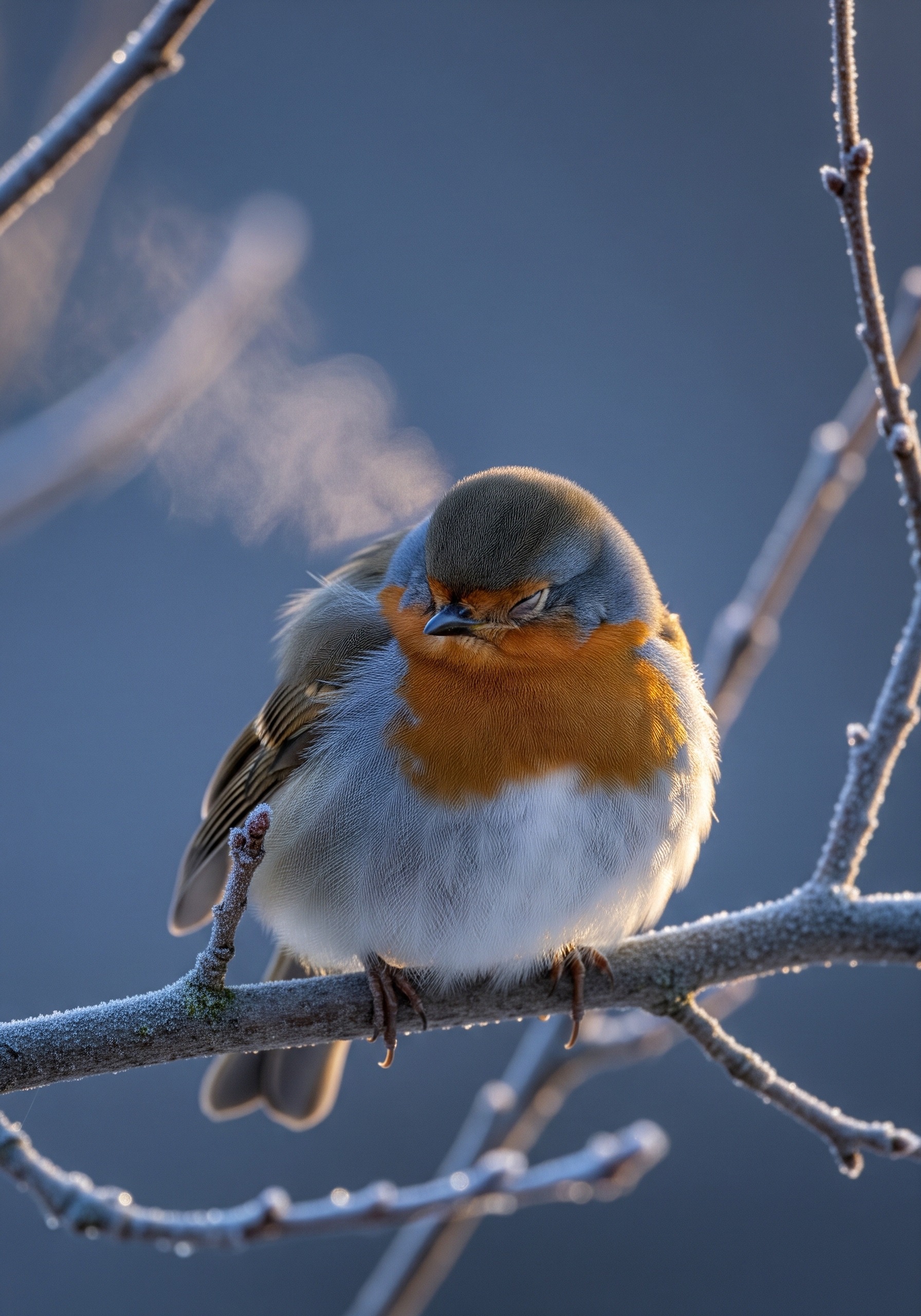
A small bird on a thin branch in a winter wind looks like it ought to fall. It doesn’t. How do birds sleep in places that would kill us — locked to a single twig, floating in a lake, sometimes mid-flight over open ocean? The answer is one of the strangest stories in vertebrate biology, and parts of it weren’t even confirmed until 2016.
Key Facts
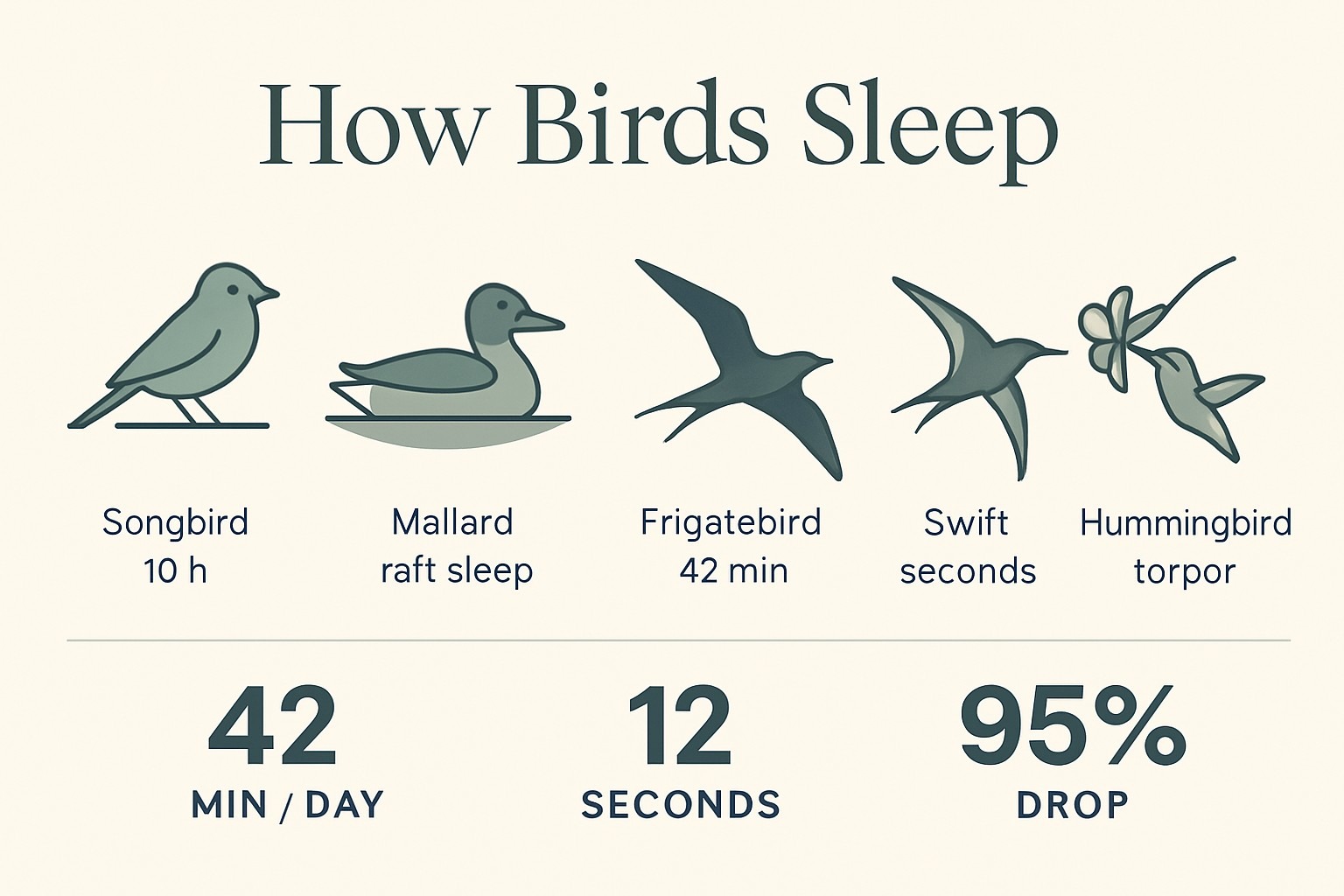
- A great frigatebird sleeps only about 42 minutes per 24-hour day while at sea, in bursts averaging 12 seconds — confirmed by in-flight EEG in 2016.
- Mallards at the end of a sleeping row keep one eye open 31.8% of the time. Ducks in the middle, only 12.4% (Rattenborg et al., Nature, 1999).
- The “perch lock” is passive: when the leg bends, the flexor hallucis longus and flexor digitorum longus tendons tighten and curl the toes shut — no muscle work, no fatigue.
- Hummingbirds drop their metabolism by up to 95% overnight. One Andean species has been recorded at a body temperature of 3.3 °C — colder than a refrigerator.
- Songbirds don’t sleep in their nests. Nests are nurseries; adults roost in dense cover, tree cavities, or pressed against a trunk on the leeward side.
In short: Birds sleep almost everywhere except where most people imagine they do. They use specialized tendons, half-brain shifts, ultra-short naps and deep cold-down states to stay rested without becoming someone’s dinner — and those mechanisms are now being mined for clues to how sleep itself works.
Key Facts
- A great frigatebird sleeps only about 42 minutes per 24-hour day at sea, in bursts averaging 12 seconds—confirmed by in-flight EEG in 2016.
- Mallards at the end of a row keep one eye open 31.8% of the time versus 12.4% in the middle (Rattenborg et al., Nature, 1999).
- The perch lock is passive: when the leg bends, the flexor tendons tighten and curl the toes shut, with no muscle effort.
- Hummingbirds drop their metabolism by up to 95% overnight; one Andean species was recorded at a body temperature of 3.3°C.
- Songbirds don’t sleep in their nests—adults roost in dense cover, tree cavities or pressed against a trunk.
In short: Birds sleep almost everywhere except nests, which are nurseries. A passive tendon perch-lock holds them to branches with no effort; many use unihemispheric sleep with one eye open; great frigatebirds sleep just 42 minutes a day in flight; and hummingbirds drop their metabolism up to 95% overnight to survive the cold.
A Hidden Roost, Not a Nest: Where Birds Sleep at Night
Most people picture a robin curled in a tidy little cup. Almost none do. Nests are nurseries — built, used for a season of eggs and chicks, then abandoned. For sleep, adult birds find a roost: a sheltered spot chosen for warmth and safety, often reused night after night by different individuals.
The choices depend on body plan and threat. Woodpeckers, chickadees and bluebirds slip into tree cavities, where wind dies and predators can’t see in. Crows and starlings gather in communal roosts — tens of thousands of birds in a single grove, a heat-saving strategy that also overwhelms any single hawk. Most songbirds in winter perch tight against a trunk on the leeward side, fluffed up, head tucked into shoulder feathers to seal the warmest air against the body. Herons doze on one leg in shallow water. Ducks sleep afloat in tight rafts. Each location is a bet against a different risk — cold here, foxes there, owls everywhere.
That nests-equals-beds myth is, in its way, the first useful correction this article can offer. If you’ve nailed a roost box to the back fence and it stays empty all winter, that doesn’t mean it isn’t working. It just means birds use one kind of structure for one job, and look for something else when it’s time to sleep.
Do Birds Sleep Standing Up? The Tendon That Won’t Let Go
Yes — and they don’t have to think about it.
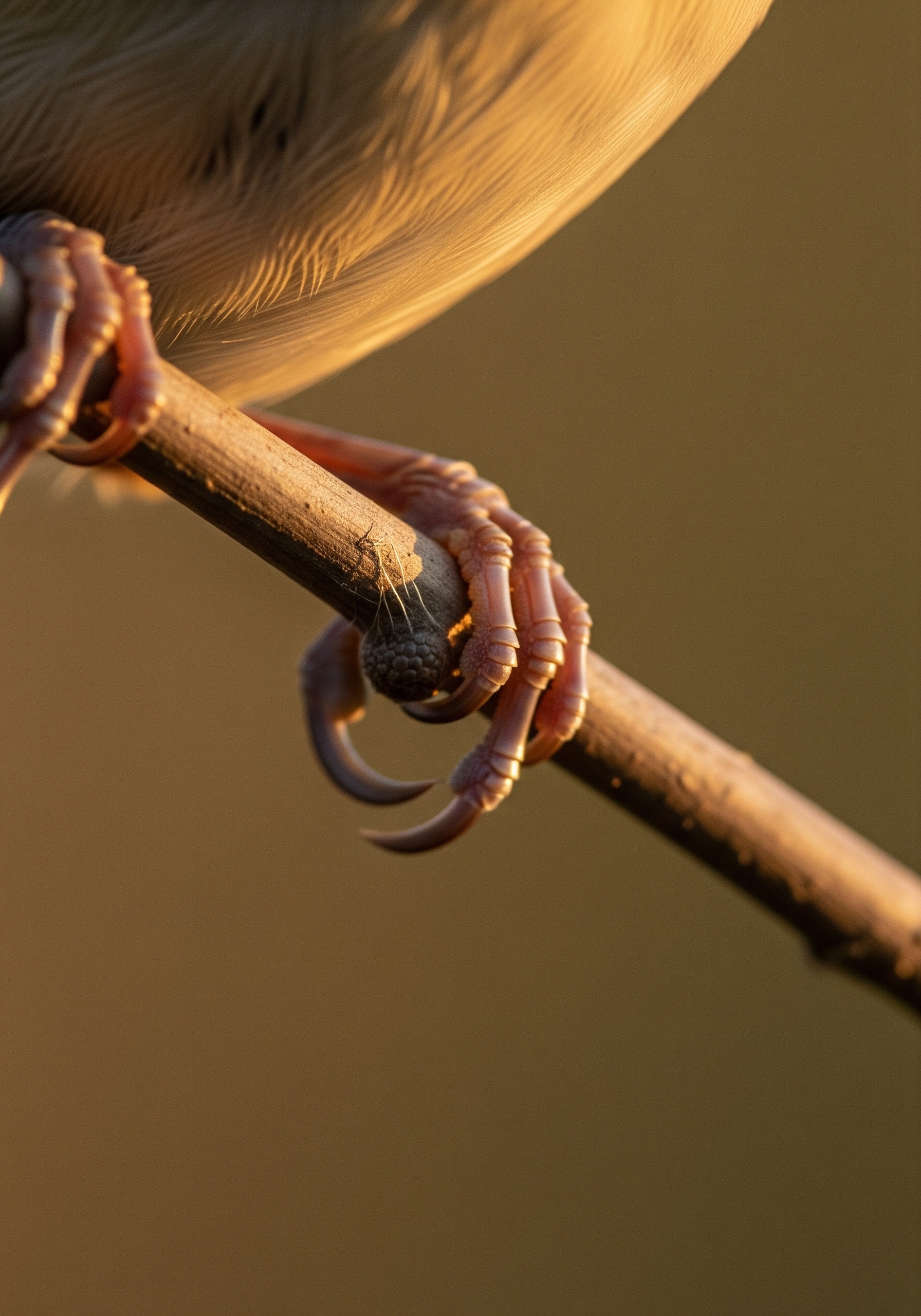
When a songbird settles on a branch and lowers its body, its legs bend. The bending stretches two long tendons that run down the back of each leg into the toes: the flexor hallucis longus and the flexor digitorum longus. As those tendons stretch, they pull the toes closed around the perch like a drawstring on a bag. In many species the surface of the tendon is ribbed where it slides through its sheath, so friction holds the lock in place. There is no muscle effort at all. A bird could, in theory, hang on dead.
{IMAGE_2}
The bird doesn’t grip the branch the way you’d grip a railing. It collapses into the grip. That’s why you almost never see a small bird fall off a perch at night, even in a thirty-mile-an-hour wind. And the mechanism is old: Mei long, a small bird-like dinosaur found curled up in Cretaceous volcanic ash in 2004, is preserved in a recognizably bird-style sleeping posture — head tucked under wing, body folded — more than a hundred million years before the songbirds it foreshadows.
There is a cost, and it’s a small one. To take off again, the bird has to actively extend its legs. That tiny act of effort is the difference between sleep and flight. It is also why a wounded or exhausted bird sometimes can’t make the jump — the lock holds even when the will to escape is gone.
How Birds Sleep With Half a Brain Awake
Some of what we know about bird sleep started, of all places, with a row of ducks in an Indiana lab.
In 1999, Niels Rattenborg — then a graduate student at Indiana State University, now leading the Avian Sleep Group at the Max Planck Institute for Biological Intelligence — lined up four mallards and filmed them sleeping. Turns out the ducks at the ends of the row, the ones with their flanks exposed to the rest of the room, kept one eye open 31.8% of the time. Ducks in the middle did the same only 12.4% of the time. The EEG was the surprise: the hemisphere of the brain feeding the open eye was running fast, wakeful rhythms, while the other hemisphere rolled out the slow waves of deep sleep. The end ducks weren’t just being more alert — they were running half a brain awake on purpose. The paper, published in Nature, was titled “Half-awake to the risk of predation.”
This trick now has a name: unihemispheric slow-wave sleep, or USWS. It has been documented across the bird family tree — chickens, parrots, falcons, songbirds, and, most spectacularly, seabirds. It also shows up in dolphins and some seals, but never in any land mammal. Why birds got it and we didn’t is one of the open questions in sleep biology.
One practical consequence: a flock of starlings or geese at rest is not, biologically, a flock of sleeping birds. It is a flock running a rotating sentry shift, built in at the cellular level, without anyone having to volunteer for the watch.
42 Minutes a Day: Sleep on the Wing
For two centuries, ornithologists argued about whether birds could really sleep in flight. The case looked obvious for great frigatebirds — long-winged seabirds that hunt for months over open ocean without ever landing on water — but obvious isn’t evidence.
The evidence finally arrived in 2016, when Rattenborg’s team at the Max Planck Institute flew custom EEG loggers on great frigatebirds in the Galápagos. The birds spent up to ten days continuously airborne. Once the sun set, the brain waves of sleep appeared — usually in one hemisphere, sometimes in both — while the birds rode rising air currents in slow circles. The average sleep bout lasted just 12 seconds. The daily total: about 42 minutes. On the same birds, on land, sleep totalled roughly 12 hours a day, in bouts of about a minute each. Flight didn’t change the architecture of sleep. It compressed it.
Common swifts, which spend up to ten months airborne at a stretch, almost certainly do something similar. Dutch radar work by Adriaan Dokter has shown that swifts climb to nearly 3 kilometres at dawn and dusk, where the air is calmer and a long, slow glide is mechanically easier. Whether they cycle their hemispheres the same way frigatebirds do hasn’t been measured directly. The experiment is hard to run on a bird the size of a sparrow.
Hummingbirds and the Deep Cold of Torpor
Some birds don’t just sleep at night. They almost stop.
A hummingbird at rest burns fuel at a rate that would kill almost anything else its size. To survive the dark hours without feeding, many species enter torpor — a controlled crash of body temperature and metabolism that looks, from outside, like death. Heart rate falls from over 1,200 beats per minute to a few dozen. Breathing drops from roughly 245 breaths a minute to around 6. Metabolism falls by up to 95 percent. Body temperature can plunge from a daytime 40 °C to about 10 °C, and in extreme cases far lower.
In 2020, a team led by Blair Wolf at the University of New Mexico, working in the high Peruvian Andes, recorded a black metaltail hummingbird at a body temperature of 3.3 °C — close to freezing, and the lowest ever measured in a non-hibernating bird. At sunrise the bird warmed itself back up, shivered its flight muscles for a few minutes, and flew off. Most other birds don’t go this far; the energy cost of rewarming is too high if you aren’t built for it. But torpor in hummingbirds quietly demolishes any clean line between sleep, hibernation, and suspended animation.
Sleep Strategies Across the Bird World
Different bird, different rules. The table below pulls together what’s measured for several well-studied groups. Daily totals are approximate, because most birds sleep in many short bouts, not one long block.
| Bird group | Where they sleep | Typical daily sleep | Special trick |
|---|---|---|---|
| Songbirds (sparrows, finches) | Dense foliage, leeward of trunk | ~10 h, mostly at night | Passive tendon perch lock |
| Ducks (mallard) | Floating in raft on water | Variable, many short bouts | Unihemispheric sleep at row’s edge |
| Great frigatebird | Mid-flight, often gliding in circles | ~42 min in flight; ~12 h on land | 12-second sleep bouts on the wing |
| Common swift | Mid-flight, climbing to ~3 km | Months airborne; sleep presumed | Eats, sleeps and mates without landing |
| Hummingbird | Branch, hidden in foliage | Most of the night in torpor | Body temp can drop to ~3 °C |
| Owls / nightjars | Tree branch or ground cover | ~12 h, during the day | Inverted schedule — nocturnal hunters |
What’s New: Why Bird Sleep Is Rewriting Sleep Science
Bird sleep used to be a footnote in textbooks built around rats and humans. It isn’t anymore.
Three findings from the past decade have changed the conversation. First, unihemispheric slow-wave sleep proved that sleep isn’t, mechanically, a whole-brain shutdown — half a brain can be in deep slow-wave sleep while the other half steers a straight line. Second, the frigatebird work showed that 42 minutes a day, taken in 12-second sips, is enough to keep a three-kilogram seabird healthy for at least ten days at sea. Sleep is far more compressible than anyone had thought. Third, ostrich EEG recordings published by John Lesku and colleagues at La Trobe University in Australia revealed a REM-like state that looks suspiciously like a transitional form between reptilian and mammalian dreaming — meaning the dreaming brain has a far older pedigree than the rat-and-human literature suggested.
Here’s the editorial verdict, plainly: the textbook picture of sleep, built on rodents and undergraduates, no longer holds — and bird researchers are quietly the ones rewriting it. The implication for humans isn’t a wellness hack. Whatever sleep actually does, it does it in a much wider range of forms than any single species can hint at. What stays the same across birds and mammals, though, is the price of losing it: even one bad night reshuffles the body’s chemistry in ways it didn’t ask for, as research on sleep deprivation and hunger hormones has now mapped in detail.
Frequently Asked Questions
Q: Do birds sleep at night or during the day?
A: Most do at night, but with major exceptions. Owls and nightjars sleep by day. Frigatebirds and swifts grab sleep mid-flight, day or night, in extremely short bursts. Many songbirds add brief daytime naps to a longer nighttime block.
Q: Why don’t birds fall off branches when they sleep?
A: A passive tendon mechanism. When the leg bends, the flexor hallucis longus and flexor digitorum longus tendons running down the back of the leg tighten and curl the toes shut around the perch. No muscle effort is required — the bird is mechanically anchored, even unconscious.
Q: Do birds dream?
A: Almost certainly. Birds show clear REM sleep on EEG, and zebra finch studies suggest they replay the day’s songs while asleep. What it “feels like” to be the bird is the harder question — no one can answer that, in any species, yet.
Q: How long do birds sleep?
A: It varies wildly. A house sparrow sleeps roughly 10 hours per night. A great frigatebird in flight averages 42 minutes per 24 hours. A hummingbird in torpor is “down” for most of the night, but with metabolism cut by up to 95%, that state isn’t quite ordinary sleep at all.
Sources
- Rattenborg, N. C., Lima, S. L., & Amlaner, C. J. (1999). “Half-awake to the risk of predation.” Nature, 397, 397–398.
- Rattenborg, N. C. et al. (2016). “Evidence that birds sleep in mid-flight.” Nature Communications, 7, 12468.
- Wolf, B. O., McKechnie, A. E. et al. (2020). Hypothermic torpor in high-elevation Andean hummingbirds. Biology Letters, Royal Society.
- Max Planck Institute for Biological Intelligence, Avian Sleep Group, Seewiesen, Germany.
- National Audubon Society, public reports on roosting behaviour of North American birds.
Next time you walk past a winter hedge at dusk and hear nothing, remember what’s actually in there: a small body locked to a single twig, half a brain on watch, the other half halfway through a dream. The most ordinary garden, at the most ordinary hour, is running biology it took a hundred and fifty million years to perfect.
Illustrations are AI-generated. Article fact-checked and human-edited. Our editorial standards.