Hummingbird Food Ratio: The 1:4 Recipe Backed by Science
The hummingbird food ratio that every wildlife agency in North America recommends — one part refined white sugar to four parts water — looks like a number chosen for ease of memorization. It wasn’t. That mixture lands at almost exactly 20% sucrose by weight, which happens to match the sugar concentration found in the wild flowers Trochilidae have been pollinating for tens of millions of years. The number is biology, not bookkeeping.
Key Facts
- The standard safe ratio is 1 part refined white sugar to 4 parts water (≈20–21% sucrose by weight).
- That concentration matches the natural nectar of hummingbird-pollinated flowers (typically 20–25% sucrose).
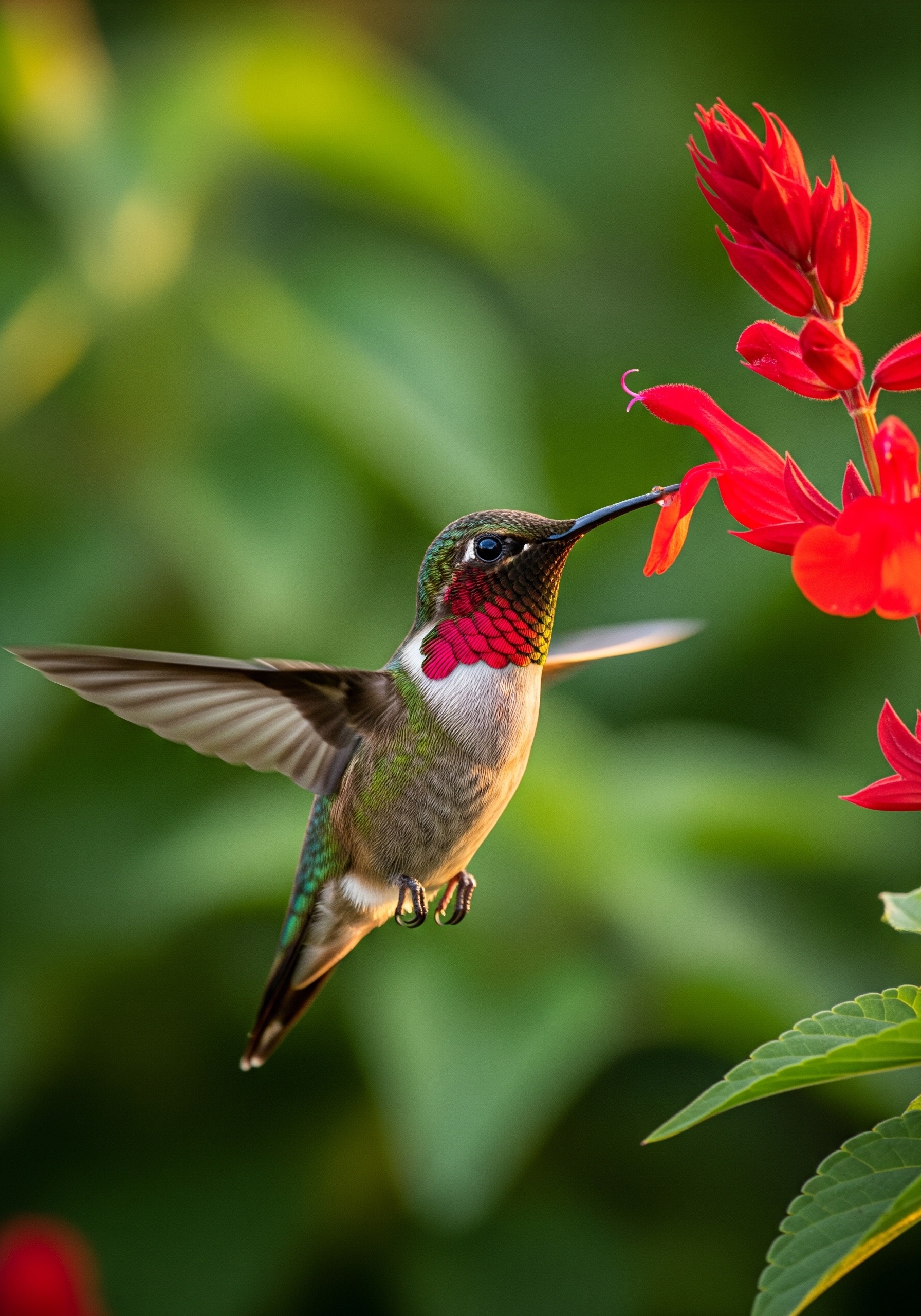
- A single Anna’s Hummingbird visits roughly 1,000–2,000 flowers per day to meet its caloric needs.
- During migration or hard cold, a temporary 1:3 ratio (about 25–26% sucrose) provides extra calories without harm.
- In summer heat above 27°C (80°F), feeders must be emptied and rinsed every two days — fermentation can be lethal.
In short: Mix 1 cup of refined white table sugar into 4 cups of hot water until dissolved, let it cool to room temperature, and pour into a clean feeder. No red dye, no honey, no brown sugar, no substitutes. Clean the feeder every two to four days, faster in heat.
Key Facts
- The standard safe hummingbird food ratio is 1 part refined white sugar to 4 parts water, about 20-21% sucrose by weight.
- That concentration matches the natural nectar of hummingbird-pollinated flowers, which typically runs 20-25% sucrose.
- A single Anna’s Hummingbird visits roughly 1,000-2,000 flowers per day to meet its caloric needs.
- During migration or hard cold, a temporary 1:3 ratio of about 25-26% sucrose provides extra calories without harm.
- In summer heat above 27 degrees C (80 degrees F), feeders must be emptied and rinsed every two days because fermentation can be lethal.
In short: Mix 1 part refined white table sugar into 4 parts hot water until dissolved, let it cool to room temperature, and pour into a clean feeder – no red dye, honey, brown sugar, or substitutes. That 1:4 ratio lands at about 20-21% sucrose by weight, matching the natural nectar of the flowers hummingbirds have pollinated for millions of years. Clean the feeder every two to four days, faster in heat.
The 1:4 Hummingbird Food Ratio, Defined
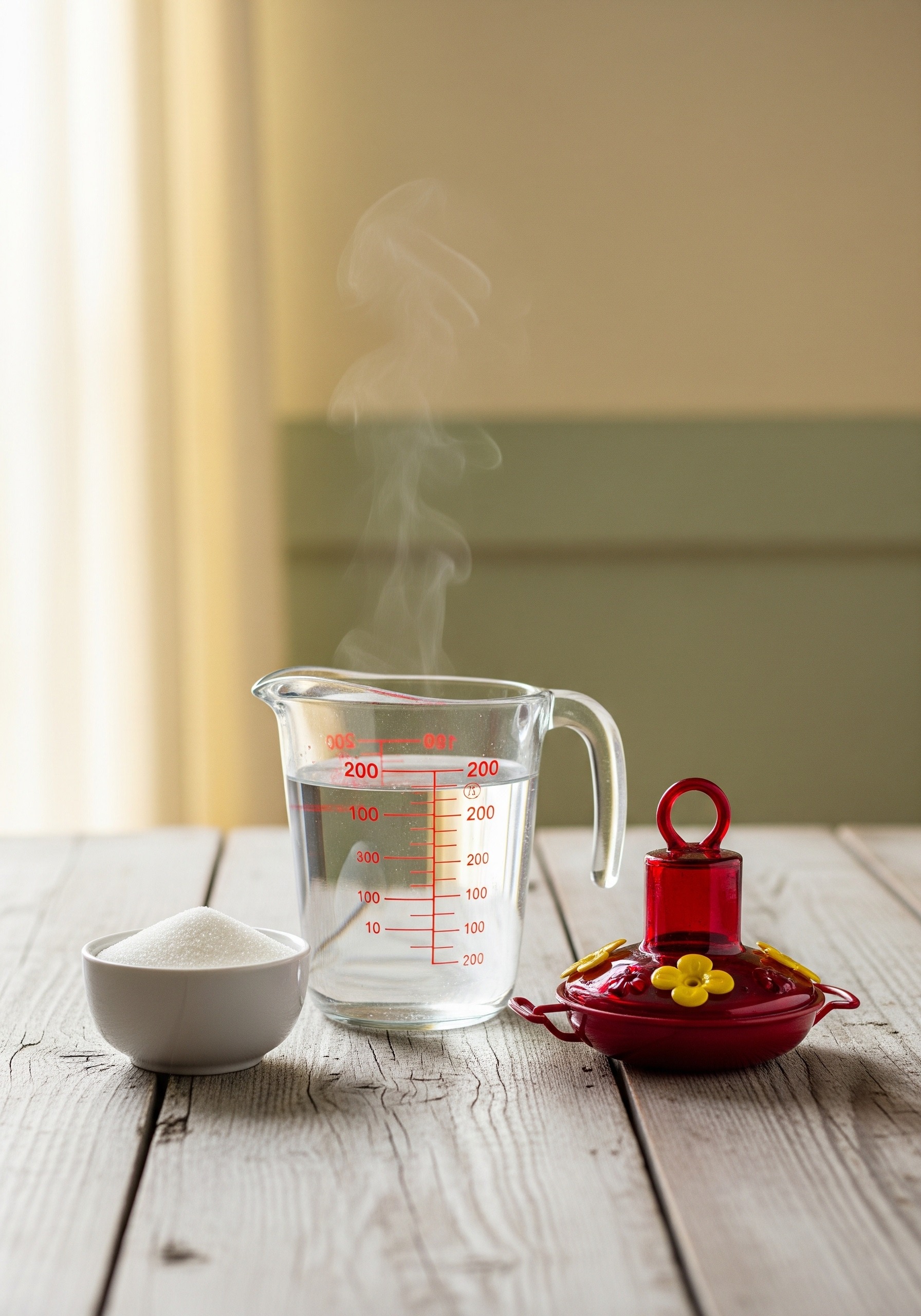
The hummingbird food ratio is 1 part refined white sugar to 4 parts plain water — by volume. One cup of sugar in four cups of water. A quarter cup in one cup. Half cup in two cups. The math scales; the chemistry does not change.
Brian Evans, a migratory-bird ecologist at the Smithsonian’s National Zoo and Conservation Biology Institute, has framed the recipe to the public the same way for years: one part sugar, four parts water, white table sugar only. Erin Kendrick, the Zoo’s animal nutritionist, signs off on the same baseline in the Institute’s official guidance. The National Audubon Society’s recipe — published in 2019 and unchanged since — is identical. So is Cornell Lab of Ornithology’s. So is the American Bird Conservancy’s.
The reason every authoritative source converged on the same number is not coordination. It is the underlying biology of a bird that runs on the metabolic equivalent of jet fuel.
Why 20% — The Natural-Nectar Math
Here’s the thing nobody on page one of Google quite spells out: the 1:4 ratio is reverse-engineered from real flowers.
Hummingbird-pollinated plants — Salvia, Penstemon, Mimulus, Castilleja, Lonicera, Aquilegia — produce nectar that sits between roughly 20% and 25% sucrose by weight. (Bee-pollinated flowers run higher; bat-pollinated ones run lower.) A 1:4 sugar-to-water mixture by volume lands at about 21% sucrose by weight, give or take a couple of points depending on how the sugar is measured. That is the entire reason for the ratio.
Push the concentration up to 1:3 (~26%) and you’re at the high end of what a Costa’s Hummingbird would find inside a Chuparosa bloom. Push it to 1:1 — as some well-meaning birders do “to give them more energy” — and you’ve left wild-plant chemistry behind entirely. A hummingbird’s kidneys are calibrated for the dilute version. Concentrated syrup forces the bird to spend water it doesn’t have to flush the sugar load.
Twenty percent is not a guess. It’s an evolutionary handshake.
How to Make It in 90 Seconds
The procedure has not meaningfully changed since the first homemade feeders appeared in the 1950s.
- Measure 1 cup of refined white granulated sugar.
- Pour it into 4 cups of just-boiled water.
- Stir until the crystals are gone — about 30 seconds.
- Let it cool to room temperature on the counter. Do not pour hot mixture into a plastic feeder.
- Fill the feeder; refrigerate the leftover in a clean jar for up to one week.
Boiling sterilizes the water and dissolves the sugar fast; it does not need to keep boiling once the sugar is in. If your tap water is clean, room-temperature dissolution works too. The cooling step is non-negotiable — hot sugar water warps plastic, can crack glass, and ferments faster once it hits the feeder.
{IMAGE_2}
Six Ingredients That Can Kill a Hummingbird
Every authoritative source warns against the same short list. The reasons are specific, and worth knowing in detail.
Honey. Once diluted, honey ferments rapidly and supports a fungus (Candida) that coats a hummingbird’s tongue. The bird can no longer feed and starves. This is the single most dangerous “natural-sounding” substitute — and the one most often suggested in old gardening columns.
Brown, raw, organic, or turbinado sugar. All contain iron and trace minerals at levels hummingbirds cannot process. Their digestive systems evolved on nectar, which is essentially iron-free sucrose. Repeated exposure to iron-loaded sugar damages the liver.
Powdered sugar. Contains cornstarch as an anti-caking agent. It ferments quickly and clogs feeder ports.
Red food dye. Not a single peer-reviewed study has shown a benefit. Several have flagged possible toxicity at the concentrations sometimes used in homemade nectar. Hummingbirds are drawn to the red of the feeder itself — the liquid can, and should, stay clear.
Artificial sweeteners (xylitol, stevia, aspartame). Catastrophic. A hummingbird burns calories at one of the highest mass-specific rates in the animal kingdom; replace the sugar with a zero-calorie sweetener and the bird literally starves with a full crop. A widely reported South African incident saw 29 wild sugarbirds die within minutes of drinking from a feeder topped with a xylitol-based “diet nectar.” Xylitol is also acutely toxic to dogs at common kitchen concentrations.
Corn syrup, maple syrup, agave. Each carries some combination of minerals, fructose imbalance, or processing residues that the hummingbird’s metabolism cannot handle long-term.
If it isn’t refined white table sugar, it does not belong in the feeder. The rule is brutal and unambiguous on purpose.
When 3:1 Is the Right Call — The Seasonal Adjustment
For most of the year, 1:4 is correct. Two windows justify a temporary jump to 1:3 (about 25–26% sucrose).
Spring and fall migration. A Ruby-throated Hummingbird preparing to cross the Gulf of Mexico nearly doubles its body weight in fat reserves before the flight. During the staging weeks — typically March through May and again from September through early November in the eastern U.S. — a denser solution lets the bird load calories with fewer trips. More fuel per visit, less time spent fending off rivals.
Hard cold snaps. A 1:3 mixture has a slightly lower freezing point than a 1:4 — roughly minus 3°C versus minus 2°C at sea level. The difference sounds trivial. For an Anna’s Hummingbird wintering over in Vancouver at dawn, with the feeder iced at its perch, it can matter.
Do not go stronger than 1:3 for sustained periods. The 1:1 syrup some online forums recommend dehydrates the bird, attracts wasps and ants in punishing numbers, and over time stresses kidney function. Return to 1:4 once weather warms or migration ends.
Editorial verdict: most North American feeders should sit at 1:4 year-round. The seasonal adjustment is a tool, not a default.
Keeping It Safe — Cleaning, Mold, and Fermentation
The recipe is the easy part. Maintenance is what most backyard feeders get wrong, and it is where most preventable hummingbird deaths happen.
In summer above 27°C (80°F), sugar water ferments in 24 to 48 hours. Cloudiness, black specks around the feeder ports, or a yeasty smell mean the nectar is already dangerous and should be tossed. Black fuzz inside the reservoir is usually Aspergillus, a mold that causes respiratory disease in birds.
A working cleaning schedule:
- Above 27°C (80°F): empty, rinse, and refill every 2 days. Scrub with a bottle brush weekly.
- 18–27°C (65–80°F): refresh every 3–4 days. Scrub weekly.
- Cooler weather: refresh weekly. Scrub at every refill.
Hot water and a bottle brush handle routine cleaning. A 1:4 white-vinegar-to-water soak dissolves stubborn mold. Bleach (one part to nine parts water) is still endorsed by some agencies, but several bird groups now lean toward vinegar for residue safety. Either way, rinse until you cannot smell what you cleaned with.
Ratios at a Glance
The science in one number
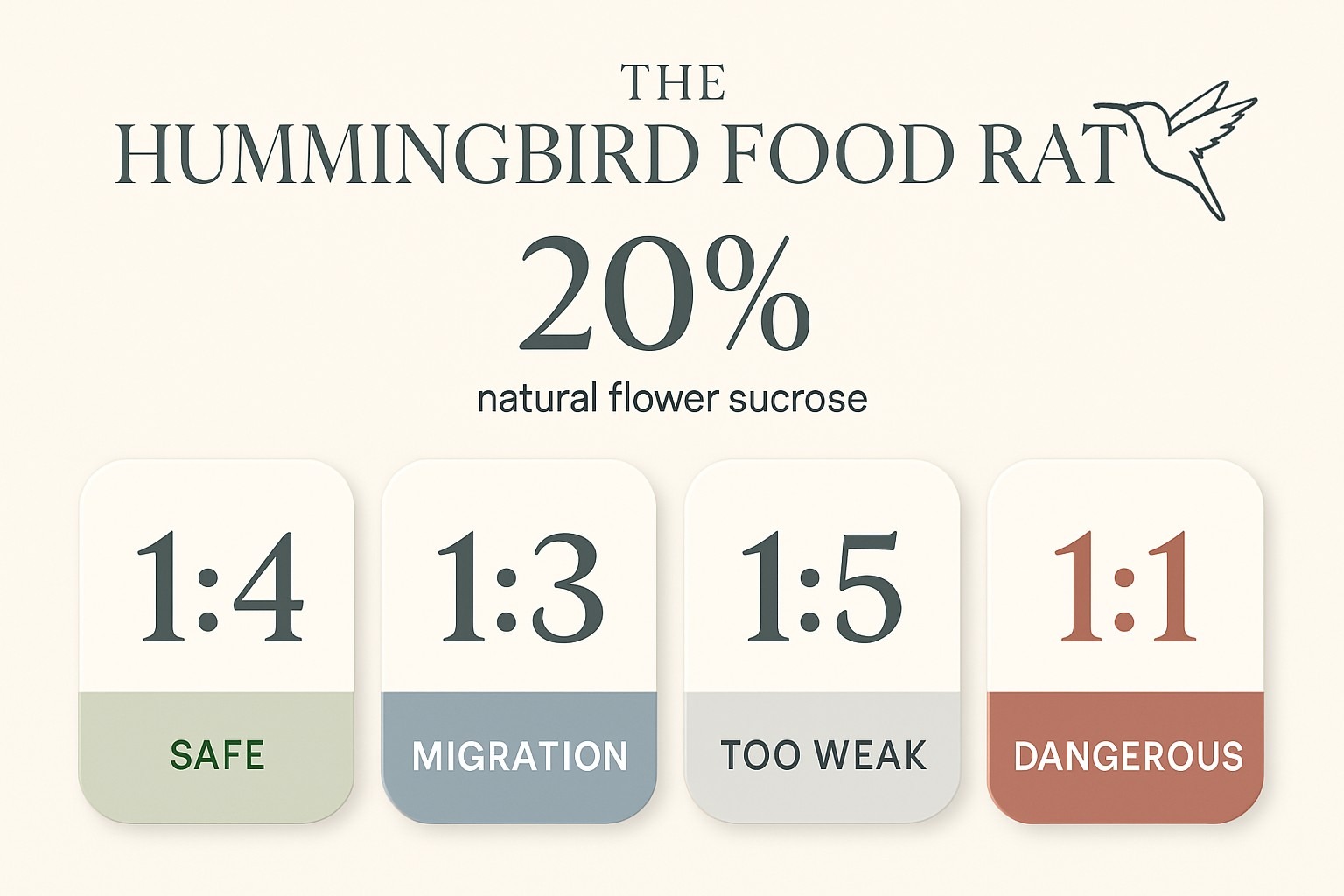
The natural sucrose concentration of hummingbird-pollinated flowers is 20–25%. A 1:4 sugar-to-water mix lands at ~21%. Every other ratio is judged against that baseline.
| Sugar : Water | Sucrose % | When to Use | Verdict |
|---|---|---|---|
| 1 : 4 | ~21% | Year-round default | Safe — matches real flowers |
| 1 : 3 | ~26% | Migration, hard cold | Temporary only |
| 1 : 5 or weaker | ≤17% | Never | Too dilute — birds reject |
| 1 : 2 or 1 : 1 | ≥33% | Never | Dehydration, kidney stress |
Frequently Asked Questions
Q: Can I use less sugar to make it “healthier” for the birds?
A: No. Below about 1:5 (17% sucrose), the calorie return per visit drops below what makes the trip worthwhile, and the bird burns more energy collecting than it gains. Hummingbirds will sample weak nectar and then ignore the feeder.
Q: Do I actually need to boil the water?
A: Only briefly, to dissolve the sugar faster and to reduce stray contaminants. The water needs only to reach a boil — sustained boiling does nothing extra. If your tap water is clean, room-temperature dissolution works.
Q: Why is red food dye actually a problem?
A: Two reasons. Hummingbirds locate feeders by the red plastic, not the red liquid, so the dye is functionally useless. And the most common dye (Red 40) has shown adverse effects in some animal studies at high doses, which is enough reason to keep it out of a 3-gram bird’s daily diet.
Q: How much sugar water can one hummingbird drink in a day?
A: A Ruby-throated Hummingbird can consume roughly twice its body weight in nectar daily — about 6 grams of fluid spread across hundreds of feeder visits. One full feeder typically supports 6 to 12 regular visitors.
Sources
- Smithsonian National Zoo and Conservation Biology Institute — guidance authored by Brian Evans (migratory-bird ecologist) and Erin Kendrick (animal nutritionist).
- National Audubon Society — “How to Make Hummingbird Nectar.”
- Cornell Lab of Ornithology — All About Birds, hummingbird feeder guidance.
- American Bird Conservancy — Hummingbird Feeder Best Practices.
- University of Florida IFAS Extension — published guidance on hummingbird feeding and liver-disease myths.
The 1:4 hummingbird food ratio is a piece of biology dressed up as a kitchen measurement. Match the flowers, keep the feeder clean, and the rest takes care of itself.
Illustrations are AI-generated. Article fact-checked and human-edited. Our editorial standards.