How an Owl Hears a Mouse Under Snow: The Truth About Owl Ears
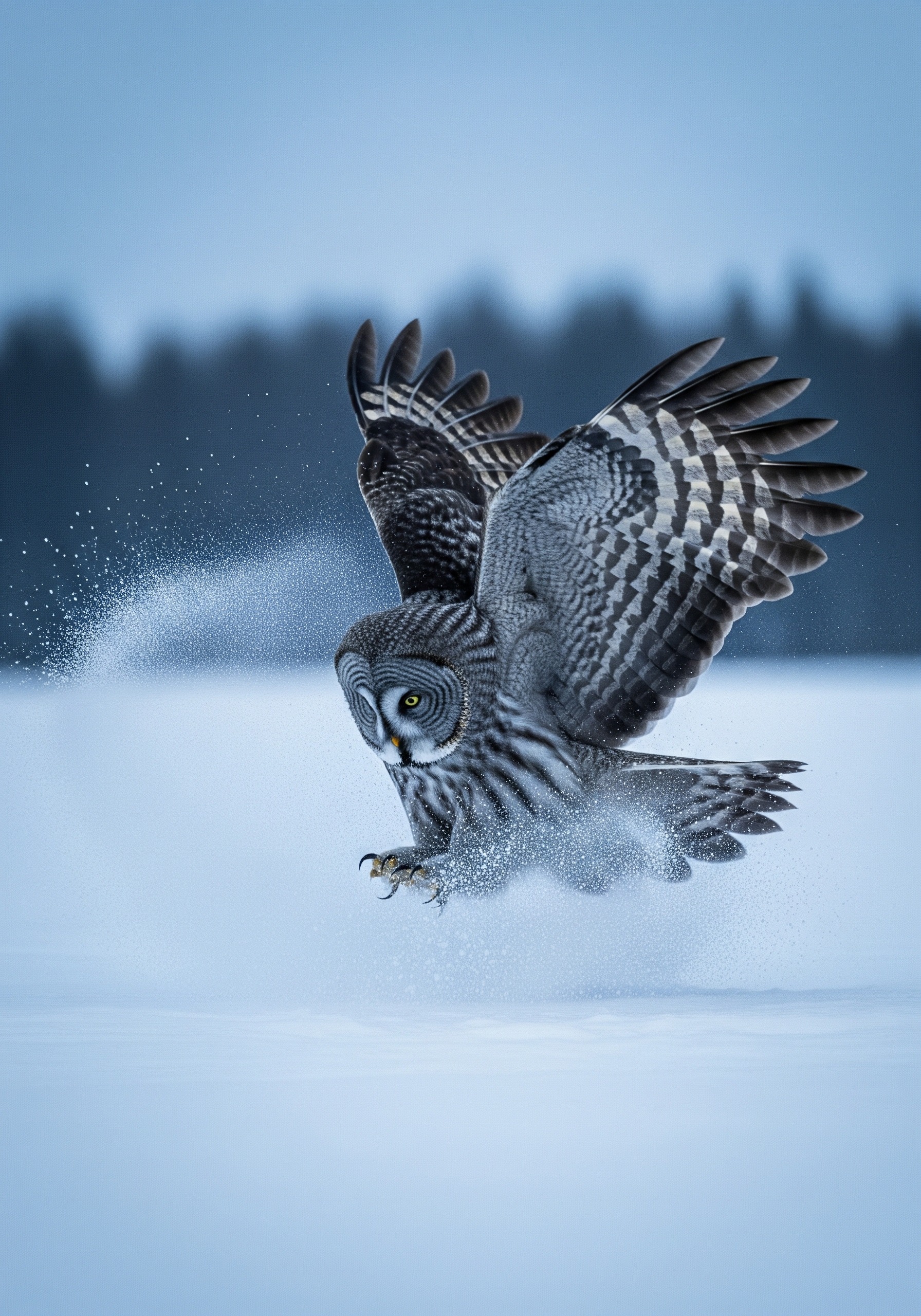
The most useful list of owl hearing facts begins not in a textbook but on a moonless January night in a Finnish boreal forest, where a Great Grey Owl drops from a spruce, plunges its talons through eighteen inches of snowpack, and comes up holding a vole it never saw. Vision did not catch that vole. Smell did not. The bird hunted with its ears — and the question of how a brain the size of a walnut pulls that off is one of the great detective stories of twentieth-century neuroscience.
Key Facts
- Barn Owls can locate prey to within about one degree of arc in both the horizontal and vertical plane using sound alone — first demonstrated by Roger Payne at Cornell in the early 1960s.
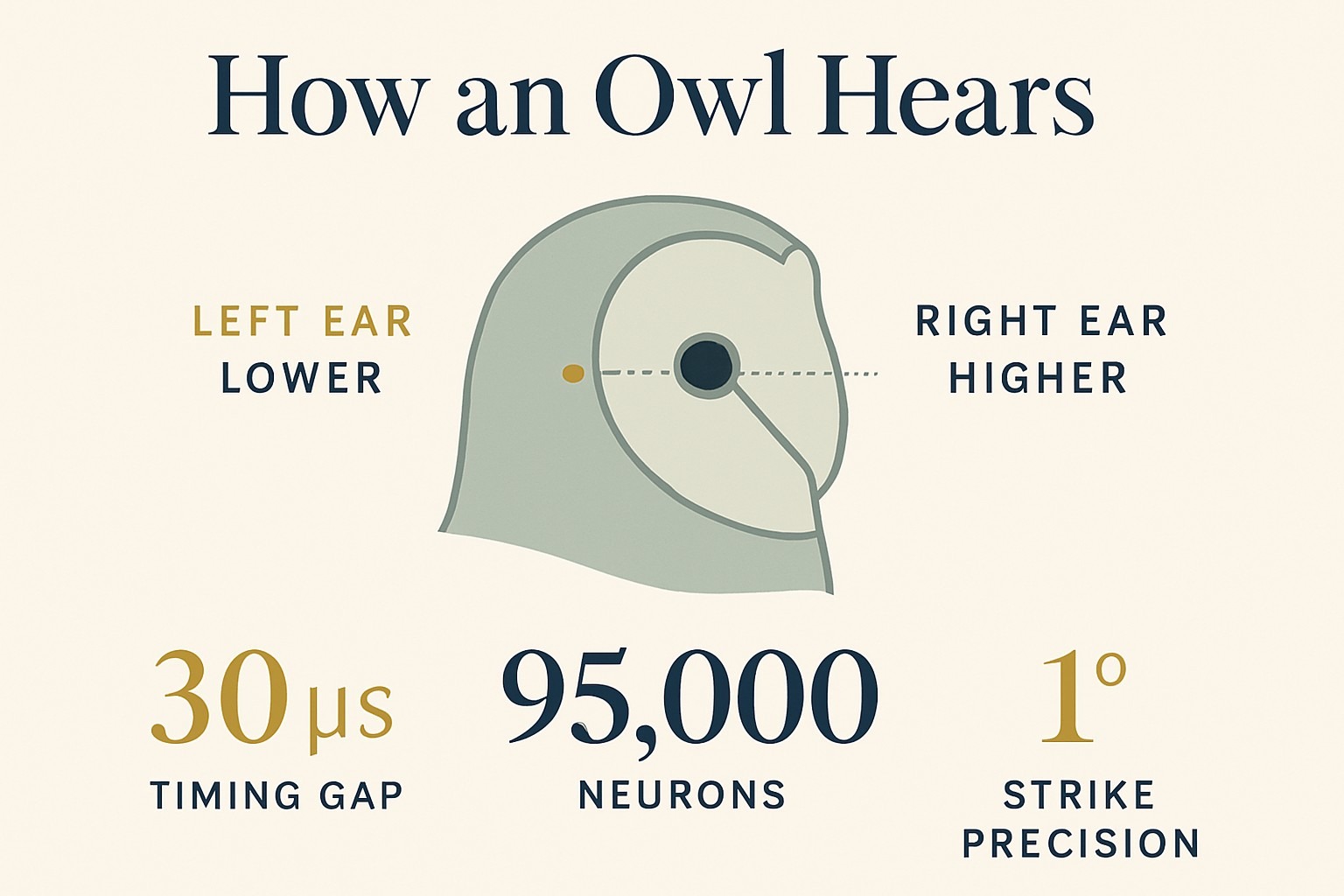
- An owl’s left ear opening sits lower on the skull than the right, and the two are also offset in the vertical plane — a built-in asymmetry that gives the brain a microsecond timing gap to work with.
- That timing gap is roughly 30 microseconds (0.00003 seconds) — the smallest left-right delay the Barn Owl auditory system can resolve.
- The visible “ear tufts” on a Great Horned, Long-eared, or Screech Owl are not ears. They are display feathers; the real ears hide beneath the facial disc.
- A Barn Owl’s auditory medulla contains roughly 95,000 neurons — about three times the count found in a similarly sized crow.
In short: Owls hunt by hearing, not by seeing. Asymmetric ear openings, a dish-shaped facial disc, and a brainstem with thousands of dedicated neurons let a Barn Owl pinpoint a mouse under snow to within a single degree of arc, in total darkness, in the time it takes a human to register the sound exists at all.
Key Facts
- Barn Owls can locate prey to within about one degree of arc in both the horizontal and vertical plane using sound alone, first demonstrated by Roger Payne at Cornell in the early 1960s.
- An owl’s left ear opening sits lower on the skull than the right and the two are offset in the vertical plane, giving the brain a microsecond timing gap to work with.
- That timing gap is roughly 30 microseconds (0.00003 seconds), the smallest left-right delay the Barn Owl auditory system can resolve.
- The visible ear tufts on a Great Horned, Long-eared, or Screech Owl are not ears but display feathers; the real ears hide beneath the facial disc.
- A Barn Owl’s auditory medulla contains roughly 95,000 neurons, about three times the count found in a similarly sized crow.
In short: Owls hunt by hearing rather than by sight. Asymmetric ear openings, a dish-shaped facial disc, and a brainstem with thousands of dedicated neurons let a Barn Owl pinpoint a mouse under snow to within a single degree of arc in total darkness, faster than a human can even register that a sound exists.
The Experiment That Proved It
In a series of experiments in the early 1960s, Roger Payne, then completing his doctorate at Cornell, brought a Barn Owl into a completely darkened acoustic chamber and let it loose on a mouse. The mouse towed a small crumpled wad of paper behind it. The owl struck the paper.
Vision could not have done that; the room had no light. Heat could not have done it; the paper was cold. Smell could not have done it; the paper had no scent. Only sound was left. Payne formalized the work in a now-classic 1971 paper in the Journal of Experimental Biology, and the numbers he reported set the bar for everything that followed: barn owls were locating prey to better than one degree of arc in both the horizontal and the vertical plane — finer angular precision than the unaided human eye gets in daylight.
Payne had answered the what. It took another twenty years for someone to explain the how. That someone was Masakazu Konishi at Caltech, who — yes, really — built tiny custom headphones for barn owls and used them to take the bird’s auditory world apart, one cue at a time.
Owl Ear Asymmetry: Why One Opening Sits Higher Than the Other
Take the skull of a Barn Owl, hold it at eye level, and look at the sides. The left ear opening sits lower than the right; the two are also offset in the vertical plane. This is not a quirk. It is the entire trick.
Sound coming from below the owl’s eye-line arrives at the lower-set left ear a fraction of a microsecond sooner — and slightly louder — than at the right. Sound coming from above does the opposite. Sound coming from directly in front arrives at both ears at the same instant. The brain reads that left-right delay (the interaural time difference, or ITD) as horizontal direction, and the left-right loudness gap (the interaural level difference, ILD) as vertical direction. Two cues, two axes, one moving target.
{IMAGE_2}
Among the roughly 250 living owl species, the most strongly nocturnal — Barn Owl, Tengmalm’s (Boreal) Owl, Saw-whet Owl — show the most extreme asymmetry. Daylight hunters like the Snowy Owl and the Northern Pygmy Owl, which work largely by sight, have far more symmetrical openings. Asymmetry is a cost paid in skull geometry to buy resolution in the dark; species that don’t need the resolution don’t pay the cost. That is, in one sentence, the evolutionary logic of the trait.
The Facial Disc Is the Antenna (and the Ear Tufts Are a Lie)
The most photographed feature of a Barn Owl — that white, heart-shaped face — is not a decoration. It is an antenna.
The stiff “ruff” of dense feathers ringing the disc reflects incoming sound forward and inward, funneling it into the hidden ear openings the way a satellite dish funnels a microwave signal. The loose auricular feathers in front of the openings are nearly acoustically transparent: they hide the ears from view without muffling them. Owls can also reshape the disc using facial muscles, tightening and tilting it the way a human cups a hand behind an ear. In experimental work, removing the ruff feathers collapses the bird’s directional hearing — sensitivity drops, and elevation cues all but vanish.
Now for a stubborn myth. The “ear tufts” on a Great Horned Owl, a Long-eared Owl, or a Screech Owl have nothing to do with hearing. Turns out they are just feathers — display structures used for camouflage (a vertical broken outline that mimics tree bark) and for signaling between birds. The real ears are buried under the facial disc, where you cannot see them at all.
Hearing a Mouse Under Snow: Owl Hearing Facts in 30 Microseconds
A Great Grey Owl can locate a vole tunneling under snow it cannot see, from a perch fifty meters away. Two numbers explain why.
The first is thirty microseconds. That is roughly the smallest interaural time difference the Barn Owl auditory nerve can resolve — about 30 millionths of a second between the arrival at the left ear and the arrival at the right. For comparison, the fastest human reacts to a starting gun in about 150,000 microseconds. The owl’s brainstem is doing arithmetic on timing differences five orders of magnitude shorter than human conscious perception can address.
The second number is 4 to 8 kilohertz. That is the frequency band where vertical-elevation cues are richest, because at those wavelengths the asymmetric openings produce the strongest left-right loudness differences as elevation changes. Barn Owls strike using frequencies above 8.5 kHz for fine target acquisition. That is, conveniently, exactly the band in which small mammals — voles, mice, shrews — produce most of their rustling, chewing, and squeaking. Owl ears are tuned to vole noises. Voles are tuned to be quiet. The owl wins.
The Numbers Behind a Snow-Strike
- 30 microseconds — smallest left-right timing gap the Barn Owl auditory nerve can resolve.
- ~1° — angular precision of a strike in total darkness (Payne, 1971).
- 95,000 — neurons in the Barn Owl auditory medulla (roughly three times a crow’s).
- 4–8 kHz — frequency band that carries the richest vertical-elevation cues.
- >8.5 kHz — frequencies a Barn Owl uses for the final strike.
Snow itself helps the owl more than it helps the vole. A vole moving under a few centimeters of powder is acoustically hidden from a fox at ground level, because low frequencies bend around obstacles and high frequencies get absorbed. But the owl is above the snow, listening down through a thin attenuating layer, with a brain tuned to exactly the frequencies that survive that layer. The snow is a low-pass filter the owl has already worked around.
Inside the Owl’s Brain: 95,000 Neurons and an Auditory Map
Konishi’s custom headphones changed neuroscience. By delivering an independent sound stream to each ear, he and his Caltech colleague Eric Knudsen could fool the bird into perceiving a virtual sound source at any location they liked — and then record which neurons fired.
What they found, in a brain region called the external nucleus of the inferior colliculus (ICx), was unprecedented: individual neurons that fired only when a sound was at one specific point in space. Move the virtual sound, a different neuron fired. Map enough of them and the owl’s midbrain contains a literal, point-by-point auditory map of the space around the bird’s head — the first such map ever found in any animal. A 1990 paper by Catherine Carr and Konishi in the Journal of Neuroscience traced the delay-line circuitry in the brainstem that does the microsecond timing arithmetic. Later work by Konishi with José Luis Peña showed that the same circuitry then multiplies time-difference and level-difference cues together — in effect performing a tiny act of probability reasoning on every chirp it hears.
The Barn Owl’s auditory medulla — the brainstem region that does this first-pass processing — has been estimated at around 95,000 neurons, roughly three times what a similarly sized crow carries. That is the hardware cost of one degree of arc in absolute darkness.
If you want to understand owl hearing in a single sentence, here it is: every other famous feature of the bird — the silent flight, the swiveling head, the soft plumage — is in service of the ears.
Not All Owls Hear Alike: A Species Comparison
We tend to talk about “owl hearing” as if all owls do it the same way. They do not. The trait scales with how much an owl actually relies on sound to hunt, and the spread across species is easier to see in a table than in prose.
| Species | Ear Asymmetry | Primary Hunting Sense | Signature Behavior |
|---|---|---|---|
| Common Barn Owl (Tyto alba) | Extreme | Hearing | Strikes in zero light by sound alone |
| Great Grey Owl (Strix nebulosa) | High | Hearing | Plunges through snowpack at unseen voles |
| Boreal (Tengmalm’s) Owl (Aegolius funereus) | High | Hearing | Strictly nocturnal forest hunter |
| Long-eared Owl (Asio otus) | Moderate | Hearing + sight | Tufts are display, not ears |
| Snowy Owl (Bubo scandiacus) | Mild | Sight | Daylight tundra hunter |
| Northern Pygmy Owl (Glaucidium gnoma) | Mild | Sight | Diurnal songbird hunter |
A couple of patterns are worth flagging. The Tytonidae family — the Barn Owls and their close relatives — sit at the extreme: maximum asymmetry, the largest and most dish-like facial disc, the most reliance on sound. The Strigidae (everyone else) vary widely, from highly auditory Boreal and Saw-whet Owls to nearly visual Pygmy Owls. The “owl that hunts by hearing” is mostly a Barn Owl story; we tend to over-generalize from it.
Frequently Asked Questions
Q: Can owls really hear better than humans?
A: At specific high frequencies, yes — substantially so. Across the lower part of the spectrum they are roughly comparable to us. The Barn Owl’s edge is not raw sensitivity, it is directional precision: about one degree of resolution by sound alone, where a person manages four or five degrees on a good day.
Q: Do owls have ears under their feathers?
A: Yes. Two hidden ear openings sit on either side of the skull, beneath the facial disc, asymmetrically placed. The tufts on top of some owls’ heads are not ears at all; they are display feathers used for camouflage and signaling.
Q: How does a Barn Owl catch a mouse in total darkness?
A: By reading interaural time differences (left-versus-right arrival time) for horizontal direction and interaural level differences (left-versus-right loudness) for vertical direction, then combining the two cues in midbrain neurons that each respond to one specific point in space.
Q: Which owl has the best hearing?
A: By every laboratory-testable measure — asymmetry, neuron count, demonstrated angular resolution — the Common Barn Owl is the gold standard. The Great Grey Owl probably matches or exceeds it for hunting through snow, but it has been less studied because it is far harder to keep in captivity.
Sources
- Roger Payne, “Acoustic Location of Prey by Barn Owls (Tyto alba),” Journal of Experimental Biology, 1971.
- Masakazu Konishi, “How the Owl Tracks Its Prey,” American Scientist.
- Catherine E. Carr and Masakazu Konishi, “A circuit for detection of interaural time differences in the brainstem of the barn owl,” Journal of Neuroscience, 1990.
- The British Trust for Ornithology (BTO), “Owl Hearing.”
- The Owl Pages, “Owl Ears & Hearing.”
The owl is not, in the end, a creature of night vision. It is a creature of ears — two hidden, asymmetric, ridiculously precise ears, wrapped in a feathered satellite dish and wired to a brainstem that does microsecond arithmetic on every sound the world makes. Next time you hear a soft whoosh overhead in the dark, remember: something just located you to within one degree, in thirty millionths of a second, and decided you weren’t worth striking.
Illustrations are AI-generated. Article fact-checked and human-edited. Our editorial standards.