Why Arctic Snow Is Bleeding Red — And It’s Getting Worse
Something is bleeding red across the world’s last pristine surfaces, and it’s not stopping. Red snow algae Arctic researchers have watched for decades is now accelerating at speeds that break our old climate models. Not in one location. Across thousands of square kilometers — from Svalbard to the Rockies to Greenland’s interior. The organism responsible is microscopic. The feedback loop it’s created is not.
Across Arctic and alpine landscapes, crimson blooms are replacing what should be blinding white. The organism — a psychrophilic green alga called Chlamydomonas nivalis — has existed in frozen environments for millions of years. But something is different now. It’s not the alga’s existence. It’s the velocity, the scale, and what happens when you darken a surface that was supposed to stay reflective. Scientists are now asking a question that would have sounded absurd a decade ago: is watermelon snow one of the climate system’s most overlooked accelerants?
Key Facts
- Chlamydomonas nivalis produces astaxanthin, a reddish carotenoid pigment that acts as biological sunscreen against UV radiation at altitude.
- A 2016 Helmholtz Centre for Environmental Research study found algal blooms reduced snow albedo by an average of 13% over a single melt season across seven Arctic sites.
- The Scottish Association for Marine Science identified over 1,600 distinct bloom sites across the Arctic in a single melt season in 2021.
- Clean white snow reflects up to 90% of incoming solar radiation, but heavily bloomed snow can drop below 80%.
- The Arctic is warming at roughly four times the global average rate (IPCC Sixth Assessment Report, 2021), extending the active bloom season.
In short: Red snow algae Arctic blooms, caused by Chlamydomonas nivalis producing red astaxanthin pigment, are spreading across thousands of square kilometers. By reducing snow albedo an average 13% per melt season, they create a feedback loop that accelerates melting in a region already warming four times faster than the global average.
What Red Snow Algae Actually Is — And Isn’t
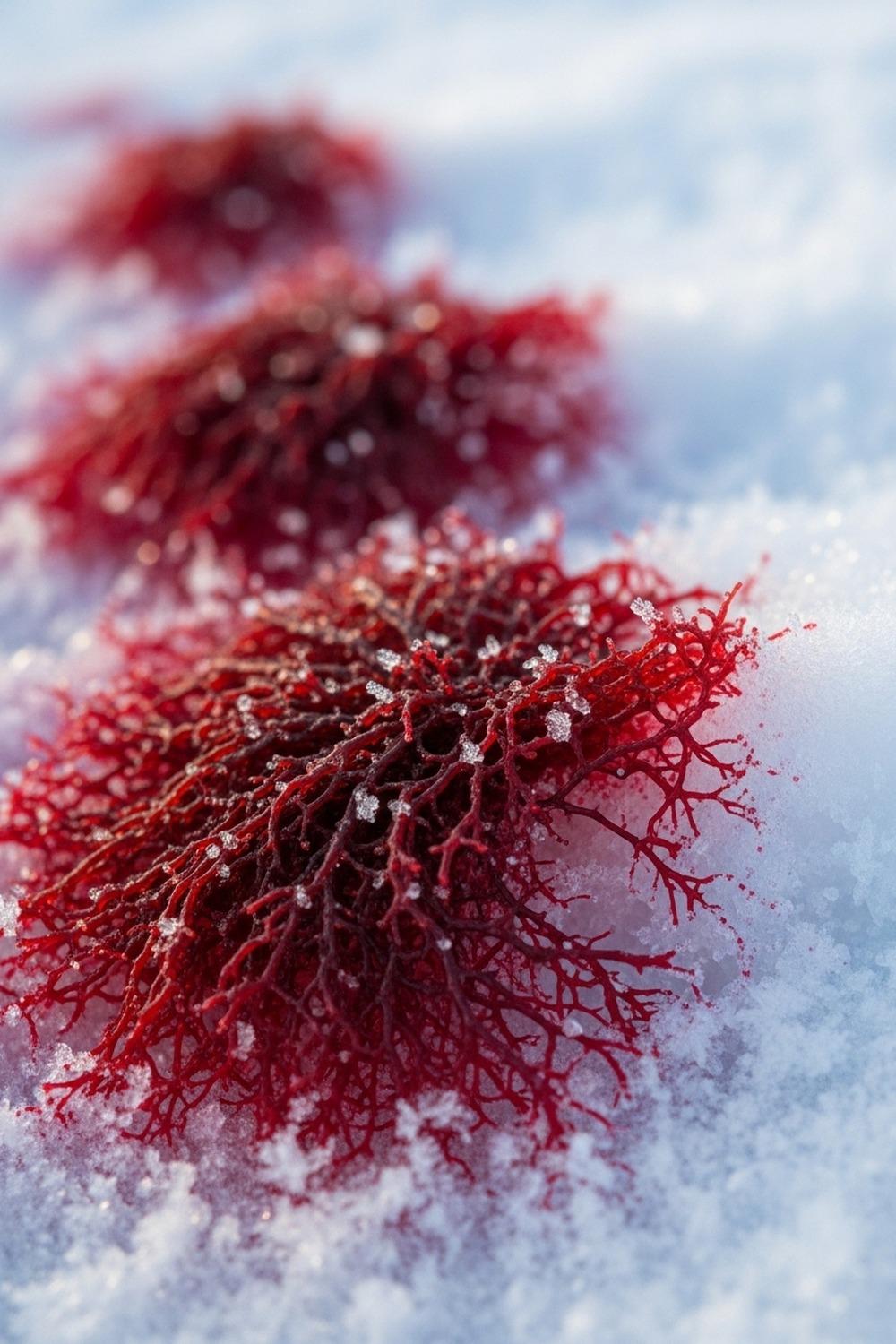
Most people assume snow is inert. It’s not. Chlamydomonas nivalis — the primary species behind red and pink coloration — is a psychrophilic green alga engineered by evolution to survive what would kill almost everything else. Technically green. Don’t let that fool you. When exposed to intense ultraviolet radiation at altitude, it manufactures a secondary pigment called astaxanthin — a reddish-orange compound that functions as biological sunscreen, protecting the cell’s chlorophyll from UV damage.
The result looks, from a distance, like a fresh wound or a strawberry sorbet. From close up, it looks like someone spilled something. Researchers at the University of Leeds and their collaborators across seven European Arctic sites have been documenting these blooms with increasing urgency since at least 2015. They’re not looking for a pattern anymore. They’re tracking an expansion.
The alga doesn’t live on the snow surface. It lives in it — beneath the snowpack in dormant cyst form during winter. When spring arrives and meltwater percolates downward, the cysts germinate and move toward sunlight. They photosynthesize. They reproduce. As their populations explode, the reddish pigment stains entire hillsides and glacier surfaces from the inside out.
Mountaineers have called it “watermelon snow” for centuries. It smells faintly sweet. It looks almost edible. Don’t.
Eating it causes severe gastrointestinal distress — a fact Alpine hikers have been relearning the hard way since at least the 1800s. The beauty is deceptive.
Why This Alga Is Changing How Snow Melts
Here’s where the story stops being a curiosity. White, clean snow reflects up to 90% of incoming solar radiation back into the atmosphere — a property scientists call albedo. It’s one of the planet’s most important cooling mechanisms. When red snow algae bloom across a snowfield, they darken the surface. Darkening causes snow to absorb more heat. More heat means faster melting. Faster melting produces liquid water — exactly the moist, nutrient-rich environment the algae need to keep blooming.
What happens next is elegant and relentless. The algae have built a feedback loop. Watching a species engineer its own acceleration like this, you stop calling it a natural process.
A landmark 2016 study led by researchers from the Helmholtz Centre for Environmental Research in Leipzig, published with contributions from field teams across Greenland, Iceland, Svalbard, and three Scandinavian glacier systems, found that algal blooms reduced snow albedo by an average of 13% over a single melt season. Thirteen percent. That number doesn’t sound catastrophic until you understand scale. The Arctic is already warming at roughly four times the global average rate. Shave 13% off the reflectivity of millions of square kilometers of snowpack, and you’ve added a significant thermal multiplier to an already destabilized system.
Fieldworkers placed spectroradiometers directly on glacier surfaces and measured what the instruments found: the most heavily bloomed sites weren’t just darker. They were measurably warmer than clean snow just meters away. You could feel it, one researcher noted, by pressing your hand to the surface. The bloomed patches were soft. The clean snow was firm.
Arctic Warming Is the Engine Driving the Blooms
Why does this matter? Because Chlamydomonas nivalis has been doing this for millions of years without threatening anything. It would be easy to frame the alga as the problem. The alga isn’t the problem. What changed is that warming Arctic temperatures have dramatically extended the melt season — the only season in which these algae are active. Longer, warmer springs and summers mean longer bloom windows. More liquid water for germination. A wider geographic range where snow temperatures stay just high enough for survival.
A 2020 analysis published in Nature Communications by a team from the University of Bristol and the Czech Academy of Sciences found that red and green algal communities on Arctic and alpine snowfields are expanding — both in density per site and in total number of sites where blooms occur. The data covered 40 glacier and snowfield locations across the Arctic and European Alps. What surprised even them: the algae weren’t restricted to pristine, ultra-clean snowfields. Blooms were intensifying on snow near coastlines. In areas downwind of human settlement. Places where atmospheric deposition of nitrogen and phosphorus from agriculture and combustion was subtly fertilizing the snowpack.
Red snow algae Arctic researchers had long treated as purely natural was, in a growing number of cases, being turbo-charged by nutrients that had no business being in the polar environment. That changes the story. Mitigation isn’t purely about temperature anymore. It’s about what we’re putting into the air thousands of miles away, and what settles out of it onto an ice sheet that was supposed to be the last pristine surface on Earth.
The Red Snow Algae Arctic Researchers Can’t Ignore
Researchers studying red snow algae Arctic-wide now face a measurement problem as much as a biological one. Satellite imagery detects large-scale blooms — the European Space Agency’s Copernicus program has been mapping snow albedo changes across Greenland and Svalbard with increasing resolution since 2017. But ground-truthing those images requires putting scientists on remote glaciers during melt season, in conditions that are physically demanding and logistically expensive. A 2021 paper from the Scottish Association for Marine Science identified more than 1,600 distinct bloom sites across the Arctic in a single melt season.
The authors noted that their satellite-based count was almost certainly an underestimate, since cloud cover obscured significant portions of the survey area for much of the summer. Each bloom site represents a localized heat sink. Individually, the effect is modest. Taken together — 1,600 sites, each absorbing more solar radiation than surrounding snowpack, each generating meltwater that feeds the next season’s bloom — the cumulative effect on regional albedo is substantial and poorly constrained.
Models of Arctic sea ice loss have historically treated snow reflectivity as a relatively stable input. That assumption is no longer defensible. The algae are a variable now. And variables trend.
Some teams are experimenting with field measurements of carbon sequestration alongside albedo. Chlamydomonas nivalis is photosynthesizing — pulling carbon dioxide out of the air while it blooms. Whether that sequestration is meaningful enough to partially offset the warming caused by albedo reduction remains an open question. The numbers, so far, don’t favor a wash.
What Happens to a Glacier That Keeps Bleeding
The Morteratsch Glacier in Switzerland lost approximately 3 kilometers of length between 1878 and 2020. The Jakobshavn Glacier in Greenland — one of the fastest-moving ice streams on Earth — retreated roughly 40 kilometers over the last two decades. These are the headline figures. What rarely makes those headlines is the surface biology happening on top of the ice.
A 2019 study by the Dark Snow Project, led by glaciologist Jason Box of the Geological Survey of Denmark and Greenland, found that biological material — including algae — accounted for a measurable and previously underquantified fraction of the dark material reducing albedo on the Greenland Ice Sheet. Box had spent years attributing ice sheet darkening primarily to black carbon soot and dust. The algae were also there. They’d been undercounted.
And here’s what keeps polar scientists awake: the compounding effect. Warmer temperatures extend the melt season. A longer melt season activates more algal blooms. More blooms darken the surface. A darker surface absorbs more heat. More heat accelerates melting. Accelerated melting produces more liquid water. More liquid water sustains and spreads the blooms. Close the loop, run it forward through decades, and the glacier doesn’t just retreat. It retreats faster than any purely physical model predicted — because the physics didn’t include the biology.
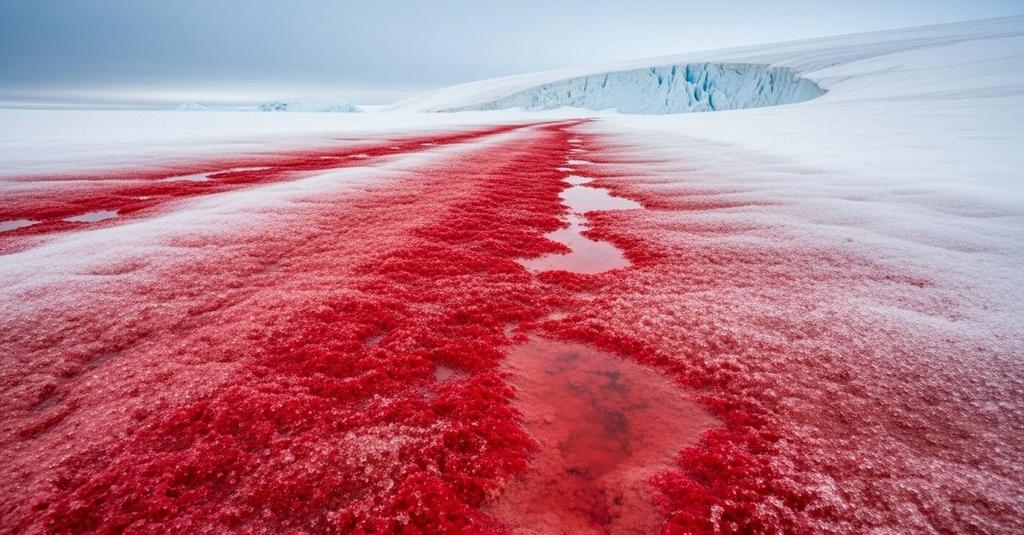
Stand on the Greenland Ice Sheet in July and you can see the blooms with naked eyes — vast pink-red smears running for hundreds of meters along the ablation zones where ice meets air. The smell is faintly sweet. The surface is soft underfoot. It gives a little, like wet felt. It doesn’t look like a climate feedback loop. It looks like an oil spill that forgot to be ugly.
How It Unfolded
- 1818 — Arctic explorer John Ross documented pink-tinged snow in Baffin Bay, initially attributing the coloration to meteorite dust before naturalists later identified it as biological in origin.
- 1970s — Laboratory studies confirmed Chlamydomonas nivalis as the primary organism responsible for red and pink snow coloration, establishing its carotenoid pigment chemistry for the first time.
- 2016 — The Helmholtz Centre for Environmental Research published the first multi-site quantification of albedo reduction caused by snow algal blooms, averaging 13% across seven Arctic sites in a single melt season.
- 2021 — The Scottish Association for Marine Science identified over 1,600 discrete red snow algae bloom sites across the Arctic in a single satellite-tracked melt season, marking the most comprehensive geographic survey to date.
By the Numbers
- 13% — average reduction in snow albedo caused by algal blooms over a single melt season, across seven Arctic sites (Helmholtz Centre for Environmental Research, 2016)
- 1,600+ — distinct bloom sites identified across the Arctic in a single melt season (Scottish Association for Marine Science, 2021)
- 4× — the rate at which the Arctic is currently warming compared to the global average, extending active bloom seasons (IPCC Sixth Assessment Report, 2021)
- 90% — reflectivity of clean, dry white snow; algal-bloomed snow can drop this to below 80% in heavily colonized zones
- 40 — glacier and snowfield locations surveyed across the Arctic and European Alps in the University of Bristol / Czech Academy of Sciences albedo study (2020)
Field Notes
- In summer 2017, fieldworkers on the Midtre Lovénbreen glacier in Svalbard documented a bloom that covered approximately 0.4 square kilometers in less than three weeks — a pace that surprised researchers who had previously treated algal expansion as a slow seasonal process.
- Chlamydomonas nivalis can survive in snow temperatures as low as -36°C in its cyst form, but only blooms and produces pigment when surface snow temperatures approach 0°C (and this matters more than it sounds — the bloom window is now a direct proxy for warming).
- The faint sweet smell associated with watermelon snow comes from biological volatile compounds released by the algae during active photosynthesis — the same metabolic processes that make the blooms a potential, if currently marginal, carbon sink.
- Researchers still can’t reliably predict which snowfields will bloom in any given year, or why adjacent sites with apparently identical conditions sometimes show dramatically different bloom intensities — the microbial ecology of snow is still, in large part, uncharted.
Frequently Asked Questions
Q: What causes red snow algae Arctic blooms to appear?
Red snow algae Arctic blooms are triggered by liquid meltwater, sufficient sunlight, and available nutrients in the snowpack. Chlamydomonas nivalis overwinters as dormant cysts beneath the snow, then germinates when spring temperatures bring the surface near 0°C. It produces a red-orange pigment called astaxanthin to protect itself from intense UV radiation. The blooms are entirely natural in origin, though warming temperatures and atmospheric nutrient deposition are now expanding their range and duration significantly.
Q: Is red or pink snow dangerous to touch or eat?
Touching red snow poses no significant risk, but eating it causes severe gastrointestinal distress — cramping, diarrhea, nausea. This has been documented since at least the 19th century among Alpine hikers and Arctic travelers. The toxicity isn’t fully understood but likely results from biological compounds in the algal cells rather than the astaxanthin pigment itself. The snow also frequently harbors other microbial communities alongside the algae, making consumption inadvisable regardless of how appealing the faint sweet smell might be.
Q: Does red snow actually speed up climate change, or is that overstated?
It’s not overstated — though it is sometimes misframed. The algae aren’t a primary driver of Arctic warming; fossil fuel emissions hold that role. But red snow algae function as a biological amplifier of warming that’s already happening. By reducing snow albedo, they accelerate melt in regions where ice loss is already a critical concern. The 2016 Helmholtz study’s 13% albedo reduction figure is significant at regional scale. The honest answer is that the algae are one of several reinforcing feedbacks that collectively make the Arctic’s trajectory worse than temperature data alone would suggest.
Editor’s Take — Alex Morgan
What stays with me about this story isn’t the albedo number or the bloom counts. It’s Jason Box’s realization that he’d been modeling Greenland’s ice loss for years and had simply left the biology out. Not because he didn’t know it was there — but because the field had quietly agreed it wasn’t significant enough to measure. That’s the kind of assumption that ages badly in a warming world. The algae were always part of the equation. We just didn’t put them in it.
The Arctic has always had red snow. What it hasn’t had — until now — is red snow spreading faster than our models anticipated, feeding on warmth we helped generate, in places we rarely visit and rarely watch. The pigment that Chlamydomonas nivalis produces to survive is one of the most efficient sunscreens in nature. It works so well that the entire ice sheet starts absorbing heat it used to reflect. Next time someone tells you climate change is about carbon alone, remember the smell of something sweet, and a glacier going soft underfoot.
Illustrations are AI-generated. Article fact-checked and human-edited. Our editorial standards.