Barn Owl Facts for Kids: The Ghost Bird of the Night
If you are hunting for barn owl facts for kids that go beyond “they hoot at night” — start here, because barn owls do not hoot. They scream. A barn owl tearing through a dark hayloft at midnight sounds less like a friendly cartoon bird and more like a person in trouble, which is one big reason farmhouses in England, France and the American Midwest have been called haunted for centuries. The ghost was just a bird, doing its job.
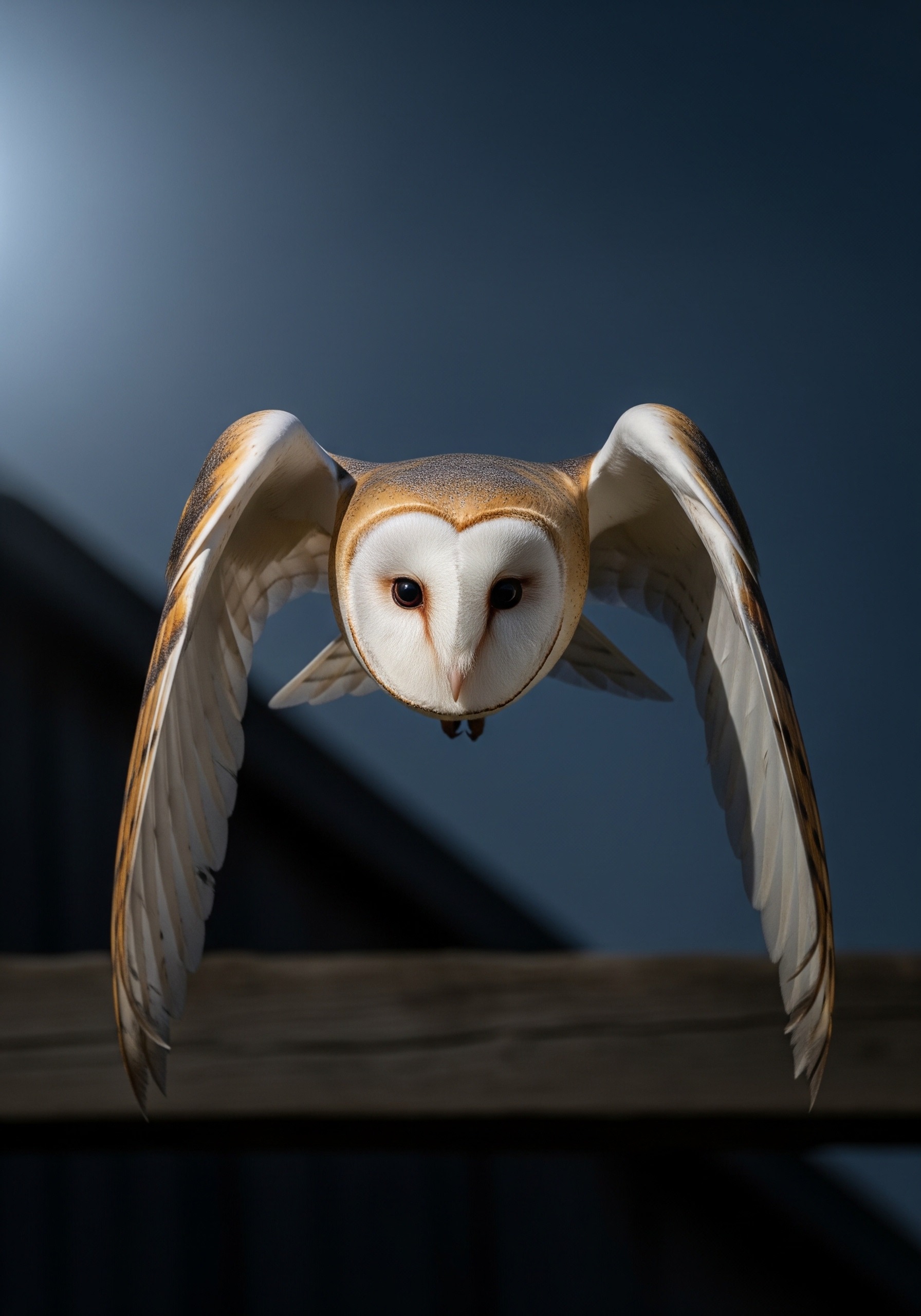
Key Facts
- Most widespread owl on Earth. Barn owls (Tyto alba and its close cousins) live on every continent except Antarctica — no other owl species comes close.
- They can hunt in total darkness — by ear alone. Harvard researcher Roger Payne proved this in 1957 by switching off every light in his lab and watching the owl still catch the mouse.
- Their face is a satellite dish. The famous heart shape is a tight ruff of stiff feathers that funnels sound into ear openings — one ear sits higher than the other so the owl can pinpoint vertical position, not just direction.
- They eat about 1,000 small rodents a year, each. A single barn owl family can clear thousands of mice from a farm in one season — which is why some California vineyards have replaced poison with nest boxes.
- They scream, they do not hoot. The classic “hoo-hoo” belongs to other owls (like the great horned owl). Barn owls hiss, snore and let out a long, raspy shriek that gave them their nickname: ghost owl, demon owl, screech owl.
In short: The barn owl is a pale, silent, screaming hunter with the sharpest hearing of any animal scientists have ever tested. It lives near people almost everywhere in the world and earns its keep eating the rodents nobody else wants around. Once you know what it actually is, every old “ghost in the barn” story starts to make sense.
Key Facts
- Barn owls (Tyto alba and close relatives) are the most widespread owl on Earth, living on every continent except Antarctica.
- Harvard researcher Roger Payne proved in 1957 that barn owls can catch prey in total darkness by ear alone.
- Their heart-shaped facial disc funnels sound to asymmetric ear openings—one ear sits higher than the other for vertical location.
- A single barn owl eats about 1,000 small rodents a year.
- A big female weighs around 550 grams and measures 33–39 cm; in 2024 most ornithologists split barn owls into three species.
In short: The barn owl (Tyto alba) is the world’s most widespread owl, living on every continent except Antarctica. Its heart-shaped face funnels sound to asymmetric ears, letting it hunt in total darkness by sound alone—proven by Roger Payne in 1957. Each eats about 1,000 rodents a year, and it screams rather than hoots.
Meet the Ghost Owl: What a Barn Owl Actually Is
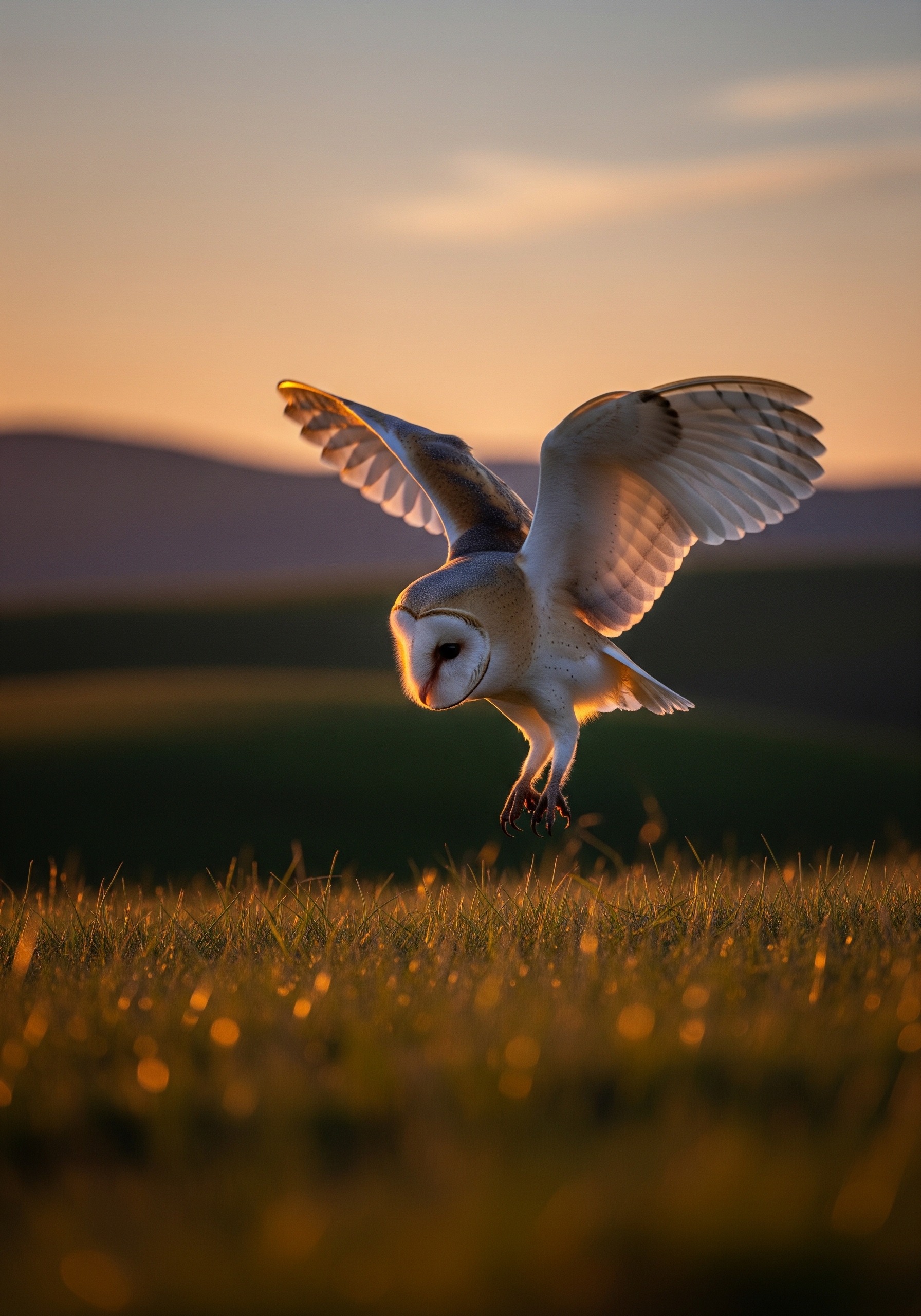
A barn owl is a medium-sized bird of prey — about as long as a school ruler from beak to tail (33–39 cm / 13–15 inches) and surprisingly light. A big female weighs roughly the same as a can of soup, around 550 grams. The males are smaller and paler. Both look almost ghostly: a snow-white belly, cinnamon-and-grey wings flecked with tiny black-and-white dots, and that unmistakable white, heart-shaped face.
The scientific name is Tyto alba, which is Latin for “white owl.” Until recently, scientists thought there was one barn owl species spread across the whole planet. In 2024, after years of DNA work, most ornithologists now recognise three separate species: the Western barn owl in Europe and Africa, the Eastern barn owl in Asia and Australia, and the American barn owl across North and South America. They look almost identical to the human eye, but their genes have been drifting apart for a long time.
Here is the strange part. Despite being everywhere, most people have never knowingly seen one. Barn owls are nocturnal, silent and famously shy. You are far more likely to find evidence — a pellet under a beam, a feather in a loft, a scream at 3 a.m. — than the bird itself.
Barn Owl Hearing Facts: A Face Built Like a Satellite Dish
That heart-shaped face is not decoration. It is the most sophisticated piece of biological sound-recording equipment we have ever found in a bird.
The pale, flat ruff of feathers around the eyes works exactly like a satellite dish, funnelling faint sounds inward toward the ear openings hidden in the feathers along the edge. The owl can even adjust the ruff slightly, tuning the dish like a person cupping a hand behind an ear.
The real trick, though, is hidden inside the skull. A barn owl’s ears are not symmetrical. The left ear opening sits higher up on the head than the right. That sounds like a flaw — it is actually genius. A sound from a mouse below the owl reaches the lower ear a tiny fraction of a millisecond before it reaches the upper ear. A sound from above arrives in the opposite order. The owl’s brain reads that tiny gap and pinpoints not just left-or-right but up-or-down — in three dimensions, in pitch darkness.
For decades, researcher Masakazu Konishi at the California Institute of Technology mapped the exact neurons that perform this calculation. His work, much of it with his colleague Eric Knudsen, showed that the barn owl’s brain builds a real-time “auditory map” of the world — essentially a sound picture as detailed as your eyes’ picture. The accuracy is extraordinary: studies at the British Trust for Ornithology note barn owls can locate prey to within about one degree of horizontal and vertical angle. That is roughly the width of your little finger held at arm’s length.
(Want the contrast? Other owls have showy “ear tufts” on top of their heads — those are just feathers, not ears. Barn owls skipped the tufts entirely and went all-in on the dish.)
{IMAGE_2}
How Barn Owls Hunt in Total Darkness
In 1957 a young biology student named Roger Payne — yes, the same Roger Payne who later became famous for recording the songs of humpback whales — ran a now-legendary experiment at Harvard. He built a room he could seal in complete, light-tight darkness, lined the floor with dry leaves, released a live mouse, and let in a barn owl. Then he switched off every light.
The owl caught the mouse. Every single time.
When Payne blocked the leaves with cloth (no rustling), or stuffed one of the owl’s ear openings with cotton, the strikes failed. The conclusion was as elegant as it was unsettling: barn owls do not need to see their prey at all. They hear it move, calculate where it is, and dive.
The dive itself is a feat of stealth engineering. Most birds whoosh through the air. Barn owls don’t. The leading edge of every flight feather has a comb-like fringe; the trailing edge has a soft, velvety hem; and the rest of the wing is covered in a fine, downy texture. Together they smother the turbulence that makes flight noisy. To a mouse, an attacking barn owl makes about as much sound as a passing thought.
Barn Owl Hunting Facts at a Glance
- Hunting speed: as slow as 3 km/h (2 mph) — they can almost hover over a meadow
- Sound accuracy: within ~1° vertical and 1° horizontal
- Prey detected in pure darkness: a mouse’s footsteps from across a room
- Strike success: serious — a hunting adult averages around 4 rodents every night
- Annual diet: roughly 1,000 small mammals per owl (RSPB and Barn Owl Trust estimates)
The Scream, Not the Hoot — Why Barn Owls Sound Like Ghosts
Here’s the thing — most people would lose money on a “barn owl call” quiz. Cartoon owls hoot. Real barn owls do not. The hoot belongs to species like the tawny owl in Europe and the great horned owl in North America. A barn owl, threatened in its roost or calling to a mate across a field, produces a long, raspy, descending shriek about two seconds long. To a human ear at 2 a.m., it is genuinely terrifying.
That sound did more than scare farmers. It built folklore. In medieval England the barn owl was an “omen bird”; in parts of rural France it was a chouette effraie, literally a “frightening owl.” Across the American South, generations of barns and abandoned plantation houses were rumoured haunted — and almost every report described a “wailing white figure” in the upper rafters. There is a very good chance most of those ghosts had feathers.
Barn owl chicks add a second sound to the menu: a long, sawing snore they use to beg their parents for food. A nest of hungry chicks at dusk sounds, charmingly, like a workshop full of small chainsaws.
Barn Owl Diet Facts: What’s Inside the Pellet
A barn owl is, basically, a small flying mouse-elimination service. Studies of thousands of barn owl pellets across Britain (collated by the Barn Owl Trust) show that field voles, common shrews and wood mice make up roughly 90% of the diet, with regional twists: more rats in cities, more bank voles in woodland, more shrews in damp meadows.
The owl swallows small prey whole, beak-first. About six to eight hours later, it coughs up a neat, dry, oval lump containing every bone, every claw and every tooth it could not digest. This is a pellet, and it is the single best gift the natural world gives to teachers. Soak one in water, tease it apart with tweezers, and you can reconstruct an entire vole skeleton — skull, ribs, hipbones — from an animal that was alive yesterday. Scientists use pellets to track which small mammals are thriving and which are vanishing in a given area, year by year.
Barn Owl vs. Other Owls — How to Tell Them Apart
If you are trying to identify an owl in a book, a backyard or a barn, the differences are sharper than they look.
| Feature | Barn Owl | Great Horned Owl | Snowy Owl |
|---|---|---|---|
| Face | Pure white, heart-shaped | Round, grey-brown, yellow eyes | Round, white, yellow eyes |
| Ear tufts? | No | Yes (tall, prominent) | No |
| Call | Long raspy scream | Deep “hoo-h’HOO-hoo-hoo” | Sharp barks and whistles |
| Hunts when | Strictly at night | Dusk and night | Day and night (Arctic) |
| Lives in | Farmland, grassland (worldwide) | Forests across the Americas | Arctic tundra |
Of those three, the barn owl is by far the most likely one a child in Europe, Australia or much of the United States will hear at night — and the least likely one they will ever see clearly.
Barn Owl Family Life: Mates, Eggs and Short Lives
Barn owls mostly pair for life. The courtship is sweet: the male performs what biologists call a “moth flight,” hovering and gliding around the female while making soft squeaks, sometimes offering her a freshly caught vole as a gift. (Romance varies by species.)
A female lays around four to seven eggs in a hollow tree, a cliff ledge or — most famously — the dusty corner of an old barn. She incubates them for about 31 days. The chicks hatch one at a time, days apart, so a single nest can hold a tiny new hatchling and an almost-grown teenager at the same time. By 13 weeks old the young are flying, hunting and gone.
And here is the saddest, most honest fact about barn owls: most of them do not live very long. The average wild barn owl in Britain lives only about four years, and roughly two out of three young owls die before their first birthday — usually from starvation in their first hard winter, or from cars. Ringed individuals have, very rarely, reached 15 or even 21 years; those owls are outliers, not the rule. We won’t pretend otherwise.
Are Barn Owls in Trouble? — And Why Farmers Are Building Boxes
Globally, barn owls are not endangered. The IUCN lists them as “Least Concern” and estimates close to ten million birds worldwide. Locally, though, the picture is darker. In the UK, barn owl numbers collapsed by an estimated 70% during the 20th century, mostly because old wooden barns were replaced with sealed metal sheds, hedgerows were ripped out, and rodenticides poisoned the very mice the owls were eating. A barn owl that swallows a poisoned rat dies of the same poison, days later.
The good news is that few wild animals respond to human help as fast as a barn owl. Putting up a single nest box on a quiet farm, away from busy roads, can produce a breeding pair within one or two years. The Hungry Owl Project in California has helped vineyards swap poison for boxes, and a recent project documented in Conservation Biology showed measurable rodent declines in fields with active barn owl pairs. A box of cheap plywood, a quiet corner, and a willingness to leave the mice alone is, genuinely, almost all it takes.
Frequently Asked Questions
Q: Are barn owls dangerous to humans?
A: No. Barn owls are small, shy and rarely interact with people at all. The only risk is to a person reaching blindly into a nest — a defensive female will hiss, click her beak and may strike with talons, but unprovoked attacks on humans are essentially unheard of.
Q: Can you keep a barn owl as a pet?
A: In most countries, no — and even where it is legal (with permits), it is a poor idea. Barn owls are wild birds with specialist needs: live or whole prey daily, large flight aviaries, and they bond uneasily with humans. Wild ones should be left wild; injured ones should go to a licensed wildlife rescue.
Q: Why is a barn owl’s face white?
A: Researchers in Switzerland (notably Alexandre Roulin’s team at the University of Lausanne) have shown that the bright white face actually startles small mammals in moonlight, freezing them for a fraction of a second — long enough for the owl to strike. The “ghostly” look is, in effect, a hunting tool.
Q: How is a barn owl different from a screech owl?
A: Despite the nickname, the barn owl is not the same as the small “screech owls” (genus Megascops) of the Americas, which have ear tufts and trilling calls. The barn owl is bigger, white-faced, tuft-less and produces a single drawn-out shriek rather than a trill.
Sources
- The Barn Owl Trust (UK) — long-term diet, lifespan and conservation data
- British Trust for Ornithology — owl hearing accuracy studies
- Audubon Society — natural history and “10 Fun Facts About the American Barn Owl”
- Roger Payne (1957, Harvard University) — original sound-localization experiment
- Masakazu Konishi and Eric Knudsen, California Institute of Technology — neural mapping of barn owl auditory localization
- Alexandre Roulin et al., University of Lausanne — research on barn owl plumage and hunting success
- IUCN Red List — global population assessment of Tyto alba
The barn owl is the rare wild animal that lives close to us, helps us without asking, and asks almost nothing back — a quiet roost, a few mice, a corner of a barn nobody is using. Knowing what it really is, and what that scream in the night really means, costs us nothing and gives back a small piece of the world.
Illustrations are AI-generated. Article fact-checked and human-edited. Our editorial standards.