Beetle Facts: Why 1 in 4 Animals Is a Beetle
The most surprising of all beetle facts is also the simplest: if you grab any animal on Earth at random, roughly one time in four you are holding a beetle. They are the silent majority of the living world — about 400,000 named species and counting, a quarter of every animal humanity has ever bothered to describe.
Key Facts
- About 400,000 beetle species have been formally described — roughly 25% of all known animal species, and close to 40% of described arthropods (source: Wikipedia / Smithsonian).
- The oldest known beetle, Coleopsis archaica, lived about 295 million years ago — tens of millions of years before the first dinosaurs.
- The goliath beetle can weigh 70-100 grams and reach 11 centimetres long; the featherwing beetle Scydosella musawasensis measures just 325 micrometres — smaller than the period at the end of a typed sentence.
- Bombardier beetles fire a defensive spray that flash-heats to nearly 100 °C and exits through a rotating “nozzle” in rapid pulses — one of the most violent chemical weapons in nature.
- African dung beetles are the only animals proven to navigate by the Milky Way (Marie Dacke and colleagues, Current Biology, 2013).
In short: Beetles are not a quirky niche of insect life — they are insect life, statistically speaking. This guide pulls together the strangest, most accurate, and most genuinely useful beetle facts: how an armoured front wing helped them conquer the planet, how a small African beetle reads the night sky, and what scientists are still arguing about today.
Key Facts
- About 400,000 beetle species have been formally described, roughly 25% of all known animal species and close to 40% of described arthropods.
- The oldest known beetle, Coleopsis archaica, lived about 295 million years ago, tens of millions of years before the first dinosaurs.
- The goliath beetle can weigh 70 to 100 grams and reach 11 centimetres, while the featherwing beetle Scydosella musawasensis measures just 325 micrometres.
- African dung beetles, shown by Marie Dacke and colleagues in Current Biology (2013), are the only animals proven to navigate by the Milky Way.
- The weevil family (Curculionidae) contains roughly 97,000 species, making it the largest family of animals on Earth.
In short: Beetles make up roughly one in four named animal species, with about 400,000 described and estimates of the true total ranging from 900,000 to over 2 million. Their evolutionary edge is the elytra, hardened front wings that armor the body and let them shrink without falling apart. Standout examples include the dung beetle Scarabaeus satyrus, the only animal confirmed to navigate by the Milky Way, and the bombardier beetle, which sprays a near-boiling defensive chemical in rapid pulses.
Why beetles quietly took over the planet
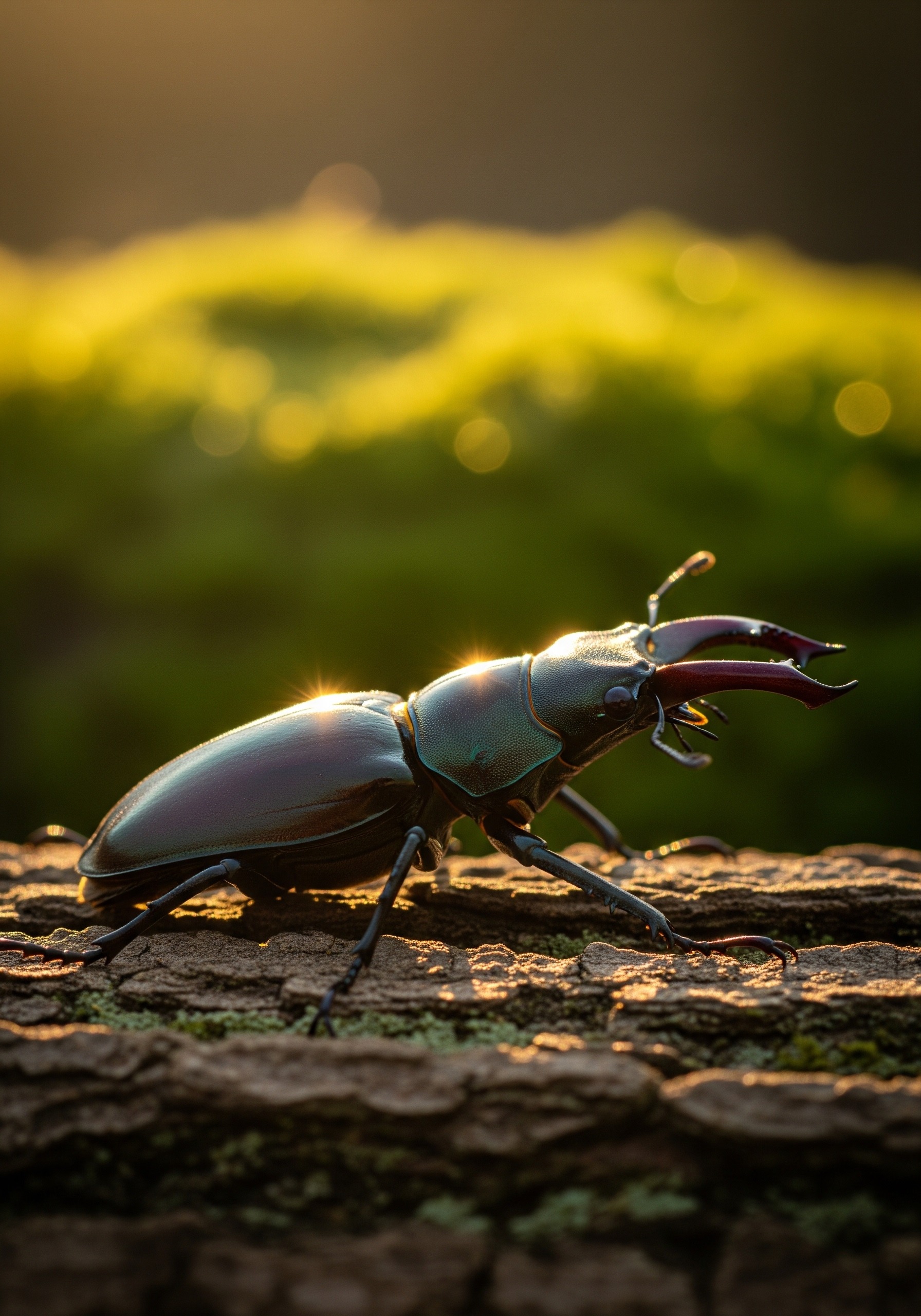
Ask an evolutionary biologist why beetles are so absurdly successful and you usually get a sentence about wings. Specifically: their front pair. In every other flying insect, both wing pairs are flight surfaces — fragile, exposed, easily torn. In beetles, the front pair evolved into elytra, a hard shell that snaps shut over the delicate rear wings like a fitted case.
That single trick turned a soft insect into an armoured one. Beetles can shoulder into rotten wood, dig under bark, swim, burrow through dung, or sit out a drought sealed inside their own body armour — and then pop the case open and fly away. The elytra also lets them keep getting smaller without falling apart, which is how a beetle can be barely visible to the naked eye and still survive a thunderstorm intact.
The British evolutionary biologist J. B. S. Haldane, asked what the study of nature taught him about the Creator, is widely reported to have answered that He must have “an inordinate fondness for beetles.” The line is famous because the numbers refuse to behave. Even the textbooks disagree by a million species.
The honest numbers (and the ones we are still arguing about)
Here is the thing about beetle counts: nobody knows the real number. The figure usually quoted — about 400,000 described species — is reasonably firm, because someone has actually written each of them down. The estimated total, including beetles that exist but nobody has named yet, runs anywhere from 900,000 to over 2 million depending on which tropical-forest study you trust. That is a wide gap, and it is honest to admit it.
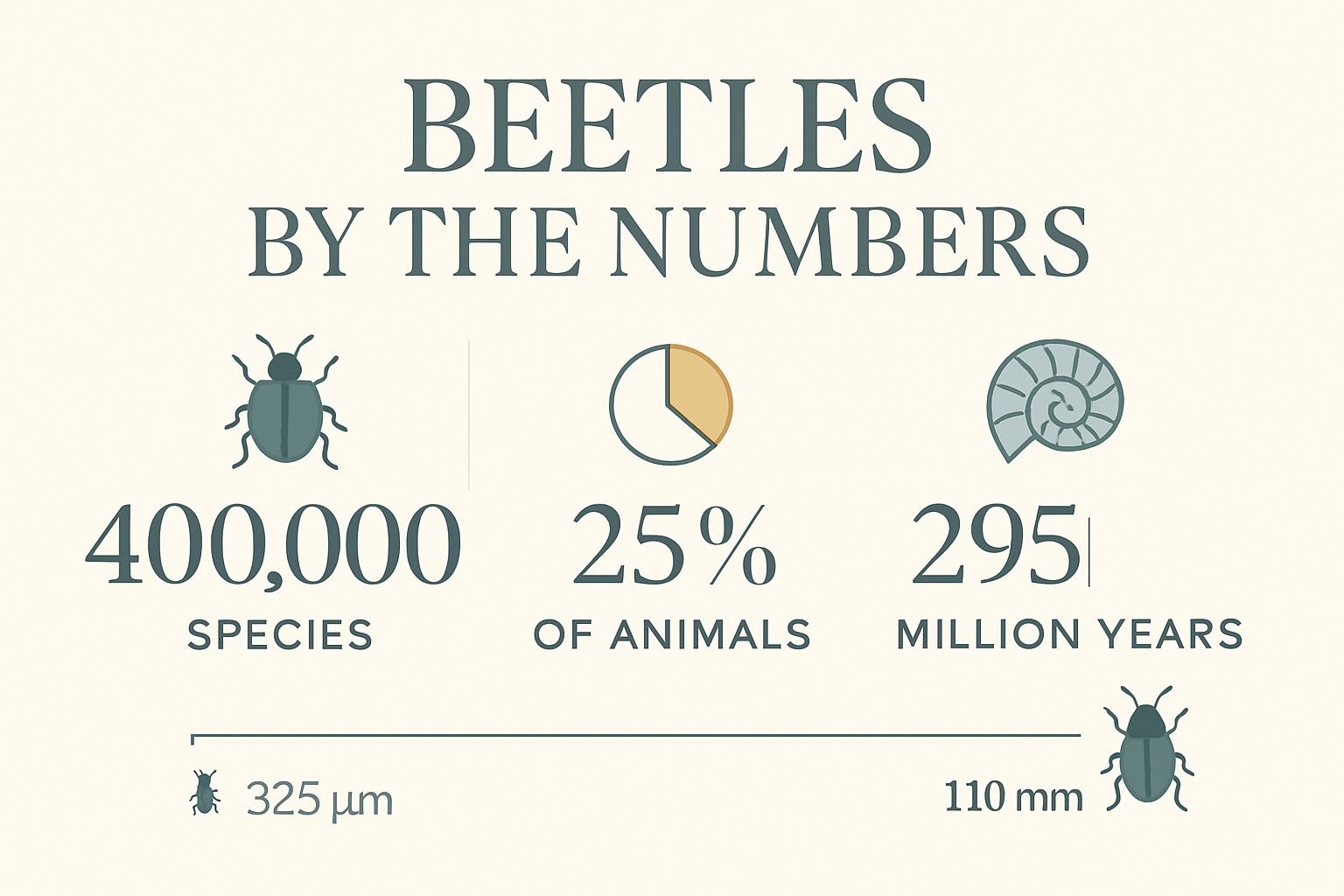
Beetles by the Numbers
- ~400,000 beetle species named so far
- ~25% of every animal species known to science
- ~97,000 species in the weevil family (Curculionidae) alone — the largest family of animals on Earth
- 295 million years: age of the oldest beetle fossil
- 325 µm to 110 mm: size range, from Scydosella to goliath
- ~100 °C: temperature of the bombardier beetle’s defensive spray
- ~20: how many shots a bombardier carries before reloading
Roughly one out of every four named animal species is a beetle. Said the other way: of all the mammals, fish, birds, reptiles, amphibians, jellyfish, spiders, worms, snails, crabs and every other living thing on Earth combined, beetles outweigh the rest of the catalogue.
{IMAGE_2}
The dung beetle that steers by the Milky Way
This one sounds invented. It is not.
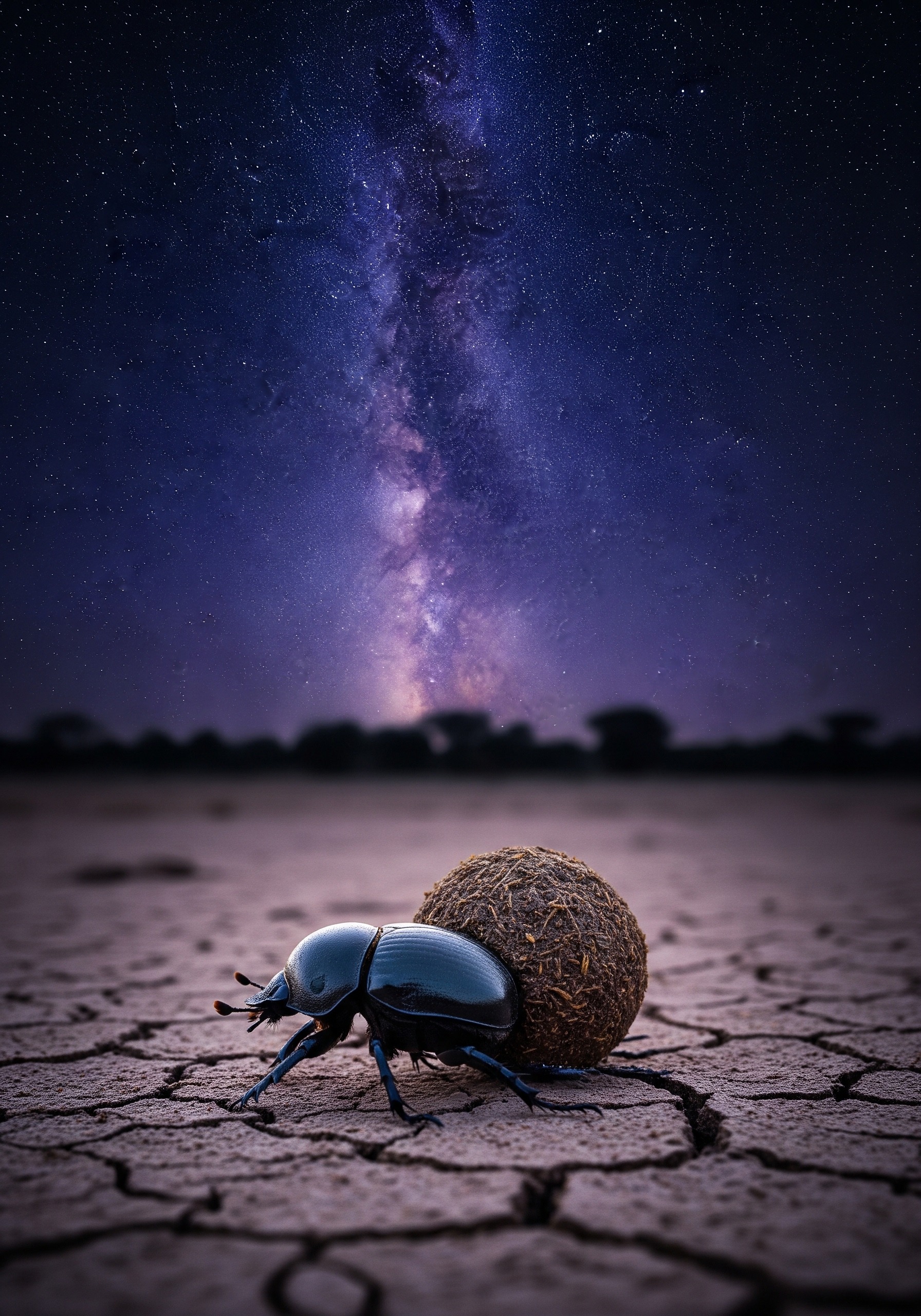
On moonless nights in the South African veld, a thumb-sized beetle called Scarabaeus satyrus rolls a ball of dung in a perfectly straight line away from the dung pile. Straight lines are how it escapes rivals — any curve, and a bigger beetle steals the ball. But how does an insect with primitive eyes hold a straight bearing in pitch darkness?
In 2013, biologist Marie Dacke of Lund University, working with Marcus Byrne at the University of the Witwatersrand and colleagues, ran an experiment that has since become a small classic. They glued tiny cardboard “hats” onto the beetles, blocking their view of the sky, and watched the straight lines fall apart. Then they took the beetles to a planetarium in Johannesburg. With the full starfield projected overhead, the beetles rolled straight. With only the brightest scattered stars showing, they wandered. With just the Milky Way’s band of light overhead — no individual stars — they rolled straight again.
The conclusion, published in Current Biology, is that nocturnal dung beetles steer by the glowing band of our own galaxy. So far, they are the only animal in the entire literature confirmed to do this. A creature whose brain is smaller than a grain of rice is using the geometry of the Milky Way as a compass. If you ever needed a reason to take insects seriously, that is it.
The boiling-acid cannon, accurately described
The bombardier beetle is a small, unremarkable-looking ground beetle — until something tries to eat it. Then a chamber in its abdomen mixes hydrogen peroxide with hydroquinone in the presence of two enzymes, catalase and peroxidase. The reaction is violently exothermic. About a fifth of the liquid flash-boils to steam, slamming an inlet valve shut and protecting the beetle’s own organs, and the rest blasts out through a rotating turret in rapid pulses — researchers at MIT have measured the bursts at hundreds per second.
The fluid that hits the attacker is near boiling point, laced with 1,4-benzoquinone (a known eye and respiratory irritant in vertebrates), and a beetle carries enough chemistry for roughly twenty shots before it has to reload. Frogs that swallow a bombardier whole have been filmed regurgitating it, still alive, more than an hour later. There is nothing else quite like it in the animal kingdom — a real chemical weapon, engineered by evolution out of two harmless ingredients found in the beetle’s own blood.
The “strongest animal” record, with the caveat the headlines skip
You will see this everywhere: the dung beetle is the world’s strongest animal, capable of pulling 1,141 times its body weight. The number is real — it comes from a 2010 study by Rob Knell at Queen Mary University of London, and it refers to the horned dung beetle Onthophagus taurus, with the male using its horns to push rivals out of underground tunnels.
The honest caveat the listicles leave out: that record is a scaled strength, and small animals always win scaled-strength contests because of basic physics — muscle power scales with cross-section while body weight scales with volume. An ant pulling fifty times its weight and an elephant lifting a quarter of its own would both lose to the beetle’s ratio. The point is not that a dung beetle could move a car. The point is that pound for tiny pound, no animal we have measured pushes harder.
What every “beetle facts for kids” list gets wrong
Three myths worth correcting, because they show up in almost every short article and they are not quite true.
“Beetles can’t see well.” Some can’t. Others — like the tiger beetles, which sprint at about 5.5 mph (around 9 km/h), so fast their eyes can’t process the world fast enough and they have to stop, look, and run again — have some of the sharpest vision in the insect order. Saying “beetles” see badly is like saying “mammals” run slowly.
“Ladybugs aren’t beetles.” Ladybugs are beetles. Family Coccinellidae, order Coleoptera, full stop. The “bug” in the name is informal English, not entomology.
“All beetles eat plants.” Most do — but plenty are predators (ground beetles, ladybugs, fireflies as larvae), some live entirely on rotting wood, some only on dung, and a few are parasites that ride inside ants’ nests. The diet of the beetle order is essentially “anything organic, somewhere.”
From the scarab to the supermarket: beetles and us
Ancient Egyptians watched dung beetles rolling balls of waste at dawn and saw the sun god Khepri pushing the sun across the sky — that is where the scarab amulet comes from, a religious symbol of rebirth carved by the millions. Ladybugs are still considered lucky across most of Europe and North America. Fireflies, which are beetles (family Lampyridae) and not flies at all, light up summer evenings using a cold-light reaction so efficient it inspired modern LED research.
The unromantic side of the relationship is loud too. Bark beetles have killed hundreds of millions of conifers across western North America in the last two decades. The boll weevil, a single beetle species, reshaped the entire economy of the American South in the early 20th century. Beetles eat about a third of all stored grain we lose to pests every year. They were here first, and they will be here last, and most of the time we only notice them when they touch our food.
For a closer look at another armoured insect with a chemistry-meets-camouflage story, see also the thorn bug — different order, same evolutionary logic of armour-plus-trick.
Frequently Asked Questions
Q: How many beetle species are there really?
A: About 400,000 have been formally described. Estimates of the true number — including beetles in tropical canopies nobody has catalogued — range from roughly 900,000 to 2.1 million. The honest answer is “we don’t know yet.”
Q: What is the difference between a beetle and a bug?
A: In entomology, “true bugs” are the order Hemiptera (cicadas, aphids, stink bugs, bed bugs) and pierce-and-suck their food. Beetles are the order Coleoptera, defined by their hardened front wings (elytra), and most chew. A ladybug and a stink bug look similar to a casual eye, but they are in completely different orders.
Q: Are beetles dangerous to humans?
A: Almost never directly. A handful of blister beetles produce cantharidin, an irritant that can blister skin on contact, and bombardier sprays can sting the eyes. Far more important are the indirect impacts — beetles that destroy crops, stored grain, or forest trees. Bites and stings from beetles are vanishingly rare.
Q: Do beetles pollinate flowers?
A: Yes, and they were arguably the first pollinators on Earth — beetle pollination of cycads and early flowering plants pre-dates bees by tens of millions of years. Magnolias and water lilies, two of the oldest flower lineages, are still mostly beetle-pollinated today.
Sources
- Smithsonian Institution — Beetles (Coleoptera) bug-info page.
- Wikipedia — Beetle and Bombardier beetle overview articles (used for descriptive figures, not as primary sources).
- Dacke, Baird, Byrne, Scholtz and Warrant, Dung Beetles Use the Milky Way for Orientation, Current Biology, 2013.
- Natural History Museum, London — research notes on bombardier beetle chemical defence.
- MIT News — 2015 study on the pulsed-spray mechanism in bombardier beetles.
- Knell and Simmons (2010), Queen Mary University of London — strength measurements in Onthophagus taurus.
Beetles are not a sideshow in the story of life on Earth — they are a quarter of the cast. The next time one trundles across a path in front of you, remember: its lineage is older than the dinosaurs, its family is larger than all the vertebrates put together, and somewhere in South Africa one of its cousins is staring up at the Milky Way to find its way home.
Illustrations are AI-generated. Article fact-checked and human-edited. Our editorial standards.