How Birds Navigate: The Magnetic Compass Inside Their Eyes
A young Arctic tern, eight weeks old, lifts off a Greenland cliff and points its beak south. Eleven months later, it will have flown to Antarctica and back — roughly 70,000 kilometres — without a map, a phone, or a teacher. Bird migration navigation and orientation has been one of biology’s hardest puzzles for two centuries, and in the last five years, scientists have finally pinned down the trick: songbirds may be reading the Earth’s magnetic field through a quantum effect inside their own eyes.

Key Facts
- Arctic terns log roughly 70,000–80,000 km a year between Arctic breeding grounds and Antarctic feeding waters — the longest migration of any animal.
- A young bar-tailed godwit (satellite tag "B6") flew 13,560 km non-stop from Alaska to Tasmania in 11 days and 1 hour in October 2022 — a Guinness-verified record.
- Night-migrating songbirds carry a magnetic compass in the right eye, not the beak; the receptor is a light-activated protein called cryptochrome 4.
- The compass detects the angle (inclination) of Earth’s magnetic field, not its north–south polarity.
- Birds use at least four navigation cues — sun, stars, magnetism, and smell — switched on or off depending on weather, time of day, and life stage.
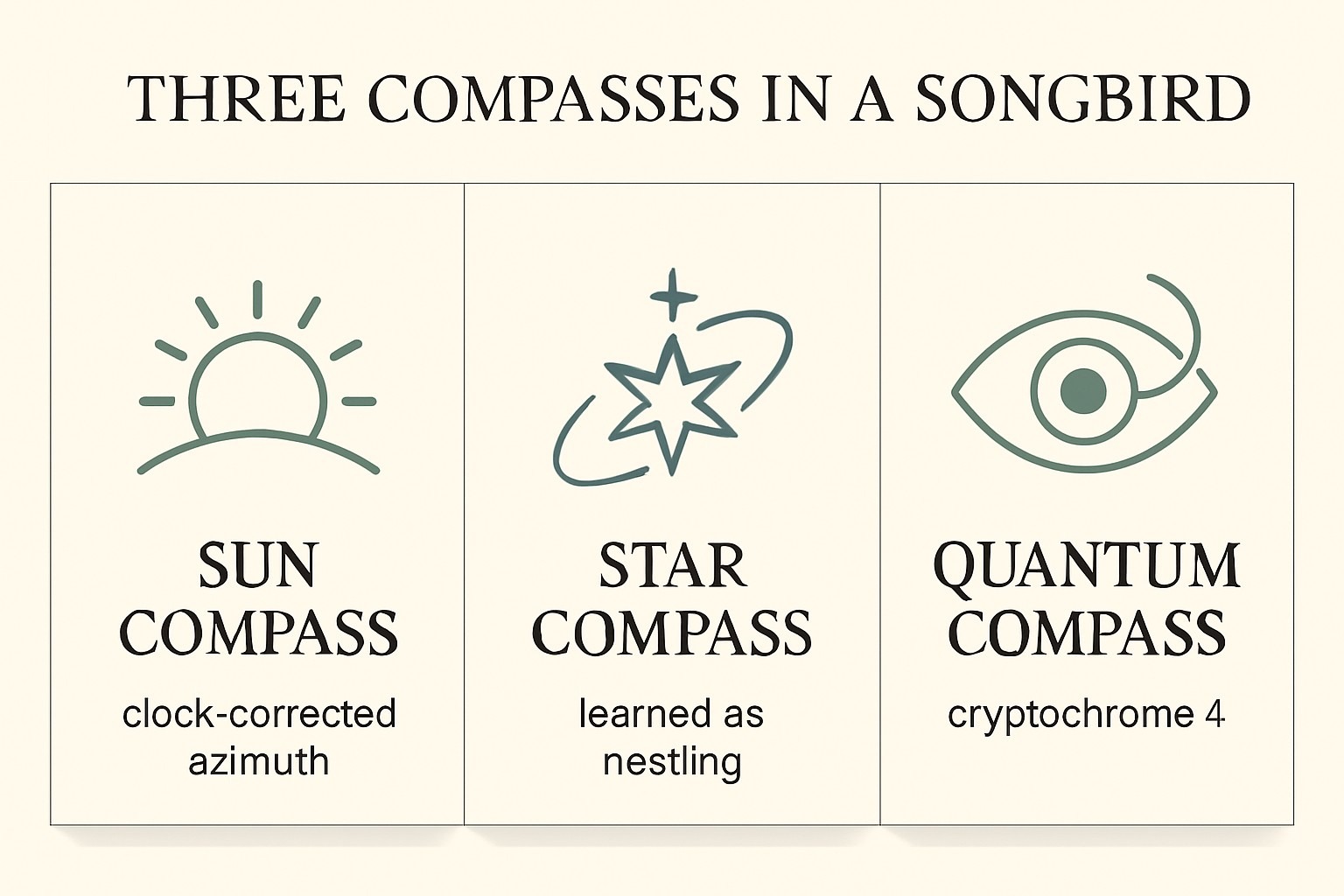
In short: Birds combine a clock-corrected sun compass, a star compass learned as nestlings, and a light-dependent magnetic compass inside the eye to cross continents with kilometre-level accuracy. The deepest mystery — the map that tells a bird where it currently is — is still only half-solved.
Key Facts
- Arctic terns log roughly 70,000 to 80,000 km a year between Arctic breeding grounds and Antarctic feeding waters, the longest migration of any animal.
- A young bar-tailed godwit (satellite tag “B6”) flew 13,560 km non-stop from Alaska to Tasmania in 11 days and 1 hour in October 2022, a Guinness-verified record.
- Night-migrating songbirds carry a light-activated magnetic compass in the right eye, based on a protein called cryptochrome 4, that detects the field’s inclination rather than its polarity.
- Henrik Mouritsen and Peter Hore showed in a 2021 Nature paper that the European robin’s cryptochrome 4 is magnetically sensitive in a test tube, more so than that of chickens or pigeons.
- Stephen Emlen’s late-1960s indigo bunting experiments at Cornell proved birds learn the star compass as nestlings by watching the night sky rotate.
In short: Birds cross continents using a map-and-compass system: a clock-corrected sun compass, a star compass learned as nestlings, and a light-dependent magnetic compass inside the eye. The magnetic sensor is cryptochrome 4, a protein in the right eye that detects the field’s inclination through a quantum radical-pair effect, confirmed in pieces between 2018 and 2026. While compass questions are largely solved, the deeper mystery of the map that tells a bird where it currently is remains only half-solved.
Map vs compass: bird migration navigation and orientation, explained

Here is the distinction that unlocks the whole field, and most popular articles skip it.
A compass tells you which way is north. A map tells you where you are. Find both, and you can plot a route home from anywhere. A homing pigeon released a thousand kilometres from its loft has to answer both questions before it lifts a wing — and biologists have known since the 1950s that birds use different sensory tools for each task. Roswitha and Wolfgang Wiltschko, the German husband-and-wife duo who first proved the avian magnetic compass exists, called this the "map-and-compass" model. It still frames every textbook chapter on the subject.
Compass questions are mostly solved. Birds carry at least three. Map questions are messier; we’ll get to those.
{IMAGE_2}
The sun compass and a bird’s internal clock
On a clear morning, watch a flock of starlings climb after sunrise. They are not just chasing warmth — they are reading the sun’s azimuth (its compass bearing along the horizon) and silently correcting for time of day. A 9 a.m. sun in Berlin sits at a very different bearing than a 3 p.m. sun. To know which way is south, a bird has to know both where the sun is and what time it is.
That clock lives in a small cluster of neurons called the suprachiasmatic nucleus, and it ticks roughly every 24 hours. Shift a captive pigeon’s day–night cycle six hours forward, release it, and it will fly 90 degrees off-course — a classic experiment first run by the German ornithologist Gustav Kramer in the 1950s, and replicated every decade since. The sun compass is real, and it depends on clean sight of the sun.
What about cloudy days? Birds fall back to polarised light — bands of polarisation across the sky that survive thin overcast — or, when even that fails, to the magnetic compass.
The star compass — learned, not innate
Most navigation in songbirds happens at night. They climb a few hundred metres after dusk and fly in silent waves until just before dawn. Up there, the sun is gone, but the stars rotate predictably around the celestial pole — and birds use that rotation, not the individual constellations, as their north–south reference.
The proof came from Stephen Emlen at Cornell in the late 1960s. He raised indigo buntings inside a planetarium and quietly shifted the projected "north" to Betelgeuse. The hand-raised birds grew up calling Betelgeuse north, and oriented their migratory restlessness toward it. Wild-raised buntings did not — they had already learned the real sky.
Here’s the thing. The star compass is learned in the nestling stage, by watching the night sky rotate. A bird hatched indoors and released as a fledgling has a broken compass for life.
Bird quantum navigation: the magnetic compass inside their eyes
Songbirds’ best-known trick was confirmed in pieces between 2018 and 2026, and it is the most beautiful mechanism in animal biology.
Night-migrating songbirds — robins, blackcaps, garden warblers — orient by Earth’s magnetic field even inside a totally dark indoor cage. Cover one of the bird’s eyes, though, and the magnetic compass fails. The receptor is in the right eye, and it needs blue-green light to work. That alone told researchers the sensor could not be a passive iron mineral; it had to be a light-activated chemical reaction.
Henrik Mouritsen at the University of Oldenburg in Germany, working with Oxford chemist Peter Hore, named the suspect: cryptochrome 4, a protein found in the double-cone photoreceptor cells of the retina. In a Nature paper in 2021, Mouritsen’s team showed that the European robin’s version of cryptochrome 4 is magnetically sensitive in a test tube — and more sensitive than the cryptochrome 4 of chickens or pigeons, which do not navigate by stars. In January 2026, a Princeton-led computational collaboration added further weight, modelling exactly how the protein could let an electron pair "feel" the geomagnetic field inside a living cell.
Inside the molecule, the trick is genuinely quantum. When blue light hits cryptochrome, an electron jumps between two atoms, creating a "radical pair" whose two spins are entangled. Earth’s magnetic field is far too weak to push an electron around directly, but it can nudge the entangled pair to relax slightly faster in one orientation than another — and the bird’s brain, presumably, reads that tiny imbalance as direction.
A compass written in quantum spin.
It still has to be proven inside a living, flying bird. But the chain of evidence is now the strongest the field has ever assembled.
The beak magnetite myth — what actually happened
For thirty years, popular articles repeated a tidy story: pigeons carry tiny iron-rich "magnetite" particles in their beaks, wired to the trigeminal nerve, and that is their compass. It made a great picture and a worse experiment.
In 2012, Christoph Treiber and David Keays at Vienna’s Institute of Molecular Pathology dissected over 200 pigeon beaks and found that the supposed magnetite cells were not nerve cells at all. They were macrophages — immune cells that hoover up iron as part of routine cleanup — and they appeared in essentially random locations bird to bird. The "beak compass" was an artefact of looking at the wrong cells.
The evidence now leans hard toward the eye, not the beak.
That said, magnetite-based receptors elsewhere in the head may still help with the map — sensing magnetic intensity, not direction. A 2024 Royal Society Proceedings B study by Nikita Chernetsov and colleagues showed migratory Eurasian reed warblers can extract positional information from inclination plus declination alone, suggesting birds may read the geomagnetic field as both compass and grid coordinates. The map question is opening up again.
Real migration records (verified)
- Arctic tern: 70,000–80,000 km round trip per year (Greenland → Antarctica → Greenland); lifetime distance over 30 years ≈ 2.4 million km.
- Bar-tailed godwit B6: 13,560 km non-stop, Alaska to Tasmania, 11 days 1 hour, October 2022.
- Northern wheatear: up to 14,500 km from sub-Arctic Canada to sub-Saharan Africa — a 25-gram songbird.
- Common swift: ten months airborne without landing, eating, drinking, and sleeping on the wing.
Smells, infrasound, and the missing map sense
Hand-raise a homing pigeon with cotton plugged in its nostrils, and it cannot find its loft. Strip the olfactory bulbs from its brain, and the bird is hopelessly lost over unfamiliar terrain. Floriano Papi, working in Pisa in the 1970s, proposed that pigeons memorise a smell map of their home region — the resin of one valley, the salt of one coast, the diesel exhaust of a particular city — and use it as a landscape-scale GPS.
Smell-mapping is still contested. It seems to work for pigeons in central Italy and for shorebirds over the open ocean (where the smell of dimethyl sulphide rising from plankton blooms can mark productive water). It seems weaker in songbirds, which may rely more on infrasound — the low-frequency hum of ocean swells crashing on distant coasts, audible to birds for thousands of kilometres — or on magnetic anomalies in the bedrock below.
Why so many overlapping systems? Because no single cue works in every weather, season, and life stage. A migrating songbird that loses its star compass to clouds, its sun compass to fog, and its smell map to a tailwind across the Sahara still has a magnetic compass and a magnetic-intensity map. Redundancy is the whole point.
What’s new in 2026 — and what is still genuinely unknown
Three things have shifted in the last twenty-four months, and one big mystery has not.
First, the cryptochrome 4 case has hardened. Princeton’s January 2026 computational work showed the protein’s radical pair can stay quantum-coherent long enough inside the messy cellular environment to register a weak magnetic signal — an objection that had haunted the theory for a decade.
Second, anthropogenic radio-frequency noise (the buzz from mobile networks, AM radio, and powerlines) is now known to scramble the magnetic compass of caged robins at field strengths a thousand times below WHO safety limits. The compass works on quantum coherence, and coherence is delicate. What this means for billions of birds migrating across modern cities is a live, unsettled question.
Third, the map. Researchers are starting to suspect that what we call "the bird’s map" is actually a stitched composite — magnetic intensity, smell, infrasound, remembered landmarks — and that no single sense holds the whole thing. Turns out the textbook story (one map, one compass, done) was simpler than reality.
Honest uncertainty: nobody has yet recorded a single cryptochrome-4 molecule responding to a geomagnetic-strength field inside a living bird’s eye. Until they do, the quantum compass remains the best-supported hypothesis on the table — not a settled fact. That distinction matters.
Frequently Asked Questions
Q: Do all birds use the magnetic compass, or only migrators?
A: Magnetoreception has been demonstrated in more than twenty bird species so far, including non-migrators like domestic chickens. But cryptochrome 4 is expressed at higher levels in the retinas of night-migrating songbirds, and only during the migratory season — migration seems to have selected for a more powerful version of a sense most birds carry.
Q: Can birds get lost?
A: Constantly. Storms, magnetic anomalies, and exhausted reserves blow individual birds far off-route every year, which is why "vagrant" species turn up on the wrong continent every autumn. The navigation system is robust on average; it is not infallible per bird.
Q: How accurate is bird navigation?
A: A homing pigeon released a thousand kilometres from its loft routinely returns within hours. A juvenile bar-tailed godwit on its first migration can hit a target island after 11 days over open ocean with no landmarks. Accuracy at the kilometre scale; precision at the metre scale via familiar landmarks at the end of the trip.
Q: Could humans use a similar quantum compass?
A: Humans carry cryptochromes in our own retinas, but our versions seem tuned for the circadian clock rather than magnetic sensing, and behavioural tests for a human magnetic sense have produced conflicting results. The honest answer is: probably not in any useful way.
Sources
- Xu, J., Jarocha, L. E., Mouritsen, H. et al. Magnetic sensitivity of cryptochrome 4 from a migratory songbird. Nature, 2021.
- Wiltschko, R. and Wiltschko, W. Magnetoreception in birds. Journal of the Royal Society Interface, 2019.
- U.S. Geological Survey, Alaska Science Center — bar-tailed godwit "B6" satellite tracking, 2022.
- Princeton University Office of the Dean of the Faculty — computational support for cryptochrome-based magnetoreception, January 2026.
- Royal Society Proceedings B — Chernetsov et al., reed warblers extract positional information from magnetic inclination and declination alone, 2024.
- Cornell Lab of Ornithology, All About Birds — basics of bird migration navigation.
A bird hatched in a Greenland tundra last June is, tonight, somewhere over the South Atlantic — climbing through the dusk with a compass written in light, an internal clock keeping pace with a sun she cannot see, and the memory of a sky rotating around a star she learned in her first weeks of life. She does not know any of this. She just knows which way is south.
Illustrations are AI-generated. Article fact-checked and human-edited. Our editorial standards.