The Ancient Blood Bleeding From Antarctica’s Ice
At the edge of Taylor Glacier in Antarctica, water that’s been locked underground for five million years is still flowing. It hasn’t frozen once, and nobody fully understands why — which is the kind of thing that should bother scientists more than it does.
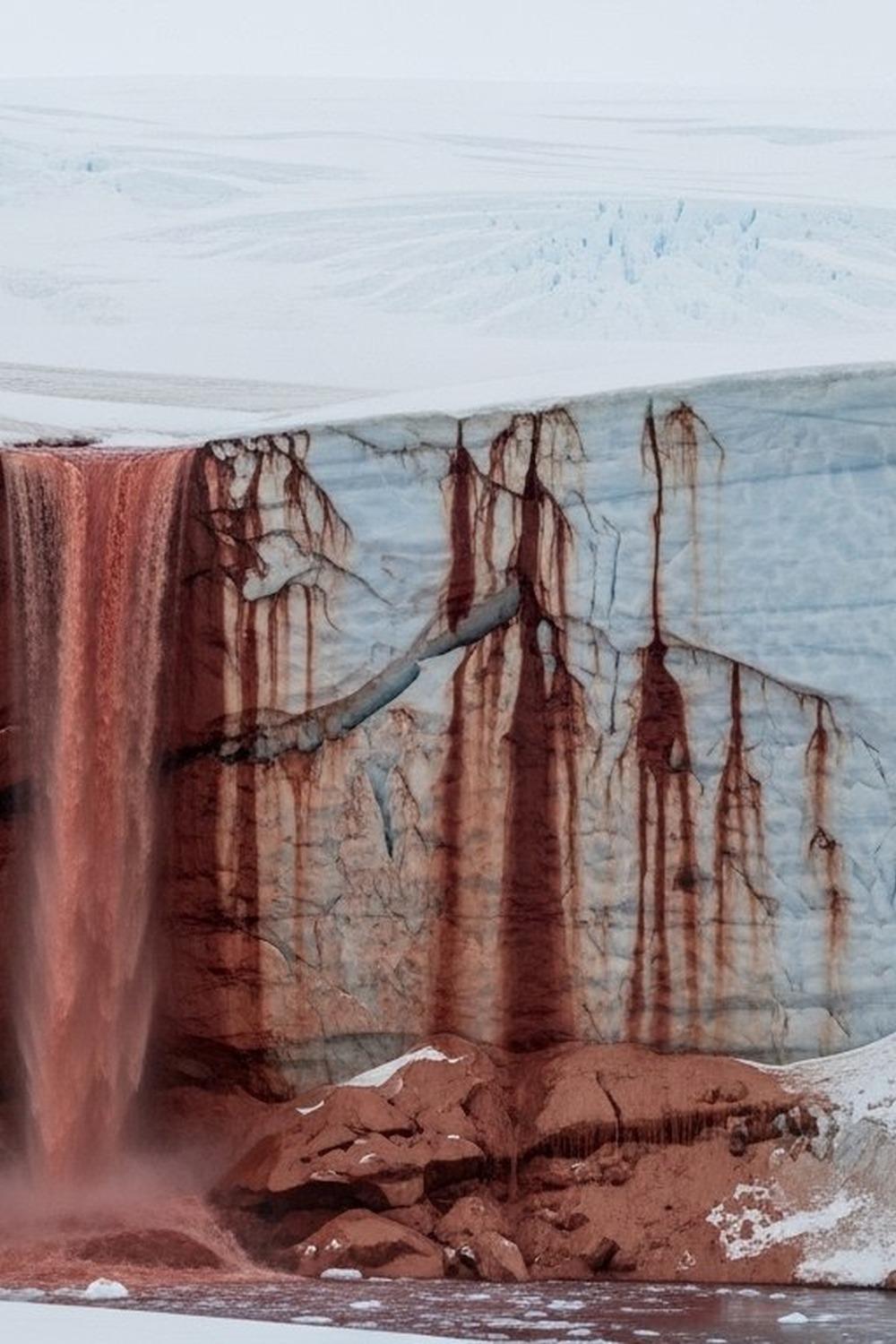
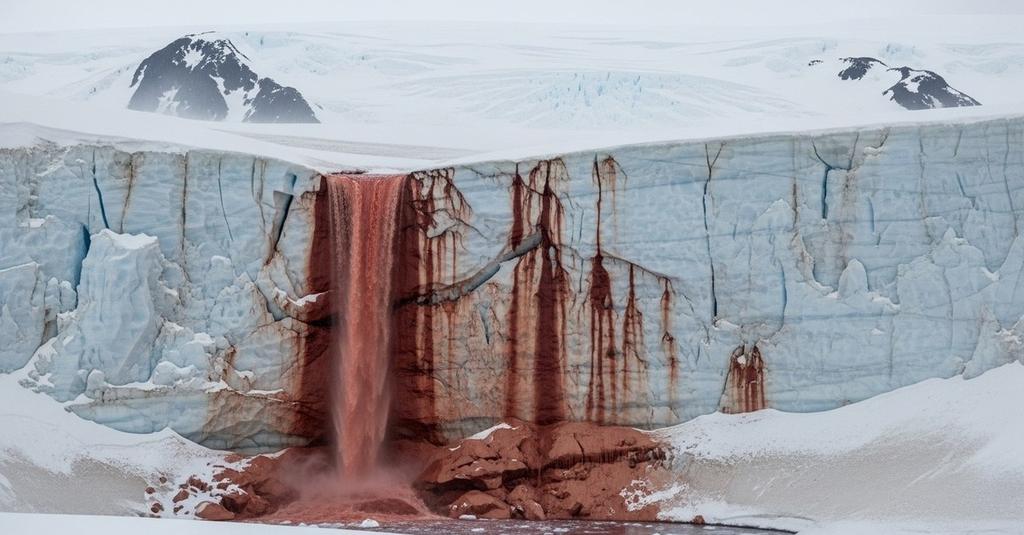
There’s a cliff face at the McMurdo Dry Valleys where something that looks disturbingly like an open wound spills rust-colored water down pristine white ice. Geologist Griffith Taylor first spotted it in 1911 and described it in terms that make you understand why the place got its name. It looks like the glacier itself is bleeding. The color is wrong. The flow is wrong. Everything about it seems to violate the basic rules of how Antarctica is supposed to work.
Key Facts
- The iron-rich brine feeding Blood Falls has been locked beneath Taylor Glacier in Antarctica for roughly five million years, predating modern humans by about 4.7 million years.
- The brine is approximately 3.5 times saltier than seawater, preventing it from freezing even at temperatures well below -10 degrees Celsius.
- Glaciologist Erin Pettit’s team used radio-echo sounding in 2017 and mapped about 3 kilometers of connected brine channels beneath the glacier.
- The brine contains less than 0.01 mg/L dissolved oxygen, compared with 8 to 10 mg/L in typical surface freshwater ecosystems.
- Geologist Griffith Taylor first described the rust-colored feature in 1911, initially attributing the color to red algae, a misidentification that persisted for over four decades.
In short: Blood Falls Antarctica is rust-colored brine seeping from Taylor Glacier, fed by iron-rich water locked underground for roughly five million years. About 3.5 times saltier than seawater, it stays liquid below -10 degrees Celsius and hosts iron-metabolizing microbes living without sunlight or oxygen, now studied as an analog for life on Europa and Enceladus.
Why Blood Falls Antarctica Looks So Wrong
The red isn’t blood. It’s iron — specifically, iron-rich brine that’s been locked beneath Taylor Glacier for roughly five million years. Think of that timeline for a moment. That’s longer than the entire evolutionary history of the genus Homo. Longer than humans have existed. Longer than most people can actually comprehend.
When that hyper-saline water finally seeps out and hits open air, it oxidizes instantly. The rust forms in real time. That’s what you’re seeing — not ancient pigment, but active chemistry happening right in front of you. Scientists have studied it ever since Taylor’s original description. But here’s the part that kept me reading for another hour: the water flowing out isn’t supposed to be liquid at all.
The brine is roughly three times saltier than seawater. Salt water freezes at lower temperatures than fresh water — that’s basic chemistry. But this brine is so saturated that it can’t freeze even when the air around it drops to -17°C. It’s antifreeze, created by geology, operating on its own ancient momentum.
A Subglacial Lake Nobody Knew Existed
For decades, researchers treated Blood Falls like a surface curiosity. A neat thing. A picture for the textbooks.
Then in 2017, glaciologist Erin Pettit’s team ran radio-echo sounding under the glacier. What showed up on their maps made everything they thought they knew incomplete — they’d found a connected network of brine channels and a liquid reservoir sitting in permanent darkness, well below the freezing point of fresh water, completely sealed from the atmosphere. It had been there. Quietly. Since before humans walked upright.
While civilizations rose and fell. While ice ages came and went. While our entire evolutionary lineage played out on the surface above — this pocket of brine just sat there in the dark, concentrating, getting stranger. You can explore more discoveries like this over at this-amazing-world.com.
Life That Shouldn’t Be Alive Down There
Here’s where it stops being just a geology story.
Living inside that oxygen-free, sunlight-free, hyper-saline brine are active communities of microorganisms. Not fossils. Not dormant spores waiting for better conditions. Living microbes, right now, metabolizing in an environment that would be lethal to virtually every multicellular organism on Earth. Blood Falls Antarctica isn’t a geological curiosity — it’s a functioning biosphere operating by chemistry we’re still trying to understand.
These microbes don’t use photosynthesis. They don’t need oxygen. They’ve evolved to extract electrons directly from iron sulfate compounds in the rock. They’re running their metabolism on rust chemistry. Eating what the stone gives them. Potentially doing this — without interruption — for millions of years.
That’s not survival. That’s mastery.
The Chemistry That Keeps It Running
The cycle sustaining Blood Falls is almost elegantly self-contained. Sulfate-reducing bacteria break down iron compounds in the brine. Ferrous iron is the byproduct. When that ferrous iron reaches the surface and touches oxygen, it oxidizes — that’s the red stain you see on the ice.
The red isn’t waste. It’s the exhaust of a biological engine that’s been running since before the Antarctic ice sheet took its current shape.
Scientists studying the site have noted something crucial: the microbial community appears stable. It’s not barely hanging on in some desperate equilibrium. It’s thriving. In the dark. Eating iron. At temperatures that would cause frostbite in exposed human skin in minutes. And this is where the story turns toward something much bigger than one glacier in Antarctica.
This Might Be What Life on Europa Looks Like
Turns out Blood Falls isn’t just interesting on its own — it’s become one of the most studied analog environments for astrobiology on the planet. Europa, one of Jupiter’s moons, almost certainly has a liquid ocean beneath its icy shell. Tidal heating keeps it liquid. Enceladus, Saturn’s moon, actively vents water vapor from beneath its surface. Both worlds are dark, cold, and potentially rich in the same mineral chemistry that sustains life in Taylor Glacier’s hidden brine.
Researchers working on NASA’s Europa Clipper mission specifically cite subglacial environments like Blood Falls as their closest Earth-based reference point. If microbes can metabolize on iron chemistry in permanent Antarctic darkness, the bedrock assumption of most early astrobiology — that life requires sunlight — falls apart completely.
The universe got a lot more populated in theory.
By the Numbers
- 5 million years old — predating modern humans by 4.7 million years (Mikucki et al., 2009, Science)
- The brine is approximately 3.5 times saltier than seawater, which prevents freezing even at temperatures well below -10°C. This is the key to everything flowing at all.
- 3 kilometers of connected brine channels mapped beneath the glacier’s surface in 2017
- Less than 0.01 mg/L dissolved oxygen in the brine. For reference, surface freshwater ecosystems typically contain 8–10 mg/L.
Field Notes
- Griffith Taylor, the geologist who discovered Blood Falls, initially assumed the red color came from red algae. This misidentification persisted in scientific literature for over four decades.
- The brine is so dense and chemically distinct that it doesn’t mix easily with surrounding meltwater — it flows like a separate fluid entirely, maintaining its composition across the ice surface.
- The microbial community shows measurable genetic diversity despite its isolation. The population has evolved distinct lineages, suggesting life adapts remarkably fast in closed, resource-limited environments.
What This Ancient Wound Tells Us About Life
Blood Falls forces a complete rethink of habitability. For most of human history, we’ve defined life-supporting environments by sunlight, liquid surface water, and oxygen. Taylor Glacier’s hidden brine doesn’t have any of those things. No sunlight. Water deeply subsurface. Oxygen essentially zero. Something in there is alive anyway. Active. Metabolically functional across million-year timescales.
That’s not a footnote to the story of life on Earth.
That’s a rewrite of the opening chapter.
It means the search for life beyond Earth may be looking in entirely the wrong places. Scanning for green planets when the answer might be hiding under red ice, in the dark, in salt water, running on chemistry we barely understand.
Five million years of darkness, salt, and rust. One slow red wound bleeding down a glacier at the end of the world. Inside it, something alive that doesn’t know — or care — that it was never supposed to exist. Blood Falls is a reminder that life doesn’t ask for permission. It finds a way, quietly, in the dark, in conditions we spent centuries convinced were impossible. There’s more at this-amazing-world.com. And the next one is even stranger.
Frequently Asked Questions
Q: What causes the red color of Blood Falls in Antarctica?
The red color comes from iron, not blood. Iron-rich brine locked beneath Taylor Glacier for roughly five million years seeps out and oxidizes instantly on contact with air, forming rust in real time. Geologist Griffith Taylor first described the feature in 1911 and initially attributed the color to red algae, a misidentification that persisted in scientific literature for over four decades before the iron-oxidation mechanism was understood.
Q: How does the water at Blood Falls stay liquid in Antarctica?
The brine feeding Blood Falls is approximately 3.5 times saltier than seawater. Because salt water freezes at lower temperatures than fresh water, this hyper-saline concentration keeps the brine liquid even when surrounding air drops well below -10 degrees Celsius. The high salinity acts as a natural antifreeze, allowing the ancient water to keep flowing from beneath Taylor Glacier after millions of years sealed underground.
Q: Is there really life living inside Blood Falls?
Yes. Active communities of microorganisms live inside the oxygen-free, sunlight-free brine, which contains less than 0.01 mg/L dissolved oxygen compared with 8 to 10 mg/L in typical freshwater. These microbes do not use photosynthesis or oxygen; they extract electrons from iron sulfate compounds, metabolizing on rust chemistry. The community appears stable and may have functioned without interruption for millions of years.
Q: Why do scientists study Blood Falls for space exploration?
Blood Falls is one of the most studied analog environments for astrobiology. Its dark, cold, hyper-saline conditions resemble the subsurface oceans of Jupiter’s moon Europa and Saturn’s moon Enceladus. Researchers working on NASA’s Europa Clipper mission cite subglacial environments like Blood Falls as their closest Earth-based reference point. If microbes can survive on iron chemistry in permanent Antarctic darkness, the assumption that life requires sunlight no longer holds.
Illustrations are AI-generated. Article fact-checked and human-edited. Our editorial standards.