Why Camel Blood Cells Are Oval — And Why It Matters
Most evolutionary breakthroughs look dramatic in hindsight. This one is the size of a red blood cell. Camel oval blood cells — elliptical where almost every other mammal’s are round — represent a single structural detour that quietly made desert civilization possible, and we spent three millennia riding on top of the adaptation before we understood what we were sitting on.
That quiet anatomical difference sits at the center of one of biology’s most underappreciated survival stories. Researchers have known about it for decades. The full implications are still being untangled. What we do know is remarkable enough.
Key Facts
- A camel’s oval red blood cell can sustain up to a 240% volume increase without rupturing, compared to roughly 150% for a human erythrocyte before lysis.
- A dehydrated dromedary can drink up to 113 litres (30 gallons) of water in approximately 13 minutes without ill effect.
- A camel can lose up to 25% of its total body water and survive, versus roughly 12 to 15% for humans before fatal organ failure.
- Knut Schmidt-Nielsen documented in 1984 at Duke University that a camel’s nasal countercurrent exchange recovers up to 70% of exhaled moisture.
- Elliptical camel erythrocytes were first catalogued in 1905, and camelid domestication on trade routes spans over 3,000 years.
In short: Camel oval blood cells are elliptical rather than the round biconcave discs of most mammals, letting them swell up to 240% without bursting when a dehydrated camel drinks 113 litres in 13 minutes. This single structural adaptation, paired with moisture-recovering nasal passages, made 3,000 years of desert trade possible.
The Science Behind Camel Oval Blood Cells
Early comparative anatomists catalogued the elliptical erythrocytes of Camelidae — the family that includes dromedaries, Bactrian camels, llamas, and alpacas — back in 1905, noting them as a curiosity without fully grasping their function. Decades of follow-up research were needed before the picture sharpened. Work published through the University of Khartoum’s Faculty of Veterinary Medicine in Sudan, a major hub for camel physiology research, helped establish that the oval shape isn’t a quirk. It’s an adaptation with measurable consequences. Unlike the biconcave disc of a human red blood cell, the camel’s elliptical erythrocyte carries a structural flexibility that allows it to change volume dramatically — expanding up to 240% of its normal size — without rupturing. That single trait unlocks a survival capability that sounds almost impossible when you write it out plainly.
Here’s the thing: watch what that actually looks like. A camel emerging from days without water in the Sonoran or the Sahara arrives at a trough and drinks — not sipping, not pacing itself. Up to 30 gallons, roughly 113 liters, in as little as 13 minutes. In any other large mammal, that sudden inrush of water would cause osmotic lysis: the rapid swelling and bursting of red blood cells as the blood becomes temporarily hypotonic. The result would be catastrophic organ failure.
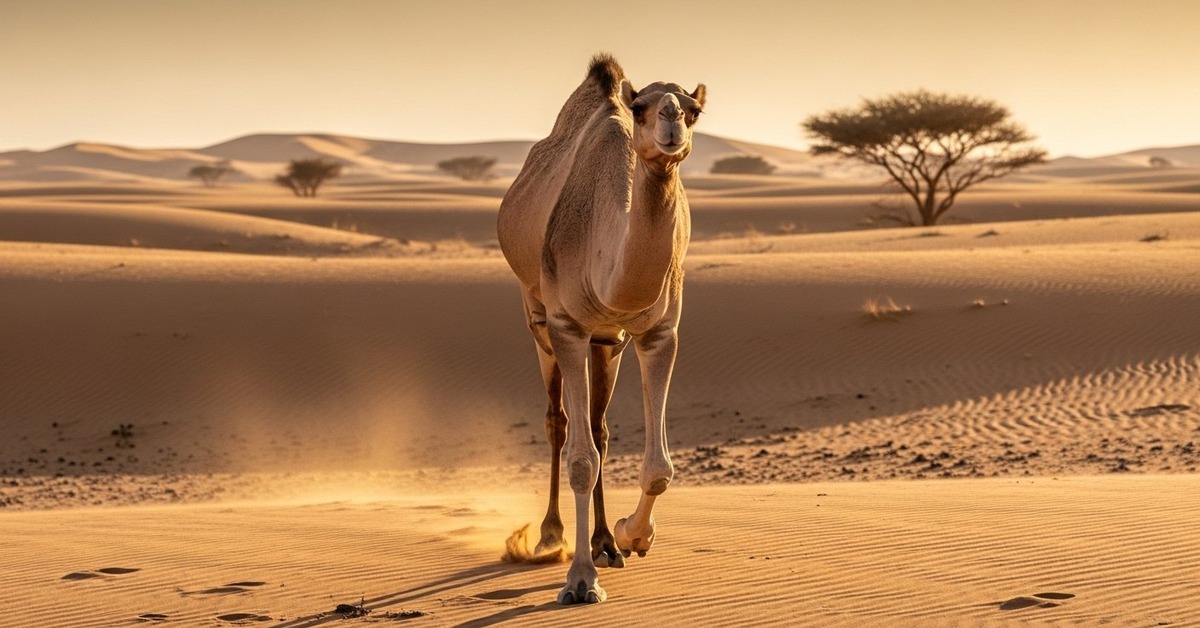
In a camel, the oval cells simply stretch. They accommodate the flood, absorb the pressure, and return to baseline as the body stabilizes. No burst cells. No organ failure. Just a quiet, cellular reset that takes hours rather than days. From the outside, unremarkable. From the inside, extraordinary engineering.
Desert Survival Is a System, Not a Trick
What makes the dehydration tolerance doubly interesting is that the camel doesn’t store water in its hump — and that persistent myth is worth retiring once and for all. The hump stores fat, an energy reserve, not liquid. The water tolerance comes from blood, tissue, and cellular architecture working in concert. Camels can lose up to 25% of their total body water and survive; humans begin experiencing severe impairment at around 8% loss and face death well before 15%. The camel’s tolerance operates in a category that most mammalian physiology simply doesn’t reach. The same principle — anatomy reshaped by environmental pressure — shows up across desert species. The antelope jackrabbit’s enormous ears serve as heat-dissipating radiators, another example of a single feature that looks simple but encodes a sophisticated thermal management strategy.
It would be tempting to treat camel oval blood cells as the whole story. They’re not.
The camel’s nose adds another layer. When a sandstorm hits — and in the Sahara, storms can carry 50-mile-per-hour winds loaded with abrasive silica — the camel closes its nostrils completely. Two muscular slits seal tight. Breathing continues through a tortuous nasal passage that filters particles and recovers moisture from exhaled air, dramatically reducing respiratory water loss. Knut Schmidt-Nielsen, who spent years studying desert animal physiology at Duke University, documented in 1984 that a camel’s nasal countercurrent heat exchange system could recover up to 70% of the moisture that would otherwise be lost with each breath. Continuously, across multi-day journeys, in ambient temperatures that can exceed 49°C (120°F) — the numbers are staggering.
Field observers working in northern Chad have noted something else: camels don’t sweat heavily until their core body temperature exceeds 41°C. They let their body temperature rise during the day — storing heat like a thermal mass — then radiate it out overnight, cutting water loss significantly. The desert doesn’t defeat the camel. The camel uses the desert’s own rhythms against it.
Three Thousand Years of Civilizational Backbone
Why does this matter beyond biology? Because without these cells, the ancient world’s trade network simply doesn’t exist in the form we know it.
Domesticated somewhere in the Arabian Peninsula roughly 3,000 years ago — possibly earlier — Camelus dromedarius became the foundational transport technology of the spice and salt trade routes connecting sub-Saharan Africa to the Mediterranean and the Indian subcontinent to the Persian Gulf. Empires didn’t just use camels. They were structured around them. The Nabataean Kingdom, whose capital Petra is now one of Jordan’s most visited archaeological sites, built its extraordinary wealth almost entirely on controlling the camel caravan routes through the Negev and Hejaz deserts. A single caravan could move hundreds of animals, and the cumulative economic power of that network — spices, silk, incense, salt — reshaped the ancient world’s trade geography in ways historians are still documenting. None of it would have been possible without a blood cell shaped like an oval.
That’s not hyperbole. Camel oval blood cells gave these animals range and resilience that no other domesticated animal could match. Horses required water too frequently for long desert crossings. Oxen were even more dependent on reliable grazing. Civilizations moved into geographical spaces that would otherwise have been impenetrable barriers, because they had an animal that could cross them. The Silk Road is often described as a triumph of human ambition. It was also a triumph of camelid biology. And when we eventually replaced camels with trucks, trains, and cargo planes, we never replaced their sandstorm response — military logistics planners in North Africa during World War II discovered this the hard way, when mechanized transport failed in conditions that working camels handled routinely.
An adaptation this consequential, ignored at the cellular level for most of recorded history: that’s not a footnote. That’s a verdict on how little we’ve paid attention.
What Camel Oval Blood Cells Tell Modern Science
Research into camel physiology has accelerated meaningfully in the 21st century, driven partly by climate science and partly by biomedical interest in extreme cellular resilience. A 2012 study from King Abdulaziz University in Jeddah, Saudi Arabia, examined the structural mechanics of camel erythrocytes under osmotic stress and confirmed that the oval shape — specifically the elongated membrane and the flexible cytoskeletal architecture beneath it — allows for deformation rates that round cells simply can’t achieve without lysing. More surface area relative to volume means the cell can absorb expansion without the membrane reaching its elastic limit (researchers actually call this the surface-area-to-volume ratio advantage, and it’s the geometric key to the whole system). It’s the same principle that lets a balloon stretch further when it starts with more rubber relative to its interior space.
That mechanical insight has attracted attention from biomedical engineers studying red blood cell disorders in humans. Conditions like hereditary spherocytosis — where abnormally round, rigid red blood cells rupture too easily — affect millions of people globally. Understanding exactly how a camel’s oval cell maintains membrane flexibility under extreme osmotic load could inform new treatment approaches. The camel isn’t a direct model for human medicine, but it’s a proof of concept: a cellular architecture that solves the fragility problem in a way that evolution arrived at millions of years before human researchers started asking the question.
Researchers at the International Livestock Research Institute (ILRI), based in Nairobi, have flagged camel physiology research as increasingly urgent given climate projections. As arid zones expand across East Africa and the Sahel, understanding the biological strategies that allow camels to thrive may prove directly relevant to food security and pastoralist livelihoods.
The Biology We Haven’t Learned to Ask About Yet
Camel antibodies — smaller and structurally simpler than human antibodies — have already entered clinical research pipelines, with pharmaceutical companies including Ablynx (acquired by Sanofi) developing nanobody therapeutics derived from camelid immune proteins. The blood cell story is one chapter in a much longer catalogue of biological solutions this animal is quietly carrying. Each solution was forged in the same crucible: the Sahara, the Arabian Peninsula, the Gobi, the Atacama. The camel’s oval blood cell didn’t evolve to be useful to humans — it evolved because the desert is merciless and survival requires specificity. But every time researchers dig deeper into camelid biology, they surface something that reframes a problem we thought we understood.
But consider what we’ve already found in one animal: elliptical erythrocytes that survive osmotic floods, nasal passages that recover moisture with near-industrial efficiency, a thermoregulation strategy that uses ambient heat as a storage medium, humps that convert fat to metabolic water, and an immune architecture that’s now influencing cancer drug design. That’s not a list of tricks. That’s a blueprint. The question isn’t whether we’ve learned everything the camel has to teach. It’s whether we’re looking carefully enough at the other organisms we haven’t studied yet — the ones sitting in equally extreme environments, solving problems we haven’t figured out how to ask.
Stand near a camel caravan in northern Mali at dawn, before the heat rises. Watch the animals move. There’s a slowness to them that reads as patience, but it’s actually precision — the gait, the breathing rate, the way they angle their bodies to the sun, all of it calibrated, nothing wasted. The desert is teaching, if we’re paying attention.
Where to See This
- Merzouga, Morocco — the Erg Chebbi dunes near this small town offer direct access to working dromedary populations; October through March gives you manageable temperatures and traditional camel routes still in active use by local Berber guides.
- ILRI in Nairobi, Kenya — ilri.org — conducts ongoing research into camelid physiology, pastoral adaptation, and food security across arid zones of East Africa and the Horn; field reports are freely available online.
- Knut Schmidt-Nielsen’s Desert Animals: Physiological Problems of Heat and Water (Oxford University Press) remains the foundational text on camel physiology — available through most university libraries and academic booksellers.
By the Numbers
- Up to 240%: the volume increase a camel’s oval red blood cell can sustain without rupturing, compared to approximately 150% for a human erythrocyte before lysis (University of Khartoum camelid physiology literature, 2008).
- 113 litres (30 gallons): the amount of water a dehydrated dromedary can drink in approximately 13 minutes without ill effect.
- 25%: the body water loss a camel can survive and fully recover from — versus roughly 12–15% for humans before fatal organ failure.
- 70%: the proportion of exhaled moisture a camel can recover through its nasal countercurrent exchange system (Knut Schmidt-Nielsen, Duke University, 1984).
- 3,000+ years: the confirmed span of camelid domestication and use on trans-Saharan and Arabian trade routes, based on archaeological evidence from the Arabian Peninsula.
Field Notes
- Researchers at the King Abdulaziz University lab in Jeddah (2012) found that camel erythrocytes maintain membrane integrity even after being placed in extremely hypotonic solutions that would destroy human red blood cells within seconds — the cells expanded, then returned to near-normal shape when moved back to isotonic conditions, a recovery behavior not previously documented in mammalian cells with such clarity.
- A fully loaded camel hump can weigh up to 35 kg (77 lbs) and shrinks visibly during long journeys without food — it stores fat, which metabolizes into both energy and a small amount of metabolic water, not liquid reserve.
- Camelid antibodies — including those from llamas and alpacas — include single-domain antibodies (nanobodies) roughly one-tenth the size of human antibodies; they can access molecular targets that conventional antibodies can’t reach, a property now actively exploited in cancer immunotherapy research.
- Researchers still don’t fully understand the precise cellular signaling that allows a camel’s red blood cell to stop expanding at the right moment — the elastic limit of the membrane is measurable, but the regulatory mechanism that prevents overextension in vivo remains incompletely characterized, with no equivalent control system identified in other mammalian erythrocytes.
Frequently Asked Questions
Q: Why are camel oval blood cells different from other mammals’ round blood cells?
Camel oval blood cells are elliptical rather than the biconcave disc shape found in most mammals. This shape evolved over millions of years under desert pressure, allowing the cells to expand dramatically — up to 240% of their normal volume — without rupturing when a camel rapidly rehydrates after dehydration. The structural difference lies in both the cell membrane’s higher surface-area-to-volume ratio and the flexible cytoskeletal proteins beneath it. No other large domesticated mammal has this adaptation.
Q: Do camels actually store water in their humps?
No — this is one of biology’s most persistent myths. The hump stores fat, not water. That fat serves as an energy reserve and can metabolize into a modest amount of metabolic water, but it isn’t the primary mechanism for water tolerance. The camel’s actual water management comes from its oval red blood cells, its moisture-recovering nasal passages, its ability to raise core body temperature without sweating, and its tolerance for extreme dehydration — all working as an integrated system rather than a single storage reservoir.
Q: Can camel blood cell research actually help human medicine?
Potentially, yes — though the path is indirect. Conditions like hereditary spherocytosis cause human red blood cells to be abnormally round and fragile, leading to hemolytic anemia. Understanding the precise membrane architecture that allows camel oval blood cells to survive osmotic extremes may offer clues for therapeutic intervention. More immediately, camelid antibody research — particularly nanobody technology derived from the same family of animals — is already in clinical pipelines for cancer and inflammatory disease treatments, with several candidates in active trials as of 2024.
Editor’s Take — Alex Morgan
What stops me here isn’t the oval shape itself — it’s the timeline. We domesticated this animal 3,000 years ago. Civilizations rose on its back. And we didn’t understand the cellular mechanism that made all of that possible until the late 20th century. That’s not a gap in scientific knowledge. That’s a reminder that we’ve been benefiting from biological solutions we hadn’t even identified yet — and that the same is almost certainly true of dozens of organisms we’re currently watching go extinct before we’ve asked the right questions.
The Sahara is expanding. Arid zones are widening across three continents. And somewhere in that landscape, an animal with oval blood cells is crossing terrain that breaks machines — drinking 30 gallons in 13 minutes, sealing its nose against a sandstorm, letting its body temperature rise and fall with the desert’s own rhythm. We spent 3,000 years riding this creature without fully understanding it. The biology was always there, waiting to be read. The question now is which other organisms are carrying solutions we haven’t slowed down enough to notice.
Illustrations are AI-generated. Article fact-checked and human-edited. Our editorial standards.