Comfort Women: The WWII System of Military Sexual Slavery
For nearly fifty years, up to 200,000 women — most of them Korean, Chinese, Filipino — existed in an official silence so complete that the system that held them had paperwork to prove it happened. The comfort women of World War II were absorbed into a military bureaucracy so formally documented, so administratively legitimate in its own eyes, that historians would later find health inspection schedules, pricing tiers, and transport manifests. The machinery didn’t hide. It logged.
The Imperial Japanese Army began building its network of “comfort stations” in the early 1930s, expanding aggressively through the Pacific War years until 1945. Women were recruited by force, by fraud, by desperation — some teenagers, some sold by families who had no idea what they were selling them into. The infrastructure held them in place.
And when it collapsed in August 1945, the silence that followed lasted decades.
Key Facts
- Up to 200,000 women were conscripted into the comfort station system between 1932 and 1945 (Korean Council for Justice and Remembrance)
- The first documented comfort stations were established in Shanghai in 1932 after the First Shanghai Incident
- In 1991, Korean survivor Kim Hak-soon became the first woman to publicly testify, breaking nearly five decades of silence
- Japan’s 1993 Kono Statement was the first official acknowledgment of military involvement and coercive recruitment
- By 2023, the number of registered Korean survivor-witnesses had fallen to fewer than 10
In short: This article examines the comfort women World War II system, a network of military sexual slavery that conscripted up to 200,000 women between 1932 and 1945. It traces the documented bureaucracy, the decades of silence broken by Kim Hak-soon in 1991, and the unresolved reckoning over Japan’s accountability.
How Japan Built Its Military Sexual Slavery System
Historians trace the formal establishment of the first comfort stations to Shanghai in 1932, following the First Shanghai Incident. Japanese military commanders decided that controlling soldiers’ sexual behavior would reduce civilian rape — which was generating international condemnation. The logic was clinical. The application was criminal.
According to research published by the comfort women historical record compiled extensively over decades, stations spread across every major theater of Japanese military operations: China, the Philippines, Burma, the Dutch East Indies, Malaya, and the Pacific Islands. By full-scale war, the network numbered in the hundreds of facilities. The military issued passes. It set prices. It scheduled visiting hours. It mandated health inspections — not to protect women, but to protect soldiers from venereal disease.
Orders exist. Supply manifests exist. Internal military memos referencing the recruitment, transport, and management of ianfu exist. What makes denial so historically untenable is that all of it was logged by the people administering it.
Yoshiaki Yoshimi, a historian at Chuo University in Tokyo, spent years in the 1990s excavating these documents from Japan’s National Institute for Defense Studies — records that the institution had not publicized. When Yoshimi published his findings in 1992, they ignited a political and diplomatic crisis that has not fully resolved in the thirty years since. The stations weren’t underground operations. They were administered. That’s the detail that never stops being jarring — these weren’t crimes committed in shadows.
Recruitment, Deception, and the Geography of Coercion
Korea was under Japanese colonial occupation from 1910 to 1945, which gave Japanese military and civilian recruiters extraordinary structural access to Korean women and girls. Historians estimate that Koreans constituted the largest single national group among comfort women World War II victims — some estimates place the proportion as high as 80 percent of the total, though figures vary across scholarly sources and are contested politically.
Why does the method matter when the outcome was identical? Because it reveals how systematically the recruitment was engineered. Some women were taken by direct force. Others were deceived — told they’d be working in factories, hospitals, or restaurants near the front. Families in poverty were sometimes paid small sums framed as employment advances. Women arrived at stations in foreign countries, often unable to speak the local language, with no legal standing, no recourse, and no way home. It’s a story of engineered helplessness.
The physical infrastructure of occupation — the railways, the troop transport routes, the administrative networks — functioned in much the same way across all occupied territories. Systems built to control populations were repurposed to move women. The machinery of empire became the machinery of exploitation.
Chinese women were targeted differently. In mainland China and in occupied territories like Manchuria, military raids on villages resulted in direct abduction. In the Philippines, women were seized during Japanese military operations. In the Dutch East Indies, there are documented cases of European women — Dutch nationals — being taken from internment camps and forced into stations, a fact that generated specific postwar legal proceedings in ways that the experiences of Asian victims, shamefully, often did not. This parallel between physical infrastructure and systems of control isn’t unlike how we examine other wartime constructions — the ways built environments encode power, like the contested histories embedded in monuments and public spaces across the world, examined in stories like the fraught politics of public memorials and the objects communities choose to preserve or destroy.
Women who resisted faced violence. Women who complied faced the same violence, daily.
The Long Silence After 1945
When Japan surrendered in August 1945, the comfort station system was dismantled — quickly and, in many cases, deliberately obscured. Some women were abandoned at remote outposts. Some were killed. Many found their way home only to discover that the stigma of what had happened to them made return nearly impossible.
In Korean and Chinese cultures of the mid-twentieth century, sexual violence carried shame that was placed on the victim rather than the perpetrator. Survivors mostly did not speak. They buried what had happened and lived with it privately for decades. It wasn’t until 1991 that Kim Hak-soon, a Korean survivor, became the first woman to publicly identify herself as a former comfort woman — breaking nearly five decades of institutional silence. The Smithsonian Magazine has documented the decades-long silence and the eventual emergence of survivor testimony.
That single act of courage opened a door.
Within months, other survivors came forward in Korea, China, the Philippines, and the Netherlands. The weight of decades compressed into a sudden, undeniable accounting. Comfort women World War II survivors who testified faced immediate political resistance. Japan’s government acknowledged a version of responsibility in the 1993 Kono Statement, issued by Chief Cabinet Secretary Yohei Kono, which admitted that the military had been involved in the establishment and management of comfort stations and that recruitment had often been conducted against women’s will. But acknowledgment and accountability moved at different speeds. Subsequent Japanese governments have repeatedly revisited, qualified, or walked back aspects of that statement, creating a cycle of diplomatic rupture — particularly with South Korea — that continues to define East Asian geopolitics today. The silence that followed 1945 wasn’t just personal. It was political. It was structural.
Comfort Women World War II: The Unresolved Reckoning
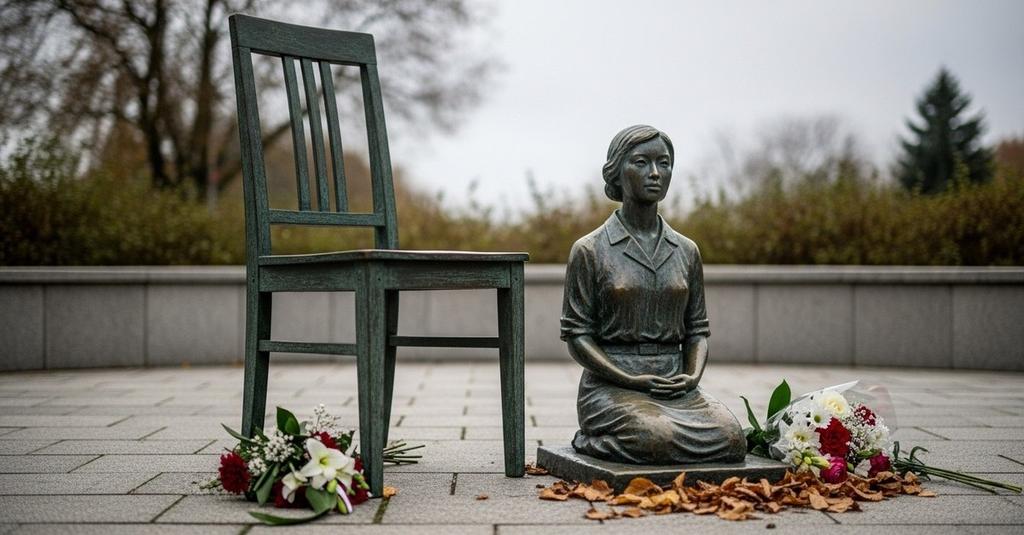
In 2011, a bronze statue of a young girl in traditional Korean dress was installed across the street from the Japanese Embassy in Seoul. She sits in a chair, barefoot, hands in her fists on her lap. Her gaze is level. The statue — created by sculptors Kim Seo-kyung and Kim Eun-sung — became one of the most politically charged objects in Asia. Japan repeatedly demanded its removal. South Korea refused. Replicas have since appeared in cities across South Korea, in the United States, Canada, Australia, and Germany.
Here’s the thing: the statue is not a memorial for the dead. It’s a demand addressed to the living. Research by the Korean Council for Justice and Remembrance, established in 1990 specifically to advocate for survivors, has documented the individual testimonies of hundreds of women, creating an archive that functions simultaneously as historical evidence and as ongoing legal argument. As of 2023, the number of registered surviving Korean comfort women had fallen to single digits. The last witnesses to the system’s operation are dying. What remains is documentation, testimony, and a dispute about what acknowledgment actually requires.
The 2015 bilateral agreement between Japan and South Korea, brokered partly through U.S. diplomatic pressure, established a one-billion-yen fund for surviving victims and was declared “final and irreversible” by both governments. Many survivors rejected it. The Korean Council rejected it. Critics argued that it prioritized diplomatic normalization over justice — that it asked survivors to accept money and silence in exchange for a settlement they had never requested. Watching a reckoning shrink into a transaction, you understand what survivors had already learned: acknowledgment without accountability is just another form of dismissal.
Numbers matter here. At the peak of recorded survivor advocacy in the early 2000s, thousands of women across Asia had given formal testimony. Each one is a specific name, a specific village, a specific sequence of events. The system that took them is documented. The gap between documentation and accountability is, at this point, entirely a political choice.
Memory, Law, and What Justice Actually Looks Like
The legal history of comfort women World War II cases reveals a particular frustration: the evidence was never really the obstacle. The 1948 Batavia (Jakarta) war crimes tribunal convicted Japanese officers specifically for the forced prostitution of Dutch women in the Dutch East Indies — establishing early precedent that this conduct constituted a war crime. But that precedent was applied narrowly, to European victims, and was not extended to the vastly larger group of Asian survivors during the broader Tokyo war crimes trials. Scholars at Harvard Law School and the International Commission of Jurists have since argued that the failure to prosecute comfort station crimes against Korean, Chinese, Filipino, and other Asian women constituted a structural blind spot in postwar justice — one shaped by Cold War politics, by the U.S. decision to prioritize Japanese stability over full accountability, and by the devaluation of Asian victims’ experiences relative to European ones.
In 2021, a Seoul district court initially ruled that Japan must pay compensation to twelve surviving Korean plaintiffs — a decision Japan rejected on the grounds of sovereign immunity. A different Seoul court later dismissed a separate case on the same grounds. Each ruling generates headlines and then stalemate. Survivors who began testifying in their sixties and seventies have waited through thirty years of legal proceedings without resolution. The legal pathways remain contested, contradictory, and exhausting.
Researchers at Korea University’s Institute for Peace and Unification Studies have argued that the question of justice can’t be answered by legal mechanisms alone — that cultural acknowledgment, educational curriculum, and official state apology have to function together for any settlement to carry moral weight. The statues are still being installed. The hearings are still being held. The answer is still outstanding.
How It Unfolded
- 1932 — Japan establishes its first documented comfort stations in Shanghai following the First Shanghai Incident, with military commanders framing the system as a way to manage soldier behavior.
- 1945 — Japan’s surrender triggers the rapid dismantling of the comfort station network; many survivors are abandoned, killed, or left stranded across Asia and the Pacific with no repatriation support.
- 1991 — Korean survivor Kim Hak-soon becomes the first woman to publicly testify about her experience, breaking nearly five decades of institutional silence and prompting hundreds of other survivors to come forward.
- 2023 — The number of officially registered Korean comfort women survivors falls to single digits, making archival testimony and documentary evidence the primary remaining record of the system’s operation.
By the Numbers
- Up to 200,000 — the estimated total number of women conscripted into the comfort station system, across all occupied territories, 1932–1945 (Korean Council for Justice and Remembrance).
- Hundreds of stations — the documented scale of comfort station infrastructure across China, Korea, the Philippines, Burma, Malaya, the Dutch East Indies, and Pacific Island territories.
- 1993 — the year Japan’s Kono Statement was issued, representing the first official government acknowledgment that military involvement and coercive recruitment had occurred.
- 1 billion yen — the amount allocated by the 2015 Japan-South Korea bilateral agreement for surviving victims, rejected by many survivors and advocacy groups as inadequate.
- Fewer than 10 — the number of registered Korean survivor-witnesses still living as of 2023, making real-time testimony increasingly impossible to gather.
Field Notes
- In 1992, historian Yoshiaki Yoshimi of Chuo University found documents in Japan’s National Institute for Defense Studies that directly linked Imperial Army headquarters to the establishment and operation of comfort stations — a discovery that forced an official response from the Japanese government within days of publication.
- The “comfort women” statues installed globally are deliberately designed without pedestals — the seated girl sits at eye level with any standing viewer, a specific sculptural choice intended to prevent the memorial from becoming abstract or elevated rather than confrontational.
- Dutch women taken from internment camps in the Dutch East Indies were the subject of specific war crimes convictions at Batavia in 1948 — yet the far larger group of Korean and other Asian victims was not given comparable legal recognition in the same postwar period.
- Researchers still cannot establish a precise total count of comfort stations that operated across all theaters, because Japan’s military destroyed significant documentation in the final days of the war — leaving gaps in the record that complicate legal proceedings and are sometimes exploited to cast doubt on the broader historical account.
Frequently Asked Questions
Q: What does the term “comfort women World War II” actually mean, and where did the name come from?
The term derives from the Japanese word ianfu, a bureaucratic euphemism used by the Imperial Japanese Army. Ianfu translates roughly as “comfort woman” or “woman of solace.” The name was chosen by the military administration to sanitize what was, in practice, a system of forced sexual slavery. Historians and survivors’ advocates have consistently argued that the clinical language was itself a tool of concealment, designed to make the system legible as administration rather than crime.
Q: Why did Japan’s government take so long to acknowledge what happened?
Acknowledgment was delayed by a combination of factors: postwar political priorities that prioritized Japanese stability during the Cold War, the stigma that kept survivors silent for decades, the destruction of documents by the Japanese military in 1945, and sustained political pressure from nationalist factions within Japan who disputed the scale and nature of coercion. The 1993 Kono Statement represented the first significant official acknowledgment, but subsequent governments repeatedly qualified or walked back its implications, making the acknowledgment feel conditional rather than settled.
Q: Is the historical record of the comfort women system actually disputed by credible historians?
No. The existence of the comfort station system, its military administration, and the coercive recruitment of women are documented by the Japanese military’s own records, survivor testimony from multiple countries, and postwar legal proceedings. What remains contested — primarily in Japanese domestic politics — is the precise degree of official military direction versus civilian contractor involvement, and the proportion of women who were directly forced versus deceived. These distinctions matter legally but don’t alter the fundamental historical account. The scholarly consensus, including among Japanese historians, is unambiguous about what the system was.
Editor’s Take — Sarah Blake
The thing that stays with me isn’t the scale, though the scale is staggering. It’s the paperwork. Health inspection schedules. Pricing tiers. Transport manifests. This was a system so confident in its own legitimacy that it generated administrative records. That confidence — the certainty that no one would ever hold it to account — is what made the survivors’ eventual testimony so threatening. They weren’t uncovering a secret. They were simply refusing to keep one that powerful people had decided was kept.
The last registered Korean survivors are in their nineties. When they’re gone, what remains is documentation, statues, and a diplomatic dispute that governments have spent thirty years trying to declare resolved without ever making it right. The comfort women of World War II were given a bureaucratic name that obscured what was done to them. They’ve spent the decades since insisting on a different vocabulary — one that doesn’t soften the noun. What we do with that insistence, now that the witnesses are almost gone, is not a historical question. It’s a present one.
“
Illustrations are AI-generated. Article fact-checked and human-edited. Our editorial standards.