Born Gripping: The Newborn Monkey Reflex That Defies Gravity
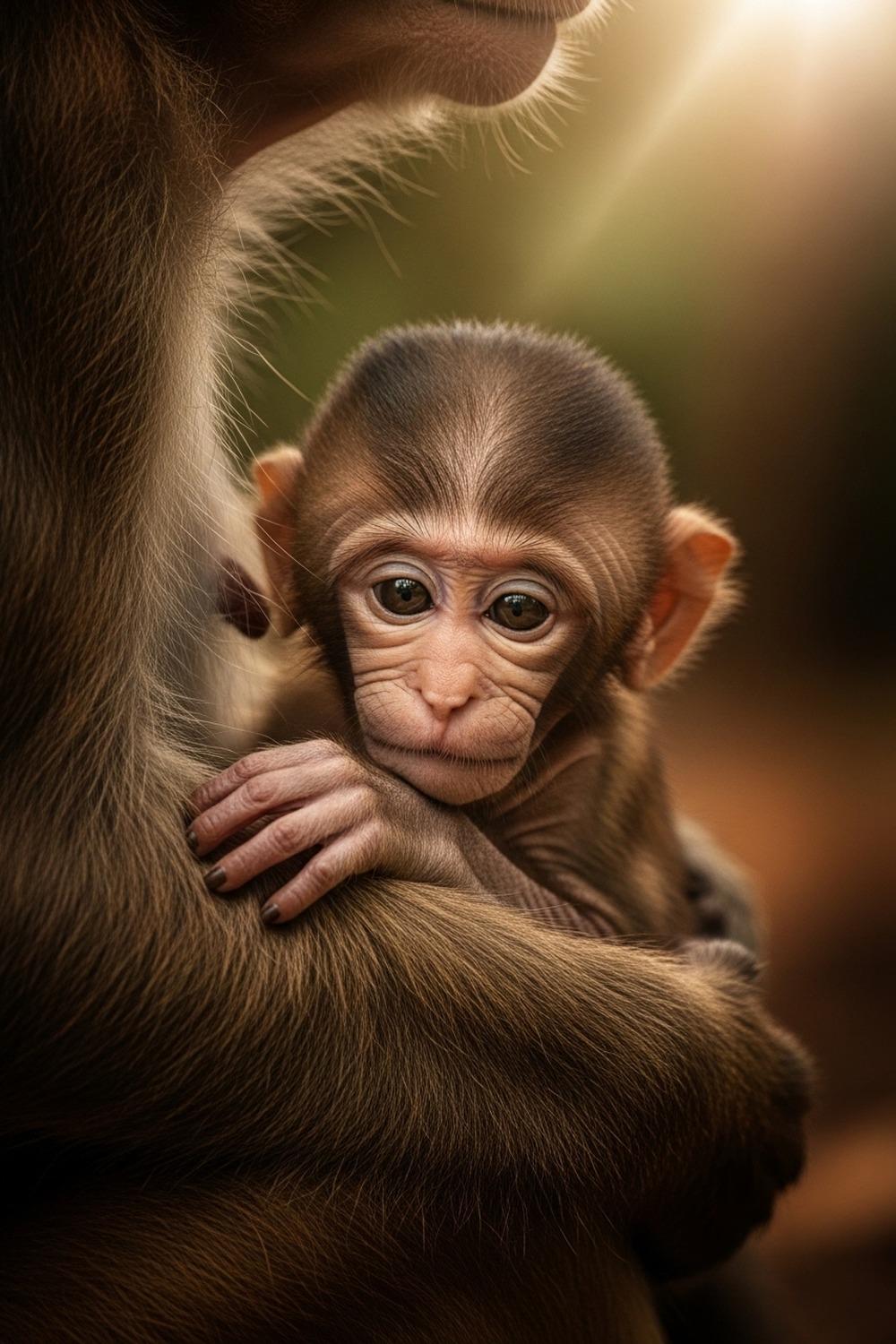
Within fifteen minutes of birth, a newborn monkey’s fingers lock down with force that can suspend its entire body weight from a single handhold. Before it sees. Before it thinks. Before it even knows what fur is. The palmar grasp reflex arrives pre-loaded, non-negotiable, and utterly essential — because in the rainforest canopy, there are no second chances, and a mother cannot slow down for a grip that isn’t already there.
That grip is evolution’s first line of defence. Not against falling — against the reality that falling is always one instant away. A macaque mother doesn’t cradle her newborn. She runs. She leaps. She moves through a vertical world at speeds that would terrify ground-dwelling animals. The infant has one job: hold on. Understanding what that reflex actually is, how it fires, and why it persists even in humans who haven’t lived in trees for hundreds of thousands of years opens a door into one of the longest-running experiments in primate biology.
Key Facts
- The palmar grasp reflex is fully operational in rhesus macaque newborns within 15 minutes of birth, strong enough to support the infant’s full body weight
- The reflex arc travels through the spinal cord and lower brainstem rather than the cortex, so conscious thought plays no role
- A capuchin monkey infant weighs approximately 400 grams at birth, and its survival depends on grip strength from minute one
- A 2019 University of Chicago study analyzed grip-strength data across 14 primate species, linking neonatal reflex intensity to adult arboreality
- The oldest confirmed primate fossils date to approximately 55 to 56 million years ago, and the human reflex fades by 3 to 4 months as cortical control develops
In short: Within 15 minutes of birth, a newborn monkey palmar grasp reflex locks its fingers with force enough to suspend its whole body weight. Mediated through the spinal cord and brainstem, this involuntary grip lets infants cling to mothers moving through the canopy. Humans retain a faded version that vanishes by 3 to 4 months.
The Reflex That Fires Before Thought
Touch the palm of a newborn monkey and the fingers curl inward with immediate, involuntary force. The palmar grasp reflex is one of the most studied involuntary responses in primate neonatal biology — and one of the least appreciated outside specialist circles. This isn’t a twitch. This isn’t a gentle closing. Research conducted at the German Primate Center (Deutsches Primatenzentrum) in Göttingen, published across the 2000s and 2010s, helped map the neuromuscular specifics of this response across multiple species, confirming that reflex strength peaks in the first hours of life and begins to moderate — though not disappear — over the following weeks. In rhesus macaques, the grip force recorded in newborns has been measured at levels sufficient to support the animal’s full body weight for sustained periods.
What happens inside the nervous system is even more remarkable than the grip itself. The reflex arc travels through the spinal cord and lower brainstem rather than the cortex, which means conscious thought plays no role whatsoever. It fires before the infant has any awareness that it’s firing. The signal travels down, the fingers close, and the animal is suspended — all before cognition enters the picture.
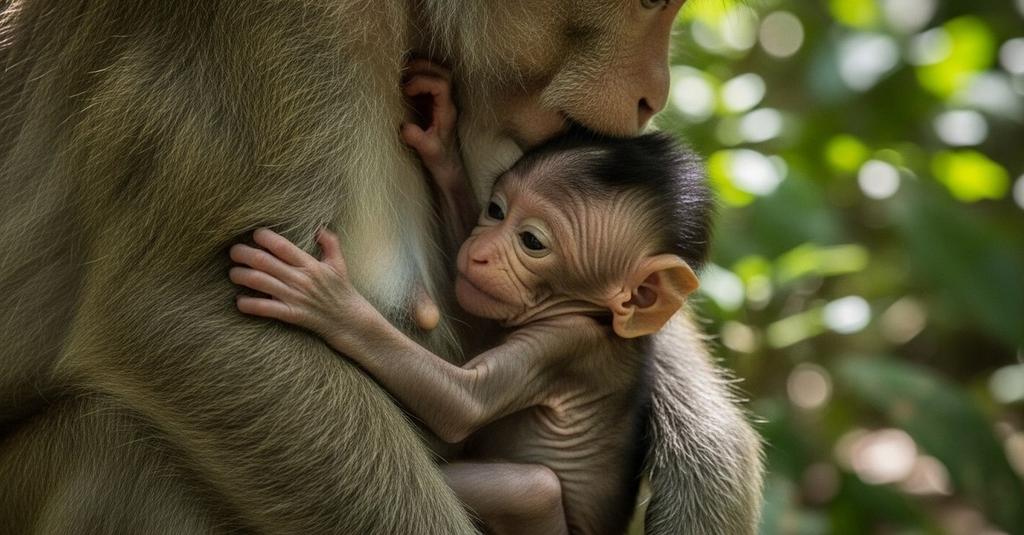
Across dozens of primate species, from spider monkeys in the Amazon basin to olive baboons on the East African savanna, the grip is operational within the first hour of life. Sometimes within the first fifteen minutes. The infant hasn’t eaten. Hasn’t slept. Is still coated in birth fluids. And yet those fingers are already locked. The nervous system has been building toward this single moment for the entire gestational period. Everything else can wait. The grip cannot.
Field researchers working in Borneo and Sulawesi have documented something that stops you mid-sentence when you first read it: newborn macaques clinging to their mothers through full-speed arboreal travel within the first day of life. The mother doesn’t slow. The mother doesn’t cradle. She runs, and the infant holds.
Why the Canopy Demands This
To understand why the palmar grasp reflex evolved with such ferocity in primates, you have to spend some time thinking about the canopy as a living environment. It’s vertical. It’s discontinuous. It moves constantly. A forest giant sways in wind. A branch that holds a 12-kilogram adult might flex alarmingly when she leaps to the next one. For an infant — weighing perhaps 400 grams at birth in a smaller species like the capuchin — the physics of that world are unforgiving. There’s no flat surface. No stable ground. No margin for a loose grip. The canopy selects hard for solutions. Soft solutions don’t survive.
And here’s the thing: the grip isn’t just palmar. In most primate species, the feet carry an equivalent reflex — the plantar grasp reflex — firing simultaneously, giving the newborn four contact points rather than two. A newborn spider monkey effectively has four hands, all clamping down at once. Studies tracking infant mortality in free-ranging primate groups have identified grip failure as a leading cause of early neonatal death. Infants that lose hold during maternal movement in the first week rarely survive the fall. In some long-term field studies of baboon populations in the Amboseli basin in Kenya, neonatal falls accounted for a measurable fraction of first-week mortality events logged between the 1980s and 2000s.
Why does this matter beyond mere survival statistics? Because watching a species solve an engineering problem this completely, this efficiently, at the moment of birth — you stop calling it instinct and start calling it what it is: evidence that the environment and the biology have been negotiating for millions of years.
The grip also regulates contact. Skin-to-skin warmth between mother and infant is critical for thermoregulation in newborns, which can’t yet maintain their own body temperature efficiently. By clinging, the infant isn’t just avoiding a fall. It’s staying warm. The grip is simultaneously a seatbelt, a heater, and a feeding position.
The Human Ghost of an Ancient Pattern
Place your finger against a newborn baby’s palm and the fingers close around it with surprising firmness. Human newborns have the palmar grasp reflex too — documented clinically since at least the early 20th century, and which paediatricians use today as one of several neurological markers in standard neonatal assessments. What’s striking is that human infants can sometimes support a portion of their body weight this way, if carefully tested. The reflex is real, functional, and present at birth. It just fades. By three to four months, the cortex begins to override it, voluntary hand movements develop, and the ancient automatic grip retreats. A Smithsonian Magazine feature on infant reflexes noted that this fade-out is actually a sign of healthy neurological development — the higher brain maturing enough to take conscious control of the hand. But the substrate is still there. The wiring hasn’t been removed. It’s been overwritten.
In biological terms, the newborn monkey palmar grasp reflex, in its human form, is what researchers call a vestigial reflex — a behaviour pattern retained from an ancestral condition that no longer serves its original function. We don’t live in the canopy. Our infants aren’t carried through the trees. A human mother doesn’t sprint through the forest while her newborn grips her chest fur. We lost our fur several hundred thousand years ago and replaced the canopy with the ground. But the reflex predates all of that. It predates language, fire, and clothing. It may predate the genus Homo entirely.
Neurologists find it clinically useful precisely because it shouldn’t be there past a certain age. If the palmar grasp reflex persists in a human infant beyond five or six months, it can indicate neurological delay or frontal lobe issues. A reflex that began as a survival tool has become a diagnostic marker. That’s a remarkable second life for a 60-million-year-old behaviour.
What Evolution Built Into a Single Moment
The oldest confirmed primate fossils date to approximately 55-56 million years ago, with animals like Plesiadapis already showing skeletal traits suggesting an arboreal lifestyle. The grasp reflex, researchers believe, predates even those earliest primates — rooted in the same selective pressure that drove the development of grasping hands and forward-facing eyes in the first place. A 2019 study from the University of Chicago’s Committee on Evolutionary Biology examined grip-strength data across 14 primate species and found a clean, predictive line: the higher the canopy dependence, the fiercer the grip at birth. Highly arboreal species — those spending more than 80 percent of their time in the canopy — showed measurably stronger grip reflexes in infants than species spending significant time on the ground.
What that research revealed is how precisely calibrated the reflex is to the actual physics of infant transport. Species whose females move fast through the canopy have produced infants with stronger reflexes. This isn’t learned. It isn’t trained. It’s encoded. The infant arrives already matched to its mother’s movement pattern, shaped by millions of years of selection pressure that punished every newborn whose grip was just slightly too weak. The margin was always survival versus a fall, and evolution does not tolerate loose margins over geological time.
Grip-reflex data now serves as a tool for assessing phylogenetic distance between primate lineages — a behavioural marker that sits alongside genetic and morphological evidence. Researchers use it. The reflex that looks simple, that feels instinctive, turns out to carry deep evolutionary information inside it. The newborn is a data point in a 60-million-year experiment.
How It Unfolded
- Early 1900s — Paediatricians first formally describe the palmar grasp reflex in human neonates, noting its similarity to behaviours observed in captive infant primates.
- 1959 — Harry Harlow’s contact-comfort experiments at the University of Wisconsin, studying rhesus macaque infants, draw widespread attention to the critical role of physical clinging in primate infant development and survival.
- 1990s-2000s — Long-term field studies in Amboseli, Barro Colorado Island, and Borneo begin systematically documenting neonatal fall events and grip-related mortality in free-ranging primate populations.
- 2019 — University of Chicago researchers publish cross-species grip-strength analysis linking neonatal reflex intensity to adult arboreality levels across 14 primate species, formalising what field workers had long suspected.
By the Numbers
- Within 15 minutes — documented time window in which the palmar grasp reflex is fully operational in rhesus macaque newborns after birth.
- 400g — approximate birth weight of a capuchin monkey infant, the creature whose life literally depends on grip strength from minute one.
- 14 species — the number of primate species included in the 2019 University of Chicago cross-species grip reflex analysis.
- 3-4 months — the age at which the palmar grasp reflex begins to fade in human infants as cortical control of voluntary movement develops.
- 55-56 million years — estimated age of the oldest confirmed primate fossils, suggesting the ancestral conditions that shaped the grasp reflex are at least that old.
Field Notes
- In 2003, primatologist Dario Maestripieri of the University of Chicago documented that rhesus macaque mothers in free-ranging groups rarely adjust their gait or slow their movement to accommodate newborns in the first 48 hours — the assumption baked into their behaviour is that the infant will hold on. And overwhelmingly, it does.
- The plantar grasp reflex in the feet fires simultaneously with the palmar reflex — meaning a newborn monkey effectively has four gripping surfaces active at once, dramatically multiplying contact security during maternal movement.
- Some researchers have noted that infant primates grip more strongly when stressed or startled, suggesting the reflex may be partially modulated by arousal — louder, faster movement triggers stronger grip. The infant is, in a sense, reading its environment and responding before its brain can process language or even image.
- Scientists still don’t fully understand why the grip reflex persists in human infants at all, given that we’ve been terrestrial for hundreds of thousands of years. The most likely answer is that the developmental programme is so deeply embedded that removing it entirely would create greater neurological risk than simply letting it fade on schedule — (and this matters more than it sounds) — but the data to confirm this cleanly doesn’t yet exist.
Frequently Asked Questions
Q: What exactly is the newborn monkey palmar grasp reflex, and how strong is it?
The newborn monkey palmar grasp reflex is an involuntary curling of the fingers in response to touch on the palm, present from the first minutes of life. It’s mediated through the spinal cord and brainstem rather than conscious thought. In species like rhesus macaques and capuchins, the grip is strong enough to support the infant’s full body weight suspended in open air. Researchers have documented this in laboratory and field conditions across dozens of primate species.
Q: Do human babies have the same reflex, and does it work the same way?
Human newborns do have the palmar grasp reflex — it’s one of the standard checks in neonatal neurological assessments. The mechanism is identical: touch the palm, fingers close involuntarily. The difference is in duration and function. In humans, the reflex fades by three to four months as the developing cortex begins overriding it with voluntary hand control. In non-human primates living in trees, it persists and strengthens through the critical early period when the infant must grip constantly during maternal movement.
Q: Is the palmar grasp reflex in newborns really an evolutionary leftover, or does it serve a purpose in humans today?
This is a common point of confusion. The reflex is genuinely functional in newborn humans — it isn’t a pure vestige in the sense of having zero effect. It promotes physical contact between mother and infant, supports skin-to-skin warmth, and may reinforce bonding. But it doesn’t serve its original canopy-survival function in humans, since we don’t live in trees. Its main clinical value today is actually diagnostic: if it persists past six months, it can signal neurological delay, giving an ancient survival reflex a surprising second career in modern medicine.
Editor’s Take — Alex Morgan
What stays with me about this story isn’t the grip strength or the evolutionary timeline — it’s the asymmetry of knowledge between mother and newborn. The mother runs because she has to. The infant holds on because it can’t do anything else. And somehow, across 60 million years of primate history, that deal has worked almost every time. We carry a faded copy of that same agreement in our own palms. We just forgot what we were holding on to.
The rainforest doesn’t accommodate fragility. Every feature of a newborn monkey — the curled fingers, the splayed feet, the face pressed flat against warm fur — is an answer to a question the canopy has been asking for longer than our species has existed. And in hospital wards across the world, a human infant closes its fingers around a parent’s thumb and triggers the same ancient circuit, still live, still connected to something enormous. What else do we carry inside us, firing quietly, from a world we’ve long since left behind?
Illustrations are AI-generated. Article fact-checked and human-edited. Our editorial standards.