Aphids Born Pregnant: The Russian-Doll Generations
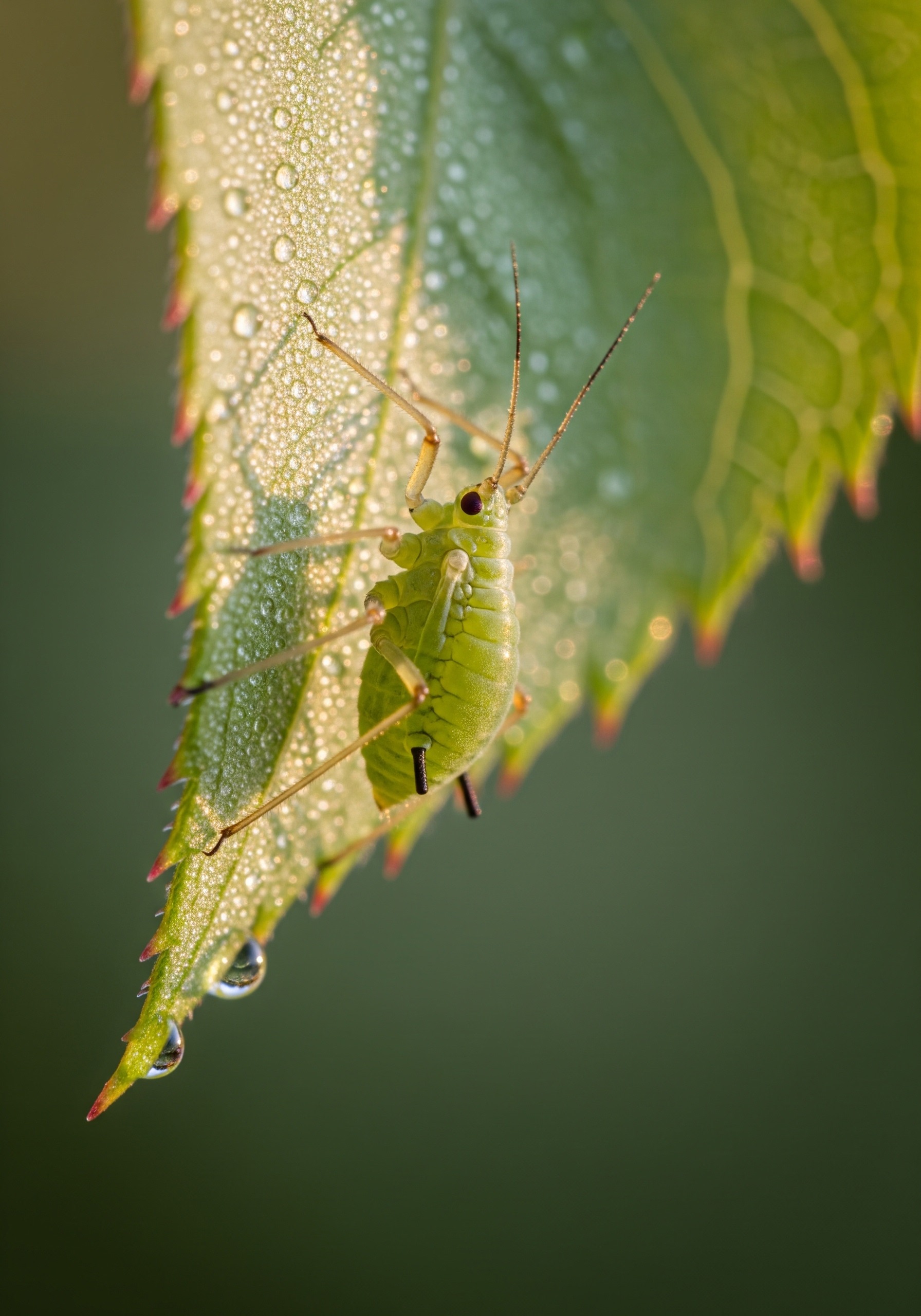
The strangest sentence in entomology is also one of the truest: aphids born pregnant is not a metaphor and not a translation quirk — it is exactly what is happening on the underside of every rose leaf this summer. A newly-emerged aphid nymph is, on the day she is born, already carrying the next generation inside her. And the daughter inside her is already carrying granddaughters.
Key Facts
- An aphid is born live, unfertilised, and already pregnant with developing embryos of the next generation.
- Three generations can coexist in one body: mother, unborn daughter, and the granddaughter’s germ cells — biologists call it “telescoping generations”.
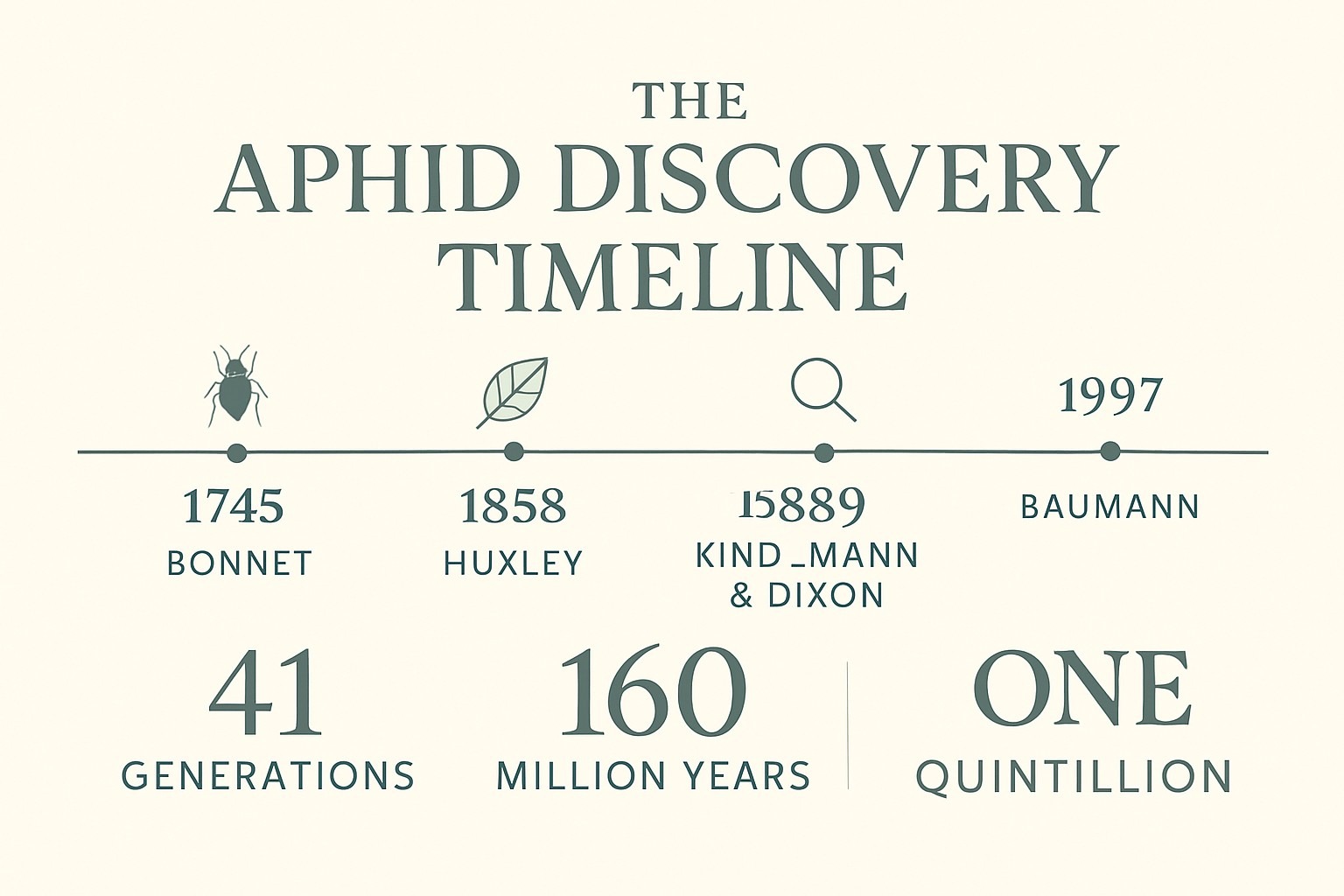
- The cabbage aphid (Brevicoryne brassicae) has been recorded at up to 41 generations in a single season — the citable maximum.
- In 1858 Thomas Henry Huxley calculated that one founding aphid’s unchecked descendants in a single summer would weigh more than 500 million adult men — a quintillion individuals.
- Every aphid carries a bacterium called Buchnera aphidicola, an inherited passenger her lineage has lived with for roughly 160 million years.
In short: Aphids skip mating for most of the year, clone themselves live and pre-loaded with the next generation, and only switch to males and eggs in autumn — when the nights get long enough to trigger the change. The result is the most explosive reproductive system in the insect world.
Key Facts
- An aphid is born live, unfertilised, and already pregnant with developing embryos of the next generation.
- Three generations can coexist in one body – mother, unborn daughter, and the granddaughter’s germ cells – a phenomenon biologists call telescoping generations.
- The cabbage aphid (Brevicoryne brassicae) has been recorded at up to 41 generations in a single season, the citable maximum.
- In 1858 Thomas Henry Huxley calculated that one founding aphid’s unchecked descendants in a single summer would weigh more than 500 million adult men, a quintillion (10^18) individuals.
- Every aphid carries a bacterium called Buchnera aphidicola, an inherited passenger its lineage has lived with for roughly 160 million years.
In short: Aphids skip mating for most of the year, cloning themselves live and pre-loaded with the next generation, and only switch to males and eggs in autumn when the nights grow long enough to trigger the change. A newborn nymph is already pregnant on the day she is born, and the daughter inside her already carries granddaughters. The result is the most explosive reproductive system in the insect world.
Aphids born pregnant: what’s actually happening
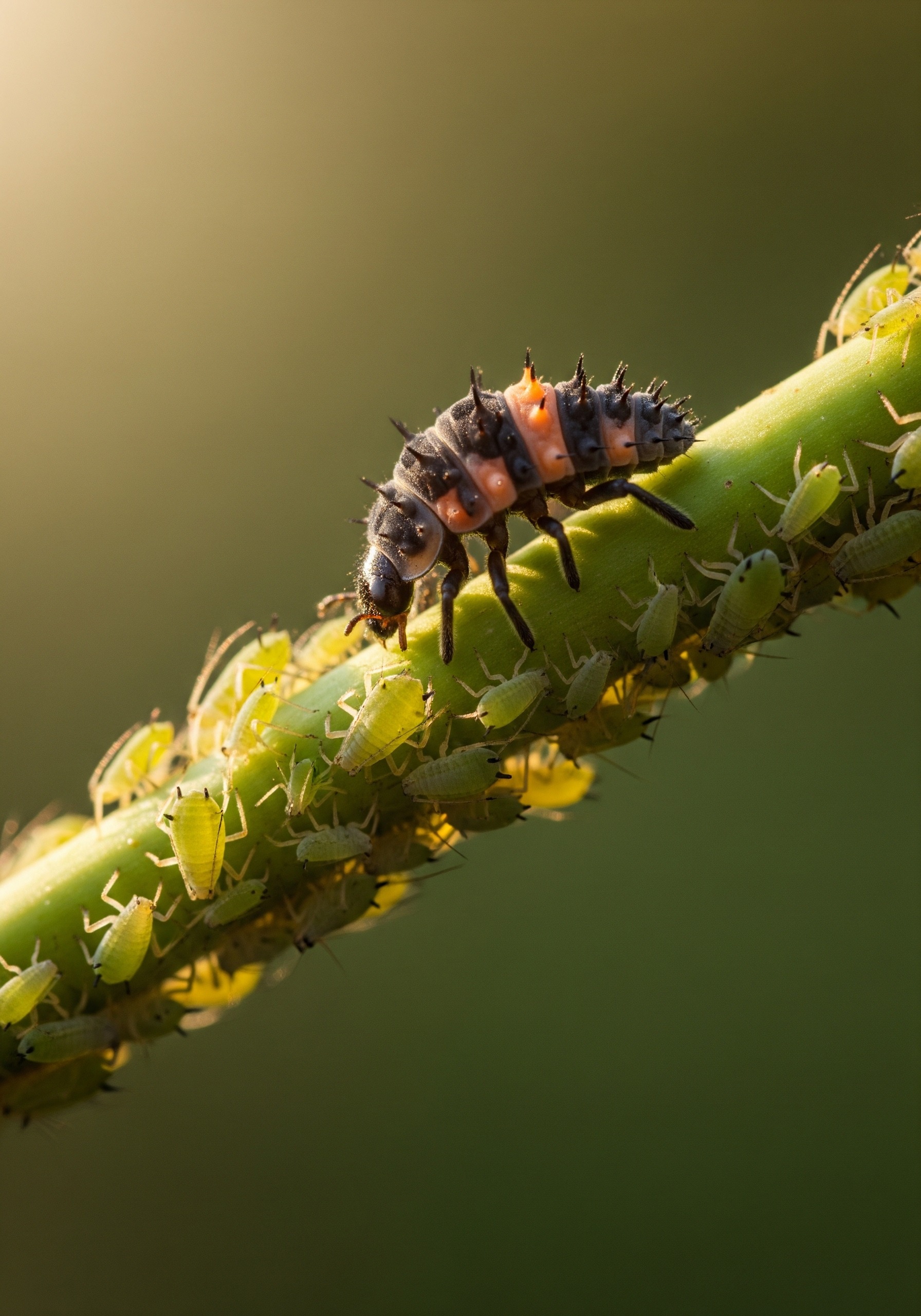
Walk up to any rose bush in late June. The new shoots near the top — the soft, pale ones — will almost certainly be carrying a colony. Lean in. The bigger aphids are giving birth, live, to smaller aphids that pop out rear-first, fully formed. No egg. No mate. No waiting. The newborn climbs a few millimetres up the stem and starts feeding within the hour.
That alone is unusual. Most insects lay eggs. Most that produce live young at least require a male first. Aphids skip both. The mother is reproducing by viviparous parthenogenesis — virgin birth, but with live, walking, feeding daughters instead of eggs. And here is the part that makes biologists smile when they explain it: the daughter she just gave birth to is already pregnant herself. So is the next one. So are all the daughters waiting inside her body to be born this week.
Aphids born pregnant is, in other words, not a figure of speech. It is mechanical, repeatable, and you can watch it through a hand lens on a Sunday morning.
Telescoping generations: how aphids are born pregnant with pregnant daughters
The technical name for this is telescoping of generations. The cleanest description I know belongs to Pavel Kindlmann and Anthony F.G. Dixon, who in a 1989 paper in Functional Ecology described it as a developmental trick: the aphid embryo starts forming its own embryos before it has even been born. By the time the daughter pops out into the world, she is already days ahead.
Picture three Russian dolls, but biologically. Outer doll: the adult mother feeding on the stem. Middle doll: an unborn daughter curled inside her abdomen, already a recognisable little aphid with eyes, legs, and a working gut. Inside that daughter: a cluster of germ cells, future eggs not yet developed into embryos, but already specified — and they are the granddaughters. Three generations, one body, no males anywhere in the picture.
{IMAGE_2}
It is the head start that makes this matter. A normal insect has to be born, mature, mate, lay, and wait. An aphid is, on day one of her own life, several days into her daughter’s pregnancy. Compound that across a summer and the math gets uncomfortable fast.
The math nobody dares to do: Huxley’s quintillion
In 1858, in his presidential address to the Linnean Society of London, the biologist Thomas Henry Huxley took the unchecked-reproduction calculation seriously. Citing observations from the entomologists Morren and Tougard, he worked out what would happen if one aphid founder simply kept reproducing for a single summer with nothing stopping her.
His answer: a quintillion. That is 1018 aphids — a one followed by eighteen zeros. To make the number physical, Huxley put it this way: the resulting mass of insects would “contain more substance than 500 million stout men”. One animal, one summer, more biomass than the population of mid-19th-century Europe.
Nothing like that actually happens, of course. Birds, weather, ladybugs, fungi and the aphid’s own crowded living conditions cut the curve down to something the planet can survive. But the theoretical engine is real. A modern figure from BASF’s agricultural research team puts the unrestricted-growth estimate at roughly 600 billion descendants from one founder in a single year. That is the number to keep in mind the next time you wonder how your roses got covered in aphids overnight. They did not arrive overnight. One arrived weeks ago, and did the math.
The aphid by the numbers
- 3 generations can coexist inside one female body (mother, unborn daughter, granddaughter germ cells).
- ~41 generations recorded in one season for the cabbage aphid, Brevicoryne brassicae.
- 1018 aphids — Huxley’s 1858 theoretical ceiling for one founder in one summer of unchecked growth.
- ~600 billion descendants per founder per year — modern theoretical estimate (BASF).
- ~160 million years of co-evolution between aphids and their inherited bacterium, Buchnera aphidicola.
Geneva, 1745: how Charles Bonnet proved virgin birth
For most of human history nobody believed parthenogenesis existed in animals. It violated something everyone thought they understood about how sex worked. The man who broke that assumption was a 25-year-old Genevan naturalist named Charles Bonnet, and he broke it with one of the cleanest experiments in the history of biology.
In May 1745, Bonnet took a single newborn aphid, placed it under a glass jar on a fresh leaf, and watched it. He fed it. He recorded what it did. He kept it utterly isolated — no male aphid had ever touched it, and none could touch it under the jar. Day after day for a month, he simply watched. And the aphid, alone under glass, kept producing live daughters.
That was the proof. Bonnet wrote it up in his Traité d’insectologie the same year, and it remains the first rigorous demonstration of parthenogenesis in any animal. It is also, charmingly, an experiment a curious adult with a magnifier and patience can still repeat today on a kitchen windowsill. A 280-year-old result, free for the rerunning.
The 160-million-year passenger: Buchnera aphidicola
There is one more character in this story, and almost no popular treatment mentions her. Every aphid alive carries, inside dedicated cells called bacteriocytes, a bacterium named Buchnera aphidicola. The bacterium does not visit. She lives there. She has lived there, in the aphid lineage, for an estimated 160 million years — work led by Paul Baumann and colleagues at the University of California, Davis, and published in Annual Review of Microbiology in 1997.
The reason for the partnership is plant sap. Sap is sugar-rich but desperately short of essential amino acids — the protein building blocks aphids cannot synthesise on their own. Buchnera can. The bacterium makes them and hands them over; the aphid gives Buchnera a sealed, climate-controlled home and a guaranteed ride into the future. Because here is the elegant part: when the mother packs each embryo inside her body, she packs a starter culture of Buchnera along with it. The bacterium is born pregnant too, in a sense — passed maternally, embryo by embryo, generation after generation, for the full 160 million years.
Strip the bacterium out and the aphid dies. They are not really two organisms anymore. They are one creature with two genomes.
How aphids count the night and suddenly need males
If clones are so efficient, why do aphids ever bother with males? They do, briefly, once a year — and the way they decide when is one of the better quiet tricks in insect biology.
Aphids do not measure day length. They measure night length. The technical term is scotoperiod, and a 2009 paper led by Gaël Le Trionnaire in BMC Genomics mapped the genetic switch in pea aphids in detail. As autumn approaches and the nights grow steadily longer, the aphid’s nervous system counts. After a threshold number of consecutive long nights, the asexual mothers do something they have not done all year: they start producing male offspring, and a separate batch of egg-laying females.
Turns out the males were latent in the genome the entire time. The summer clones were simply not switching that program on. Now the males mate with the egg-laying females, the females lay a small batch of fertilised eggs glued to a stem or bud, and those eggs — and only those eggs — survive the winter in diapause. In spring, every one of them hatches into a new founding female. And she is, of course, born pregnant.
That is the twist ending nobody saw coming: a year of pure cloning culminates in a single secret week of sex, then resets.
Why the garden survives: ladybugs, lacewings, and a wasp with a needle
The reason your roses are not buried under Huxley’s quintillion by August is that the rest of the food web has had 160 million years to figure out what to do with all this protein. Aphids are, in the most literal sense, a base of the terrestrial food chain.
Ladybug larvae — the spiky little crocodile-shaped grubs, not the dome-shelled adults — can eat hundreds of aphids before they pupate. Lacewing larvae do the same. Hoverfly larvae do the same. But the most cinematic predator is a parasitoid wasp, often a species in the genus Aphidius: she lands on an aphid, inserts a needle-thin ovipositor, lays one egg inside the living aphid, and walks off. The egg hatches, the larva eats the aphid from within, and a few days later the aphid is a hardened, hollow brown shell with a perfectly circular escape hatch cut in its back. Gardeners call them mummies. They are the surest sign your aphid problem is being handled for you.
And the ants? The ants protect the aphids. They drink the sugary honeydew aphids excrete and, in return, drive off the ladybugs, the lacewings, the wasps. Some ant species even bite the wings off winged aphids to keep their dairy herd from leaving. The aphid–ant alliance is, on fossil evidence, tens of millions of years old. It is, by a comfortable margin, the oldest livestock arrangement on Earth.
What this rewrites about reproduction
It is tempting to file aphids under “weird insect facts” and move on. But the honest verdict — and I will stand behind this one — is that aphids quietly demolish the textbook picture of how reproduction is supposed to work. Reproduction is not necessarily sexual. Generations are not necessarily linear. An organism is not necessarily a single entity with a single genome. And birth is not necessarily the start of a new life cycle — sometimes it is the middle of one.
Stingrays do something rhyming: a captive stingray named Charlotte became internationally famous in 2024 for producing offspring without a mate — also parthenogenesis, also no fabrication, also a violation of what most people assume is mandatory. We covered the science of how Charlotte got pregnant alone in more detail. The aphid is the same trick, just done at industrial scale and roughly 150 million years older.
The next time you see a cluster of green dots on a rose stem, lean in. You are not looking at a pest. You are looking at one of the most successful evolutionary inventions on the planet — a mother, her unborn daughter, her not-yet-born granddaughter, a 160-million-year-old bacterium, an ancient livestock contract with the ants, and a lineage that has been doing all of this since before flowering plants had really finished being a good idea. Quietly. On a leaf.
Frequently Asked Questions
Q: Are aphids really born pregnant?
A: Yes, literally. A newborn aphid nymph already has developing embryos inside her body. The phenomenon is called telescoping generations and is well-documented in the scientific literature, including Pavel Kindlmann and Anthony F.G. Dixon’s 1989 paper in Functional Ecology.
Q: How many generations can aphids produce in one year?
A: It depends on species and conditions, but the citable maximum is around 41 generations in a single season for the cabbage aphid, Brevicoryne brassicae. Most species manage 10 to 30 generations a year in temperate climates.
Q: Do aphids ever mate?
A: Yes, but only briefly, once a year. In autumn, triggered by long nights, the all-female cloning mothers begin producing male and egg-laying-female offspring. They mate, the females lay fertilised eggs that survive the winter, and the cycle restarts in spring.
Q: Why do aphids have bacteria inside them?
A: They depend on a bacterium called Buchnera aphidicola, which has lived inside the aphid lineage for around 160 million years. The bacterium produces essential amino acids aphids cannot make from plant sap; without it, the aphid dies.
Sources
- Thomas Henry Huxley, Presidential Address, Linnean Society of London (1858) — the “quintillion of aphides” calculation, citing Morren and Tougard.
- Pavel Kindlmann and Anthony F.G. Dixon, “Developmental constraints in the evolution of reproductive strategies: telescoping of generations in parthenogenetic aphids,” Functional Ecology 3 (1989).
- Paul Baumann and colleagues, Annual Review of Microbiology (1997) — dating the aphid–Buchnera endosymbiosis to roughly 160 million years.
- Charles Bonnet, Traité d’insectologie, Geneva (1745) — the first experimental demonstration of parthenogenesis in an animal.
- Gaël Le Trionnaire and colleagues, “Transcriptomic and proteomic analyses of seasonal photoperiodism in the pea aphid,” BMC Genomics 10:456 (2009).
Aphids born pregnant is the kind of fact that stays with you. A century and a half after Huxley did the math and three centuries after Bonnet first watched a single insect produce daughters alone under a glass, the system is still running, still quietly producing its daughters-inside-daughters, still rewriting what reproduction is allowed to look like. The next thing on a rose leaf might just be the most ingenious animal you have ever ignored.
Illustrations are AI-generated. Article fact-checked and human-edited. Our editorial standards.