The Dad Who Tattooed His Son’s Heart Scar on His Own Chest
A nine-centimeter scar running down a five-year-old’s chest. His father’s response? Get it tattooed onto his own body, exact replica, heartbeat line and all.
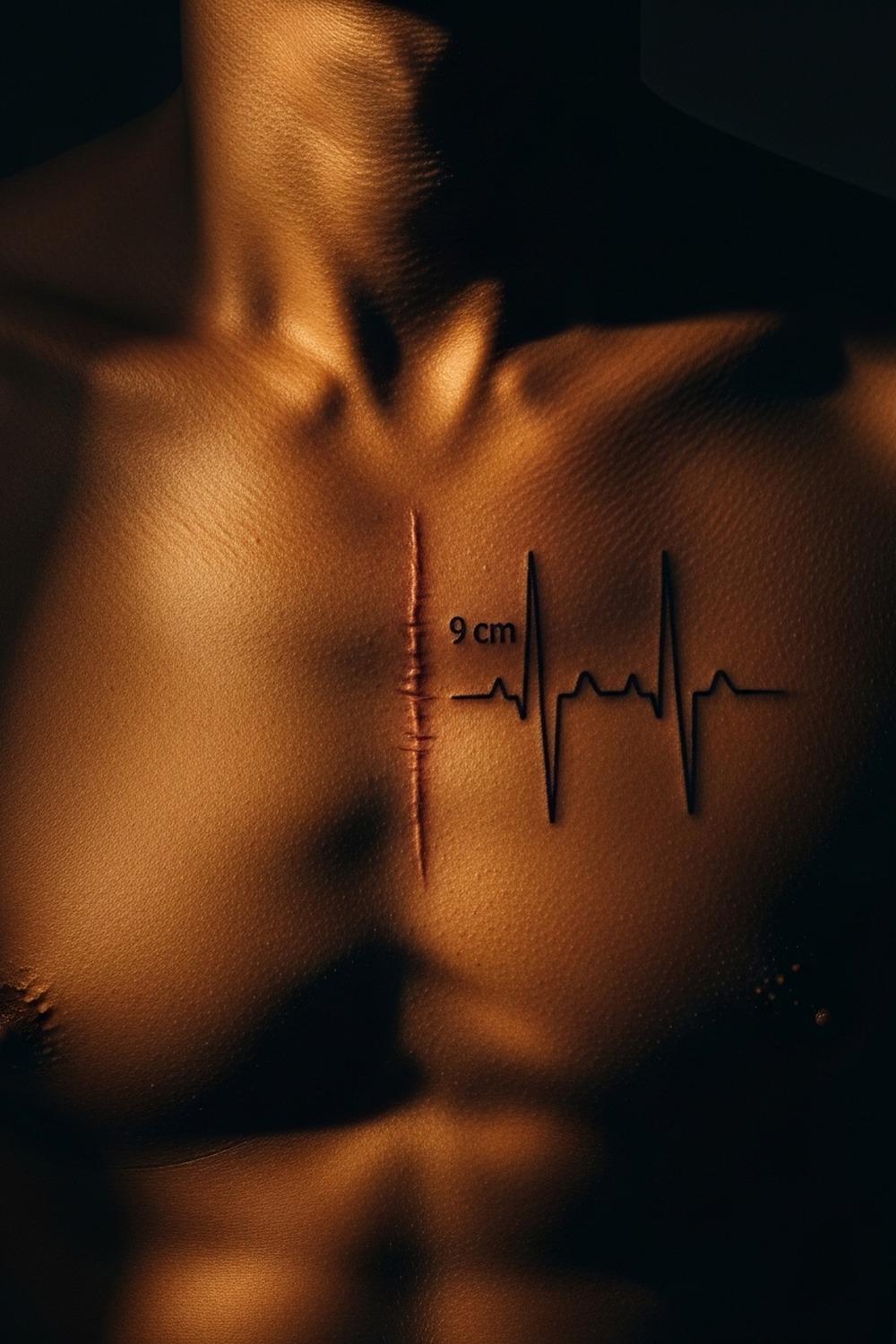
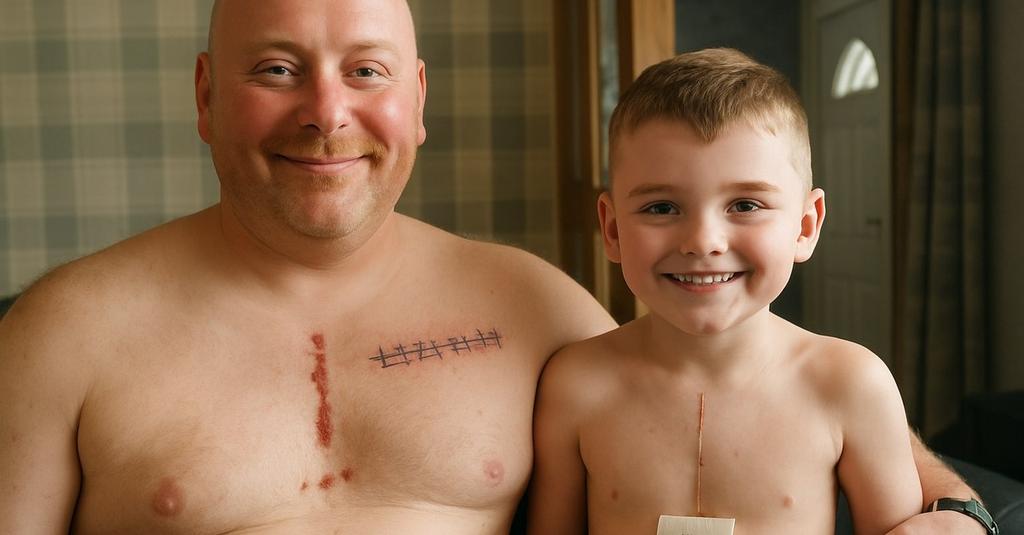
Martin Watts stood in a waiting room while surgeons opened his son Joey’s chest to fix a hole between the chambers of his heart. He couldn’t be in the operating theater. Couldn’t stop what was happening. Couldn’t even see it. When Joey came home weeks later with that long, healing line down his sternum, Martin did something that would bind them together in a way neither of them expected — he brought the surgical photos to a tattoo artist and asked for an exact copy on his own chest.
Same length. Same placement. Same subtle curve where the incision had healed slightly off-center.
Key Facts
- Martin Watts had his son Joey’s nine-centimeter open-heart surgery scar tattooed onto his own chest as an exact replica, including the EKG waveform from Joey’s monitor
- Joey was treated for a ventricular septal defect, a hole between the heart’s lower chambers, the most common congenital heart condition
- Congenital heart defects affect roughly 1 in 100 children born worldwide, about 40,000 babies a year in the US (CDC, 2023)
- Survival rates for ventricular septal defect surgery have risen from under 70% in the 1970s to over 95% today
- A 2022 Congenital Heart Alliance survey found 68% of parents reported significant anxiety symptoms lasting more than one year after their child’s cardiac surgery
In short: The pediatric heart surgery tattoo trend sees parents like Martin Watts replicate a child’s surgical scar, in his case Joey’s nine-centimeter incision plus the EKG waveform. With congenital heart defects affecting 1 in 100 children and 68% of parents reporting lasting anxiety, the ink transforms helpless trauma into chosen, visible meaning.
The Rise of Medical Tattoos in Cardiac Families
Tattoos tied to trauma aren’t exactly new, but something’s shifted in the cardiac surgery world over the last ten years. Dr. Karin Tönz at the University of Zurich has been studying families of children with congenital heart defects, and what she’s documenting is this: parents experience what clinicians call “secondary traumatic stress” — invisible wounds from watching your child suffer while you’re powerless to stop it. A tattoo becomes the answer to that helplessness. It transforms passive trauma into active choice.
It’s not just parents, either. Siblings get them. Grandparents. The kids themselves once they’re old enough to decide. Families are using ink to reclaim something the illness took from them — agency. Control. A narrative they get to write the ending of.
What Makes Martin’s Tattoo Different
He didn’t get a heart symbol. Didn’t get a ribbon or a date.
The tattoo artist had to stop twice during the session. Not for technical reasons — because Martin kept talking. Stories about Joey in the ICU. How small his hands were. How he asked for apple juice before he was fully awake from anesthesia. Some moments just stop you mid-task, and that was one of them.
But here’s where it gets precise: Martin also had the EKG line from Joey’s post-surgery monitor printed as a tattoo. The exact waveform that meant his son’s heart was still beating. Not abstract. Not symbolic. Real data from a real machine on a real afternoon when everything could have gone differently. You can find other stories about parental devotion at this-amazing-world.com, but the specificity here — that’s what separates this from sentiment. That’s what makes it radical.
Joey’s Condition — and Why So Many Families Face This
Ventricular septal defect. A hole between the two lower chambers of the heart that prevents efficient blood pumping. It hits roughly 1 in 100 children born worldwide — making it the most common congenital heart condition on the planet. Forty thousand babies a year in the US alone.
Decades ago, a diagnosis like Joey’s meant real mortality risk. Modern surgical techniques changed that. Survival rates now exceed 95% for children who receive intervention. But here’s the thing nobody talks about: those improved survival rates created a secondary phenomenon. More children living long enough for families to actually process what happened to them. More families wrestling with trauma that doesn’t disappear just because the child comes home healthy.
The waiting room memory doesn’t fade. The surgeon’s face when they come through the doors stays vivid. The ventilator sound. Those don’t evaporate because the discharge papers say “full recovery expected.” For some parents, that trauma sits unaddressed for years. And then one day, someone picks up a needle.
What Research Says About Tattoos and Trauma Processing
Here’s what surprised me while reading through this: the psychological research on tattoos as trauma tools is still playing catch-up to what people are actually doing. A 2021 study in Body Image found that individuals who tattooed images related to traumatic events reported significantly higher rates of “narrative coherence” — essentially, a sense that their story had a beginning, middle, and chosen endpoint. The tattoo lets you write the last line yourself.
For parents who never controlled anything about their child’s medical crisis — not the diagnosis, not the surgery date, not the outcome — choosing exactly what goes on their own body gives back the agency that illness stole. It’s not denial. It’s reclamation.
The implication is striking, and in families navigating the long aftermath of pediatric cardiac surgery, that distinction matters enormously.
By the Numbers
- Approximately 40,000 babies born with congenital heart defects annually in the US — roughly 1 in 100 globally (CDC, 2023).
- Survival rates for ventricular septal defect surgery have climbed from under 70% in the 1970s to over 95% today. One of modern pediatric medicine’s most dramatic successes, and yet nobody throws parties for it.
- The longest documented surgical scar from pediatric open-heart repair measured over 14 centimeters — nearly the length of an adult hand, on a child’s chest.
- A 2022 Congenital Heart Alliance survey found that 68% of parents reported significant anxiety symptoms lasting more than one year after their child’s cardiac surgery.
Field Notes
- Some pediatric cardiac units now keep surgical photo documentation specifically because families have started requesting images for tattoo references — a practice that began informally and is quietly becoming policy in certain hospitals.
- EKG line tattoos are now their own subcategory within medical memorial tattooing. Some tattoo artists specialize almost exclusively in them for cardiac families.
- Joey Watts is eight now. He’s told his father that when he grows up, he wants a matching tattoo of his own scar — so they’ll be identical. A scar he was given, and a scar he’ll choose.
Why This Matters Beyond One Family
The pediatric heart surgery tattoo is a window into how families are building their own rituals for processing medical trauma in a healthcare system that doesn’t always offer them the tools to do it. Hospitals focus (rightly) on the patient. The parents sitting in waiting rooms for six hours, living on vending machine coffee and terror, often get almost nothing in return. No structured support. No ritual. No acknowledgment that what they witnessed was real and that it marked them.
The tattoo fills that gap.
It says: this happened. It was real. I’m carrying it with me — not as a wound, but as a choice. Martin didn’t need Joey to know he loved him. Joey already knew. But Martin needed something — a way to hold what he went through, to make it visible, to say without words that he would have taken every centimeter of that scar himself if he could have.
The tattoo doesn’t pretend otherwise.
It just says: I was here. I am here. Same chest. Same heartbeat. Some stories remind you that humans will find a way to love each other through absolutely anything — even a surgical incision, even a monitor line, even ink pressed into skin. If this kind of thing keeps you up at night, there’s more waiting at this-amazing-world.com. The next one is even stranger.
“
Frequently Asked Questions
Q: What is a pediatric heart surgery tattoo?
A pediatric heart surgery tattoo is a tattoo a family member gets to replicate or memorialize a child’s cardiac surgery, such as the scar or an EKG waveform. Martin Watts had his son Joey’s nine-centimeter open-heart incision tattooed onto his own chest as an exact replica, matching length, placement, and the subtle off-center curve, and added the actual EKG line from Joey’s post-surgery monitor. Clinicians link the practice to processing secondary traumatic stress experienced by parents.
Q: How common are congenital heart defects like Joey’s?
Ventricular septal defect, the hole between the heart’s two lower chambers that Joey had, is the most common congenital heart condition on the planet. Congenital heart defects affect roughly 1 in 100 children born worldwide, which amounts to about 40,000 babies a year in the United States alone according to 2023 CDC figures. Because survival rates now exceed 95%, far more children live long enough for their families to process the trauma of the experience.
Q: Do tattoos actually help people process trauma?
Research suggests they can. A 2021 study in the journal Body Image found that people who tattooed images related to traumatic events reported significantly higher rates of narrative coherence, a sense that their story had a beginning, middle, and chosen endpoint. For parents who controlled nothing about their child’s medical crisis, choosing exactly what goes on their own body restores a measure of agency. Researchers frame it as reclamation rather than denial.
Q: How much have survival rates for this heart surgery improved?
Dramatically. Survival rates for ventricular septal defect surgery have climbed from under 70% in the 1970s to over 95% today, one of modern pediatric medicine’s most significant successes. But improved survival created a secondary phenomenon: more children living long enough for families to process what happened, and more lasting parental trauma. A 2022 Congenital Heart Alliance survey found 68% of parents reported significant anxiety symptoms lasting more than one year after their child’s cardiac surgery.
Illustrations are AI-generated. Article fact-checked and human-edited. Our editorial standards.