The Wolves of Denali: How a Pack Survives –40°F Winters
Nobody planned to study them in the dark. But that’s where the Denali wolves turned out to be doing the most interesting things — 30 miles in a single night, at –40°F, on empty stomachs.
Deep in Alaska’s interior, where cold doesn’t so much arrive as it swallows everything whole, the Iron Creek West pack is moving. Eight wolves, two at the lead, threading through black spruce and moonlit snow. They’re not wandering. They’re working. And what they do to survive the most extreme winter conditions in North America reads like something out of a different world entirely.
Key Facts
- Denali National Park spans roughly 6 million acres, and its winter wolf population hovers around 70 individuals across 20,000 square kilometers.
- Denali’s wolf population peaked at approximately 143 individuals in 2007, according to National Park Service aerial surveys.
- Wolf pack territories range from 300 to over 1,000 square miles seasonally.
- The record low at Denali’s base camp is -40 degrees, the point where Fahrenheit and Celsius converge, and wolves remain fully active.
- A wolf’s nose can detect prey up to 1.75 miles away, roughly 100 times more sensitive than a human’s.
In short: The Denali wolf pack survives -40 degree Alaskan winters by hunting on cold snaps, when frozen lakes become highways and heavy moose break through snow that lightweight wolves glide over. Denali spans 6 million acres with around 70 wolves, navigating by a nose roughly 100 times more sensitive than a human’s.
How the Denali Wolf Pack Reads a Frozen Landscape
Denali National Park spans roughly 6 million acres — about the size of Massachusetts — and in winter, its wolf population hovers around 70 individuals spread across 20,000 square kilometers. Biologist Layne Adams of the U.S. Geological Survey spent years tracking these animals and documented how pack territories shift dramatically with prey movement. A single pack’s range can exceed 1,000 square miles in the leanest months.
So how do they know where to go?
They read the land like a language. Wind direction. The age of a track pressed into crusted snow. The faint musk of a moose that passed through hours ago. Wolves process environmental information through senses that make human perception look genuinely blunt — the gray wolf’s nose is estimated to be 100 times more sensitive than ours, which means they’re navigating a scent map we can’t even imagine.
The Alpha Pair Hold the Pack Together
Here’s the thing about wolf hierarchy — Hollywood got it badly wrong. The old “alpha wolf” idea was built entirely on studies of captive wolves forced together unnaturally, and it doesn’t hold up once you watch real animals in the field. In Denali, the leading pair of a pack are essentially the breeding parents. They don’t dominate through aggression. They lead through experience, decision-making, and what researchers now describe as social trust. You can read more about wild animal social bonds and survival strategies at this-amazing-world.com.
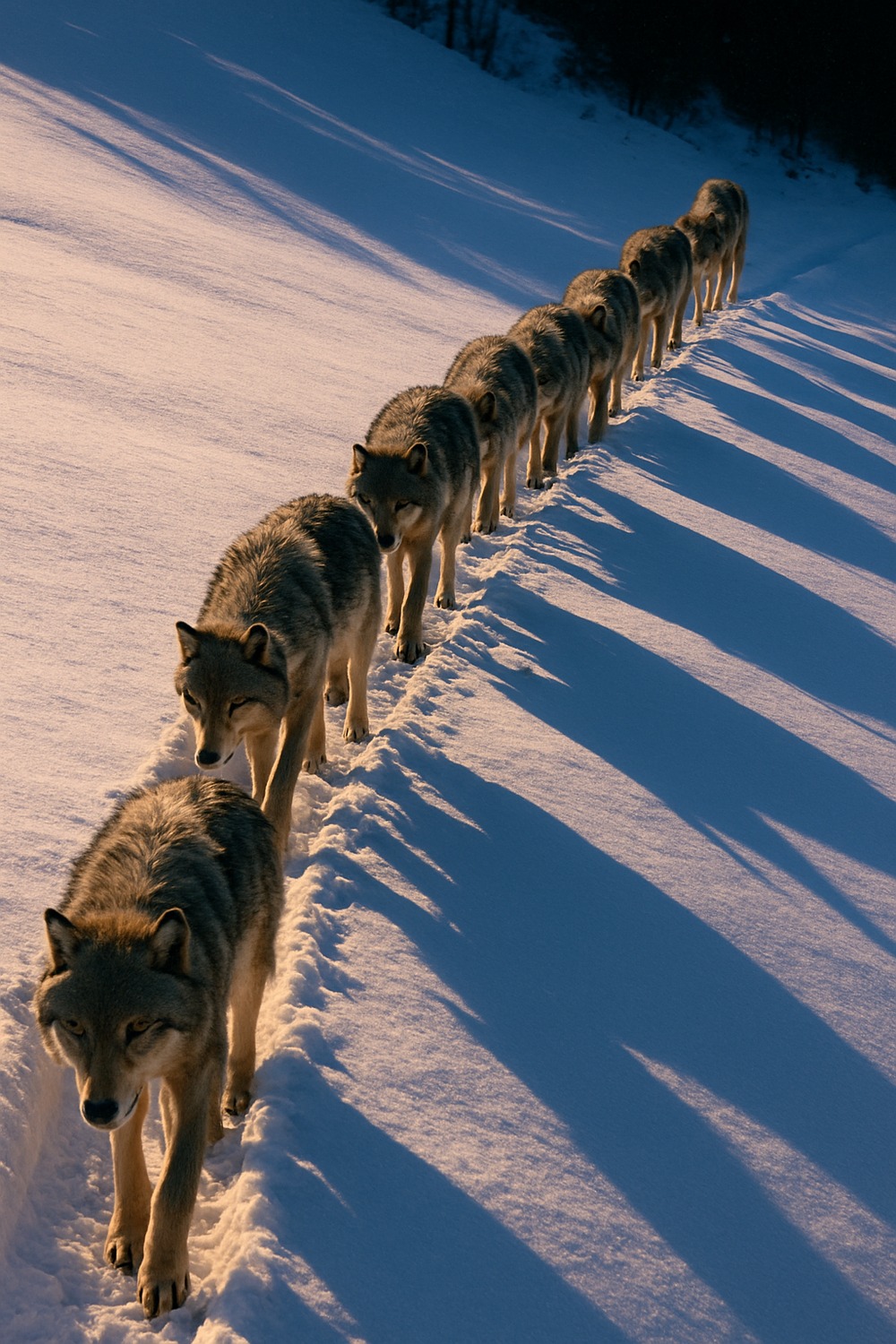
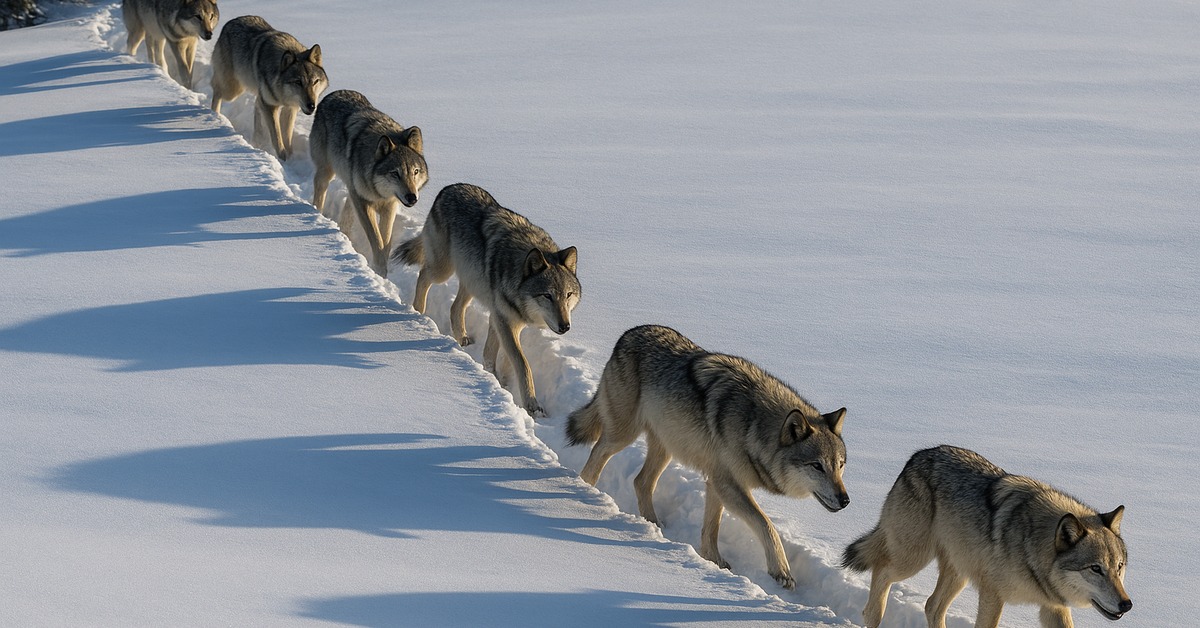
Watch the Iron Creek West pair move and you see it plainly. The male breaks trail through deep powder, his broad chest compressing the snow so smaller pack members can follow in the channel he’s carved.
It’s not dominance. It’s service.
Leadership, in a wolf pack, looks a lot like sacrifice.
What –40°F Actually Does to a Living Body
Forty below is the temperature where Fahrenheit and Celsius converge — a brutal coincidence that feels almost symbolic. At that point, exposed skin freezes in under two minutes. Breath crystallizes mid-air. Metal snaps. Diesel gels in engines. And yet a Denali wolf pack doesn’t just survive this — they hunt in it, travel through it, and raise pups after it. What separates them from the cold isn’t just fur. It’s physics, physiology, and millions of years of refinement.
Wolf fur is a two-layer system. The outer guard hairs repel moisture and wind. The dense underfur traps body heat in tiny air pockets. Their paws contain a counter-current heat exchange system — warm arterial blood heats the cooler venous blood returning from the foot, keeping extremities functional without losing core warmth. It’s engineering that no Gore-Tex jacket has fully matched. That last fact kept me reading for another hour.
And then there’s the cold itself — which, in a strange way, works in the wolves’ favor.
Winter Actually Gives Wolves a Hunting Edge
Turns out, the brutal Alaskan winter hands wolves one of their most critical advantages: the freeze. When temperatures plummet, lakes and rivers solidify into highways. Wolves, with their wide-spreading paws and low body weight relative to surface area, can sprint across ice that would collapse under a moose. A moose weighing 1,200 pounds punches through crusted snow with every step. A wolf at 100 pounds glides over it. The physics of pursuit shift entirely.
This is why Denali wolf packs often time their hunts around cold snaps rather than avoid them. Wildlife ecologist Gordon Haber, who spent four decades studying Denali’s wolves before his death in 2009, observed that successful hunts spiked during the hardest freezes. The prey’s mobility collapses. The pack’s doesn’t.
Cold isn’t the enemy — it’s a tool.
But a kill is never guaranteed. A pack can go five, seven, even ten days without a successful hunt. Wolves evolved to gorge — a single adult can consume 20 pounds of meat in one sitting — precisely because they’ve also evolved to starve. The feast-and-famine cycle isn’t a failure of strategy. It’s the strategy.
By the Numbers
- Denali’s wolf population peaked at approximately 143 individuals in 2007, according to National Park Service aerial surveys. It’s fluctuated significantly since then, driven by prey cycles and hunting pressure near park boundaries — two forces that don’t always move in the same direction.
- Pack territories: 300 to 1,000+ square miles, seasonally.
- The record low at Denali’s base camp is –40°F (–40°C) — the exact threshold where both temperature scales converge, and where wolves remain fully active.
- A wolf’s nose can detect prey up to 1.75 miles away under ideal conditions, roughly 100 times more sensitive than a human’s. Across a vast open snowfield, that difference is everything.
Field Notes
- Wolves in Denali have been documented playing in fresh snow — chasing each other, rolling, tossing objects — behavior researchers believe maintains social bonds during the high-stress winter period when cohesion is most critical to survival.
- Pack members that don’t participate in a kill still eat. Wolves regurgitate meat for packmates who stayed behind, including pups and injured individuals.
- Denali wolves have been observed crossing open ridgelines during whiteout conditions rather than staying sheltered in valleys — navigating by memory and topography even when visibility drops to near zero. Which raises the obvious question: how much of this behavior is instinct, and how much is something closer to learned knowledge passed between generations? Researchers don’t have a clean answer yet.
Why the Denali Wolf Pack Still Matters to All of Us
The Denali wolf pack isn’t just a wildlife story. It’s a pressure test for everything we think we know about survival, cooperation, and resilience. These animals exist at the absolute edge of what’s biologically possible in a cold environment — and they don’t just endure, they organize, adapt, and lead. Ecologists have long understood that where wolves thrive, ecosystems stabilize. Their predation on ungulates prevents overgrazing, which keeps riverbanks intact, which sustains fish populations. The wolf is, quietly, holding entire landscapes together.
That’s why what happens to the Iron Creek West pack ripples outward in ways most people never see.
The line of paw prints in the snow isn’t just a trail. It’s a signal that the whole system is still working.
Eight wolves moving through –40°F darkness, led by a pair who’ve survived this before. No GPS. No shelter beyond each other. Just memory, muscle, and the kind of trust that only forms when survival depends on it. The Denali wolf pack is proof that the wild still holds lessons we haven’t finished learning. If this kind of story keeps you up at night, there’s more at this-amazing-world.com — and the next one is even stranger.
Frequently Asked Questions
Q: How large is the Denali wolf pack population and territory?
Denali National Park spans roughly 6 million acres, about the size of Massachusetts, and in winter its wolf population hovers around 70 individuals spread across 20,000 square kilometers. The population peaked at approximately 143 individuals in 2007, according to National Park Service aerial surveys, then fluctuated with prey cycles and hunting pressure. A single pack’s range can run from 300 to over 1,000 square miles seasonally.
Q: How do wolves survive temperatures of -40 degrees?
At -40 degrees, the point where Fahrenheit and Celsius converge, exposed skin freezes in under two minutes. Wolf fur is a two-layer system: outer guard hairs repel moisture and wind while dense underfur traps body heat in air pockets. Their paws use a counter-current heat exchange system, where warm arterial blood heats cooler venous blood returning from the foot, keeping extremities functional without losing core warmth.
Q: Why do Denali wolves hunt during the coldest weather?
When temperatures plummet, lakes and rivers freeze into highways. A wolf at around 100 pounds glides over ice and crusted snow that a 1,200-pound moose punches through with every step, shifting the physics of pursuit. Wildlife ecologist Gordon Haber, who studied Denali’s wolves for four decades before his death in 2009, observed that successful hunts spiked during the hardest freezes because prey mobility collapses while the pack’s does not.
Q: How sensitive is a wolf’s sense of smell?
A wolf’s nose can detect prey up to 1.75 miles away under ideal conditions, roughly 100 times more sensitive than a human’s. Across a vast open snowfield, that difference is decisive. Wolves read the land like a language, processing wind direction, the age of a track pressed into crusted snow, and the faint musk of a moose that passed through hours earlier, navigating a scent map humans cannot perceive.
Illustrations are AI-generated. Article fact-checked and human-edited. Our editorial standards.