What Was the First Civilization on Earth?
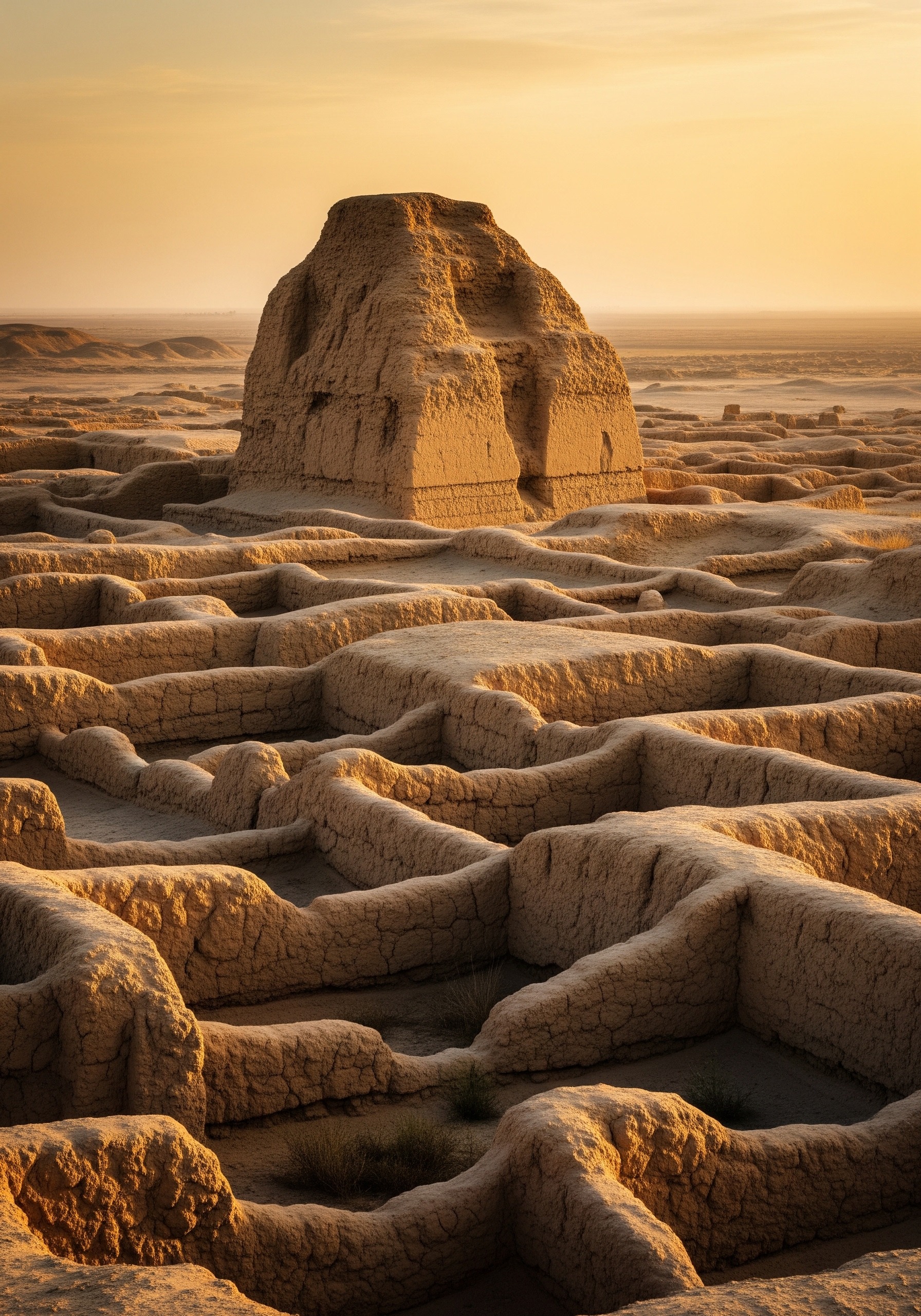
Ask “what was the first civilization on earth?” and the textbook answer comes back almost reflexively: Sumer, in southern Mesopotamia, around 3500 BC. That answer is right — but it hides a much more interesting question underneath it, which is what we even mean by “civilization” in the first place.
Key Facts
- The Sumerians of southern Mesopotamia — in what is now southern Iraq — built the first urban literate civilization on earth, with cities, writing, and central administration emerging together between roughly 3500 and 3200 BC.
- Uruk, by about 3200 BC, was likely the largest city on the planet: roughly 250 hectares (about one square mile of dense urban core) and an estimated 40,000 to 90,000 inhabitants.
- The oldest known writing — proto-cuneiform on small clay tablets, mostly accounting records — dates to c. 3350–3200 BC and was excavated at Uruk.
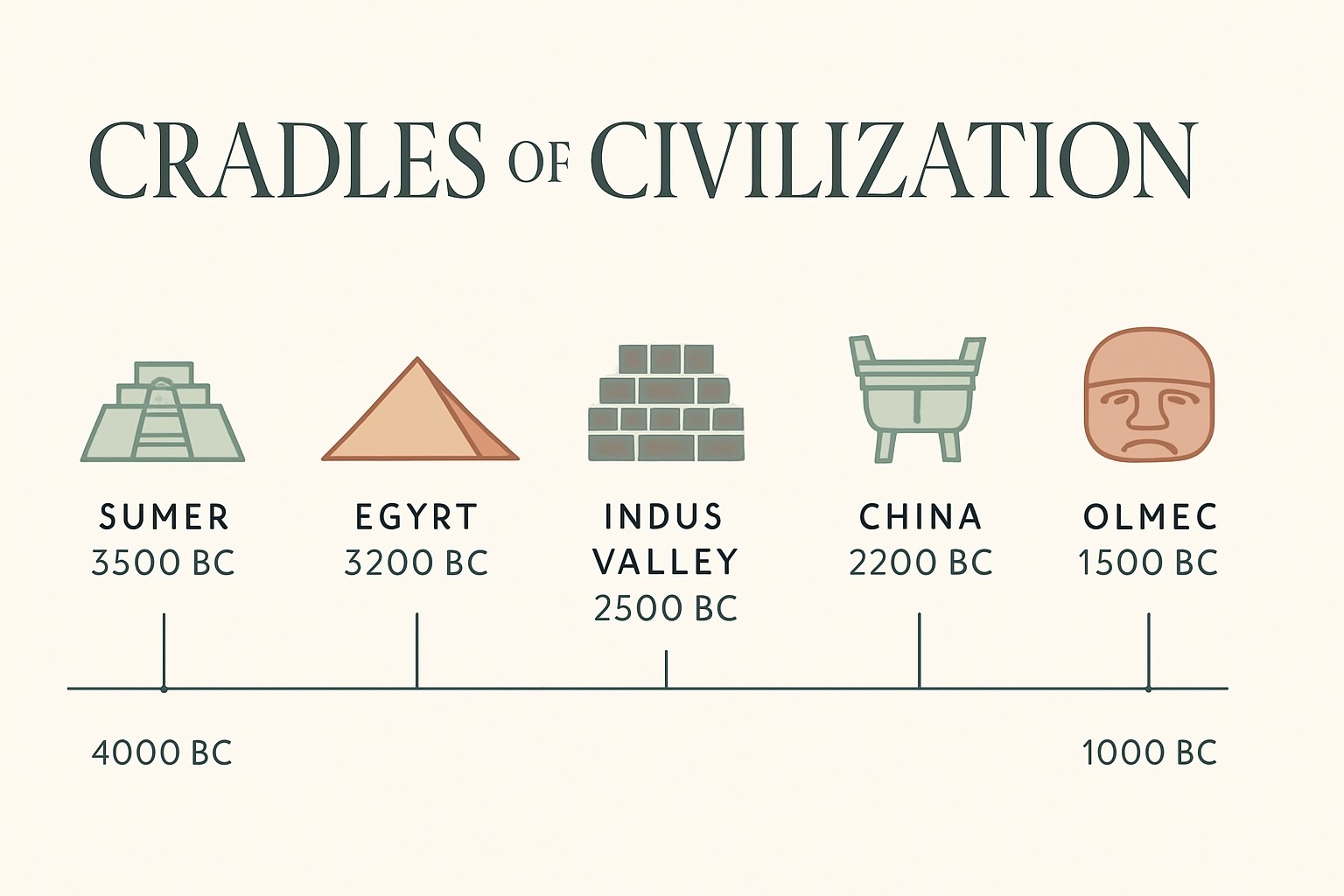
- Mesopotamia was followed in close succession by five other independent cradles: Egypt (c. 3200 BC), the Norte Chico of coastal Peru (c. 3100 BC), the Indus Valley (c. 2500 BC), China’s Yellow River basin (c. 2200 BC), and Mesoamerica’s Olmec (c. 1500 BC).
- Göbekli Tepe in southeastern Turkey is older than Sumer by some 6,000 years — but it is monumental Neolithic religion, not a civilization. No city, no writing, no state.
In short: The first civilization on earth was Sumer, in the lower Tigris–Euphrates plain, where the full package — dense cities, writing, bureaucracy, monumental architecture — first appeared together between about 3500 and 3200 BC. Older monumental sites exist, and older continuous cultures exist, but Sumer is the first place all the boxes are ticked at once.
Key Facts
- The first urban literate civilization was Sumer, in southern Mesopotamia (modern southern Iraq), emerging roughly 3500-3200 BC.
- By about 3200 BC the city of Uruk covered roughly 250 hectares and held an estimated 40,000 to 90,000 inhabitants.
- The oldest known writing is proto-cuneiform on clay tablets, dated to about 3350-3200 BC and excavated at Uruk.
- Five other independent cradles followed: Egypt (c.3200 BC), Norte Chico Peru (c.3100 BC), the Indus Valley (c.2500 BC), China’s Yellow River (c.2200 BC), and the Olmec (c.1500 BC).
- Goebekli Tepe in southeastern Turkey predates Sumer by some 6,000 years but is monumental Neolithic religion, with no city, writing, or state.
In short: The first civilization on Earth was Sumer in southern Mesopotamia (modern southern Iraq), where dense cities, writing, bureaucracy and monumental architecture first appeared together between roughly 3500 and 3200 BC. Uruk, the largest early city, reached 40,000 to 90,000 people. Five other cradles followed independently within a few thousand years.
The short answer — and why it gets argued about
If you mean the first society that put together permanent cities, a writing system, a stratified state, and monumental public buildings — the standard scholarly answer is the Sumerians of southern Mesopotamia, c. 3500–3200 BC. That answer holds across the British Museum, the Metropolitan Museum of Art, Britannica, and most peer-reviewed Near Eastern archaeology.
Where it gets noisy is the internet’s habit of mixing different questions under one label. “First civilization” can mean the earliest urban state. It can mean the oldest continuous culture. It can mean the earliest monumental architecture. These are three different races, with three different winners.
Here’s the thing: the news isn’t that there is one neat winner. It’s that humans crossed the urban threshold in at least six places, independently, in a startlingly narrow window of two to three thousand years — and Sumer got there first by a nose.
What “civilization” actually means in archaeology
Archaeologists don’t use “civilization” loosely. The standard checklist — sometimes called the Childe criteria after the Australian archaeologist V. Gordon Childe — usually requires most of the following:
- Dense, permanent settlements large enough to be called cities (typically 10,000+ people).
- Food surplus from intensive agriculture, supporting people who don’t farm.
- Social stratification — kings, priests, craftsmen, labourers — not just bigger families.
- A central authority, usually religious and political at once, capable of organising labour.
- Monumental architecture: temples, palaces, ziggurats, walls.
- A system of writing or equivalent symbolic record-keeping.
- Specialised crafts and long-distance trade.
Hit most of those and you have a civilization. Hit a few and you have a complex society, a chiefdom, or a Neolithic village — meaningful things, but not the same. This is the bar Sumer clears first, and it’s also the bar that disqualifies a lot of older sites that show up on listicles.
{IMAGE_2}
Sumer: where the first civilization on earth came together
Sumer sat in the flat alluvial plain between the lower Tigris and Euphrates rivers — roughly today’s Dhi Qar and Muthanna provinces in southern Iraq. The land was hot, flat, almost treeless, and chronically short of stone and timber. But it had two superpowers: thick river silt that produced absurd grain yields when irrigated, and two highways of water connecting the Persian Gulf to the highlands.
The story didn’t start at zero in 3500 BC. The pre-Sumerian Ubaid culture (c. 6500–4000 BC) had already drained marshes, dug canals, fired pottery, and built temple platforms at sites like Eridu, traditionally counted as the oldest city in Sumer. What changed in the centuries after 4000 BC, during the Uruk period, was scale. Villages fused into towns; towns swallowed villages; one town in particular pulled ahead.
Treating “first civilization” as a fixed prize misses the point — the real story is that this remote, marshy, resource-poor strip of southern Iraq is where the human species first managed to run a society of tens of thousands of strangers without anyone in it personally knowing more than a small fraction of the rest. That is the real invention.
Uruk and the invention of writing
By around 3200 BC, the city of Uruk covered roughly 250 hectares, ringed by walls Gilgamesh would later be credited with building. Estimates of its peak population range from about 40,000 to as many as 80,000–90,000 if you include its immediate hinterland — making it almost certainly the largest human settlement that had ever existed up to that point.
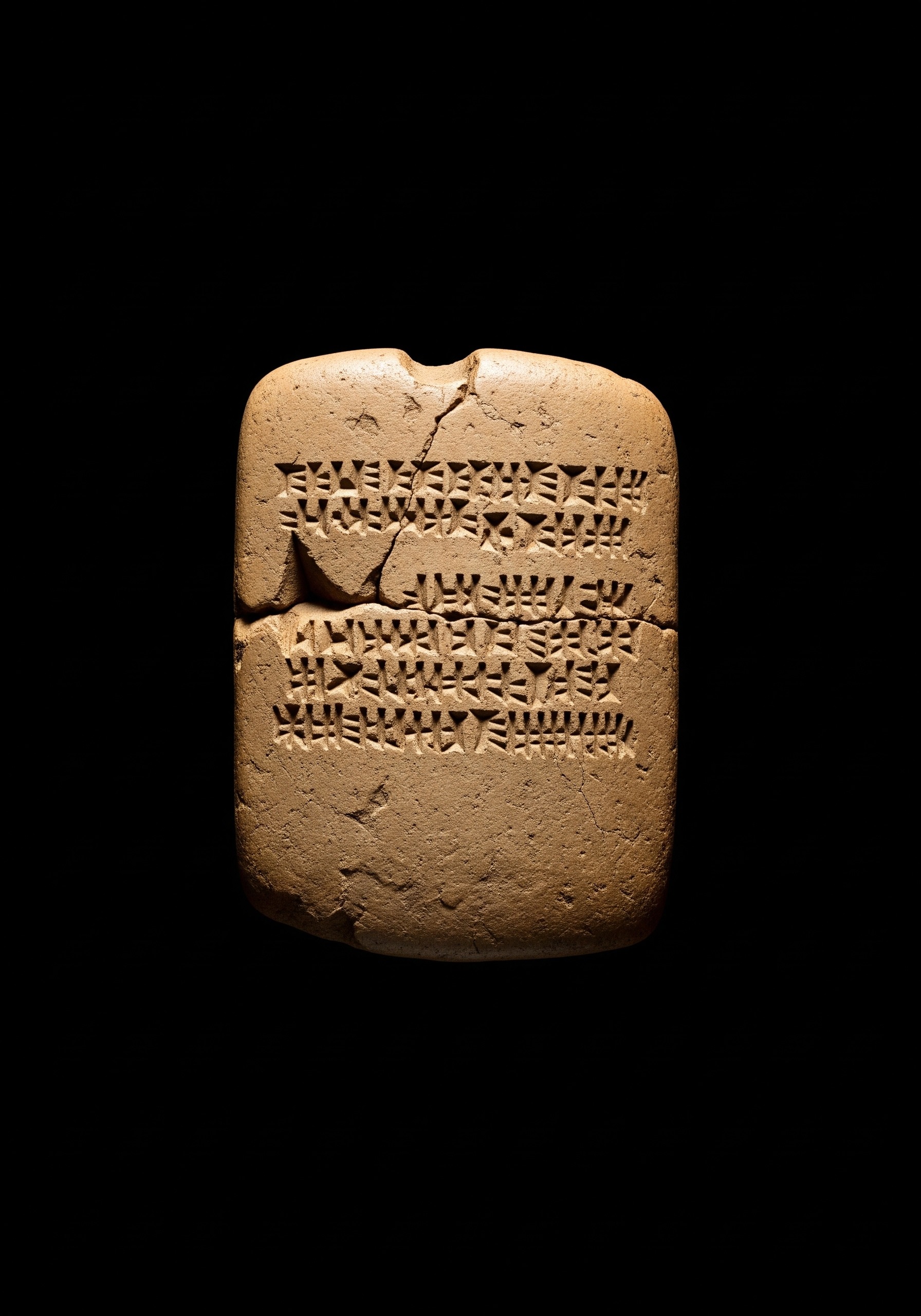
Uruk is also where writing shows up. The earliest tablets — small lumps of sun-dried clay impressed with reed-stylus marks — come from the so-called Uruk IV stratum and have been dated to roughly 3350–3200 BC. They are not poetry. They are receipts: counts of barley, sheep, beer rations, oil, textiles. Bureaucracy invented writing, not the other way round.
The German archaeologist Hans J. Nissen, of the Freie Universität Berlin, spent decades re-editing these tablets in the Archaische Texte aus Uruk project, and his analysis of how proto-cuneiform signs evolved from numerical tokens into a flexible script is still the foundation of how we date the birth of writing. The earlier Sumerologist Samuel Noah Kramer famously catalogued thirty-nine “firsts” he attributed to Sumer — the first schools, the first written laws, the first love song, the first cosmology — and while some of those have been challenged at the edges, the central claim has not.
The other cradles: parallel inventions, not copies
Sumer was first. It was not alone for long. Within roughly two millennia, at least five other regions independently crossed the urban-state threshold, with no plausible evidence that any of them learned the trick from the Sumerians.
| Cradle | Modern location | Earliest urban phase | Defining river / setting | Native script |
|---|---|---|---|---|
| Sumer | Southern Iraq | c. 3500–3200 BC | Tigris & Euphrates | Cuneiform |
| Ancient Egypt | Egypt | c. 3200 BC | Nile | Hieroglyphs |
| Norte Chico (Caral–Supe) | Coastal Peru | c. 3100–1800 BC | Pacific coast, Supe valley | None known (quipu later) |
| Indus Valley | Pakistan & NW India | c. 2600–1900 BC | Indus | Indus script (undeciphered) |
| Ancient China | North-central China | c. 2200–1600 BC (Erlitou) | Yellow & Yangtze | Oracle-bone (later, Shang) |
| Mesoamerica (Olmec) | Gulf coast of Mexico | c. 1500 BC | Coatzacoalcos lowlands | Early Mesoamerican glyphs |
Two of these deserve a brief footnote. The Norte Chico of coastal Peru built terraced platform pyramids and sunken plazas without pottery and without (so far as we know) any writing — a useful reminder that the Childe checklist is a guideline, not a law. And the Indus Valley sites of Harappa and Mohenjo-daro, with their standardised brick sizes and grid-planned streets, had an engineering culture so consistent across hundreds of miles that it still unnerves archaeologists.
But what about Göbekli Tepe? And Aboriginal Australians?
This is where most of the confusion online comes from, and it deserves a straight answer.
Göbekli Tepe, in southeastern Turkey, is dated to roughly 9500–8000 BC — about 6,000 years before Sumer. Excavated by the late German archaeologist Klaus Schmidt of the German Archaeological Institute, it consists of large circular enclosures of T-shaped limestone pillars, some weighing several tonnes, carved with reliefs of foxes, snakes, vultures, and scorpions. It is genuinely revolutionary; it shifted our understanding of how early ritual organisation predates agriculture. But there is no city there, no permanent dense population, no writing, no state. It is monumental Neolithic religion built by people who were still mostly hunter-gatherers. Older than Sumer, yes. A civilization in the technical sense — no.
Aboriginal Australians represent something different again: the world’s oldest continuously practised culture, with archaeological evidence of human presence on the continent stretching back at least 50,000–65,000 years. That is an astonishing depth of unbroken tradition, and it is true in a way Sumer’s record is not (Sumer was buried under sand for two thousand years before its rediscovery). But traditional Aboriginal societies were mobile hunter-gatherer cultures, not urban states. Calling them “the oldest civilization” is a category swap — true on one dimension, false on the dimension archaeologists usually use the word.
Both deserve their full weight. Neither displaces Sumer as the first urban literate civilization on earth.
What we still don’t know
Honest uncertainty is part of the story here, and it’s worth naming. We don’t know exactly why Sumer crossed the urban threshold first; the leading guesses involve some combination of irrigation-driven grain surplus, ecological squeeze as the Persian Gulf shoreline retreated, and the political pressure of densely packed competing temple-cities. We don’t know how to read the Indus script, and until we can, the inner life of the Harappans remains largely closed to us. We don’t know whether Norte Chico had a script that simply hasn’t survived in the dry Peruvian coast — knotted-cord quipu-like devices have been found at Caral. And our oldest dates keep getting older as excavation continues; Eridu’s earliest layers are still being pushed back.
What is not in doubt is the basic shape of the answer: the first civilization on earth — in the strict, archaeological, full-checklist sense — was Sumer.
Frequently Asked Questions
Q: Was Mesopotamia or Egypt the first civilization?
A: Mesopotamia, by a clear margin. Sumerian cities like Eridu and Uruk were already large urban centres with proto-cuneiform writing by c. 3350–3200 BC. Unified dynastic Egypt emerges slightly later, around 3100 BC, and the earliest Egyptian hieroglyphs date a little after the earliest Sumerian tablets.
Q: Where exactly was the first civilization formed?
A: In the lower Tigris–Euphrates plain — what is now southern Iraq, between roughly modern Baghdad and the Persian Gulf. The Fertile Crescent is the broader arc; Sumer is its southern tip.
Q: Were the Sumerians the first civilization, or were the Ubaidians?
A: The Ubaid culture (c. 6500–4000 BC) laid the groundwork — irrigation, pottery, temple platforms, the earliest settlement at Eridu — but did not produce cities, writing, or a state. By the standard archaeological definition, the Sumerians who built on top of that foundation are counted as the first civilization.
Q: Isn’t Göbekli Tepe older than the first civilization?
A: Yes, by about six millennia — but it is not a civilization. It is a monumental religious site built by Neolithic people who had not yet adopted farming on any large scale. Older does not mean “more civilized”; the two concepts are different.
Sources
- The Metropolitan Museum of Art — essays on Uruk, the Origins of Writing, and Mesopotamian art history
- British Museum — Mesopotamia collection and curatorial notes on Sumerian cuneiform tablets
- Hans J. Nissen, Archaische Texte aus Uruk (Freie Universität Berlin) — foundational scholarship on proto-cuneiform
- Encyclopaedia Britannica — entries on Sumer, Uruk, and the Cradle of Civilization
- Getty Museum — Mesopotamia: Civilization Begins exhibition materials
- UNESCO World Heritage — site documentation for Uruk, Eridu, Caral–Supe, and Göbekli Tepe
The deepest thing the Sumerians left us isn’t ziggurats or law codes or even writing itself. It’s the proof of concept — the demonstration, in a hot flat plain along a muddy river, that human beings can build a society too big to know personally and still make it work. Every city since has been a variation on what they did first.
Illustrations are AI-generated. Article fact-checked and human-edited. Our editorial standards.