The Glass Octopus Is Nearly Invisible — And That’s Just Normal
Nobody set out to film it. The ROV was there for something else entirely, running a survey near the Phoenix Islands, when the glass octopus transparent body just… appeared in frame. Organs floating. Arms trailing. The ocean visible straight through it.
Somewhere between 200 and 1,000 meters down in the Pacific, a creature the size of your hand drifts past and you almost miss it. Not because it’s small, not because it moves fast — because its entire body, muscle, skin, tissue, is made of something that looks almost exactly like nothing. And until 2021, we had basically no footage of it doing anything at all.
Key Facts
- The glass octopus (Vitreledonella richardi) was filmed in extended detail for the first time in 2021 by the Schmidt Ocean Institute’s research vessel Falkor near the Phoenix Islands Archipelago
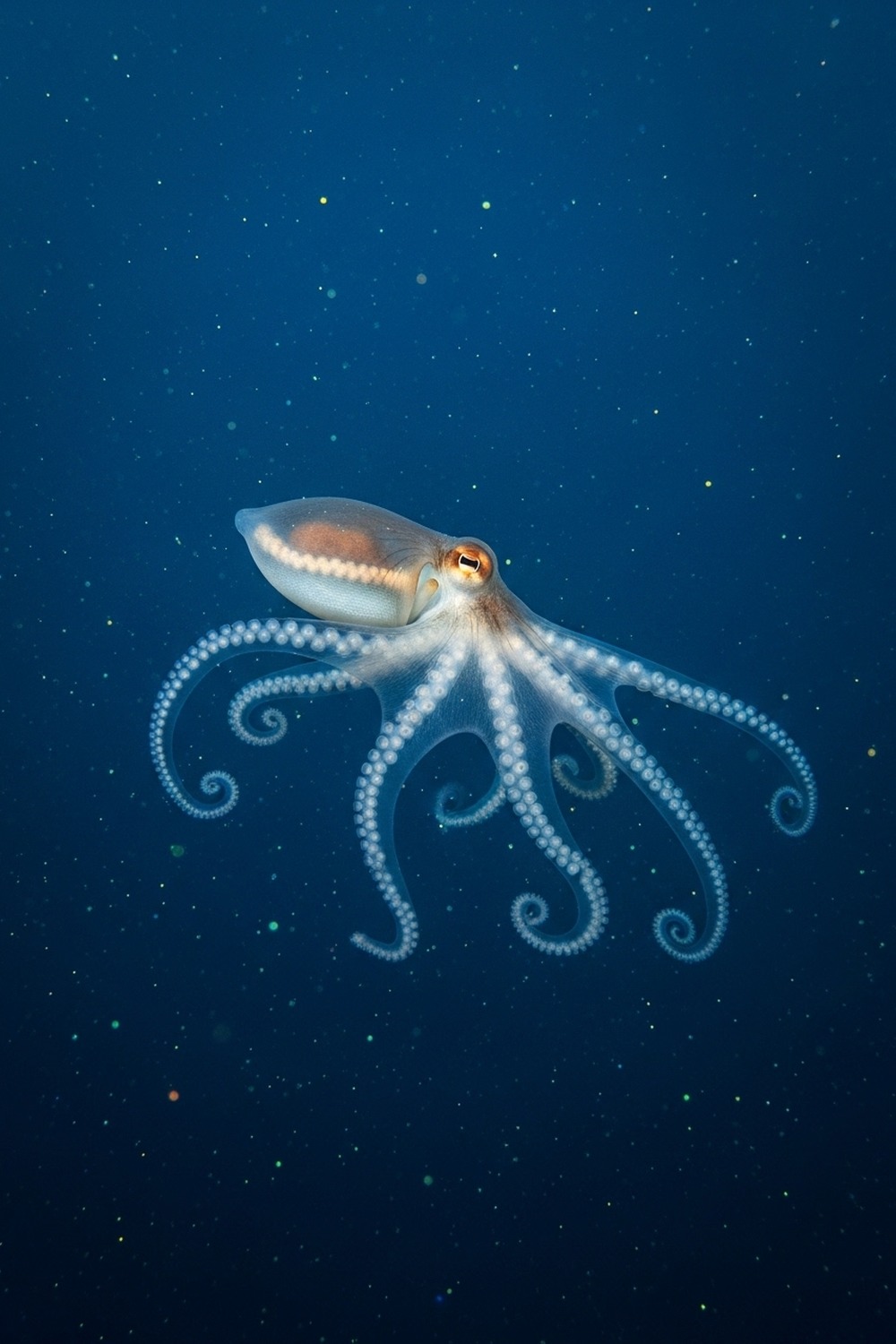
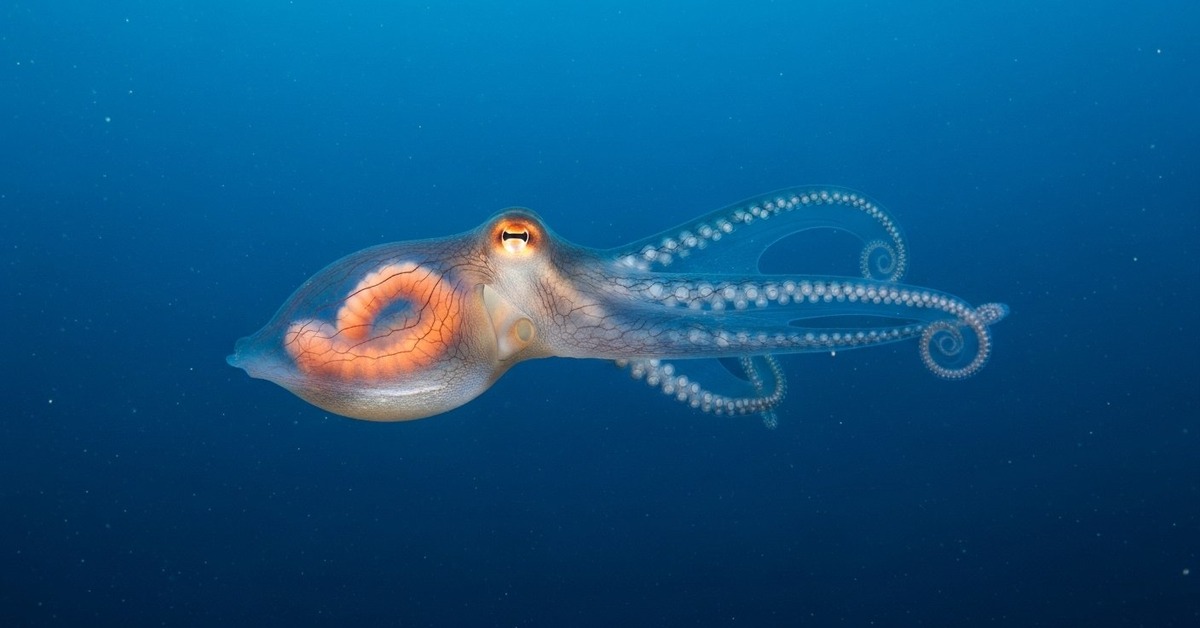
- Only the cylindrical eyes, optic nerves, and digestive tract are visible through the otherwise transparent body
- Glass octopuses inhabit the mesopelagic zone between 200 and 1,000 meters depth in the Pacific Ocean
- Mantle length reaches approximately 10–11 centimeters and arm span reaches nearly 45 centimeters when extended
- The 2021 Falkor expedition captured two separate glass octopus encounters totaling more than 10 combined minutes of footage
In short: The glass octopus, Vitreledonella richardi, lives in the mesopelagic zone 200–1,000 meters deep, with a transparent body that reveals only its cylindrical eyes, optic nerves, and digestive tract. Described in the early 20th century, it was finally filmed in detail by Schmidt Ocean Institute’s Falkor near the Phoenix Islands in 2021, capturing over ten combined minutes of behavior.
The Glass Octopus Transparent Body Explained Simply
The Glass Octopus (Vitreledonella richardi) sits in a genuinely strange corner of cephalopod biology. Described first in the early 20th century, it spent decades as little more than a name on a specimen label — too fragile for trawling nets, too deep for easy observation. The Vitreledonella richardi classification gave scientists something to call it. What they couldn’t do was actually study it.
Here’s what you can see when you look at one: its cylindrical eyes, its optic nerves, and its digestive tract.
That’s it. The body wall, the mantle, the arms — all reduced to a transparency so complete that open ocean reads right through them. It’s not camouflage, exactly. It’s more like the animal never developed a surface in the first place.
Why This Animal Doesn’t Need To Hide
Most deep-sea creatures do something active to survive. The mimic octopus shape-shifts. The firefly squid blinks. The anglerfish lures. The Glass Octopus doesn’t perform camouflage — it simply exists in a state where camouflage isn’t necessary.
In the mesopelagic zone, light arrives as faint blue scatter rather than direct rays. A transparent body casts almost no shadow, reflects almost no light, leaves almost no visual signature from any angle.
This is evolution making a structural argument. If your predators hunt by silhouette and you don’t have one, you’ve already won. No energy spent on ink sacs. No milliseconds lost deciding whether to flee or blend. Just drift, hunt, exist — invisible by default.
The 2021 Footage That Changed Everything
For most of its documented history, the Glass Octopus was essentially theoretical in motion. Scientists knew what preserved specimens looked like. They didn’t know how it moved, how it hunted, how it carried itself in actual open water.
Then the Schmidt Ocean Institute’s research vessel Falkor was running a deep-sea survey near the remote Phoenix Islands Archipelago in the central Pacific — and its ROV picked up the glass octopus transparent form on extended video for the first time in useful detail.
That last fact kept me reading for another hour.
The footage ran long enough to actually observe behavior. And what it showed was quietly astonishing — not because the animal did something dramatic, but because it did everything so calmly. Moving through open water with this unhurried, almost indifferent confidence that only makes sense once you understand it has essentially no reason to panic.
Living In The Ocean’s Twilight Zone Is Weirder Than It Sounds
The mesopelagic zone — that 200-to-1,000-meter band the Glass Octopus calls home — is one of the least understood habitats on the planet. Sunlight doesn’t reach it in any useful quantity. Pressure climbs steadily. Food arrives mostly as marine snow, tiny particles of organic matter drifting down from the surface like slow-motion debris.
And yet this zone is estimated to contain more fish biomass than all the world’s surface fisheries combined.
It’s crowded, dark, and we’ve barely looked at it. The glass octopus transparent form is a perfect adaptation to this specific environment — not the deep abyss, not the sunlit shallows, but this exact middle layer, where evolution has had time to get very precise about what works.
Here’s the thing that should probably unsettle you a little: we’ve mapped less of this zone than we’ve mapped the surface of Mars. There are creatures down there we’ve never seen. Some of them may be hiding in plain sight, in exactly the same way the Glass Octopus spent decades doing exactly that.
Its Eyes Solve A Problem Most Animals Never Face
Turns out, complete transparency creates one serious problem: eyes. Eyes need pigment to function — the retina has to absorb light, which means it can’t be see-through. A fully transparent animal has nowhere to hide its visual system.
The Glass Octopus’s solution is structurally fascinating. Its eyes are cylindrical rather than spherical, oriented to point permanently upward — always scanning for the silhouettes of prey or predators against whatever faint light filters down from above. The trade-off is that the eyes are visible. The one dark giveaway in an otherwise near-invisible body.
But their upward orientation may minimize how much of that dark pigment can be detected from below, which is where most predators approach from. It’s a compromise. The kind that only makes sense after millions of years of very specific pressure in a very specific layer of water.
By the Numbers
- The mesopelagic zone spans 200–1,000 meters depth and covers roughly 1 billion cubic kilometers of ocean volume, making it the largest habitat on Earth by sheer space (NOAA, 2022).
- Less than 20% of the deep ocean mapped with meaningful resolution — compared to over 70% of Mars’s surface (Ocean Exploration Trust, 2023).
- Mantle length: approximately 10–11 centimeters. Arm span when extended: nearly 45 centimeters. Mid-sized cephalopod, enormous relative reach.
- The 2021 Falkor expedition near the Phoenix Islands captured two separate Glass Octopus encounters totaling more than 10 combined minutes of footage — more observation time than the entire previous century of research had produced. Read that one again.
Field Notes
- The Glass Octopus doesn’t appear to use ink as a defense — in an environment this dark and open, an ink cloud wouldn’t confuse a predator already navigating by senses other than sight.
- Extremely fragile. Its gelatinous, water-rich tissue means most historical specimens arrived in research nets as torn fragments, which is a large part of why it took so long to understand. The animal essentially dissolves under the wrong conditions.
- The Phoenix Islands Archipelago is a UNESCO World Heritage Site covering 408,250 square kilometers — one of the most protected marine areas on Earth, which may explain why the Glass Octopus population there exists in relatively undisturbed conditions.
What This Animal Tells Us About What We’re Missing
The Glass Octopus has been known to science for over a hundred years. It has a Latin name, a classification, a place in the taxonomic record. And until 2021, we had almost no idea how it actually lived.
That’s not a story about one unusual animal.
That’s a story about the limits of what we know. The glass octopus transparent body spent a century drifting through water we technically knew existed, in a zone we’d technically catalogued, and it still managed to be essentially a mystery. There are estimated to be hundreds of thousands of marine species not yet described by science. The mesopelagic zone alone is thought to harbor organisms we haven’t encountered, in numbers we genuinely can’t estimate. The Glass Octopus isn’t an exception to that — it’s the example we happened to catch on camera.
The ocean is not a solved problem. It’s barely an opened one.
An animal that’s nearly invisible, living in a layer of ocean we barely understand, finally filmed doing ordinary things for the first time in 2021. And the footage was almost incidental — the ROV was there for something else. That’s what makes it strange. Every dive into that twilight zone comes back with something that quietly rewrites what we thought we knew, and most of those dives, we’re not even specifically looking. If this kind of thing keeps you up at night, there’s more waiting at this-amazing-world.com. The next one is even stranger.
Frequently Asked Questions
Q: What is the glass octopus?
Vitreledonella richardi, the glass octopus, is a deep-sea cephalopod first described in the early 20th century but rarely studied because it is too fragile for trawl nets and too deep for easy observation. Its body wall, mantle, and arms are nearly transparent, so open ocean reads straight through them. Only the cylindrical eyes, optic nerves, and digestive tract remain visible. Mantle length is around 10–11 centimeters and arm span reaches nearly 45 centimeters when extended.
Q: Why is it transparent instead of using camouflage?
In the mesopelagic zone, light arrives as faint blue scatter rather than direct rays. A transparent body casts almost no shadow, reflects almost no light, and leaves almost no visual signature from any angle. Unlike the mimic octopus or firefly squid, the glass octopus does not perform camouflage — it exists in a state where camouflage is unnecessary. The structural argument is simple: if predators hunt by silhouette and you do not have one, you have already won.
Q: How are its eyes adapted to a transparent body?
Eyes need pigment to function — retinas have to absorb light, which means they cannot be see-through. The glass octopus solves this by giving its eyes a cylindrical shape rather than the typical spherical form, oriented permanently upward to scan for silhouettes of prey or predators against the faint light filtering down from above. The eyes remain visible as the one dark giveaway in an otherwise invisible body, but the upward orientation minimizes how much pigment can be detected from below.
Q: When was the glass octopus finally filmed?
In 2021, the Schmidt Ocean Institute’s research vessel Falkor was conducting a deep-sea survey near the remote Phoenix Islands Archipelago in the central Pacific when its ROV captured the glass octopus on extended video for the first time in useful detail. The expedition recorded two separate encounters totaling more than ten combined minutes of footage. Until then, the species was essentially theoretical in motion — known from preserved specimens but never observed behaving in open water.
Illustrations are AI-generated. Article fact-checked and human-edited. Our editorial standards.