Inky the Octopus: The Great Escape That Stunned Science
An octopus walks out of an aquarium one night and vanishes into the Pacific. No alarms. No struggle. Just a trail of moisture across linoleum and a gap the width of an envelope — and suddenly, the Inky the octopus escape becomes the thing that forces science to ask questions it had been avoiding for decades. What does it mean when a captive animal doesn’t want to stay?
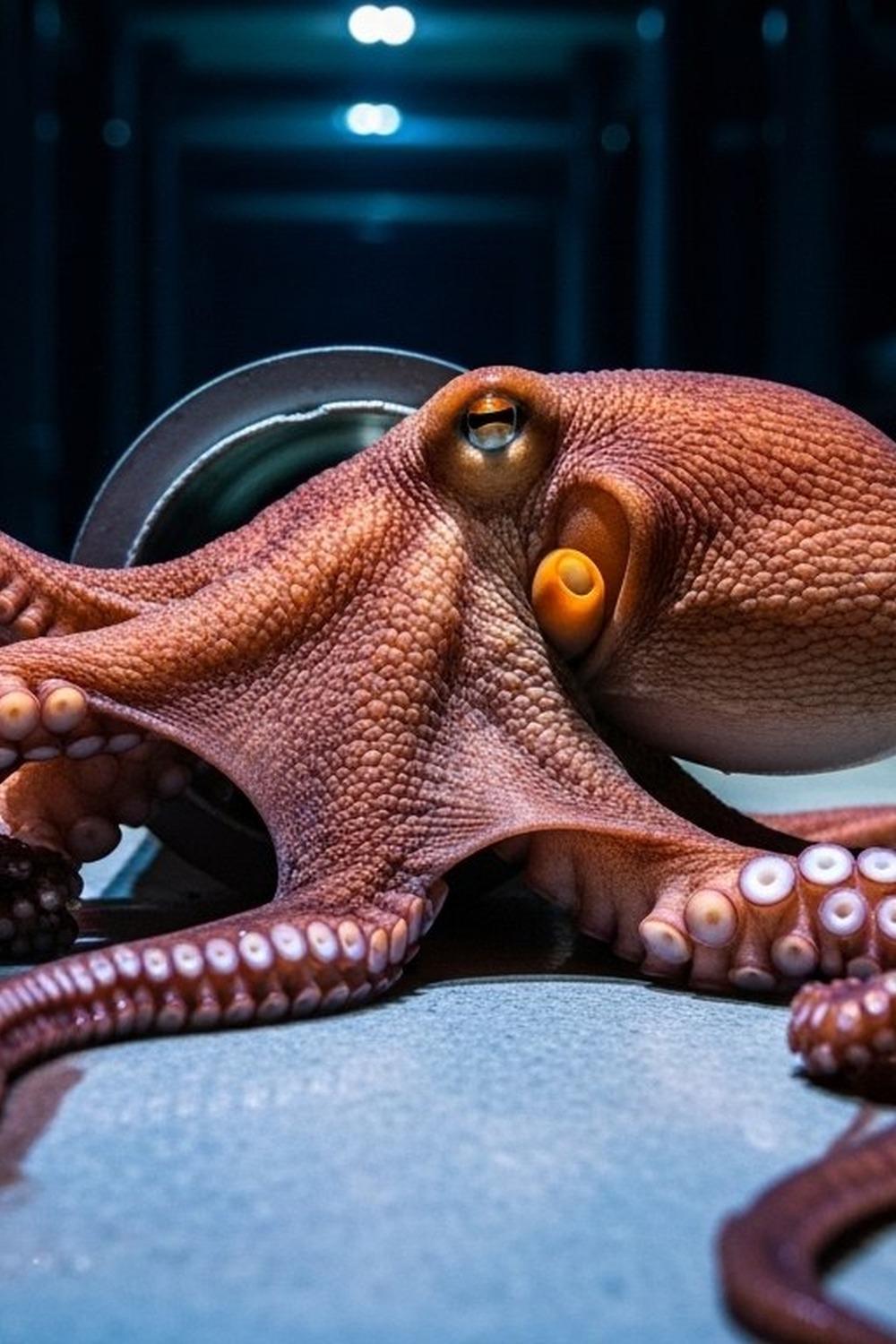
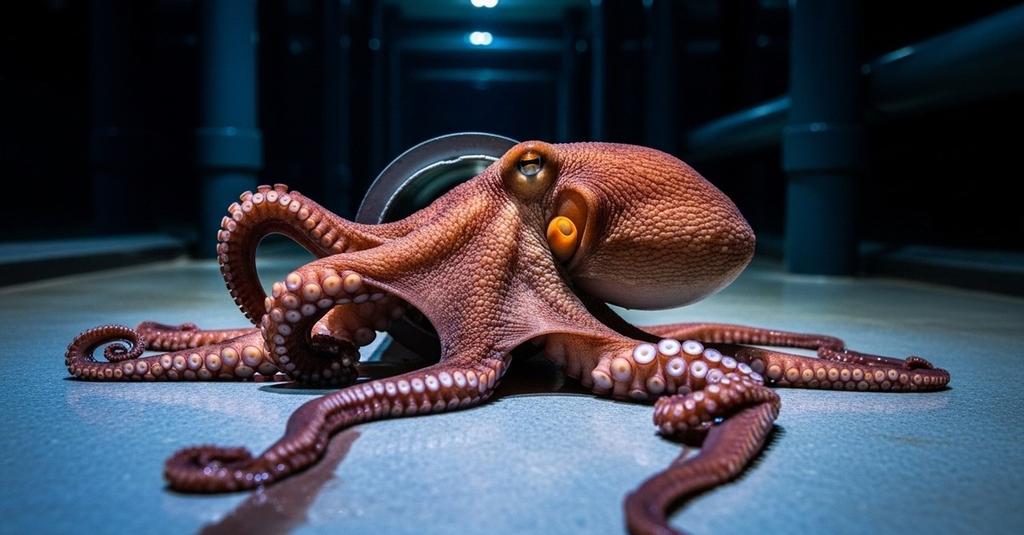
The National Aquarium of New Zealand sits in Napier, a small coastal city on the North Island. Sometime between closing on a night in late 2015 and opening the next morning, staff arrived to find one tank empty. Not overturned. Not damaged. Empty. Glistening floor tiles marked where something wet had crossed roughly 1.8 meters of open ground. At the baseboard, a drainpipe outlet — 15 centimeters wide — showed signs of disturbance. The pipe ran fifty meters before opening into Hawke’s Bay. By April 2016, when aquarium manager Rob Yarrall went public with the story, Inky the octopus was already gone, already legend, already the beginning of a very different kind of conversation about what these animals actually are.
Key Facts
- Inky the octopus escaped the National Aquarium of New Zealand in Napier sometime in late 2015, confirmed publicly by aquarium manager Rob Yarrall in April 2016.
- Inky pushed through a gap roughly 15 centimeters wide, crossed about 1.8 meters of floor, and traveled approximately 50 meters through a drainpipe to Hawke’s Bay.
- An octopus has approximately 500 million neurons, with about two-thirds located in its eight arms rather than its central brain.
- A 2010 University of Otago study published in Current Biology documented wild octopuses carrying coconut shells for deferred shelter, the first case of invertebrate tool use.
- A 2019 review across seventeen aquarium facilities found fewer than 40 percent of octopus enclosures included environmental enrichment.
In short: The Inky the octopus escape saw a common octopus squeeze through a 15-centimeter gap at New Zealand’s National Aquarium in late 2015, cross the floor, and travel about 50 meters through a drainpipe to the ocean. Confirmed in April 2016, it sharpened scientific debate over cephalopod intelligence and triggered enrichment reforms at major aquariums.
How Inky the Octopus Escape Actually Happened
Start with the body. An octopus is almost entirely soft tissue — muscle, organ, mantle, all of it negotiable. One exception exists: the beak. That hard, parrot-like jaw sits at the center where the arms converge, and it genuinely cannot compress. Everything else flows. Scientists have long used this anatomical fact to model how boneless organisms navigate three-dimensional space, but Inky’s escape gave them something they hadn’t asked for — a vivid, real-world sequence of it actually happening.
The mechanics alone demand attention. An octopus can reduce its apparent volume under muscular compression so dramatically that a gap designed to prevent escape becomes merely a suggestion. For Octopus vulgaris — the common New Zealand octopus Inky was — a beak roughly the size of a parrot’s beak meant that 15 centimeters might as well have been an open door. He pushed through the gap in his tank lid, crossed the open floor, located the drainpipe outlet, and threaded himself through it. Fifty meters of pipe. No guarantee of what waited at the other end. He was never seen again. Octopus vulgaris is one of the most widely studied cephalopod species on Earth — and still one of the least understood.
What strikes researchers isn’t the flexibility.
It’s the sequencing. Inky didn’t just squeeze out of a gap — he identified a specific exit and committed to a fifty-meter tunnel with no guarantee of what waited. That’s not reflex. That’s something else entirely.
The Mind Inside Eight Arms
To understand why the Inky the octopus escape generated genuine scientific attention and not just headlines, consider the nervous system itself. These animals have approximately 500 million neurons — comparable in raw count to some mammals. But here’s what makes it genuinely strange: roughly two-thirds of those neurons aren’t in the brain at all. They’re distributed through the arms. Each arm processes information semi-independently, sensing and responding to its environment without waiting for central instruction. It’s a kind of intelligence that doesn’t map cleanly onto anything vertebrates do.
In 2010, researchers at the University of Otago published observations that changed everything. They watched octopuses in the field collecting coconut shell halves, carrying them across the seafloor, and later assembling them into portable shelters. This was the first documented case of invertebrates using tools with deferred purpose — the octopus carried the shell not because it was useful in the moment, but because it planned to use it later. Current Biology published the paper, and marine biology suddenly had to reconsider what tool use actually means. Inky’s escape fits the same pattern. Action taken now. Future payoff not yet visible.
Aquarium staff had noted something about Inky before he left. He watched people. He reached for equipment. He responded differently to different individuals. That’s not metaphor — controlled studies have shown that octopuses recognize and remember individual human faces, a skill requiring perceptual discrimination we don’t typically assign to mollusks. If you’ve ever been curious about how ocean creatures evolve unexpected survival strategies, the same principle runs through pygmy seahorse camouflage, where concealment is so total that scientists spent decades missing species in plain sight.
What Science Still Doesn’t Know About Octopus Intelligence
Why does octopus behavior matter so much to marine biologists? Because it forces a choice: either these animals constitute genuine planning and intentionality, or we’re anthropomorphizing an organism very good at responding to stimuli. Jennifer Mather, a comparative psychologist at the University of Lethbridge in Canada, has spent decades arguing the former. Her 2008 paper examining play behavior in octopuses suggested that these animals engage in activities with no immediate survival function — a behavioral science hallmark of cognitive complexity. Smithsonian Magazine’s exploration of octopus cognition remains one of the most thorough lay accounts of where this science stands and where it keeps hitting walls.
The skeptical counterargument deserves serious consideration. Octopuses are solitary, short-lived, and don’t raise their young — conditions that evolutionary biologists associate with simpler cognitive architecture. They don’t cooperate, negotiate, or teach. So why would they evolve the social intelligence that usually drives brain complexity in mammals? The Inky the octopus escape doesn’t resolve this question. It sharpens it. Because whatever Inky did — whether we call it planning, problem-solving, or something we don’t yet have language for — it worked. Repeatedly. With precision. In the dark. Watching a sequence unfold this deliberately, and being unable to explain the inner experience driving it, that’s when the limits of our understanding become impossible to ignore.
Mather herself acknowledges the genuine methodological challenge: studying an animal with no facial expressions, no vocalizations, and a body that can change color and texture in milliseconds creates a language problem. We’re reading an alphabet we don’t have.
Inky’s Escape and What It Revealed About Captivity
The dimension that gets less attention: what the Inky the octopus escape says about keeping these animals in captivity at all. The National Aquarium in Napier is respected — accredited, conservation-focused, staffed by people who clearly cared about Inky. And yet he still left. Researchers at the New England Aquarium in Boston, which has maintained octopus exhibits for decades, have documented chronic low-level stress responses in captive cephalopods. Animals that repeatedly test enclosure boundaries. Animals that alter resting patterns. Animals that reduce feeding. These are the markers zoological science uses to flag poor welfare outcomes.
The numbers tell the story. A 2019 review by the Cephalopod Page project, drawing on welfare assessments across seventeen aquarium facilities in Europe and North America, found that fewer than 40 percent of octopus enclosures included environmental enrichment — objects, puzzles, variable terrain designed to engage problem-solving capacity. Octopuses deprived of stimulation show higher rates of autophagy, where they begin consuming their own arms. In an animal this cognitively active, boredom has real physiological consequences.
Since 2016, several major aquariums redesigned their cephalopod exhibits. But the quiet conversation within the aquarium community remained pointed: were standard tank designs genuinely adequate for animals of this cognitive complexity?
The Monterey Bay Aquarium in California introduced rotating enrichment programs specifically after Inky’s escape. Staff now routinely give octopuses childproof bottles, puzzle feeders, novel objects on weekly rotation. Whether it’s enough remains an open question — but at minimum, Inky forced the reckoning.
How It Unfolded
- 2008 — Jennifer Mather and Roland Anderson publish observations of play behavior in captive octopuses at the Seattle Aquarium, one of the first systematic studies suggesting non-instrumental cognition in cephalopods.
- 2010 — University of Otago researchers document tool use in wild octopuses carrying coconut shells for deferred shelter construction, published in Current Biology and forcing a redefinition of invertebrate intelligence benchmarks.
- 2016 — Inky the octopus escapes from the National Aquarium of New Zealand in Napier, traveling fifty meters through a drainpipe to Hawke’s Bay; the story goes globally viral and triggers fresh scientific and welfare debate.
- 2019 — A cross-facility welfare review finds the majority of aquarium octopus enclosures lack enrichment, prompting revised husbandry guidelines from the World Association of Zoos and Aquariums.
By the Numbers
- 500 million neurons in a typical octopus — roughly equivalent to the neuron count of a domestic dog, distributed across the brain and arms (Mather, University of Lethbridge, 2010).
- 50 meters — the length of the drainpipe Inky traversed from tank to ocean at the National Aquarium of New Zealand in 2016.
- Two-thirds of an octopus’s neurons are located not in its central brain but in its eight arms, each of which can process sensory information semi-autonomously.
- Fewer than 40 percent of octopus enclosures in a 2019 seventeen-facility survey included any form of environmental enrichment.
- Octopus lifespans average just 1–2 years for most species — making their cognitive complexity all the more remarkable given how little time natural selection had to work with.
Field Notes
- In 2021, researchers at the University of Naples Federico II observed octopuses in the Mediterranean apparently punching fish that had failed to contribute usefully during joint foraging sessions with other species — a team described it cautiously as apparent punitive behavior, suggesting social rules in animals not previously thought to have them.
- Octopuses are colorblind, yet they produce extraordinarily precise color camouflage — a paradox that has puzzled researchers for years; the current leading hypothesis involves photoreceptors distributed across the skin itself, essentially “seeing” color without using eyes.
- Inky was not the only octopus to escape the National Aquarium of New Zealand. A companion octopus shared his tank and apparently chose not to leave — a detail that makes Inky’s departure feel, if anything, more deliberate.
- Researchers still cannot explain with certainty how octopuses navigate during open-water journeys — whether they use magnetic fields, current cues, chemical gradients, or something else entirely remains unresolved, and it matters enormously for understanding what Inky’s fifty-meter pipe swim actually represented.
Frequently Asked Questions
Q: What exactly happened during the Inky the octopus escape, and was it ever fully explained?
The Inky the octopus escape occurred sometime between closing one night in late 2015 and opening the next morning. The aquarium confirmed it publicly in April 2016. Inky pushed through a gap in his tank lid — estimated at roughly 15 centimeters — crossed 1.8 meters of open floor, entered a drainpipe, and traveled approximately fifty meters to an ocean outflow. Aquarium staff reconstructed the sequence from physical evidence. No one witnessed it directly. Inky was never recovered.
Q: How can an octopus fit through such a small opening?
An octopus’s body is almost entirely soft tissue with no rigid skeleton except for one exception: the beak. A hard, keratin-like structure at the center of the arms used for feeding. As long as an opening is larger than the beak, the octopus can generally compress its mantle, organs, and arms to squeeze through. For Inky, whose beak was roughly the size of a parrot’s, that meant a surprisingly small gap was all that stood between his tank and the Pacific Ocean. The mantle alone can reduce its apparent volume dramatically under muscular compression.
Q: Does the Inky story prove octopuses are intelligent, or is that an overstatement?
Most behavioral scientists would say it’s evidence of sophisticated problem-solving, but not definitive proof of intelligence in the way the word is often used. Octopuses demonstrably learn, remember, and adjust behavior based on experience — those are measurable. Whether that constitutes planning, intentionality, or consciousness remains genuinely contested. Jennifer Mather at the University of Lethbridge argues it does. Others maintain the bar for those terms requires evidence we don’t yet have. Inky’s escape is compelling data, not a closed case.
Editor’s Take — Alex Morgan
What I keep coming back to isn’t the escape itself — it’s the companion octopus who didn’t leave. Same tank, same gap, same drainpipe. One went, one stayed. If this were pure instinct or reflex, you’d expect both to go. The fact that one chose not to — or didn’t notice, or didn’t want to — is the detail that keeps this story from being just clever animal behavior. It starts to look like individual decision-making. And that’s a much harder thing to explain away.
Inky is almost certainly dead by now. Common octopuses rarely live beyond two years even in the wild, and his escape happened nearly a decade ago. But the questions he left behind have longer lifespans than he did. How much of what we call intelligence is actually just problem-solving we haven’t recognized yet? How many animals are navigating inner lives we’ve never thought to look for? Somewhere in Hawke’s Bay, a drainpipe still opens into the Pacific — and the water moving through it doesn’t know anything about the debate it started.
Illustrations are AI-generated. Article fact-checked and human-edited. Our editorial standards.