The Strawberry Squid That Lights Up the Deep Ocean
Nobody on the crew was expecting the third squid to be the one. Two had already come up in the net — unremarkable, logged, set aside. Then this thing appeared, crimson and jeweled and quietly running its own light show, and someone just stopped.
NOAA’s Deep-See expedition had been pushing through the mesopelagic zone for weeks — one of the ocean’s least-visited corridors, 200 to 1,000 meters down, no sunlight, no landmarks, no real sense of scale. The final trawl brought up three squid total. That’s it. And one of them was a strawberry squid in full, undeniable form. Phones came out. Someone apparently stood there for a full minute, not photographing, not logging anything. Just looking. When trained scientists forget to take notes, something genuinely unusual is sitting in front of them.
Key Facts
- The strawberry squid, Histioteuthis heteropsis, reaches up to 13 centimeters in mantle length and is covered in hundreds of densely packed light-producing photophores.
- Its left eye is dramatically larger and points upward to scan for silhouettes, while its smaller right eye angles downward to watch for bioluminescent flashes below.
- The mesopelagic zone where it lives stretches 200 to 1,000 meters deep and holds an estimated 660 million cubic kilometers of water.
- Roughly 76% of all marine animals produce bioluminescence, making it the dominant communication method at these depths.
- Scientists have mapped over 99% of Mars in high resolution but only about 20% of Earth’s deep ocean floor.
In short: This story follows a NOAA Deep-See trawl that pulled up three squid, one a strawberry squid in full strawberry squid bioluminescence. Histioteuthis heteropsis uses hundreds of photophores and two mismatched eyes to survive the mesopelagic zone, 200 to 1,000 meters down, in a deep ocean we have barely mapped.
How Strawberry Squid Bioluminescence Actually Works
The glowing spots covering Histioteuthis heteropsis aren’t decoration. Each one is a photophore — a dedicated light-producing organ the squid controls with what researchers describe as almost unsettling precision. Dr. Edith Widder, who’s spent decades studying deep-sea bioluminescence, has documented how these organs pulse, dim, and modulate — not randomly, but in patterns that look less like a party trick and more like vocabulary. You can read more about photophore biology on Wikipedia’s photophore page.
Here’s the thing about the deep ocean: there’s no sunlight to reflect down there. No color. The only light that exists is the light animals manufacture themselves. So bioluminescence isn’t some evolutionary novelty. It’s infrastructure — built over millions of years, refined by pressure and darkness into a communication system we’re honestly still fumbling to decode. So what is the squid actually saying? And to whom?
That question kept me reading about this for another hour.
The Deep-See Cruise Pulled Up Something Rare
The mesopelagic zone is one of those places scientists talk about in terms of volume — an estimated 660 million cubic kilometers of water. Not a metaphor for “it’s big.” That’s the actual number. A world without sunlight, without landmarks, without any of the spatial cues we rely on to orient ourselves. The strawberry squid has been living its full, complex life in that space, entirely indifferent to our ignorance of it.
The crew’s reaction to that specimen matters more than it might seem. Scientists are trained to stay detached — to observe without reacting. When the detachment fails, you’re usually looking at something that breaks your existing mental categories. The strawberry squid did that.
If you’re curious about other creatures living in these forgotten corridors, this-amazing-world.com has more stories from the deep that don’t get nearly enough attention.
A World We’ve Mapped Less Than Mars
Here’s a number worth sitting with: we’ve mapped more of Mars’s surface than we have of Earth’s deep ocean floor. Specifically, Mars sits at over 99% mapped in high resolution. Earth’s ocean floor? Roughly 20%.
Scientists now estimate the mesopelagic zone may contain ten times more fish biomass than previously calculated. Ten times. The revision isn’t a minor correction — it’s a complete overhaul of what we thought we knew about life in that layer. The strawberry squid isn’t some rare aberration down there. It might be closer to typical.
That thought should be unsettling. In the best possible way.
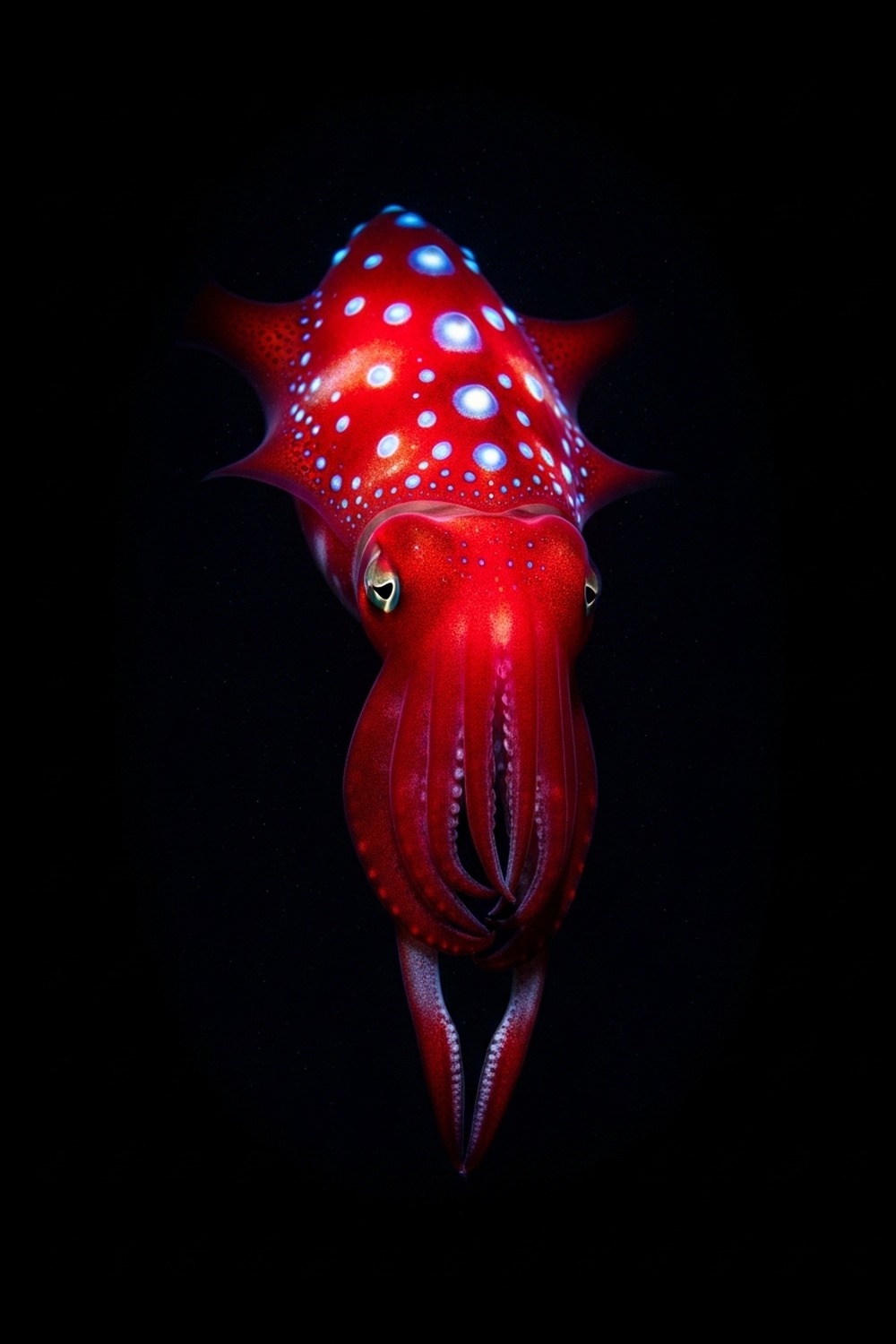
One Eye Is Bigger Than the Other — On Purpose
The thing about Histioteuthis heteropsis that doesn’t get talked about enough is the eyes. It has two completely different ones. The left eye is dramatically larger — almost bulging — and it points upward. The right is smaller, angled downward into the dark below. This isn’t a deformity or a developmental quirk.
Turns out it’s a split visual strategy operating simultaneously. The large eye scans upward for silhouettes backlit by the faint, filtered surface light trickling down from above. The small eye watches below for bioluminescent flashes from other creatures moving through the dark. One animal, two completely different ways of seeing, running in parallel at all times.
That kind of biological engineering takes millions of years to develop — and it develops because the deep ocean isn’t simply dark. It’s dark in specific, structured ways that evolution has learned to exploit, layer by layer, organ by organ. The strawberry squid isn’t surviving down there despite the darkness. It’s built for it.
By the Numbers
- The mesopelagic zone stretches 200 to 1,000 meters deep and contains an estimated 1 billion tons of carbon-cycling organisms, per a 2014 study in Nature Communications.
- Roughly 76% of all marine animals produce bioluminescence — making it the dominant form of communication at these depths, more common than sound or chemical signaling.
- Photophores in the hundreds, densely packed.
- Histioteuthis heteropsis reaches up to 13 centimeters in mantle length, but those photophores are distributed across its lower body in a pattern that appears unique to each individual squid — which raises the obvious question of whether they’re identifying themselves to each other, and nobody’s quite answered that yet.
- Mars: 99%+ mapped. Earth’s ocean floor: roughly 20%.
Field Notes
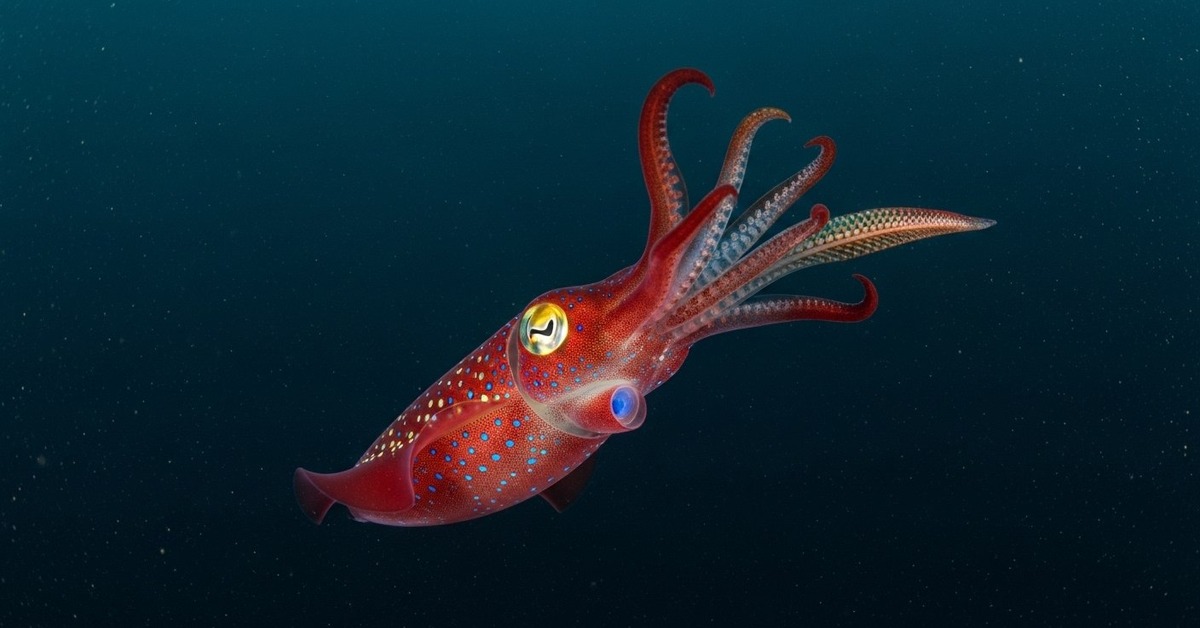
- Some Histioteuthis species have internal photophores visible through their semi-transparent mantle — meaning they glow from the inside out. Less like wearing a light. More like being one.
- These squid are notoriously difficult to study alive. The pressure change during retrieval from depth is usually fatal, which means most of what researchers know about their behavior comes from dead specimens, brief ROV footage, and inference. We’re essentially reading the book from the back cover.
- Primary prey for sperm whales, elephant seals, several tuna species.
- The strawberry squid’s bioluminescence may be evolving in direct response to predators that hunt partly by detecting light flashes — which means the squid’s most sophisticated feature might also be its greatest liability. The glow that helps it communicate could be the same glow that gets it eaten.
Why the Strawberry Squid Changes How We Think
The strawberry squid bioluminescence story isn’t really about one unusual animal. It’s about what happens when you look closely at a place you assumed was empty.
The deep ocean has been treated, historically, as a void — something between the surface world and the seafloor, not quite worth serious attention. Then you send a net down during the final trawl of a research cruise, haul up three squid, and one of them is running a light show that evolution spent millions of years choreographing. The void was never empty. We just weren’t looking, and honestly weren’t equipped to look even when we tried.
Every specimen retrieved from these depths rewrites a small piece of what we thought we knew. Every trawl is a dispatch from a world operating in parallel to ours — different rules, different senses, different languages made of light instead of sound, of pulse instead of word. And the stakes aren’t abstract. What lives in the deep ocean regulates carbon cycles, anchors food webs, shapes the chemistry of water that eventually becomes water we depend on. Understanding it isn’t a curiosity. It’s overdue.
Three squid. That’s all it took to stop a research crew cold and remind them that the most extraordinary things on this planet aren’t waiting to be found on some distant world. They’re already here, glowing in the dark, 800 meters below the surface, living lives we’ve only just started paying attention to. The ocean keeps its secrets close. But every now and then, a net comes up, and one of those secrets is crimson, jeweled, and impossible to look away from. There’s more at this-amazing-world.com — and the next one is stranger still.
Frequently Asked Questions
Q: How does strawberry squid bioluminescence actually work?
The glowing spots on Histioteuthis heteropsis are photophores, dedicated light-producing organs the squid controls with precision. Deep-sea researcher Dr. Edith Widder has documented how these organs pulse, dim, and modulate in patterns rather than randomly. Because there is no sunlight below roughly 200 meters, the only light in the mesopelagic zone is what animals manufacture themselves, making bioluminescence a core communication system refined over millions of years.
Q: Why does the strawberry squid have two different-sized eyes?
The squid runs a split visual strategy simultaneously. Its dramatically larger left eye points upward to detect silhouettes backlit by faint surface light filtering down, while its smaller right eye angles downward into the dark to catch bioluminescent flashes from other creatures. This is not a deformity but evolved biological engineering, letting one animal watch two zones of the ocean at once at depths around 800 meters.
Q: How deep is the mesopelagic zone where the strawberry squid lives?
The mesopelagic, or twilight, zone stretches from 200 to 1,000 meters deep and contains an estimated 660 million cubic kilometers of water with no sunlight. A 2014 study in Nature Communications estimated it holds about 1 billion tons of carbon-cycling organisms. Scientists now believe this layer may contain ten times more fish biomass than previously calculated, meaning the strawberry squid may be closer to typical than rare.
Illustrations are AI-generated. Article fact-checked and human-edited. Our editorial standards.