The Penguin Who Fell in Love With a Cardboard Cutout
Here’s the thing about the Grape-kun penguin cardboard cutout story: it shouldn’t have meant anything. A zoo acquires a promotional figure from an anime series. Staff place it in an elderly penguin’s enclosure, more or less as background decoration. And then — nothing happens, except that a 21-year-old bird walks over and doesn’t walk away again. For months. That’s the whole story. And yet it gutted people.
Grape-kun was a Humboldt penguin at Torii Pine Zoo in Higashiyama, Japan. His mate Midori had left him — reassigned to another facility. Zoo staff placed a promotional cutout from the anime series Kemono Friends inside his enclosure, featuring Hululu, a cheerful cartoon penguin roughly his own height. What happened next wasn’t funny. It wasn’t a meme. It was something harder to name.
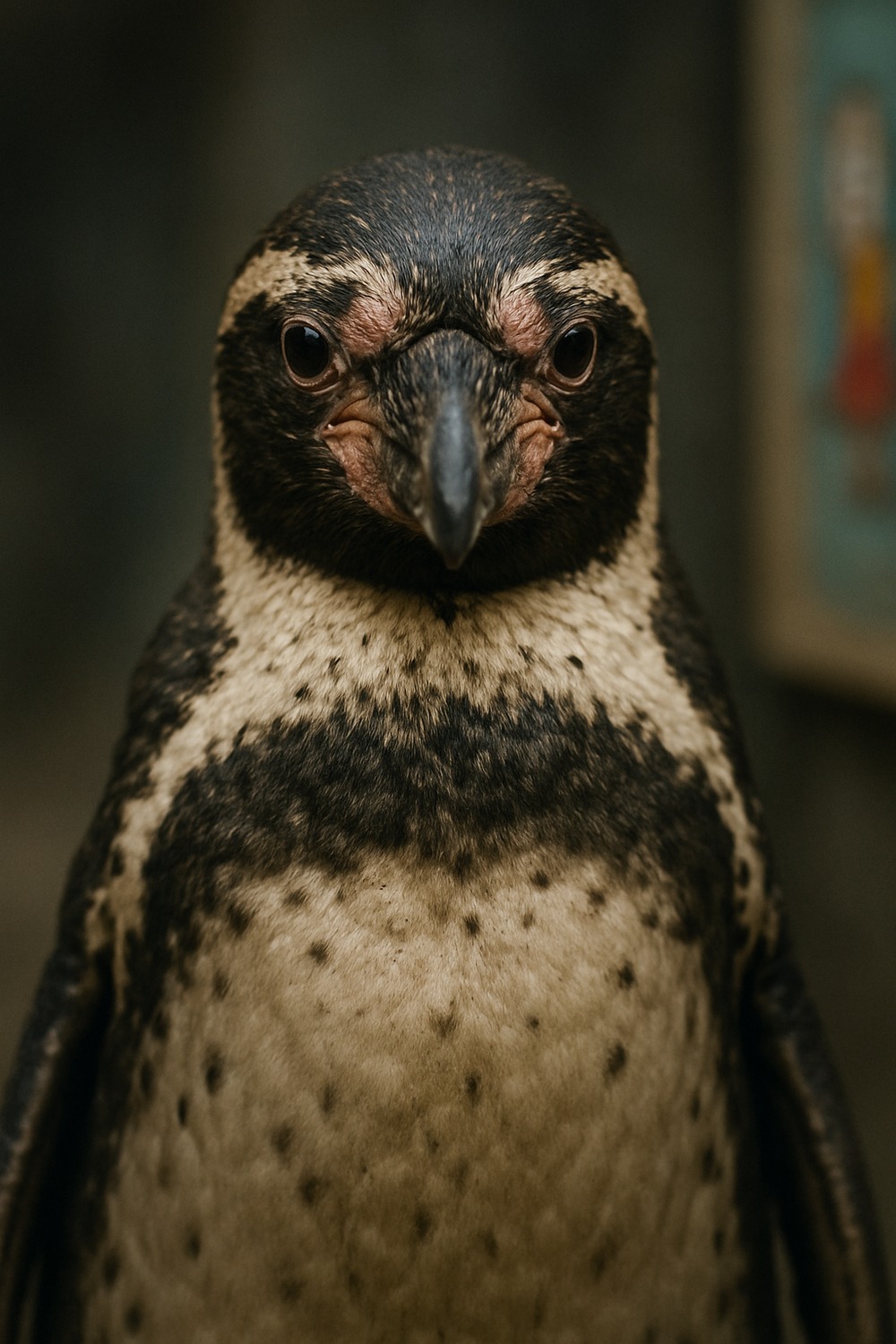
The Lonely Humboldt Who Chose a Paper Companion
Humboldt penguins — Spheniscus humboldti — are not solitary animals. They evolved along the cold Humboldt Current off the coasts of Peru and Chile, huddling in dense breeding colonies where pair bonds are everything. According to research published by the Humboldt penguin’s species profile on Wikipedia, these birds are known to mate for life, returning to the same nest and the same partner season after season — a consistency that behavioral ecologists at the University of Washington have described, since at least 2009, as among the most robust monogamous systems observed in any seabird. In the wild, they live 15 to 20 years. In captivity, slightly longer. Grape-kun, at 21, was already an elder by any measure.
His body knew it. So, in all likelihood, did he. When Midori left — as reported by Japanese media in 2017 — his behavior shifted. He became still. He ate less enthusiastically. He stopped engaging with the social activity around him. Zoo staff at Torii Pine noted the change but had few tools to address it. Penguins don’t respond to therapy. They respond to presence.
What Grape-kun had lost was presence — warm, breathing, familiar presence — and nothing in his enclosure replaced it. Until the cutout arrived. The Hululu figure was roughly his height. She faced forward, smiling. She didn’t move. Grape-kun walked directly to her and stayed. Hours passed. Keepers watched. He wasn’t confused — or if he was, the confusion clearly didn’t trouble him. He had found something to stand beside.
When Animals Bond Beyond Their Own Kind
What changed? Everything, starting with what we thought we understood about attachment.
Grape-kun’s story isn’t the first time an animal has formed a profound attachment to something that can’t reciprocate in any biological sense. The psychological literature on infant macaques clinging to surrogate objects for years goes back to Harry Harlow’s landmark contact-comfort experiments in the 1950s — studies that fundamentally changed how scientists understood the nature of attachment. What Harlow demonstrated was that warmth and presence, even simulated presence, could function as a genuine psychological anchor. The organism’s nervous system doesn’t always distinguish between what’s real and what’s reliably there (researchers actually call this “stimulus equivalence,” and it matters more than it sounds).
Grape-kun’s behavior sits in that same strange territory. He wasn’t deceived by Hululu. He was comforted by her constancy. There’s a difference. In the months following the cutout’s placement in 2017, Torii Pine Zoo became a pilgrimage destination. Visitors arrived expecting to laugh and left feeling something closer to tenderness. Some brought flowers. Some left handwritten notes along the fence.
The zoo documented Grape-kun spending the majority of his daylight hours stationed in front of Hululu — not pacing, not vocalizing distress, but standing quietly, oriented toward her. His food intake stabilized. His keepers described him as calmer than he’d been in months. Whatever the mechanism, the outcome was measurable. Social media accelerated everything. By mid-2017, Grape-kun was a phenomenon across Japan and beyond. The production studio behind Kemono Friends acknowledged his devotion publicly, and the character Hululu was officially recognized as his partner — absurd and earnest and completely, irreducibly real.
What Science Says About Grief and Attachment in Birds
Grief in animals is not a metaphor. A 2016 study from the University of Exeter, published in the journal Animal Behaviour, identified prolonged social withdrawal, reduced foraging, and altered vocalizations as measurable grief markers in multiple avian species following the loss of a bonded partner. Oxytocin pathways, dopamine regulation, stress hormone levels: the biology of loss doesn’t respect the boundaries between classes. The researchers found that pair-bonded birds — penguins, albatrosses, corvids — show neurochemical responses to separation that closely mirror those observed in socially bonded mammals. For a more detailed exploration of how loss reshapes animal behavior, the Smithsonian Magazine’s investigation into animal grief offers a rigorous and moving survey of current evidence.
That Grape-kun grieved at all wasn’t surprising. What was unusual was that he found resolution. Most birds in his situation don’t — they remain withdrawn until death or until a live partner is introduced. His behavioral shift after Midori’s departure matched documented grief responses in Humboldt penguins previously described by researchers at the San Francisco Zoo in 2014. And yet he pulled back from the edge of that withdrawal in a way the literature hadn’t quite anticipated.
A species heading toward fewer than 12,000 individuals in the wild, classified Vulnerable on the IUCN Red List, and we’re only now understanding how badly isolation damages the ones we keep — that oversight is going to look worse with time.
Turns out, presence might be more malleable than anyone expected. Grape-kun’s case was widely cited in behavioral ecology discussions about what “social need” actually requires at a neurological level — not because any peer-reviewed paper emerged specifically about him, but because his documented stability raised questions nobody had clean answers for.
The Final Days of the Grape-kun Penguin and His Cutout
By October 2017, Grape-kun’s health was declining. At 21 years old, he was moving toward the outer boundary of what any Humboldt penguin — wild or captive — had ever survived. Torii Pine Zoo staff noted changes in his gait, his appetite, his energy. Through the summer and into early autumn, the Grape-kun penguin cardboard cutout remained in his enclosure. He continued to orient himself toward it. Visitors continued to come.
The offerings along the fence accumulated. There was something liturgical about it — this quiet vigil maintained by strangers for a bird none of them had met, mourning a loss none of them had witnessed, in front of an image that couldn’t feel anything at all.
He died on October 12, 2017. Torii Pine Zoo announced his passing on Twitter, and the response was immediate and overwhelming — tens of thousands of messages from Japan, South Korea, the United States, and Europe. The production studio for Kemono Friends released a tribute illustration: Hululu drawn with a single tear on her cheek. The studio’s official statement said simply that they hoped Grape-kun and Hululu would meet again somewhere. For a promotional tie-in that had begun as background decoration, it had traveled very far.
After his death, the Hululu cutout was retired from the enclosure and placed in storage at the zoo. A memorial was held. Staff and longtime visitors attended. The Grape-kun penguin cardboard cutout — so casually placed in that enclosure months before — was, in the end, treated with the same care as any meaningful object left behind by someone who had mattered.
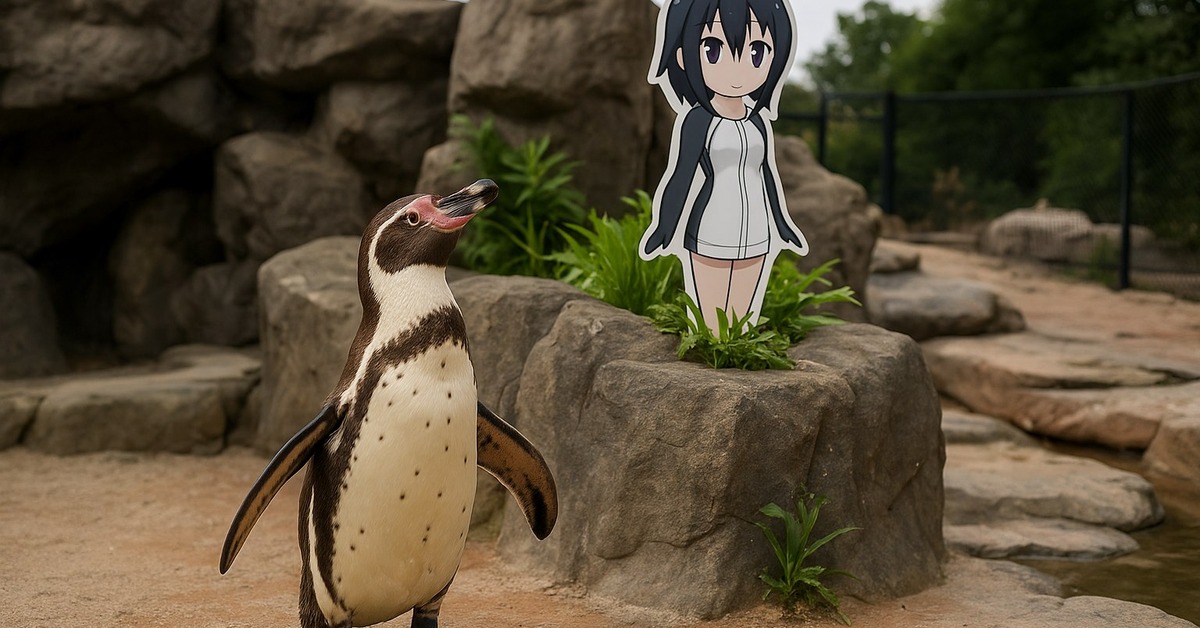
How It Unfolded
- 2017, spring: Torii Pine Zoo staff place Kemono Friends promotional cutouts throughout the park, including a Hululu figure inside Grape-kun’s enclosure.
- 2017, June–July: Japanese media first report Grape-kun’s attachment to the cutout; the story spreads rapidly across social media platforms in Japan and internationally.
- 2017, August: The production studio behind Kemono Friends officially acknowledges Grape-kun’s devotion; Hululu is declared his partner in a public statement; visitors begin leaving flowers and notes at the zoo fence.
- 2017, October 12: Grape-kun dies at age 21; Torii Pine Zoo’s announcement draws hundreds of thousands of responses worldwide; a tribute illustration from the Kemono Friends studio circulates globally within hours.
By the Numbers
- 21 years: Grape-kun’s age at death in 2017 — significantly exceeding the Humboldt penguin’s wild life expectancy of 15–20 years
- Humboldt penguins spend roughly 70–80% of their lives within established pair bonds, according to behavioral surveys conducted along the Chilean coast (Centro de Estudios del Cuaternario, 2015)
- Fewer than 12,000 Humboldt penguins remain in the wild as of the most recent IUCN Red List assessment, classifying the species as Vulnerable
- Grape-kun stood before the Hululu cutout for an estimated 8–10 hours per day during peak months, according to keeper observations reported by Japanese media in 2017
- Over 150,000 retweets: the reach of the Kemono Friends tribute illustration within 48 hours of Grape-kun’s death, making it one of the most widely shared wildlife memorial posts in Japanese social media history
Field Notes
- Grape-kun’s story prompted Torii Pine Zoo to formally review its protocols for socially isolated elderly penguins — a policy shift that hadn’t been considered before 2017, when most zoo welfare literature focused on juveniles and breeding pairs rather than aged animals living alone.
- Humboldt penguins can recognize individual humans by face and voice — a cognitive capacity documented by researchers at the Penguin Sentinel Project in Chile, suggesting Grape-kun’s ability to distinguish “familiar presence” from random stimuli was far more sophisticated than casual observers assumed.
- Before Grape-kun’s story broke, the Kemono Friends anime had languished in near-total obscurity; late 2017 brought a dramatic surge in streaming viewership — an accidental outcome the studio’s producers publicly described as bittersweet.
- Researchers still can’t fully explain why Grape-kun’s attachment to the cutout produced measurable behavioral improvement rather than indifference. Was it the image’s penguin-like proportions? The static, predictable presence? The specific placement at his eye level? The honest answer is: nobody knows.
Frequently Asked Questions
Q: What exactly happened between Grape-kun and the penguin cardboard cutout — did he really think it was real?
Almost certainly not in any literal sense. Grape-kun was a 21-year-old penguin with decades of lived experience around both real animals and human zoo visitors. The more likely explanation, supported by behavioral ecology research, is that the cutout provided a consistent, non-threatening visual anchor that satisfied some component of his social need without requiring him to process it as a genuine conspecific. His brain found something useful in her presence. That’s different from being fooled.
Q: Are Humboldt penguins really monogamous, and what happens when they lose a partner?
Humboldt penguins are functionally monogamous across breeding seasons, returning to established nest sites and preferred partners year after year. When a bond is broken — through death, separation, or relocation, as happened when Midori was transferred — the remaining bird typically shows marked behavioral changes including reduced activity, decreased foraging, and social withdrawal. Some birds eventually re-pair. Others, particularly older individuals, don’t. Grape-kun was 21 when Midori left, an age at which new social bonds become increasingly unlikely.
Q: Is the Grape-kun penguin cardboard cutout story just a viral moment, or does it have real scientific significance?
Both — and it’s worth separating them. As a viral story, it was widely misread as simply charming or funny. As a behavioral case study, it raised genuine questions about what “social presence” requires neurologically — whether visual constancy alone can buffer against grief-related decline in birds. No formal study was published specifically about Grape-kun, but his case has been referenced in captive animal welfare discussions since 2017, particularly around the management of elderly pair-bonded animals living in isolation.
Editor’s Take — Alex Morgan
What stays with me isn’t the cutout. It’s the flowers people left along the fence. Strangers, arriving to watch a penguin stand in front of a piece of cardboard, feeling something so strongly they needed to leave an offering. We project, yes — but we don’t project randomly. Grape-kun wasn’t performing grief or attachment. He was simply present with what he had. And somehow, watching that, people recognized something in themselves they couldn’t quite articulate. That’s not anthropomorphism. That’s biology finding its mirror.
Grief looks different across species, but its architecture is surprisingly consistent — withdrawal, stillness, the pull toward whatever remains. Grape-kun didn’t overcome his loss. He found a way to be beside it, in front of a smiling paper penguin who never moved and never left. The zoo filled with flowers. The internet filled with grief of its own. And somewhere in that cascade of feeling — stranger and human and digital all at once — a question sits unanswered: what is presence, exactly, and how little of it do we actually need to feel less alone?