Praying Mantis Facts for Kids: The Garden Ninja
Praying mantis facts for kids are usually a list of weird body parts — five eyes, a swivel head, those scary front legs. Here is the version with the real science underneath. The praying mantis is a tiny ambush hunter that sees the world in 3D, hears with one ear in the middle of its chest, and can stay completely still on a leaf for hours. Scientists call it one of the cleverest insects on Earth. Gardeners just call it a friend.

Key Facts
- Scientists have described more than 2,400 praying mantis species, found on every continent except Antarctica.
- A praying mantis has five eyes — two large compound eyes plus three tiny simple eyes called ocelli on top of its head.
- It has only one ear, hidden in the middle of its chest between the back legs, tuned to ultrasonic bat calls.
- The praying mantis is the only insect ever proven to see in true 3D, confirmed in 2016 by neuroscientist Jenny Read at Newcastle University.
- A mantis can rotate its head 180° — a full half-circle — without moving the rest of its body.
In short: The praying mantis is a small, harmless-to-humans hunter with the senses of a science-fiction robot. It eats garden pests, sees in three dimensions, and lays its eggs inside a tough foam case that can survive a snowy winter.
Key Facts
- Scientists have described more than 2,400 praying mantis species in the order Mantodea, found on every continent except Antarctica.
- A praying mantis has five eyes, two large compound eyes plus three tiny simple eyes called ocelli on top of its head.
- It has only one ear, hidden in the middle of its chest between the back legs, tuned to ultrasonic bat calls of about 20-100 kHz.
- The praying mantis is the only insect proven to see in true 3D (stereopsis), confirmed in 2016 by neuroscientist Jenny Read at Newcastle University.
- A mantis can rotate its head 180 degrees, and its strike takes roughly 50-100 milliseconds, faster than a human blink.
In short: The praying mantis is a small, harmless-to-humans ambush hunter with senses like a science-fiction robot. It eats garden pests, is the only insect proven to see in true 3D, and lays its eggs inside a tough foam case that can survive winter.
What Is a Praying Mantis, Really?
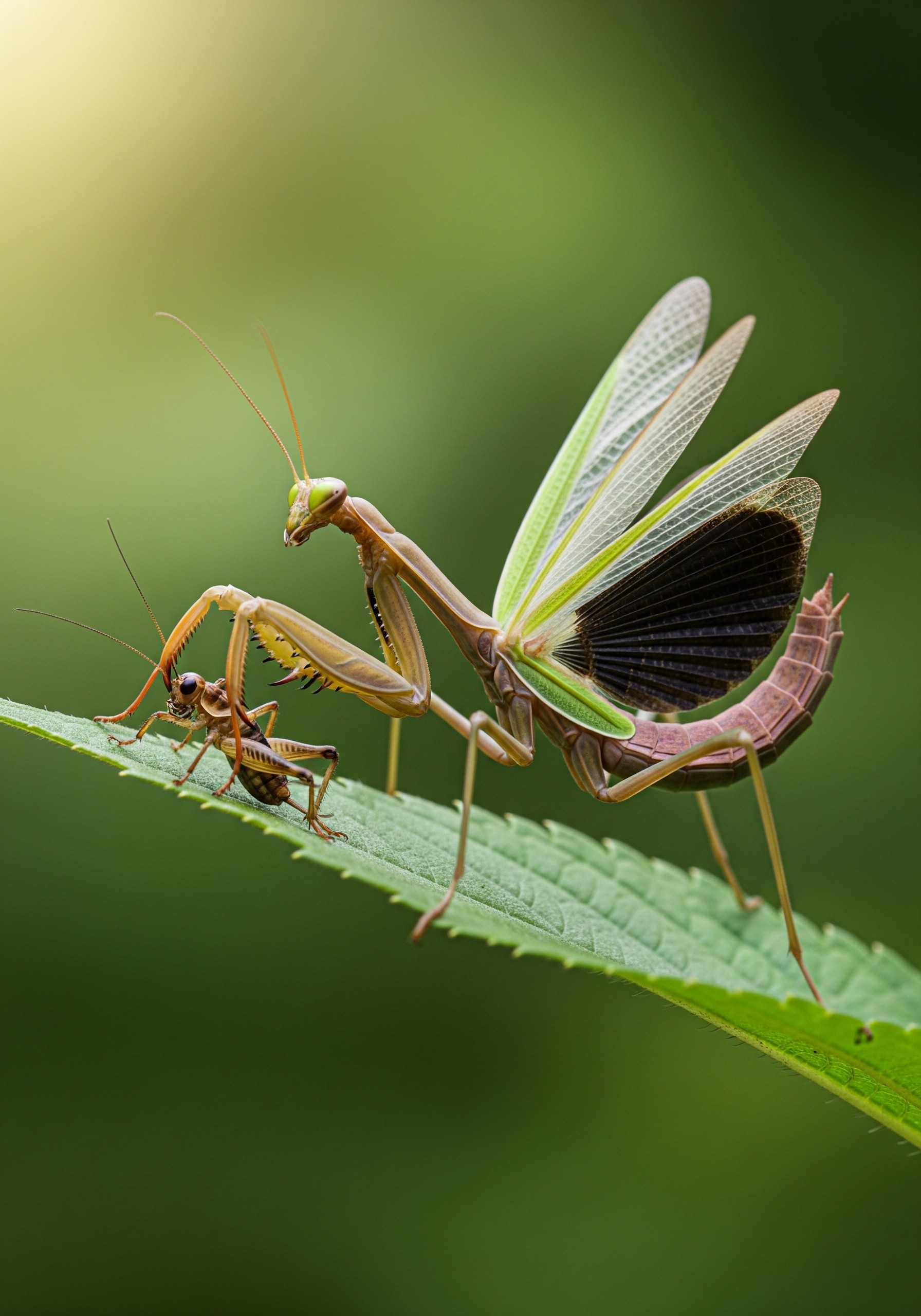
The praying mantis is not actually praying. It is waiting. Those famous front legs are folded into a sharp Z-shape that early naturalists thought looked like hands pressed together in prayer — and the name stuck. Biologists call those legs raptorial forelegs. Look closely and you will see rows of needle-sharp spikes along the inside edges. Those spikes are not for praying. They are for catching crickets in a fraction of a second.
Mantises belong to the insect order Mantodea — more than 2,400 species, mostly in warm tropical forests. A few are tough enough for cool gardens in places like northern Germany or upstate New York. The European mantis (Mantis religiosa) is the one most kids in Europe and North America are most likely to meet. It was the original “praying mantis” — the species Carl Linnaeus formally named in 1758.
Here is the part that always surprises people. Mantises are not closely related to grasshoppers at all. Their nearest living cousins are cockroaches and termites. Turns out, the perfect insect ninja and the kitchen pest share a great-great-grandparent.
Five Eyes, One Ear, and a Spinning Head
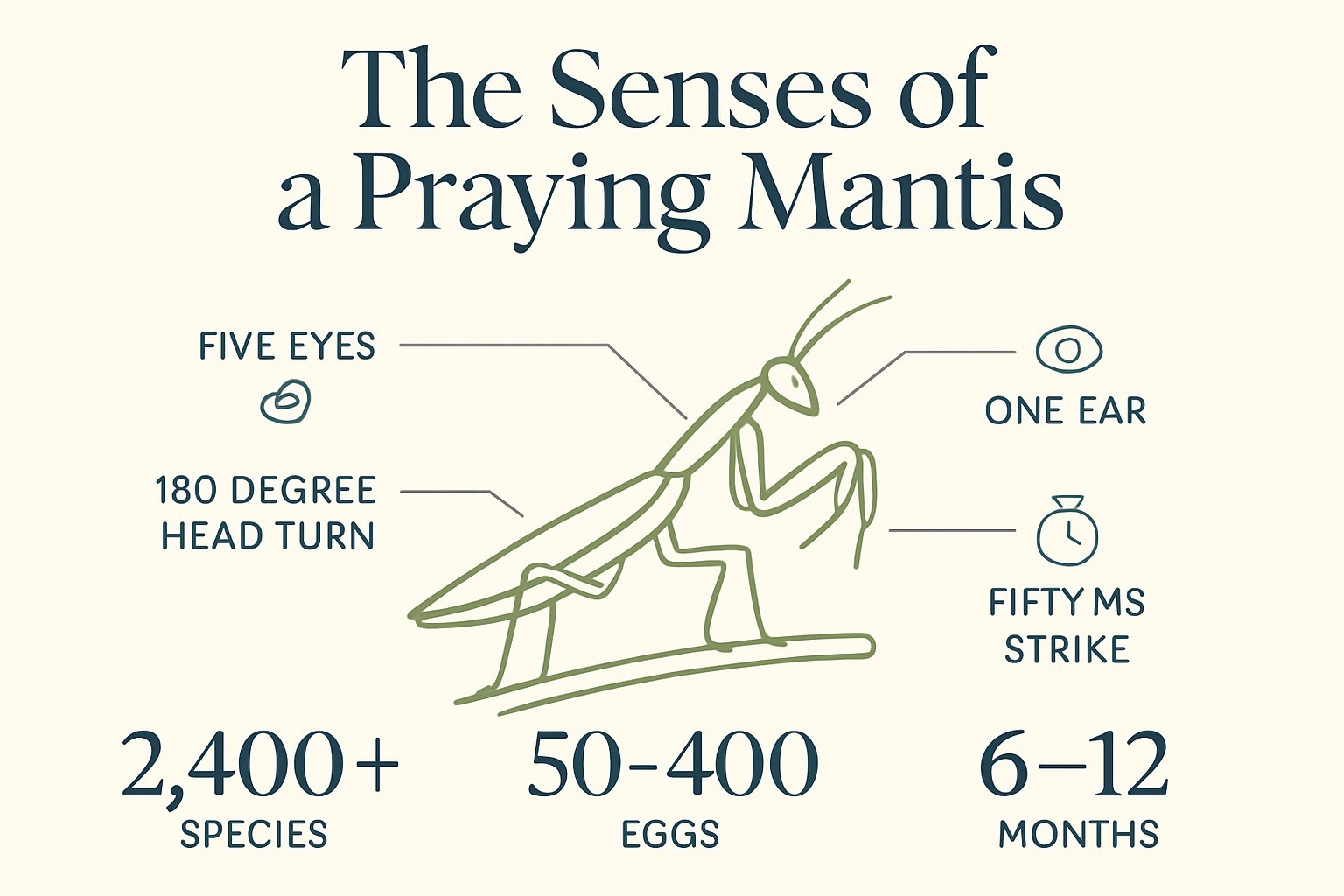
A praying mantis has five eyes. The two big ones on the sides of its triangular head are compound eyes — each made of thousands of tiny lenses. Those are for seeing shape, motion, and prey. The three smaller eyes, called ocelli, sit in a neat row on top of the head between the antennae. Ocelli are too simple to see detail. They detect changes in light — useful for telling night from day, or noticing a shadow rushing in from above.
Then there is the ear. Just one. It is not on the head. It sits in a deep slot in the middle of the mantis’s chest, between the back legs. This single ear is tuned to ultrasonic sounds — the same high-pitched calls that bats use to hunt at night. Why does a flying insect need a chest-ear tuned to bat sonar? Because bats are what eats them. When a flying mantis hears bat clicks, it folds its wings and drops sideways through the air to escape.
Finally, the head. A mantis is the only insect that can turn its head 180° to look behind itself (owls can do this; cats cannot; humans certainly cannot). That swivel head, those five eyes, and the chest-ear together make the mantis one of the most carefully wired hunters of its size on Earth.
{IMAGE_2}
How a Praying Mantis Sees in 3D — and the Lab That Proved It
For a long time scientists assumed 3D vision (the proper word is stereopsis) was a vertebrate trick — something only animals with backbones, like humans, eagles, and frogs, could do. In 2016, neuroscientist Jenny Read and her team at Newcastle University in England proved that wrong. They built the world’s first “insect cinema”: a tiny screen, in front of which they sat praying mantises wearing carefully made 3D glasses. The lenses were green and blue, not the usual red and blue — mantises see red poorly.
When the mantises watched a fake bug appear to float in three-dimensional space, they reached out with their forelegs to grab it. They were judging depth, exactly the way a person catches a ball. Mantises are the first invertebrates ever confirmed to see in true 3D. Read’s lab is now studying mantis vision to help engineers build cheaper, simpler 3D cameras for robots.
A bug is teaching us how to build better machines.
- Eyes: 5 total (2 compound + 3 ocelli)
- Vision: True 3D stereopsis — the only insect proven to see in 3D
- Ears: 1 — on the chest, between the rear legs
- Hearing range: Ultrasonic (20–100 kHz) — the same band as bat sonar
- Head rotation: 180° (a full half-circle)
- Strike speed: roughly 50–100 milliseconds — faster than a human blink
The Lightning Strike — How Mantises Hunt
A praying mantis is a sit-and-wait hunter. It can stay perfectly still on a stem for hours, blending into the leaves, antennae barely moving. When a fly, cricket, or moth wanders within reach, the mantis strikes in roughly 50 to 100 milliseconds — too fast for the human eye to see. The spiked forelegs snap shut like a folding pocketknife. The prey is usually held alive while the mantis begins eating from the head down.
The menu changes with size. A young mantis eats fruit flies and aphids. A full-grown Chinese mantis (Tenodera sinensis), which can reach 11 cm long, has been recorded in a handful of documented cases catching small hummingbirds — though that is rare and not a normal meal. The everyday food list is much friendlier from a gardener’s view: mosquitoes, crickets, grasshoppers, beetles, caterpillars. Every one a pest. Mantis egg cases have been collected and traded in China for centuries — both as a traditional medicine and, more recently, as a quiet form of natural pest control in farm fields.
Praying Mantis Facts for Kids: 3 Species You Might Spot
Most kids who find a mantis in their garden are looking at one of three species. They look alike at first glance but live very different lives.
| Species | Adult length | Color | Where you’ll find it | Cool detail |
|---|---|---|---|---|
| Mantis religiosa (European mantis) |
4–8 cm | Bright green or pale brown | Southern + central Europe, North Africa, parts of North America | A dark “eye-spot” hides under each foreleg — flashed to startle attackers |
| Tenodera sinensis (Chinese mantis) |
7–11 cm | Pale brown to soft green | Native to China; accidentally introduced to the US around 1896 — now common in many states | The largest mantis in North America |
| Stagmomantis carolina (Carolina mantis) |
5–6 cm | Gray, brown, or green | Southern United States — the official state insect of South Carolina | Female wings are too short for flight; only the males can really fly |
The Egg Case Mystery — From Foam to Hundreds of Ninjas
In late autumn, a female mantis backs up to a twig, a fence post, or the side of a brick wall, and squeezes out a strange foam from the tip of her body. The foam looks like beige meringue or stale marshmallow. Within an hour it hardens into a tough, weather-proof case called an ootheca. Inside that case, packed in tidy rows like eggs in a carton, sit anywhere from 50 to 400 baby mantises.
The ootheca is one of biology’s better inventions. It insulates the eggs against frost. It waterproofs them against rain. It hides them in plain sight on a winter twig. When spring warms the wall in April or May, hundreds of mantis nymphs come pouring out — perfect miniature copies of the adults, no bigger than a grain of rice. Most are eaten within a week, often by ants, birds, or each other. Only a handful will live long enough to hunt.
Myth vs Fact — What Praying Mantis Stories Get Wrong
You may have heard that the female mantis always bites off the male’s head during mating. This is the most famous mantis “fact” — and it is mostly wrong. The biologist S. E. Lawrence’s 1992 field study of European mantises (Mantis religiosa), published in Animal Behaviour, recorded cannibalism in roughly 31% of observed wild matings — not every time. In most cases the male simply mates and flies away. Cannibalism is real, and rates vary widely between species, but the “female always eats the male” story is the exception sold as a rule.
Another story claims it is illegal to kill a praying mantis in the United States. This has been false for as long as it has been repeated. No US state has ever protected the praying mantis under law. The myth probably started decades ago, when teachers used “endangered” as a creative way to stop kids from squashing useful garden insects. Mantises are not endangered. Most species are doing fine. Killing one is legal — and a small mistake, because each mantis you remove is hundreds of garden pests you keep.
One more correction: a praying mantis cannot hurt you. It carries no venom and no sting. The worst it can do is pinch with those spiky front legs if you grab it the wrong way — a sharp surprise, not an injury. Let one walk onto your hand instead. You will get a much better look at the eyes.
Frequently Asked Questions
Q: Can a praying mantis bite a human?
A: It can pinch with its spiked front legs, and very rarely a large mantis might give a tiny nip with its mandibles, but no praying mantis is venomous and none can hurt a person. If one lands on your hand it is far more likely to look around than to bite.
Q: How long do praying mantises live?
A: Most live about 6 to 12 months in total. The European mantis usually lives one summer; the Chinese mantis can stretch a little over a year in warm regions. The bulk of their life is spent as small nymphs — only the final few months are spent as the famous winged adults.
Q: Do praying mantises eat plants?
A: No. Praying mantises are pure carnivores. They will not chew a leaf, sip nectar, or nibble fruit. Everything they eat must be alive (or just-caught) and animal — usually an insect, sometimes a spider, occasionally something as surprising as a small frog or hummingbird.
Q: Where do praying mantises live in the wild?
A: They live on every continent except Antarctica, mostly in warm tropical and subtropical regions. In cooler climates like northern Europe or the northeastern United States, mantises survive the winter as eggs inside the ootheca. The adult is a creature of summer only.
Sources
- National Geographic Kids — “Praying Mantis”
- Encyclopaedia Britannica — “Mantis (insect)”
- Nityananda, V., Read, J. C. A. et al. (2016, 2018) — research on insect stereopsis, Newcastle University, published in Scientific Reports and PLOS Computational Biology
- Lawrence, S. E. (1992) — “Sexual cannibalism in the praying mantid, Mantis religiosa: a field study,” Animal Behaviour
- Smithsonian National Museum of Natural History — Mantodea reference collection
The praying mantis is a small reminder that you do not have to be big to be amazing. A creature shorter than your finger can see in 3D, listen with its chest, and out-time a hummingbird’s wingbeat. Next time you find one on a tomato plant, leave it where it is. It is not a pest. It is a tiny ninja, quietly working for you.
Illustrations are AI-generated. Article fact-checked and human-edited. Our editorial standards.