How Did Ancient Egypt Mummify Their Dead? A 70-Day Guide
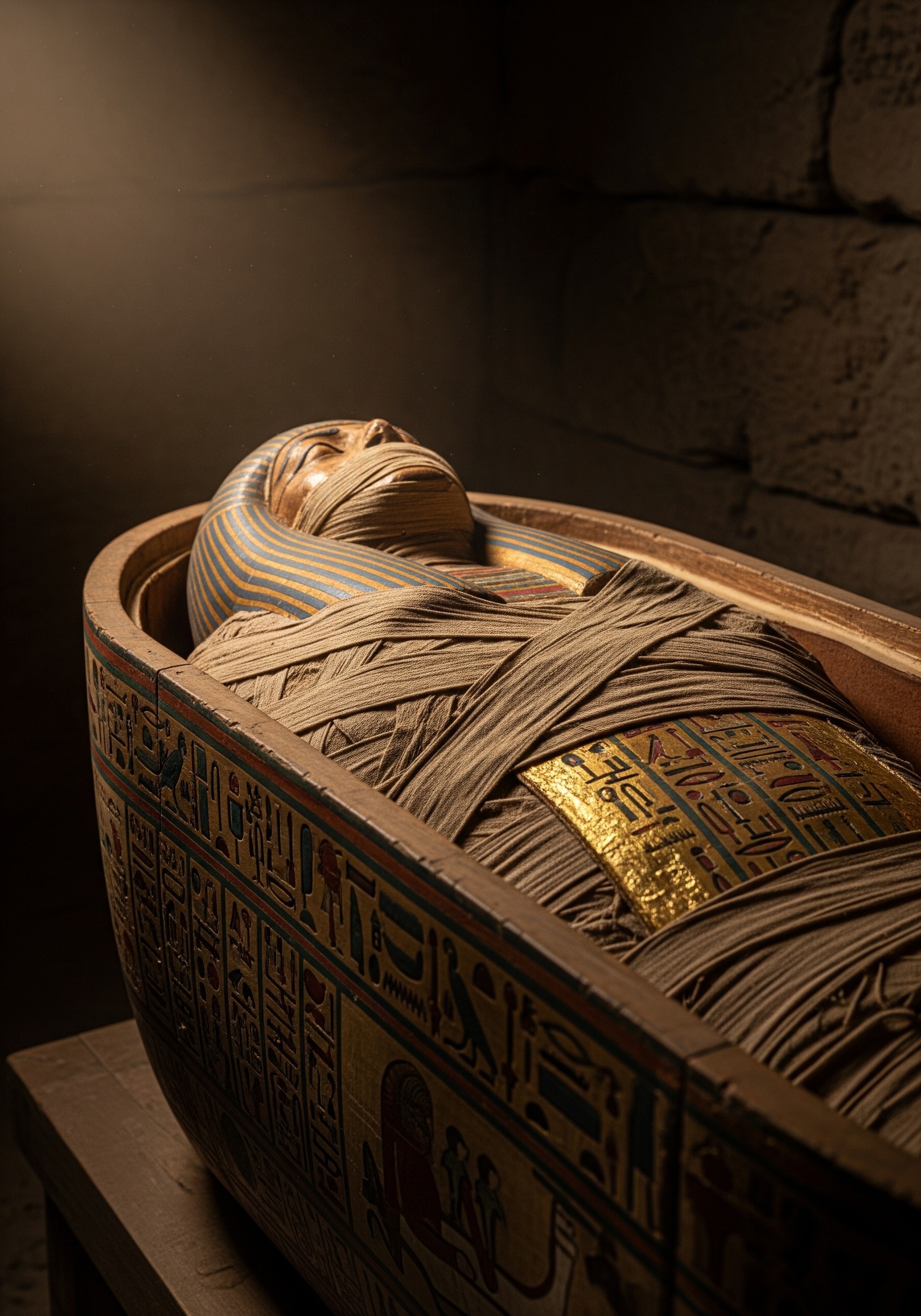
How did ancient Egypt mummify their dead? Across roughly seventy days, a guild of priest-embalmers transformed a corpse into a chemically stabilised vessel for the soul, using a desert salt, a pharmacy of tree resins, and a religious choreography so precise that some of their work still has skin, hair and fingerprints three thousand years later.
Key Facts
- The full mummification ritual lasted about 70 days, of which roughly 35–40 were spent drying the body in natron, a naturally occurring sodium-rich salt mined at Wadi El Natrun, northwest of Cairo.
- The brain was liquefied and drained out through the nose via the ethmoid bone; the lungs, liver, stomach and intestines were removed through a small incision on the left flank made with an obsidian or flint blade. The heart was almost always left in place.
- The four removed organs were stored in canopic jars guarded by the four Sons of Horus: Imsety (human-headed, liver), Hapy (baboon, lungs), Duamutef (jackal, stomach), and Qebehsenuef (falcon, intestines).
- A landmark 2023 study published in Nature chemically identified the embalming substances stored in jars from a workshop at Saqqara (c. 664–525 BC), proving that the famous balm antiu was not myrrh as long assumed, but a blend of cedar, juniper and cypress oils — antimicrobials, in effect.
- Artificial mummification in Egypt is older than once thought: chemical analysis of a predynastic body from Mostagedda dates plant-resin embalming to roughly 3700 BC, about 1,500 years before the pyramid-age date traditionally given for the practice’s origin.
In short: Ancient Egyptian mummification was a 70-day religious and surgical procedure that removed water and most internal organs, replaced them with linen and a perfumed cocktail of imported tree resins, and wrapped the result in metres of linen so the soul could recognise — and return to — its own body in the afterlife.
Key Facts
- The full mummification ritual lasted about 70 days, of which roughly 35–40 were spent drying the body in natron, a sodium-rich salt mined at Wadi El Natrun.
- The brain was drained through the nose; the lungs, liver, stomach and intestines were removed through a left-flank incision made with an obsidian or flint blade. The heart was almost always left in place.
- The four removed organs were stored in canopic jars guarded by the Four Sons of Horus: Imsety (liver), Hapy (lungs), Duamutef (stomach), and Qebehsenuef (intestines).
- A 2023 study in Nature chemically identified balms from a Saqqara workshop (c. 664–525 BC), showing the famous antiu was not myrrh but a blend of cedar, juniper and cypress oils.
- Chemical analysis of a predynastic body from Mostagedda dates plant-resin embalming to roughly 3700 BC.
In short: Egyptian mummification was a 70-day religious and surgical procedure that removed water and most internal organs, replaced them with linen and perfumed tree resins, and wrapped the body so the soul could recognise and return to it. Drying relied on natron, and organs were preserved in canopic jars.
The 70-Day Death Sentence Against Decay

An Egyptian mummy is, at its core, an engineering solution to a biological problem. A human body in the heat of the Nile Valley spoils within hours. Yet Egyptian priests learned, by trial and error over three thousand years, how to stop putrefaction almost completely. They did it not with cold storage but with chemistry: pull out the wet bits, pull out the water, replace what was lost with sterile substitutes, then seal the surface against air and insects.
The result was so durable that the resin coating on Ramesses II’s bandages, applied around 1213 BC, was still recognisable when Cairo radiologists unwrapped his skull for X-rays in the 1970s. No other ancient civilisation came close to matching this combination of duration, anatomical detail and scale of production — by the Late Period, embalming workshops at Saqqara were processing dozens of bodies in parallel along what was, in effect, a sacred assembly line.
Why Egyptians Mummified Their Dead: The Ka, the Ba, and the Eternal Body
To understand the procedure, you have to understand the theology. Egyptians believed each person had several spiritual components, of which two — the ka (life-force) and the ba (personality, sometimes shown as a human-headed bird) — survived bodily death. But the ba had to fly back each night to a body it could recognise. If the corpse dissolved into bone and dust, the soul lost its anchor in the world, and eternal life ended.
The famous Book of the Dead spells, the gilded death masks, the painted eyes on coffin lids — all of these were practical infrastructure for a returning soul. The mummy itself was the homing beacon. That is why preserving recognisable facial features mattered enormously, and why embalmers padded sunken cheeks with linen, sometimes inserted false eyes of stone or onion, and arranged the body in a pose evoking Osiris, lord of the underworld.
{IMAGE_2}
The Embalmers’ Workshop: Sacred Space and Specialist Hands
Mummification was not done in a back room. It happened in a dedicated structure called the wabet (“the pure place”) or the ibu (“tent of purification”) — typically a temporary reed enclosure or, in cities like Saqqara and Thebes, a permanent stone workshop near the cemetery. A 2018 discovery at Saqqara revealed an underground complex with a ventilation shaft, two basins for soaking the body in natron, and rows of labelled ceramic jars, each containing a specific embalming substance.
The team was hierarchical. The senior priest, called the hery seshta (“overseer of the mysteries”), wore a mask of the jackal-headed god Anubis and conducted the rites. A reader-priest chanted spells from a ritual papyrus. The per-ankh physicians supplied anatomical expertise. And a much-mocked figure called the paraschistes made the actual cut into the abdomen — then, according to the Greek writer Diodorus Siculus, ran from the workshop while his colleagues ritually threw stones after him for having violated the body. It was sacred work shadowed by ritual disgust.
Step by Step: How Did Ancient Egypt Mummify Their Dead, Day by Day
The classical Egyptian procedure, refined in the New Kingdom (c. 1550–1070 BC), can be tracked across roughly 70 days. The number was not arbitrary: 70 days was the period the bright star Sirius spent invisible below the horizon before its heliacal rising flooded the Nile — a celestial mirror of the soul’s transit through darkness toward rebirth.
The 70-Day Mummification Timeline
- Days 1–4 · Purification. The body is carried to the ibu, washed in Nile water, and bathed with a dilute natron solution to start removing surface bacteria.
- Days 4–15 · Evisceration. The brain is liquefied through the nostrils with a bronze hook; the lungs, liver, stomach and intestines are removed through a left-flank incision; the body cavity is rinsed with palm wine and spices.
- Days 15–55 · Desiccation. The body is packed inside and out with dry natron and left on a slanted embalming table. Roughly 40 days later, it has lost about 75% of its water weight.
- Days 55–65 · Anointing and stuffing. The hollow body is washed, the skin is anointed with cedar, juniper and pistachio resins, and the cavity is packed with linen, sawdust or natron bags to restore its shape.
- Days 65–70 · Wrapping and ritual. Up to 20 layers — some hundreds of metres — of fine linen are wound around the body, with protective amulets tucked between the bandages and the Book of the Dead placed at the chest.
Every stage was accompanied by spells from the Ritual of Embalming, a papyrus that survives in fragments. The procedure ended with the “Opening of the Mouth” ceremony at the tomb, in which a priest touched the mummy’s face with a ceremonial adze so that the deceased could breathe, eat and speak in the afterlife.
The Chemistry Revealed: What 2023 Lab Analysis Found Inside the Saqqara Jars
For two millennia, everyone — from the Greek tourist Herodotus to nineteenth-century chemists — assumed the perfumed black resin in mummy wrappings was mainly myrrh and frankincense. A 2023 study in Nature by a German-Egyptian team led by Maxime Rageot (University of Tübingen) and Susanne Beck (University of Munich) demolished that assumption. The researchers ran gas chromatography-mass spectrometry on 31 ceramic vessels recovered from the underground Saqqara workshop dated to c. 664–525 BC. Many of the jars were inscribed with the substance they once held and the body part it was used on.
The balm labelled antiu, often translated as “myrrh” in older Egyptology textbooks, turned out to be a mixture of cedar oil, juniper or cypress oil, and animal fat — substances chosen for their potent insecticidal and antimicrobial properties. Other jars contained pistachio resin, castor oil, beeswax, bitumen, and — most strikingly — elemi and dammar, two resins that grow only in the tropical forests of Southeast Asia and Central Africa. To preserve a single noble in Memphis, embalmers were drawing on a supply chain that reached India and the Philippines almost a thousand years before the Silk Road’s traditional opening date.
This single workshop’s pottery rewrote two histories at once: the chemistry of how Egypt preserved its dead, and the geography of Bronze Age and Iron Age trade. Read the full open-access paper at Nature: Biomolecular analyses enable new insights into ancient Egyptian embalming.
Three Tiers for Three Pockets: Herodotus and the Economics of Embalming
When Herodotus visited Egypt around 450 BC, he wrote that embalmers showed grieving families three model corpses at three different prices — “the best and most expensive kind, the next best, and the third, which is the cheapest of all.” His description, partly corroborated by mummies of different social classes, is still the clearest surviving picture of the industry’s price structure.
| Tier | Procedure | Who Could Afford It |
|---|---|---|
| Premium (“of Osiris”) | Full evisceration, brain removal, 40-day natron drying, imported resins, multi-layer linen, painted mask, decorated coffin. | Pharaohs, high priests, viziers, wealthy nobles. |
| Middle (“cedar-oil injection”) | No incision: cedar oil injected through the anus to dissolve internal organs, which were then drained out, followed by natron drying. | Middle-ranking officials, prosperous artisans, merchants. |
| Basic (“of the poor”) | Intestines purged with a herbal enema (clyster); the body soaked in natron for 70 days, then returned to the family for burial in a simple pit. | Modest farmers, labourers, low-level scribes. |
What about the poorest Egyptians? Most never saw an embalmer at all. They were buried in shallow desert graves where the dry sand did the work naturally — and, ironically, often produced better-preserved bodies than the expensive resin-and-linen process. The earliest mummies in Egyptian collections, including specimens at the British Museum, are these naturally desiccated predynastic burials.
Beyond Pharaohs: Animals, Predynastic Origins, and the Practice’s Long Decline
Mummification was not reserved for humans. Egyptians embalmed millions of animals as votive offerings to specific gods: cats for the cat-goddess Bastet, ibises for the wisdom god Thoth, falcons for Horus, crocodiles for Sobek. At the catacombs of Tuna el-Gebel, archaeologists estimate roughly four million ibis mummies were once stacked in galleries. A 2020 synchrotron-imaging study of a juvenile crocodile mummy showed embalmers had specifically designed the wrapping to mask decomposition the animal had undergone before reaching the workshop.
The practice’s origins are also older than the pyramid age. In 2014 and 2018, chemical studies of a small predynastic body from Mostagedda (Upper Egypt), held by the Egyptian Museum in Turin, found that the linen wrappings had been impregnated with a complex resin-and-aromatic-oil mixture as early as 3700 BC — roughly 1,500 years before the traditional date for the start of “artificial” mummification. Egyptian embalming, in other words, was not invented for kings. It grew out of much older funerary chemistry whose makers we will never name.
The end was just as gradual. After the Roman conquest of Egypt in 30 BC, mummification continued for almost four centuries, increasingly fused with classical portraiture in the Fayum mummy panels. Christianity, which prized resurrection of an unembalmed body, finally extinguished the practice by the fourth century AD. The last mummies were sealed; the workshops fell silent; the recipes were lost — until lab chemistry, in our own century, began reading them again. For the broader story of how Egypt’s afterlife beliefs shaped its monumental architecture, see our companion piece on the religious engineering behind the pyramids, and our dive into the spells of the Egyptian Book of the Dead that accompanied every wrapped body. Curious about the bodies themselves? Our profile of the most famous mummies ever discovered picks up the story from the tomb.
Frequently Asked Questions
Q: How long did it take to mummify a body in ancient Egypt?
A: The full procedure lasted about 70 days from death to burial. Roughly 35–40 days were spent drying the body in natron salt; the remaining time covered purification, evisceration, anointing with imported resins, wrapping in linen, and funerary ritual. The number 70 mirrored the 70 days that the star Sirius spent invisible below the horizon before its annual reappearance.
Q: Why did Egyptians remove the brain but leave the heart?
A: Egyptians believed the heart, not the brain, was the seat of intelligence, emotion and moral character. It would be weighed against the feather of Ma’at in the afterlife to judge whether the deceased deserved eternal life. The brain was considered useless for this judgement, so embalmers simply liquefied it with a bronze hook inserted through the nose and let it drain out.
Q: What chemicals and ingredients did Egyptian embalmers actually use?
A: A 2023 study of labelled jars from a Saqqara workshop identified a pharmacy of substances: natron (drying salt), cedar oil, juniper and cypress oils, pistachio resin, castor oil, animal fats, heated beeswax, bitumen, and the tropical resins elemi and dammar — the last two imported from Southeast Asia. Many had antimicrobial or insecticidal properties.
Q: Were ordinary Egyptians mummified, or only pharaohs?
A: Pharaohs received the most elaborate treatment, but the practice extended down the social pyramid. Herodotus described three price tiers — a premium full procedure, a middle “cedar-oil injection” method, and a basic enema-and-natron version for the poor. The poorest Egyptians were buried directly in the dry desert sand, which often preserved bodies naturally with no embalming at all.
To stand before an Egyptian mummy today is to look at a 3,000-year-old technical document. The dried skin records every choice the embalmers made — which resin they could afford, which jar they reached for, which spell they recited. The 2023 lab analyses simply finished reading what those silent bodies had been trying to tell us all along: that preserving a human against time required a global supply chain, a working theory of biochemistry, and a faith strong enough to keep the work pure for thirty centuries.
Illustrations are AI-generated. Article fact-checked and human-edited.