How Did Ancient Egyptians Build the Pyramids? A Modern Answer
How did ancient Egyptians build the pyramids without iron tools, wheels, pulleys, or a written word for “engineer”? The answer that survives modern scrutiny is less mystical than the movies suggest and far more impressive: a 4,500-year-old fusion of state logistics, river hydrology, copper-and-sand quarrying, and a workforce of fed, paid, and proud Egyptians whose own diary we can now read.
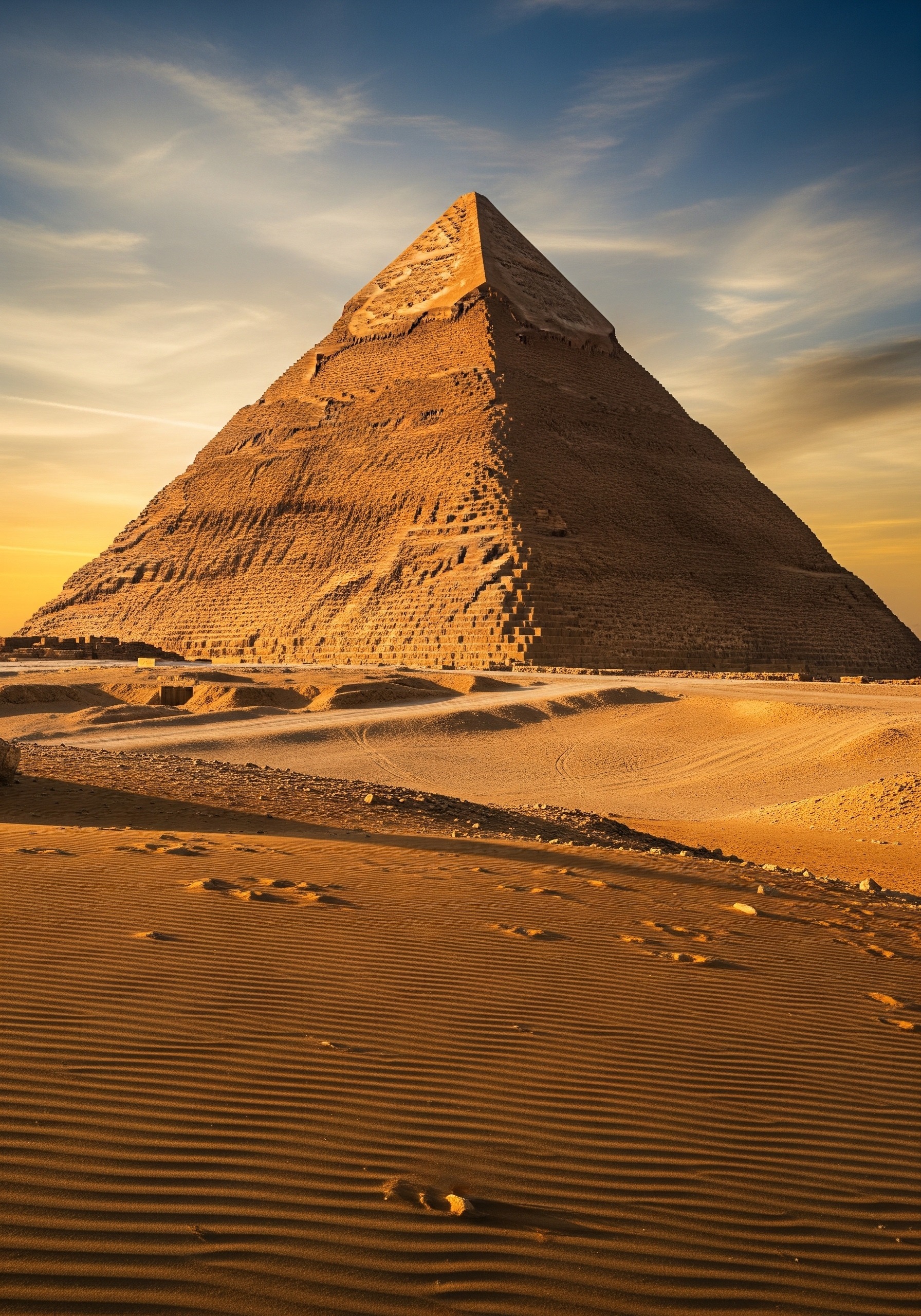
Key Facts
- The Great Pyramid at Giza contains roughly 2.3 million stone blocks averaging about 2.5 tonnes each — a total mass near 5.75 million tonnes, assembled in approximately 20 years during the reign of Khufu (c. 2580–2560 BCE).
- The builders were not slaves. Workers’ cemeteries excavated since 1990 by Egyptologist Zahi Hawass at Giza show skilled, well-fed laborers buried with honor near the king — roughly 4,000–5,000 permanent specialists and a rotating seasonal corps that peaked around 20,000–30,000.
- The Diary of Merer, discovered in 2013 at Wadi al-Jarf on the Red Sea, is the oldest known papyrus in the world — a logbook by an Old Kingdom inspector recording boat trips that ferried fine Tura limestone casing blocks to the Great Pyramid in Khufu’s 27th regnal year.
- In 2024, a multinational team using satellite radar and sediment cores confirmed a now-buried branch of the Nile — the “Ahramat Branch,” running about 64 kilometres past 31 pyramids — proving the builders sailed materials almost to the foot of each construction site.
- The heaviest stones in the Great Pyramid — the granite beams roofing Khufu’s burial chamber — weigh up to 80 tonnes each and were quarried 800 kilometres south at Aswan, an engineering feat unmatched in Bronze Age construction.
In short: Ancient Egyptians built the pyramids with copper chisels, wet-sand sledges, mud-brick ramps, and a brilliantly organized riverine supply chain. There is no single lost secret — there is a stack of small, ingenious solutions that, taken together, are still hard to beat.
Key Facts
- The Great Pyramid at Giza contains roughly 2.3 million stone blocks averaging about 2.5 tonnes each — a total mass near 5.75 million tonnes — assembled in about 20 years under Khufu (c. 2580–2560 BCE).
- The builders were not slaves; workers’ cemeteries excavated since 1990 by Zahi Hawass show skilled, well-fed laborers — about 4,000–5,000 permanent specialists plus a seasonal corps peaking around 20,000–30,000.
- The Diary of Merer, found in 2013 at Wadi al-Jarf, is the oldest known papyrus, logging boat trips that ferried Tura limestone casing blocks in Khufu’s 27th regnal year.
- In 2024 a team using satellite radar and sediment cores confirmed the buried ‘Ahramat Branch’ of the Nile, running about 64 kilometres past 31 pyramids.
- The heaviest stones — granite beams roofing Khufu’s burial chamber — weigh up to 80 tonnes each and were quarried 800 kilometres south at Aswan.
In short: Ancient Egyptians built the pyramids with copper chisels, wet-sand sledges, mud-brick ramps and a riverine supply chain — not magic. The Great Pyramid’s 2.3 million blocks were raised in about 20 years by paid, well-fed workers, with materials floated along a now-buried Nile branch confirmed by satellite radar in 2024.
The Question That Won’t Die: How Did Ancient Egyptians Build the Pyramids?
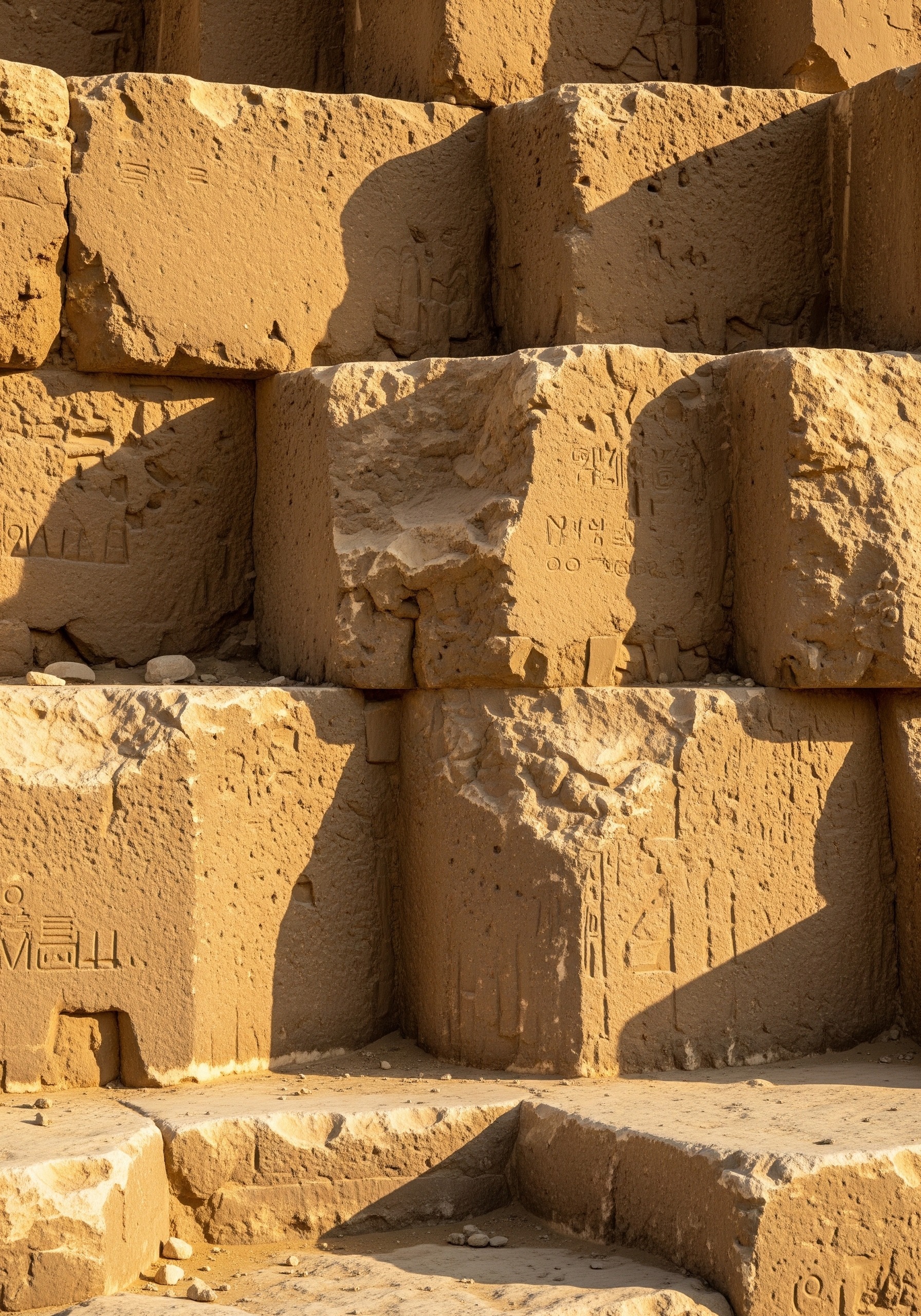
Every generation rediscovers Giza and asks the same thing. The Greek traveler Herodotus asked it in the fifth century BCE, two thousand years after the last casing stone was set, and got an answer about ramps and 100,000 men working in shifts. Napoleon’s savants asked it in 1798 and came home with measurements that still hold. NASA satellites are asking it now, mapping vanished river channels under modern farmland. The question survives because no one has ever found a labelled blueprint — and because the Great Pyramid of Khufu is, objectively, one of the most absurd constructions our species has ever attempted.
The honest modern answer is this: archaeologists do not have one neat secret. They have a converging body of evidence — settlements, cemeteries, tool fragments, quarry marks, ramp remnants, a now-lost river, and a literal handwritten work diary — that together describes a sophisticated industrial operation. What looks magical from a tour bus is, on closer inspection, project management on an imperial scale.
The Materials Beneath the Mystery
Before any block was lifted, three materials had to converge at the Giza Plateau, and each came from a different geological province of Egypt.
The bulk of the Great Pyramid — about 96 percent of its volume — is core limestone quarried within a few hundred metres of the site itself. You can still see the trench at Giza where the southern face was cut. The outer skin, the gleaming white “casing stones” that gave the pyramid the polished look medieval travellers described, came from the Tura quarries across the Nile, where the limestone is denser, whiter, and almost free of fossils. The internal chambers and the structural beams that span the King’s Chamber are red granite from Aswan, roughly 800 kilometres up the Nile.
About 5.5 million tonnes of limestone, 8,000 tonnes of Aswan granite, and around 500,000 tonnes of mortar were combined in the Great Pyramid alone. To put that in context, the entire stone mass of every cathedral built in medieval Europe over 500 years does not equal it.
{IMAGE_2}
Quarrying: Cutting Stone with Copper and Sand
The pyramid builders had no iron — that technology was still a thousand years in their future. They had copper, hardened with about 2–4 percent arsenic to give it a useful working edge, and they had time, abrasive sand, and patience. Modern experiments (notably the 1992 NOVA tests led by Egyptologist Mark Lehner and stonemason Roger Hopkins) showed that four workers with copper chisels and dolerite hammerstones could quarry a 2.5-tonne limestone block in about four days. Multiply that by hundreds of crews working in parallel and the arithmetic of 2.3 million blocks in 20 years stops sounding impossible.
Harder rock demanded smarter tricks. To cut granite, masons drove tubular copper drills under loads of wet quartz sand — the sand did the cutting, the copper just held it. Saw kerfs in surviving Aswan blocks show the same technique: a long copper blade, dragged back and forth, with sand as the actual abrasive. Some of those saw marks are still preserved on the unfinished Aswan obelisk and on granite door frames inside the Giza pyramids, a forensic fingerprint of how the work was done.
Floating Mountains: The Nile as Construction Highway
The single most underrated answer to “how did ancient Egyptians build the pyramids” is one word: the river. Stone is heavy on land and almost weightless on water, and the pharaonic state turned that fact into infrastructure.
Every August the Nile flooded, and for three to four months the floodplain became a shallow inland sea. Builders cut harbours and canals so that cargo boats laden with Tura limestone or Aswan granite could be poled almost to the base of a pyramid, then unloaded by ramp onto the construction site. For a long time this was inference. In 2024, a team led by Eman Ghoneim at the University of North Carolina Wilmington published satellite-radar and sediment-core evidence of an extinct Nile branch — they named it the Ahramat Branch — running roughly 64 kilometres parallel to the desert edge and threading past 31 Old and Middle Kingdom pyramids, including all the major ones at Giza, Abusir, Saqqara, and Dahshur. The ancient causeways that link each pyramid to its valley temple end almost exactly where the ancient riverbank was. The builders, in other words, parked their loading docks right where we now find sand.
Building the Great Pyramid: by the numbers
- Built: c. 2580–2560 BCE, reign of Khufu (4th Dynasty)
- Original height: 146.6 m · today 138.5 m (top casing lost)
- Base: 230.3 m per side, error under 4 cm
- Blocks: ~2.3 million, average 2.5 tonnes
- Granite roof beams (King’s Chamber): up to 80 tonnes, hauled from Aswan ~800 km
- Workforce: ~4,000 permanent + ~20,000 seasonal
- Construction span: ~20 years — about one block placed every 2 minutes of daylight
The Great Ramp Debate: Three Theories, One Pyramid
If the river got the stone to the foot of the pyramid, ramps got it to the top. Nobody disputes that ramps were used; what scholars argue about is what shape they were.
The straight frontal ramp is the textbook image: a long, sloping causeway of mudbrick and rubble pushed straight at the pyramid’s face, extended upward as the structure rose. The math is brutal. To reach 146 metres at a workable 8-degree slope, a straight ramp would need to be more than a kilometre long and would itself contain more material than the pyramid. Almost no Egyptologist now believes a single straight ramp built the upper courses.
The zigzag or wraparound ramp, climbing in switchbacks along the outer face, solves the volume problem but creates a new one — sharp turns where heavy sledges would have to be pivoted on the unfinished edge. Bits of such ramps have been found at smaller pyramids, like that of Sahure at Abusir.
The internal ramp hypothesis, advanced in 2007 by French architect Jean-Pierre Houdin, proposes that the first 30 percent of the Great Pyramid was built using a short external ramp, after which a corkscrew ramp continued upward inside the masonry, leaving the corners open for sighting. Micro-gravimetric scans of the pyramid in 1986 and again in the 2010s have hinted at a spiralling lower-density anomaly that fits Houdin’s model, but the case is not yet closed.
And then, in 2018, a real ramp was found — at the Hatnub alabaster quarry in Egypt’s Eastern Desert. A joint French–British team led by Yannis Gourdon and Roland Enmarch documented a 4,500-year-old inclined ramp flanked by two rows of post-holes and staircases, dated by inscriptions to the reign of Khufu himself. Workers, the evidence suggests, dragged sledges up the steep central ramp while teams on the side staircases pulled ropes through wooden posts acting as primitive pulleys, effectively doubling their force. The Hatnub system worked on slopes of about 20 degrees — far steeper than Egyptologists had thought possible. The discovery did not prove that the same technique built the Great Pyramid, but it shut down the long-running argument that the Egyptians “could not have” used steep ramps. They demonstrably did.
The Workers Beneath the Wonder
Hollywood, beginning with Cecil B. DeMille and continuing into more recent imaginations, has loved the image of whip-driven slaves dying in the desert. The archaeology says otherwise. Excavations begun in the 1990s at Heit el-Ghurab — the “Lost City” of the pyramid builders just south of the Sphinx — uncovered barracks, bakeries, breweries, fish-processing yards, and copper workshops. Bone analysis from nearby cemeteries shows healed fractures set by skilled physicians and a diet rich in beef and fish: this was a prized assignment, not a death sentence.
The most recent estimates, drawn from settlement size and ration records, put a permanent core of about 4,000–5,000 skilled workers — masons, carpenters, surveyors, scribes, smiths — and a rotating draft of 20,000–30,000 seasonal labourers from across Egypt’s nomes. Workers were organized into a quasi-military hierarchy: two “great gangs” of about 2,000, each split into five zaa phyles of 200, themselves divided into squads of 20. Graffiti scrawled on hidden interior blocks still preserves the names of these crews, with proud nicknames like “Friends of Khufu” and “Drunkards of Menkaure.” It is hard to read those scribbles and still imagine a slave gang.
The Diary of Merer: A Foreman’s Voice from 4,500 Years Ago
In 2013, Egyptologist Pierre Tallet and a team from the University of Paris-Sorbonne were excavating a long-disused harbour at Wadi al-Jarf on the Red Sea coast, more than 100 kilometres east of the Nile. Inside a sealed storage gallery they found the world’s oldest surviving inscribed papyri: the dusty notebooks of an inspector named Merer, written in red and black ink on linen-fibre paper during the 27th regnal year of Khufu — roughly 2562 BCE.
For the first time, the pyramid builders speak. Merer records boat trips, daily rations, the names of his officers, and — most importantly — round trips between the Tura quarries and “Akhet-Khufu,” the Egyptian name for the Great Pyramid. His crews loaded fine white casing limestone at Tura, sailed it down the Nile, and unloaded it at canals that ran right up to the pyramid’s construction yard. The diary is a missing chapter we never expected to recover. It does not say which kind of ramp climbed the pyramid, but it confirms, in the words of a foreman who walked the site, that the river was the spine of the whole operation.
What We Still Don’t Know
Three things remain genuinely open. First: which ramp configuration dominated the upper 50 metres, where the work area shrinks to almost nothing and a straight ramp becomes geometrically impossible. Houdin’s internal-ramp model is the leading hypothesis; we await definitive imaging. Second: how Egyptians achieved the famously near-perfect cardinal alignment of the Great Pyramid’s faces — error of about four arc-minutes — without a magnetic compass. The best current explanation, proposed by Glen Dash in 2018, is a solar-shadow method using the equinox; it works in experiment but has not been archaeologically proven. Third: how the 80-tonne granite roof beams of the King’s Chamber, some of the heaviest worked stones in antiquity, were lifted 70 metres above the desert. Levering on counterweighted timber cribs is the leading guess.
That short list of unknowns is, in a sense, the answer to the original question. Ancient Egyptians built the pyramids by combining roughly a dozen techniques we now understand, plus two or three we are still piecing together. The miracle is not that we cannot explain it; the miracle is how close we have come, with copper, mud, rope, water, and four millennia in between.
Frequently Asked Questions
Q: How long did it take to build the Great Pyramid of Giza?
A: About 20 years, during the reign of pharaoh Khufu (c. 2580–2560 BCE). That figure, originally given by Herodotus, is supported by modern engineering studies based on quarrying rates, block counts, and workforce size. Placing 2.3 million blocks in two decades works out to roughly one block every two minutes of daylight, year-round.
Q: Were the pyramid builders slaves?
A: No. Excavations of the workers’ city and cemeteries near Giza show paid, well-fed, organized labourers — a permanent skilled core supplemented by rotating seasonal crews of farmers fulfilling a corvée (labour-tax) obligation. They received bread, beer, beef, fish, and medical care, and were honoured with burials near the pyramid they built.
Q: What tools did the Egyptians use without iron?
A: Copper chisels and saws, dolerite hammerstones, wooden mallets and sledges, plumb bobs, set squares, ropes, and — crucially — abrasive quartz sand. Sand under a copper saw or tubular drill is what actually cut granite; the copper merely guided the abrasive. Iron tools did not arrive in Egypt until centuries after the Great Pyramid was already weathering.
Q: How were such heavy stones moved across the desert?
A: On wooden sledges, with water poured on the sand in front to reduce friction. A 2014 study at the University of Amsterdam showed that wetting desert sand to the right level cuts the pulling force needed by about half — and a tomb painting from Djehutihotep depicts workers doing exactly that, pouring water in front of a sledge carrying a giant statue. For long-distance transport, the Egyptians used the Nile and a network of canals.
Stand at the base of the Great Pyramid today and run your hand across the warm, weathered limestone. What you are touching is not magic and not mystery. It is copper, sand, river water, and the steady, organized work of a society that decided to write its faith in geometry across the desert — and largely succeeded.
Illustrations are AI-generated. Article fact-checked and human-edited.