How Did Ancient Egypt Fall? Three Collapses in 3,000 Years
How did ancient Egypt fall? The honest answer is that it didn’t fall once — it fell three times across nearly two thousand years, and only the last collapse, sealed by a Roman sword in 30 BCE, finally stuck. Egypt’s death is not a single dramatic event but a slow-motion story of climate shocks, priestly takeovers, weakened pharaohs, hungry empires, and a Nile that occasionally — catastrophically — refused to flood.
Key Facts
- Ancient Egypt endured for roughly 3,000 years, from political unification under Narmer around 3100 BCE to the Roman annexation in 30 BCE — longer than the gap between Cleopatra and the iPhone.
- The Old Kingdom (pyramid-building age) collapsed around 2181 BCE during the “4.2-kiloyear event,” a global megadrought that crippled Nile floods and ushered in 140 years of fragmentation called the First Intermediate Period.
- The New Kingdom — Egypt’s imperial peak under Hatshepsut, Tutankhamun, and Ramesses II — ended around 1070 BCE amid the Late Bronze Age Collapse, repeated invasions by the still-mysterious “Sea Peoples,” and the High Priests of Amun seizing economic control of Upper Egypt.
- By 945 BCE foreign-born pharaohs ruled the Nile: Libyans (22nd Dynasty), then Kushites from Sudan (25th Dynasty), then Assyrians, then Persians (twice), then Macedonian Greeks under Alexander the Great in 332 BCE.
- The last native Egyptian pharaoh, Nectanebo II, fled the Persians in 343 BCE; the very last pharaoh of any kind, Cleopatra VII of the Greek Ptolemaic dynasty, killed herself on roughly 12 August 30 BCE after the naval Battle of Actium, and Egypt became a personal province of the Roman emperor Augustus.
In short: Ancient Egypt fell because three different combinations of climate, political fragmentation, and foreign pressure each struck a state already weakened by the last crisis. The Old Kingdom died of drought, the New Kingdom of priests and Sea Peoples, and Cleopatra’s Egypt of Rome — but the older culture itself faded only over the next four centuries as Christianity and Arabic replaced the temples and hieroglyphs.
Key Facts
- Ancient Egypt endured for roughly 3,000 years, from unification under Narmer around 3100 BCE to Roman annexation in 30 BCE.
- The Old Kingdom collapsed around 2181 BCE during the ‘4.2-kiloyear event,’ a global megadrought, ushering in about 140 years of fragmentation called the First Intermediate Period.
- The New Kingdom ended around 1070 BCE amid the Late Bronze Age Collapse, invasions by the ‘Sea Peoples,’ and the High Priests of Amun seizing economic control of Upper Egypt.
- By 945 BCE foreign-born pharaohs ruled: Libyans, then Kushites (25th Dynasty), then Assyrians, then Persians, then Macedonian Greeks under Alexander the Great in 332 BCE.
- The last pharaoh, Cleopatra VII, died around 12 August 30 BCE after the Battle of Actium, and Egypt became a Roman province under Augustus.
In short: Ancient Egypt did not fall once but three times across roughly 2,000 years. The Old Kingdom died of drought around 2181 BCE, the New Kingdom of Sea Peoples and priests around 1070 BCE, and Cleopatra’s Egypt of Rome in 30 BCE. Only the last collapse proved permanent.
Why Did Ancient Egypt Last So Long in the First Place?
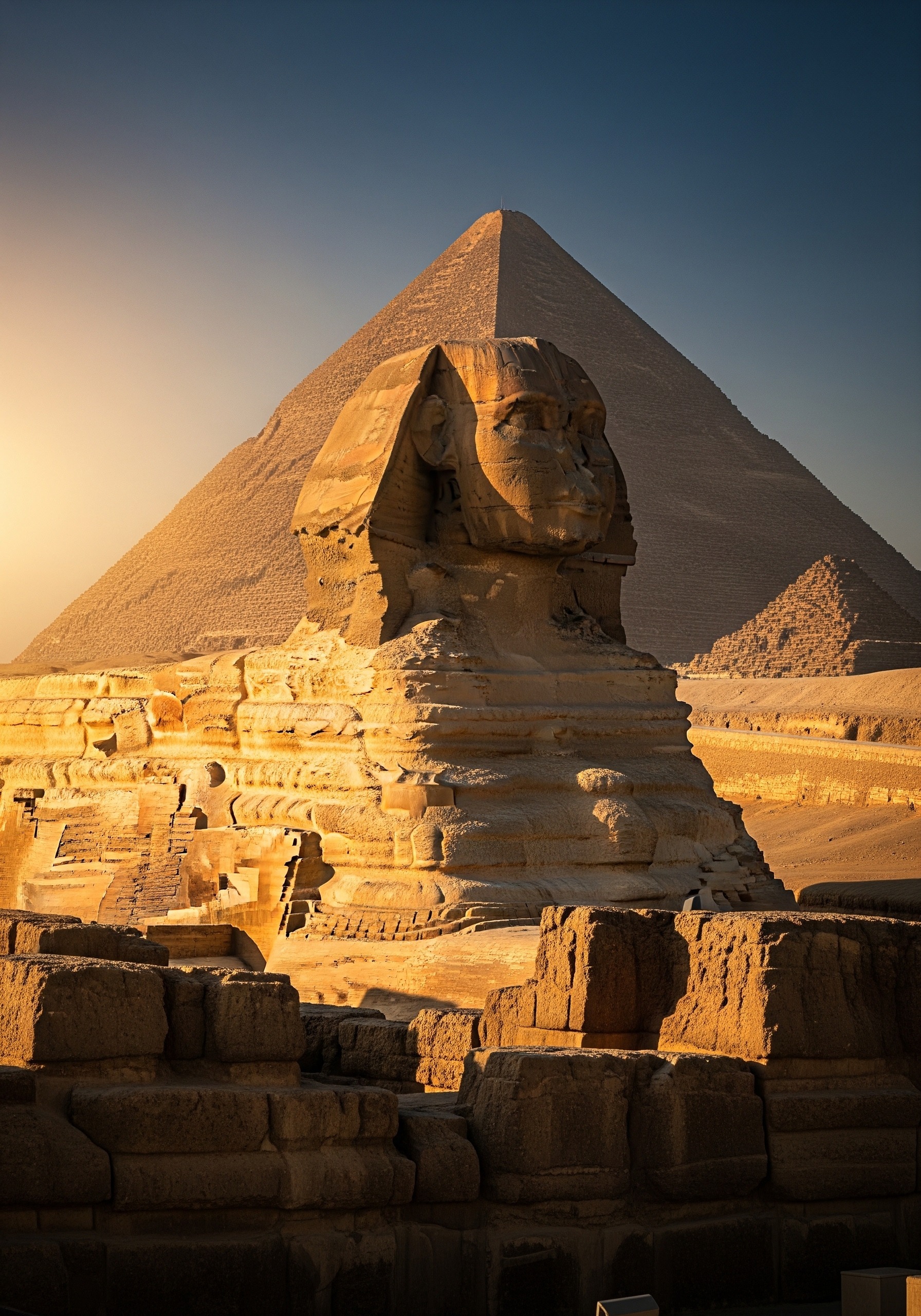
Before asking how Egypt fell, it helps to ask why it lasted three millennia when contemporaries like the Akkadian Empire or the Hittites barely managed three centuries. Egypt enjoyed a geographic cheat code: the Nile is the only river of its size in the world that flows from south to north through a desert, flooding on a predictable annual cycle that dumped fresh black silt on the fields each summer. Deserts to the east and west, cataracts to the south, and a marshy delta to the north made Egypt nearly invasion-proof for most of the Bronze Age.
That isolation produced one of the most conservative civilizations in human history. Hieroglyphic writing, divine kingship, mummification, and temple economics persisted with remarkable continuity from the Old Kingdom of Khufu (who built the Great Pyramid around 2560 BCE) through the New Kingdom of Ramesses II more than 1,300 years later. A scribe from the age of pyramids could have read inscriptions from the age of chariots with only modest difficulty — try that with English from 700 CE.
But the same geography that protected Egypt also tied it to a single river, and the same conservatism that preserved it made it brittle when the Nile failed or when iron-age outsiders finally figured out the route in.
The First Fall: When the Old Kingdom Cracked Around 2181 BCE
{IMAGE_2}
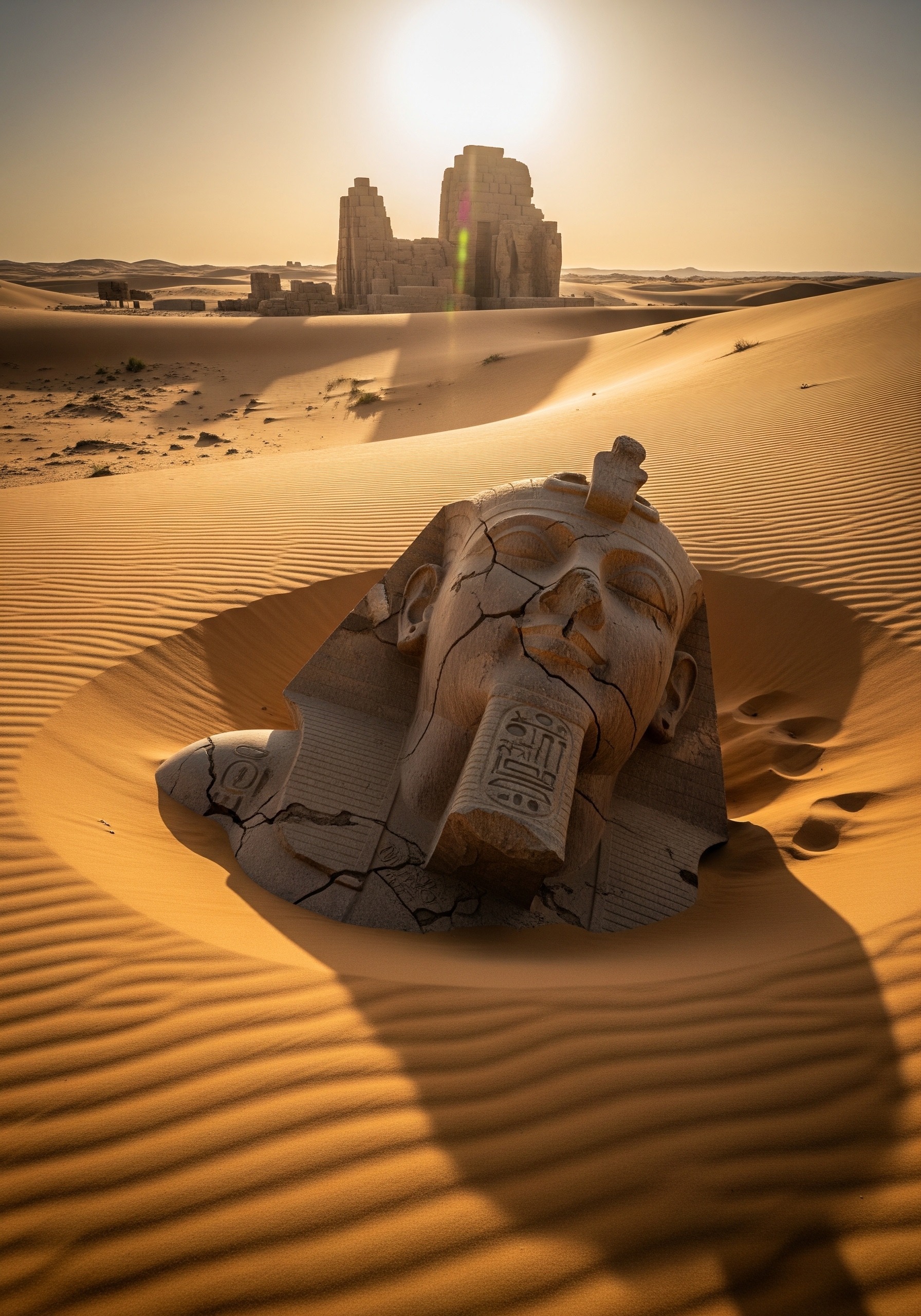
The first time ancient Egypt fell, the killer was the weather. Around 2200 BCE the entire eastern Mediterranean and Near East was hit by what paleoclimatologists call the “4.2-kiloyear event,” a sudden, severe, multi-century drying captured in cave stalagmites from Israel, lake sediments in Anatolia, and dust layers in the Gulf of Oman. The same event toppled the Akkadian Empire in Mesopotamia and is so abrupt in the geological record that the International Union of Geological Sciences uses it to mark the start of the Meghalayan Age — our current chunk of Earth history.
In Egypt the consequence was catastrophic: the Nile’s annual flood, which depends on summer monsoons over the Ethiopian highlands, repeatedly fell short. A tomb inscription from the period describes people eating their own children — extreme rhetoric, but it tracks with what archaeologists find: shrunken granaries, looted royal tombs, and the abrupt end of pyramid construction after Pepi II’s reign around 2184 BCE. Central authority dissolved into the First Intermediate Period, with local nomarchs (regional governors) ruling like petty kings for roughly 140 years until the Theban warlord Mentuhotep II reunified the country around 2055 BCE and launched the Middle Kingdom.
Lesson one: Egypt was a hydraulic civilization, and when the hydraulics failed, the pharaoh failed with them.
How Did Ancient Egypt Fall in the Bronze Age Collapse?
The second and most famous fall came at the end of the New Kingdom, between roughly 1200 and 1070 BCE. This was the same generation in which Troy burned, Mycenaean Greece collapsed into the Greek Dark Ages, the Hittite capital Hattusa was razed, and Ugarit on the Syrian coast was destroyed so completely that its last king’s distress letter survived in a clay tablet still in the kiln. Historians call this the Late Bronze Age Collapse — one of the most spectacular system failures in pre-modern history — and Egypt was the only major eastern Mediterranean state to survive it, but only just, and in a much-diminished form.
Three forces hit Egypt simultaneously. First, a documented megadrought struck the Levant and Aegean between roughly 1250 and 1100 BCE, confirmed by pollen cores from the Sea of Galilee showing a sudden crash in olive and oak pollen. Second, mysterious raider coalitions the Egyptians called the “Sea Peoples” — probably a mix of refugees including Sherden, Peleset (possibly the Biblical Philistines), Tjeker, and others driven from collapsing Mycenaean and Anatolian homelands — attacked the Nile delta twice. Pharaoh Merneptah beat them off around 1207 BCE; Ramesses III barely defeated them in a desperate land-and-sea battle around 1175 BCE that he commemorated on the walls of his mortuary temple at Medinet Habu.
Third, and decisively, Egypt rotted from within. Ramesses III himself was assassinated around 1155 BCE in a harem conspiracy — forensic CT scans of his mummy in 2012 revealed a deep throat wound that had been hidden by bandages for 3,000 years. The first recorded labor strike in history broke out the year before, when royal tomb-workers at Deir el-Medina marched on the granaries because their rations had not arrived. Inflation roared: the price of grain in some regions rose roughly eightfold. And the high priests of the god Amun at Karnak, who had been quietly accumulating land and gold for centuries, finally became a parallel state — by the reign of Ramesses XI in the late 1080s BCE they controlled an estimated one-third of all cultivable land in Egypt, ran their own army, and the priest Herihor effectively co-ruled with the pharaoh. When Ramesses XI died around 1077 BCE the priest-king Smendes took the north and the Amun priesthood took the south. The New Kingdom was over.
The Three Falls of Ancient Egypt — at a glance
- ~2181 BCE — End of the Old Kingdom. Trigger: 4.2-kiloyear megadrought, repeated Nile flood failure. Outcome: 140-year fragmentation (First Intermediate Period). Egypt recovers.
- ~1070 BCE — End of the New Kingdom. Trigger: Bronze Age Collapse + Sea Peoples + Amun priesthood + assassinated Ramesses III. Outcome: 350 years of split rule, foreign dynasties (Libyan, Kushite, Assyrian). Egypt partially recovers under the Saites.
- 30 BCE — End of pharaonic Egypt entirely. Trigger: Roman defeat of Cleopatra and Mark Antony at Actium (31 BCE). Outcome: Egypt becomes a Roman grain province; the last hieroglyph is carved in 394 CE at Philae; ancient Egyptian religion is banned by 391 CE.
The Long Twilight: Libyans, Kushites, Assyrians, and Persians
Between 1070 and 332 BCE — the long stretch historians lump together as the Third Intermediate and Late Periods — the throne of Egypt was occupied almost continuously by foreigners. Libyan chiefs from the western desert founded the 22nd Dynasty around 945 BCE. Then the Kingdom of Kush, Egypt’s old southern colony in what is now Sudan, marched north under King Piye and conquered the whole country around 728 BCE; these Kushite or “Black Pharaohs” of the 25th Dynasty actually revived classical Egyptian art, religion, and pyramid building (Sudan today contains more pyramids than Egypt does).
Then the empires of Iron Age Mesopotamia arrived. The Assyrians under Esarhaddon sacked Memphis in 671 BCE and under Ashurbanipal sacked Thebes — the immensely wealthy Karnak temple complex — in 663 BCE, an event so traumatic the Hebrew prophet Nahum was still gloating about it decades later. A brief native revival under the Saite 26th Dynasty (664-525 BCE) ended when the Persian king Cambyses II routed Pharaoh Psamtik III at the Battle of Pelusium in 525 BCE. After a brief independence (the 28th-30th Dynasties), Persia reconquered Egypt in 343 BCE under Artaxerxes III; the last native-born pharaoh, Nectanebo II, fled south into Nubia and disappears from history. He is the final ethnically Egyptian person ever to wear the double crown.
Enter the Greeks: Alexander, the Ptolemies, and the Last Native Religion
Alexander the Great took Egypt from the hated Persians without a battle in 332 BCE — the Egyptian priesthood crowned him pharaoh at Memphis and the oracle of Amun at Siwa allegedly hailed him as a son of the god. He founded Alexandria, which within a century became the largest, richest, and most intellectually dazzling city in the Mediterranean world, home to the Great Library and the Pharos lighthouse. After Alexander’s death in 323 BCE his general Ptolemy seized Egypt, and the resulting Ptolemaic Dynasty ruled for nearly 300 years.
The Ptolemies are paradoxical: they were ethnically Macedonian Greek and almost all spoke only Greek (Cleopatra VII, the very last of them, was reportedly the first who bothered to learn Egyptian), they ruled from a Greek-speaking capital, and they conducted court politics in the murderous Hellenistic style of fratricide and sibling marriage. But they also built immense, archaeologically classic-looking Egyptian temples at Edfu, Dendera, and Philae, depicted themselves as traditional pharaohs in headdresses smiting Egypt’s enemies, and patronized the priesthoods. Pharaonic Egypt’s last great architectural age was technically run by Greeks.
The Final Fall: Cleopatra, Actium, and Rome
By the first century BCE, Rome had digested the rest of the eastern Mediterranean and Egypt — fabulously wealthy and the breadbasket of the region — was the obvious last prize. Cleopatra VII, who came to the throne in 51 BCE at about age 18, played the only game available to her: alliance through the bedroom. She bore Julius Caesar a son (Caesarion) and then allied with and married Mark Antony, producing three more children. When Octavian (the future emperor Augustus) finally faced Antony’s combined fleet at the Battle of Actium on 2 September 31 BCE, the Egyptian and Roman ships were decisively beaten. Antony and Cleopatra fled to Alexandria and killed themselves the following August. Octavian had Caesarion strangled — there could be no surviving heir of Julius Caesar — and on 30 August 30 BCE annexed Egypt as a personal imperial province governed by an equestrian prefect, not a senator. After 31 centuries of pharaohs, Egypt now belonged to a man in Rome.
What Actually Ended — and What Did Not
Politically, ancient Egypt ended in 30 BCE. Culturally, it lingered for another four hundred years. Under Roman rule the temples still functioned and the priesthood still mummified the dead — Roman-period mummies wearing astonishingly lifelike Fayum portrait paintings are among the most haunting objects in any museum. But Christianity spread fast in the Nile valley from the 2nd century CE onward, and in 391 CE the Christian emperor Theodosius banned pagan worship across the empire. The temples were closed, defaced, or converted to churches. The last datable hieroglyphic inscription was carved at the temple of Philae on 24 August 394 CE; the last demotic graffito there is from 452 CE. After that, no human alive could read the script of the pharaohs until Jean-François Champollion decoded the Rosetta Stone in 1822 — a silence of nearly 1,400 years.
So how did ancient Egypt fall? Three times, by three different mechanisms, over two thousand years. It fell to climate when the Nile failed; it fell to internal rot and foreign refugees when the Bronze Age collapsed; and it fell to Rome when geopolitics finally caught up with geography. The civilization that built the pyramids did not die suddenly. It simply, finally, ran out of next chapters.
Frequently Asked Questions
Q: Who was the last true pharaoh of ancient Egypt?
A: It depends on how you count. The last native Egyptian-born pharaoh was Nectanebo II, who fled the Persian invasion in 343 BCE. The last pharaoh of any kind was the Macedonian Greek queen Cleopatra VII Philopator, who died on roughly 12 August 30 BCE. Her son Caesarion was technically co-ruler and is sometimes listed as Ptolemy XV; the Roman victor Octavian had him executed within weeks.
Q: Did the Sea Peoples really destroy ancient Egypt?
A: No — they didn’t quite destroy Egypt, but they helped end its imperial period. Pharaoh Ramesses III defeated a major Sea Peoples invasion around 1175 BCE in battles depicted on his temple at Medinet Habu. But the cost of those wars, combined with megadrought, priestly takeover, and the assassination of Ramesses III himself, was enough to end the New Kingdom within about a century. The Sea Peoples completely destroyed Egypt’s contemporaries, including the Hittite Empire and Mycenaean Greece.
Q: How long did ancient Egypt last in total?
A: About 3,000 years, from the unification of Upper and Lower Egypt under King Narmer around 3100 BCE to Roman annexation in 30 BCE. By comparison, that span is longer than the time between the building of the Great Pyramid (around 2560 BCE) and today. No other state has come close to that political continuity, which is itself one of the most striking facts in human history.
Q: Was ancient Egypt destroyed by climate change?
A: At least twice, yes — but only partly. The 4.2-kiloyear megadrought helped collapse the Old Kingdom around 2181 BCE, and the Late Bronze Age drought (~1250-1100 BCE) helped collapse the New Kingdom. Both episodes are confirmed by independent paleoclimate evidence including cave stalagmites, lake sediments, and pollen records. Climate alone never killed Egypt — but it removed the slack the system needed to survive simultaneous political and military shocks.
The fall of ancient Egypt is less a death and more a long, dignified exhale: a 3,000-year civilization that absorbed three catastrophic collapses, two of which it survived, and finally one it did not. The Nile still floods (now controlled by the Aswan High Dam); the pyramids still stand; the language of Coptic Christians still preserves echoes of pharaonic Egyptian. Egypt, in the deepest sense, never quite fell. It just stopped being ruled by pharaohs — and started being read about by everyone else.
For a broader look at how great states unravel, see our companion pieces on the fall of the Roman Empire, the Late Bronze Age Collapse, and the collapse of the Classic Maya. Authoritative external sources used here include the British Museum’s Egyptian collections, the Metropolitan Museum of Art’s Heilbrunn Timeline of Art History on the Late Period, and the open-access Wikipedia survey of the Late Bronze Age collapse.
Illustrations are AI-generated. Article fact-checked and human-edited.