How Do Axolotls Regrow Limbs? The 2025 Answer
How do axolotls regrow limbs so cleanly that not even a scar is left behind? A juvenile Mexican axolotl can rebuild an entire leg — bone, nerves, blood vessels, muscle and skin — in roughly 40 to 50 days, and for almost two centuries nobody could explain the trick. Then, across a single remarkable year, three separate teams finally pried the mechanism open.
Key Facts
- A juvenile axolotl regrows a complete limb — bone, muscle, nerves, blood vessels and skin — in about 40–50 days with no scar, according to the University of Kentucky’s Ambystoma Genetic Stock Center.
- Regrowth runs through a blastema, a knot of cells that forms over the wound within roughly 24 hours; a March 2025 study found connective-tissue cells make up about 75% of it.
- Retinoic acid — a vitamin-A derivative — acts as a positional map. A June 2025 Nature Communications paper showed the gradient is set by an enzyme, CYP26B1, destroying the molecule, not just producing it.
- An October 2025 study in Cell found axolotls launch regeneration body-wide using the sympathetic “fight-or-flight” nervous system and the messenger noradrenaline.
- Ambystoma mexicanum is critically endangered: once thousands per square kilometre in Mexico City’s Lake Xochimilco, wild numbers are now estimated in the dozens to low hundreds.
In short: An axolotl regrows a lost limb by reverting nearby mature cells into a flexible repair cluster called a blastema, then re-reading a chemical map that tells each cell exactly which part to rebuild. We humans scar instead because our cells stay locked in their jobs. In 2025, scientists finally identified the enzyme that draws the map, the cells that do most of the work, and the nerve signal that fires the starting gun.
Key Facts
- A juvenile axolotl regrows a complete limb, including bone, muscle, nerves, blood vessels and skin, in about 40 to 50 days with no scar, according to the University of Kentucky’s Ambystoma Genetic Stock Center.
- Regrowth runs through a blastema that forms over the wound within roughly 24 hours; a March 2025 study found connective-tissue cells make up about 75% of it.
- A June 2025 Nature Communications paper showed retinoic acid’s positional gradient is set by the enzyme CYP26B1 destroying the molecule, not just producing it.
- An October 2025 study in Cell found axolotls launch regeneration body-wide using the sympathetic fight-or-flight nervous system and the messenger noradrenaline.
- Ambystoma mexicanum is critically endangered, with wild numbers in Lake Xochimilco now estimated in the dozens to low hundreds, down from thousands per square kilometre.
In short: The axolotl regrows a lost limb by reverting mature cells into a repair cluster called a blastema, then re-reading a chemical map that tells each cell what to rebuild. In 2025, three teams identified the mapping enzyme CYP26B1, the connective-tissue cells doing most of the work, and the nerve signal that triggers regeneration.
The salamander that refuses to grow up
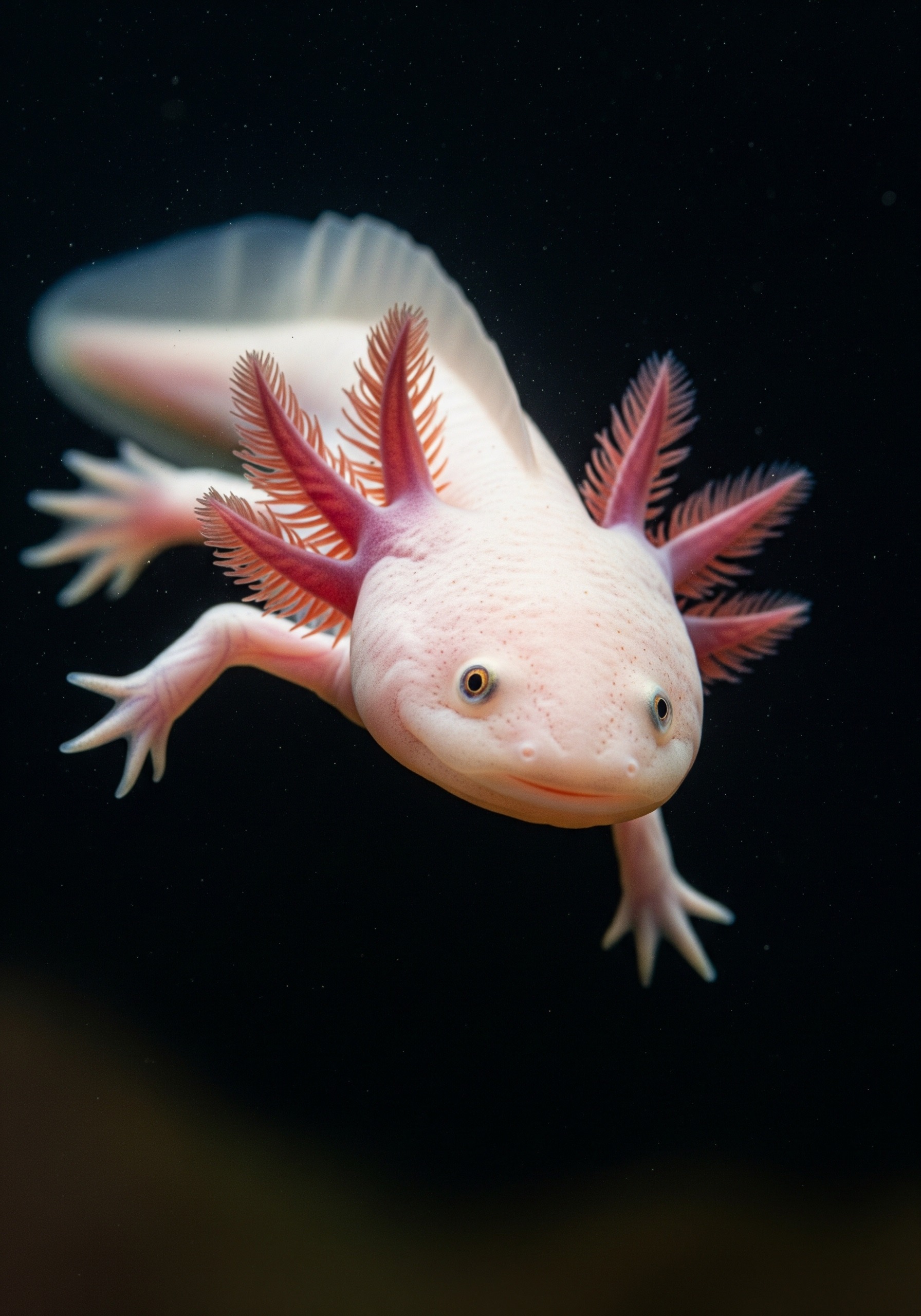
Most amphibians swap their gills for lungs and crawl onto land. The axolotl simply… doesn’t. It spends its whole life in the larval body it was born with — feathery pink gills fanning out behind its head, a permanent half-smile, a tail built for water. Biologists call this neoteny: staying young forever. And that refusal to grow up is exactly what makes it a regeneration superstar.
Native to a single waterlogged corner of Mexico City, Ambystoma mexicanum became science’s favourite lab animal more than a hundred years ago precisely because of what it can survive. Cut off a limb and it grows back, perfectly patterned, every single time. Researchers have watched individual axolotls regrow the same leg again and again without the result degrading — something no mammal can manage.
Here’s the thing, though: for most of that century, “how” was a polite mystery. Scientists could describe the regrowth in beautiful detail and still not tell you what set the rules.
What grows back — and what doesn’t
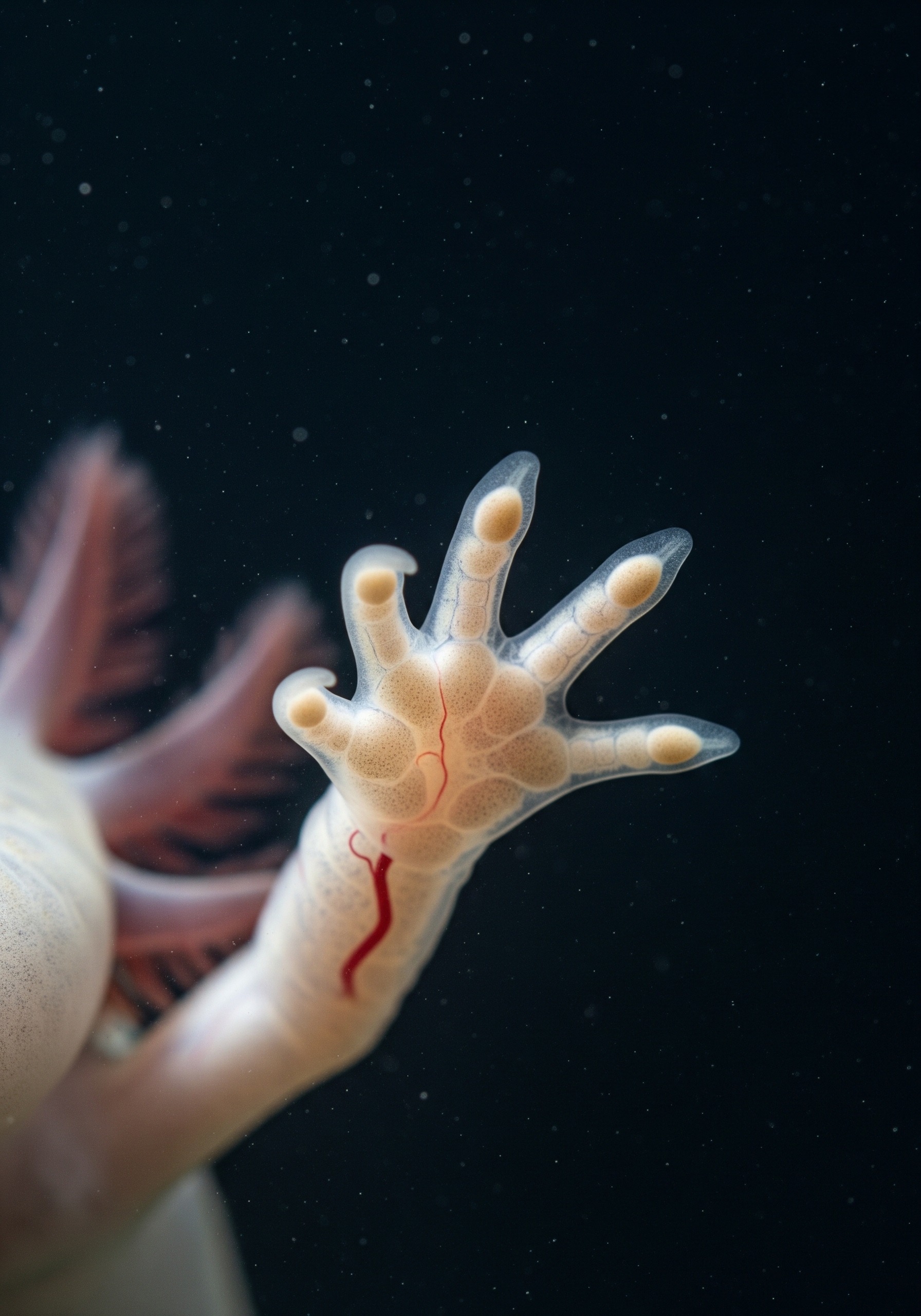
Start with the headline: a full limb. Not a stump, not a fin-like approximation, but a complete arm or leg with the right number of bones, jointed correctly, wired with nerves and threaded with blood vessels, capped by a hand or foot with separate digits. No scar tissue marks the seam. You cannot tell, weeks later, where the cut was.
The limb is just the famous example. Axolotls also regenerate sections of the heart, large parts of the spinal cord, jaw, and even portions of the brain and retina. Damage that would leave a person paralysed or permanently scarred, the axolotl treats as a temporary inconvenience.
What it can’t do has limits worth stating honestly: regeneration is fastest and most flawless in young animals, slows with age, and a badly mangled or repeatedly injured limb can occasionally come back malformed. This is biology, not magic — but it is the closest thing to magic that vertebrate medicine has found.
{IMAGE_2}
Inside the stump: building a blastema in 24 hours
Watch the first day after an amputation and the speed is startling. Within hours, skin cells migrate across the raw surface and seal it under a thin layer called the wound epithelium — no scab, no clot-and-scar response. Underneath, the real work begins.
Nearby mature cells do something almost unheard of in animals: they dedifferentiate. Muscle, cartilage and connective-tissue cells partly forget their adult identity, switch back to a flexible state, and pile up beneath the wound skin into a dome of progenitor cells — the blastema. Within roughly 24 hours the construction site is staffed; over the following weeks the blastema rebuilds the missing limb outward, like a 3D printer working from the shoulder to the fingertips.
For decades, textbooks waved at “stem cells” doing this job. A March 2025 preprint from a European research group sharpened the picture dramatically: using spatial mapping of the blastema, they found that connective-tissue cells make up around 75% of it at peak — not generic stem cells, but the humble cells that build tendon, bone covering and the scaffolding between organs. Switch those cells off, and regeneration stalls or truncates. The lesson is that the axolotl’s secret labour force was hiding in plain sight, in the most ordinary tissue in the body.
- ~24 hours — wound epithelium seals the stump; blastema cells begin to gather
- ~75% — share of the blastema made of connective-tissue cells (2025 finding)
- 40–50 days — to regrow a full juvenile limb (terrestrial salamanders take 155–375)
- 3 landmark 2025 papers — CYP26B1 enzyme (June), connective tissue (March), nerve signal (October)
- <100s — estimated wild axolotls left in Lake Xochimilco
How a cell knows it’s an elbow and not a wrist
This is the deep puzzle, and it’s older than you’d think — naturalists were arguing about it 200 years ago. When a limb is severed at the shoulder, the blastema rebuilds the whole arm. Sever it at the wrist, and the same kind of blastema rebuilds only the hand. How does a cluster of look-alike cells know how much limb is missing?
The long-known answer is a molecule called retinoic acid, a derivative of vitamin A that forms a chemical gradient along the limb — high near the body, low at the fingertips. Think of it as an altitude reading: a cell measures its retinoic-acid level and infers, “I’m at the elbow, so I need to build everything from here down.” Bathe a wrist blastema in extra retinoic acid and it will dutifully grow a whole forearm, too much limb, because you’ve lied to it about its position.
But where the gradient actually came from stayed unsolved — until June 2025. A team led by James Monaghan at Northeastern University, publishing in Nature Communications, showed the gradient is shaped less by where retinoic acid is made and more by where it is destroyed. An enzyme called CYP26B1 breaks the molecule down in the distal blastema, carving the slope from the top end. Block CYP26B1 and distal cells reprogram into proximal ones, growing limb segments that shouldn’t be there. The same study flagged a gene named Shox — linked in humans to skeletal proportion — as one of the positional switches the gradient flips. After two centuries, the map finally had a draughtsman.
The 2025 surprise: regeneration starts with a jolt of adrenaline
The strangest discovery of the year came from Harvard. If the blastema is the construction crew and retinoic acid is the blueprint, what fires the starting gun? You might guess a local wound signal. The answer, published in Cell in October 2025 by Duygu Payzin-Dogru and colleagues in Jessica Whited’s lab, is far weirder: the axolotl hijacks its own panic system.
When a limb is lost, the sympathetic nervous system — the same “fight-or-flight” network that floods your body with adrenaline when a car swerves at you — releases noradrenaline that activates stem cells across the entire animal, not just at the injury. The whole body is quietly primed to rebuild, days before there’s a visible bud. Strip away the science-fiction headlines about humans regrowing arms, and the nearer, more honest prize is right here: an animal that turns the stress response into a repair signal is showing us a switch, not a miracle.
Why your cut finger only scars
So why can’t we do this? We share most of the relevant genes; a salamander is a vertebrate cousin, not an alien. The difference is what our cells choose to do at a wound.
In humans, injury summons fibroblasts that rush in and lay down collagen — fast, tough scar tissue that seals the gap and stops infection. It is excellent triage and terrible regeneration. Our fibroblasts stay fibroblasts; they do not dedifferentiate into a blastema, so there is no flexible cell pool to rebuild structure from. We trade the ability to regrow for the ability to heal quickly and not bleed out. Evolution, turns out, made a bargain — and for a fast-moving, warm-blooded animal at constant risk of infection, scarring was probably the safer deal.
| After tissue loss | Axolotl | Human |
|---|---|---|
| Wound covering | Thin wound epithelium, no scar | Clot → collagen scar |
| Cell behaviour | Mature cells dedifferentiate into a blastema | Fibroblasts stay specialised, deposit collagen |
| Final result | New, correctly patterned limb | Closed wound, no new structure |
From salamander to surgery ward
Here is where honesty matters most, because this is where the hype lives. No, this research will not let an amputee regrow an arm next year, or likely this decade. What the 2025 findings do is hand researchers concrete levers — a specific enzyme, a specific cell type, a specific nerve signal — to test in mammals.
The realistic near-term payoffs are smaller and genuinely valuable: coaxing a wound to rebuild instead of scar, helping severed nerves reconnect, regrowing damaged heart or spinal tissue rather than replacing it with scar. That retinoic acid sits at the centre of the limb map is intriguing partly because it is already a well-studied vitamin-A molecule that human biology uses elsewhere — a familiar tool, not an exotic one. (This is biology to understand, not a treatment to try; none of these findings are medicine yet.) If you want to see how widely this repair toolkit is spread across the animal kingdom, the broader story of animals that can regenerate limbs puts the axolotl in striking company.
The cruel paradox: Earth’s best healer is nearly gone
And now the part that should bother you. The most gifted regenerator on the planet cannot regenerate its own habitat. Wild axolotls live in essentially one place — the canals and remnants of Lake Xochimilco, in southern Mexico City — and that water is vanishing under pollution, urban sprawl and invasive carp and tilapia that eat axolotl young.
Surveys tell a brutal story. In the late 1990s, researchers counted thousands of axolotls per square kilometre. By the mid-2010s the figure had collapsed to a handful per square kilometre, and recent estimates put the wild population somewhere between a few dozen and perhaps a thousand animals. The species is classed as critically endangered. Millions thrive in aquariums and labs worldwide, which means the axolotl will not go extinct — but the wild creature, the one that taught us how regeneration works, is almost gone from the only lake it ever called home.
Frequently Asked Questions
Q: How long does an axolotl take to regrow a limb?
A: About 40 to 50 days for a young axolotl to rebuild a complete limb, per the University of Kentucky’s Ambystoma centre. It runs slower in older or larger animals, and far slower in land-dwelling salamanders, which can take 155 to 375 days.
Q: Why can’t humans regrow limbs like axolotls?
A: Our cells respond to injury by scarring. Human fibroblasts deposit collagen and stay specialised, so there’s no flexible blastema to rebuild from. Axolotl cells dedifferentiate into that repair pool; ours don’t. The trade-off bought us fast, infection-resistant healing.
Q: What is a blastema?
A: A blastema is the cluster of reset, progenitor-like cells that forms under the wound skin after amputation and rebuilds the missing part. In axolotls it appears within about a day, and roughly three-quarters of it is connective-tissue cells.
Q: Could axolotl research ever help human medicine?
A: Potentially, but slowly and indirectly. The 2025 discoveries give scientists specific targets — the CYP26B1 enzyme, connective-tissue cells, adrenergic nerve signals — to test in mammals, aiming first at reducing scarring and improving nerve or tissue repair, not regrowing whole limbs.
Sources
- Monaghan et al., “Retinoic acid breakdown is required for proximodistal positional identity during axolotl limb regeneration,” Nature Communications, June 2025 (Northeastern University)
- Payzin-Dogru, Whited et al., “Adrenergic signaling coordinates distant and local responses to amputation in axolotl,” Cell, October 2025 (Harvard University)
- “The essential role of connective-tissue cells during axolotl limb regeneration,” bioRxiv preprint, March 2025
- University of Kentucky Ambystoma Genetic Stock Center — measured regeneration times
- IUCN Red List — Ambystoma mexicanum conservation status
The axolotl spent a century smiling up from lab tanks while it kept its biggest secret. In one year we learned who draws its body map, who does the building, and what fires the signal to begin — even as the animal itself slips toward the edge in its last wild lake. The least we owe a creature that may one day teach us to heal is to make sure it survives to finish the lesson.
Illustrations are AI-generated. Article fact-checked and human-edited. Our editorial standards.