Etruscan Shrew Heart Rate: 1,511 Beats a Minute Explained
The Etruscan shrew heart rate tops out at 1,511 beats per minute — about 25 beats every second, the fastest heartbeat ever recorded in any animal with a backbone. Hold that number for a moment. Your own heart, resting, manages maybe 60. This creature runs its at a rate you cannot even count.
Key Facts
- The peak recorded heart rate of Suncus etruscus is 1,511 beats per minute (Jürgens et al., Journal of Experimental Biology, 1996) — the highest of any vertebrate.
- It is the smallest mammal on Earth by mass: roughly 1.8 grams, lighter than a one-cent coin, with a body 3–5.2 cm long before the tail.
- It must eat 1.5 to 2 times its own body weight every day and will starve to death in as little as four hours without food.
- Its heart muscle is about 1.2% of its body weight — proportionally more than double a human’s (~0.5%).
- A 2024 study in Science found shrews have deleted part of the cardiac troponin I gene, releasing a molecular brake that normally slows the heartbeat.
In short: The Etruscan shrew’s record-breaking heartbeat is not a party trick — it is the engine of a metabolic prison. The same furnace that lets a 2-gram body stay warm also burns through food so fast that the heartbeat and the hunger clock are, quite literally, the same equation.
Key Facts
- The peak recorded heart rate of the Etruscan shrew (Suncus etruscus) is 1,511 beats per minute, about 25 beats per second, documented by Jurgens et al. in the Journal of Experimental Biology, 1996.
- It is the smallest mammal on Earth by mass, weighing roughly 1.8 grams with a body 3 to 5.2 cm long before the tail.
- It must eat 1.5 to 2 times its own body weight daily and can starve to death in as little as four hours without food.
- Its heart muscle is about 1.2% of body weight, more than double a human’s roughly 0.5%.
- A 2024 study in Science found shrews have deleted part of the cardiac troponin I gene, releasing a molecular brake that slows the heartbeat.
In short: The Etruscan shrew has the fastest heartbeat of any vertebrate, peaking at 1,511 beats per minute. Weighing about 1.8 grams, it is Earth’s smallest mammal by mass and must eat 1.5 to 2 times its body weight daily, starving within roughly four hours without food.
A heart that beats 25 times a second

In 1996, the German physiologist Klaus Jürgens and his colleagues did something fiddly: they recorded electrocardiograms from Etruscan shrews through electrodes under their tiny feet. What the trace showed has never been beaten. The mean resting rate sat around 835 beats per minute. Under exertion the average climbed past 1,000. And the single highest value they captured — the fastest heartbeat documented in any warm-blooded animal — reached 1,511 beats per minute.
That is 25 contractions per second. A hummingbird’s wings, for comparison, look like a blur at about 50 beats per second; this animal’s heart is doing half of that, inside its chest, all day. There is no slow gear. The shrew cannot idle.
Here is the thing most write-ups miss. A heartbeat that fast is not a record for the record book — it is a debt that has to be paid in food, every few hours, for the animal’s entire two-year life.
{IMAGE_2}
Meet Suncus etruscus: 1.8 grams that shouldn’t work
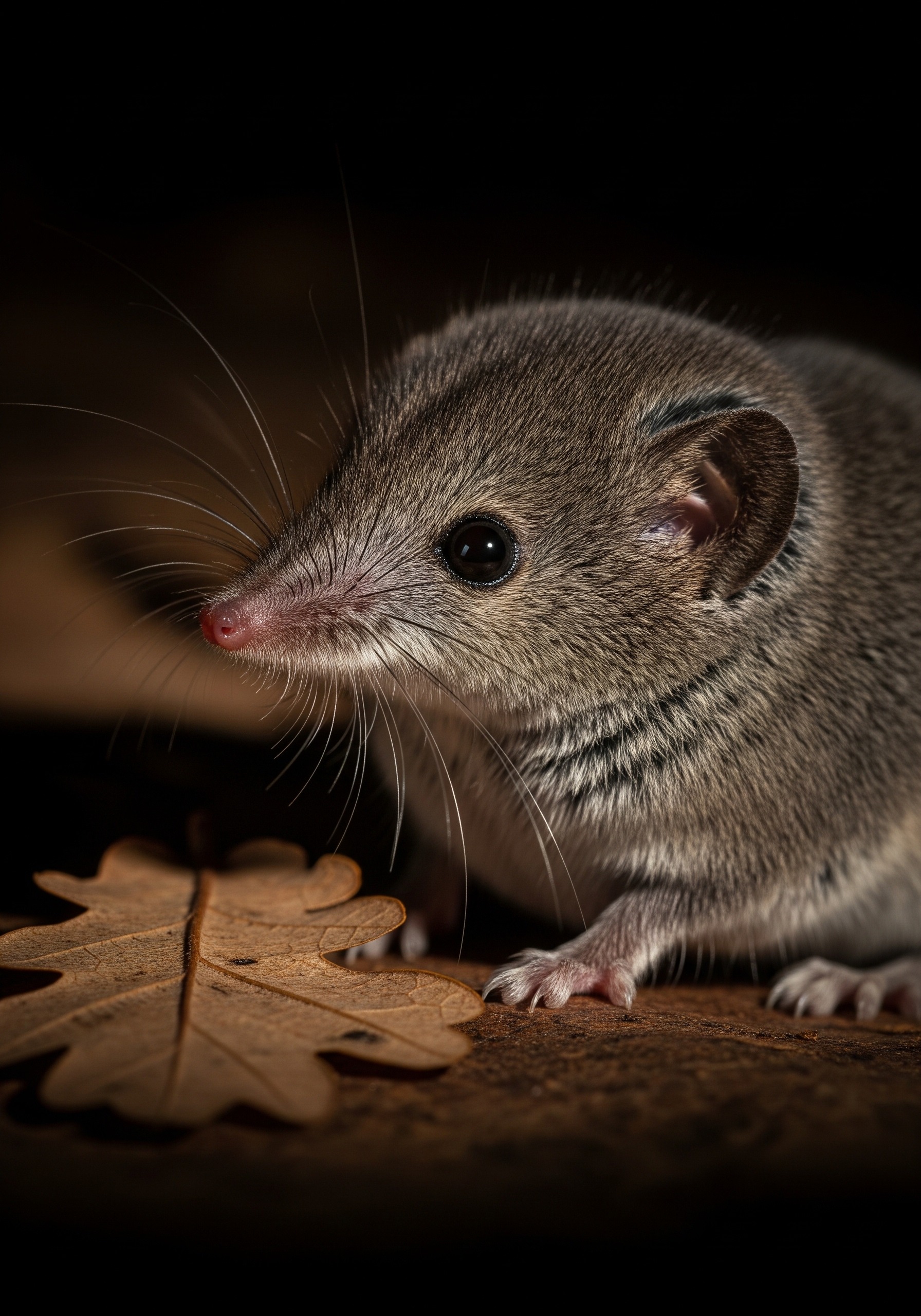
The Etruscan shrew — also called the Etruscan pygmy shrew or white-toothed pygmy shrew — weighs about 1.8 grams. The range runs from roughly 1.3 to 2.5 grams. Its body, tail excluded, measures 3 to 5.2 centimetres; the tail adds another 2.4 to 3.2. You could mistake it for a large bumblebee moving through leaf litter.
It lives across a warm, damp belt of the planet — broadly between 10°N and 45°N — taking in southern Europe, North Africa, and parts of Asia. It hunts mostly invertebrates: crickets, grasshoppers, beetle larvae, the occasional small vertebrate. Remarkably, it will take prey nearly its own size, striking, killing, and eating animals as big as it is. Owls, other birds of prey, and weasels return the favour.
Being this small is the whole problem. Heat leaves a body through its surface, and a tiny body is almost all surface relative to its volume. A 1.8-gram animal sheds warmth ferociously, so it must generate warmth just as ferociously — and that is what the heart is feeding.
The four-hour clock: why the heartbeat is the hunger
Connect the two facts nobody usually connects, and the shrew stops being a curiosity and becomes a single elegant equation. A heart running at 1,000-plus beats per minute is pumping oxygen to a metabolism burning fuel at a furious rate. That metabolism is why the shrew eats 1.5 to 2 times its body weight daily. And because it carries almost no fat reserve, the moment the food stops arriving, the furnace has nothing left to burn.
The result: an Etruscan shrew can starve to death in roughly four hours. The beats-per-minute is the starvation clock. The heart cannot slow down to conserve fuel, so the fuel keeps disappearing, so the animal must hunt again — through the night, through the day, in short frantic bursts of activity and sleep. For a creature this size, rest is not recovery. It is just the gap before the next meal.
- 1,511 — peak heartbeats per minute (≈25 per second)
- ~835 — resting heartbeats per minute (Jürgens, 1996)
- 1.5–2× — body weight eaten in food per day
- ~4 hours — survival time without food
- ~2 years — typical lifespan
So who really has the fastest heart?
Ask most people which animal has the fastest heartbeat and they will say the hummingbird. They are wrong, and the error is worth correcting because it is everywhere. A ruby-throated hummingbird in hard flight reaches around 1,260 beats per minute. Impressive — but the Etruscan shrew hits 1,511 at rest-to-moderate effort. The champion of the entire vertebrate world is not the bird. It is the shrew.
| Animal | Approx. heart rate (BPM) | Body mass |
|---|---|---|
| Etruscan shrew (peak) | 1,511 | ~1.8 g |
| Ruby-throated hummingbird (flight) | ~1,260 | ~3 g |
| House mouse | ~500–600 | ~20 g |
| Human (resting) | ~60–80 | ~70,000 g |
| Blue whale (diving) | ~2 | ~150,000,000 g |
The pattern is iron-clad across mammals: the smaller the animal, the faster the heart. The shrew sits at the extreme end of that line because nothing smaller has ever managed to stay warm-blooded. It is the wall.
A Formula 1 engine in a 2-gram chassis
The cardiologist M. Harris captured the idea neatly in a 2018 presentation to the FASEB, calling the shrew’s heart a “Formula 1 engine” — an organ pushed to the absolute physical limit of what muscle can do. The metaphor holds up under the numbers. In the Etruscan shrew the heart makes up roughly 1.2% of total body weight. In a human it is about 0.5%. The engine takes a proportionally huge share of the chassis.
And rate alone does not explain it. Jürgens’ team showed in 1996 that beating fast is only part of the trick: the shrew also needs an unusually large stroke volume relative to its size and blood chemistry tuned for rapid oxygen delivery. Speed, volume, and the oxygen-carrying capacity of the blood all have to be cranked together. Stop at “1,500 BPM, wow” and you miss the actual engineering — the whole oxygen-transport system is redlined, not just the pump.
2024: the gene that took the brakes off
How is any of this physiologically possible? For years that question had no mechanism behind it. Then, in 2024, a team led by William Joyce and Professor Kevin Campbell of the University of Manitoba published an answer in the journal Science — and it is the freshest, most concrete piece of this whole story.
In most mammal hearts, a protein called cardiac troponin I carries a small molecular “extension.” Under stress, adrenaline acts on that extension to make the heart relax faster between beats — a temporary boost. Joyce and Campbell’s team found that shrews (and several other fast-hearted mammals) have genetically deleted the relevant segment of the troponin I gene altogether. The brake is simply gone. The heart relaxes ultra-fast all the time, as if permanently flooded with adrenaline, which is exactly what a heartbeat 25 times a second requires: each contraction must finish and reset in a sliver of a second, or the next one cannot come.
One honest wrinkle worth flagging: the 2024 study describes a resting rate around 1,020 beats per minute, higher than the ~835 Jürgens measured in 1996. The numbers differ because conditions and methods differ — body temperature, stress, and how “resting” is defined all move the figure. The records agree on the only thing that matters: this is, by a wide margin, the fastest mammalian heart known.
The whiskers strike before the eye can blink
An extreme heart needs an extreme animal wrapped around it, and the shrew obliges. Its brain weighs about 60 milligrams — and roughly a third of it is given over to processing touch. It has over 100 whiskers (vibrissae) arranged in six neat rows, and it sweeps them across the dark at about 14 times a second, building a map of the world by feel rather than sight.
The neuroscientist Michael Brecht and colleagues, working at the Bernstein Center in Berlin and publishing through the Royal Society in 2011, clocked the result: from whisker contact to killing strike, the Etruscan shrew reacts in 25 to 30 milliseconds — among the fastest tactile reflexes ever measured in a mammal. It is, in effect, the highest-revving predator on Earth: a hair-trigger nervous system bolted to a hair-trigger heart.
But that reflex has a fatal dependency. Brecht’s team found that if the shrew’s body temperature falls from 36°C to 24°C, its cortical response times slow by two to three times. So the cold is a trap. A chilled shrew reacts too slowly to catch the insects it needs; missing meals means it cannot fuel its furnace; an unfueled furnace means it gets colder still. For an animal that can starve in four hours, getting cold is not discomfort — it is the first link in a chain that ends in death. The heart that cannot slow down has built a life that cannot pause.
Frequently Asked Questions
Q: What is the fastest heart rate of any animal?
A: The Etruscan shrew (Suncus etruscus) holds the record, with a peak of 1,511 beats per minute documented by Jürgens and colleagues in 1996 — the highest reliably recorded heart rate of any vertebrate, faster even than a hummingbird in flight.
Q: How long can an Etruscan shrew survive without food?
A: Only about four hours. It carries almost no fat reserve and must eat 1.5 to 2 times its body weight daily, so its blistering metabolism leaves no cushion. This is general biological information, not a husbandry guide.
Q: Is the Etruscan shrew really the smallest mammal?
A: By mass, yes — at roughly 1.8 grams it is the lightest mammal known. (Kitti’s hog-nosed bat is sometimes called the smallest by skull and body length, so the “smallest mammal” title depends on whether you measure weight or length.)
Q: Does a hummingbird’s heart beat faster than a shrew’s?
A: No. A ruby-throated hummingbird reaches roughly 1,260 BPM in flight, while the Etruscan shrew hits 1,511 BPM. The widely repeated claim that the hummingbird has the fastest heartbeat is incorrect.
Sources
- Jürgens, K.D., Fons, R., Peters, T. & Sender, S. “Heart and Respiratory Rates and Their Significance for Convective Oxygen Transport Rates in the Smallest Mammal, the Etruscan Shrew Suncus etruscus.” Journal of Experimental Biology, 199(12), 1996.
- Joyce, W., Campbell, K.L. et al. Study on cardiac troponin I gene excision and high heart rates in mammals, published in Science, 2024 (University of Manitoba / international collaboration).
- Brecht, M., Naumann, R., Anjum, F. et al. “The neurobiology of Etruscan shrew active touch.” Philosophical Transactions of the Royal Society B, 2011.
- Harris, M. “The Formula 1 Heart of the Etruscan Shrew Suncus etruscus.” The FASEB Journal, 2018 supplement.
The Etruscan shrew is what life looks like when it presses right up against a physical wall. Make a warm-blooded animal any smaller, beat its heart any faster, and the equation stops balancing — there simply aren’t enough hours in the day to eat. It survives in the narrowest margin any mammal has ever held, and that, more than the record itself, is the wonder of it.
Illustrations are AI-generated. Article fact-checked and human-edited. Our editorial standards.