How Do Insects Breathe? The Tracheal System Explained
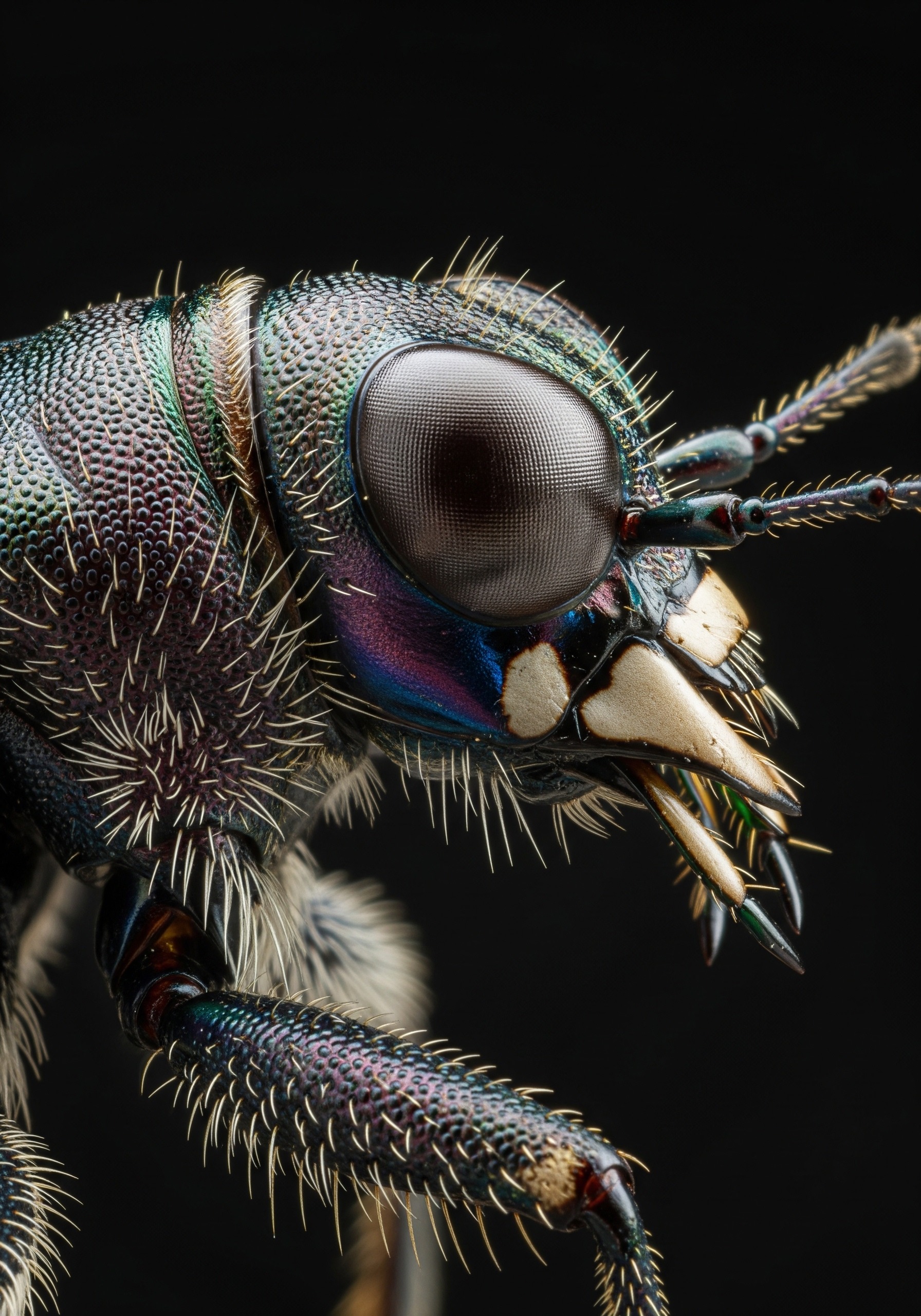
To understand how do insects breathe, you have to throw out the entire vertebrate playbook and start over. A blowfly hums through summer air at roughly 200 wingbeats a second, burning oxygen per gram faster than a hummingbird — and it does this with no lungs, no nose, and no blood that carries gas. Insects breathe through a private wind-tunnel finer than spider silk, piping air directly to every cell.
Key Facts
- Insects have no lungs. They breathe through 1–10 pairs of valved side-of-body openings called spiracles.
- The tracheal system delivers oxygen directly to cells, bypassing the bloodstream entirely.
- The finest air tubes (tracheoles) are roughly 0.2–2 micrometers wide — thinner than a single red blood cell.
- Some insects hold their breath in cycles lasting minutes — a pattern called discontinuous gas exchange.
- Aquatic insects use three different tricks: feathery gills, silvery air bubbles, or permanent “plastron” films held by hydrophobic hairs.
In short: Insects breathe by piping atmospheric air through tiny side-of-body valves (spiracles) into a branching network of tubes (tracheae) that deliver oxygen straight to each cell. No lungs, no oxygen-carrying blood — just a plumbing system finer than human hair, ventilated by passive diffusion in small species and by muscular pumping in larger ones.
Key Facts
- Insects have no lungs; they breathe through 1 to 10 pairs of valved side-of-body openings called spiracles.
- The tracheal system delivers oxygen directly to cells, bypassing the bloodstream, so insect blood (hemolymph) is colorless and carries almost no oxygen.
- The finest air tubes, the tracheoles, are roughly 0.2 to 2 micrometers wide, thinner than a single red blood cell at about 7.5 micrometers.
- In 2003 Mark Westneat and colleagues at the University of Chicago used a synchrotron X-ray beam at Argonne National Laboratory to show even tiny insects pump air advectively, not just by diffusion.
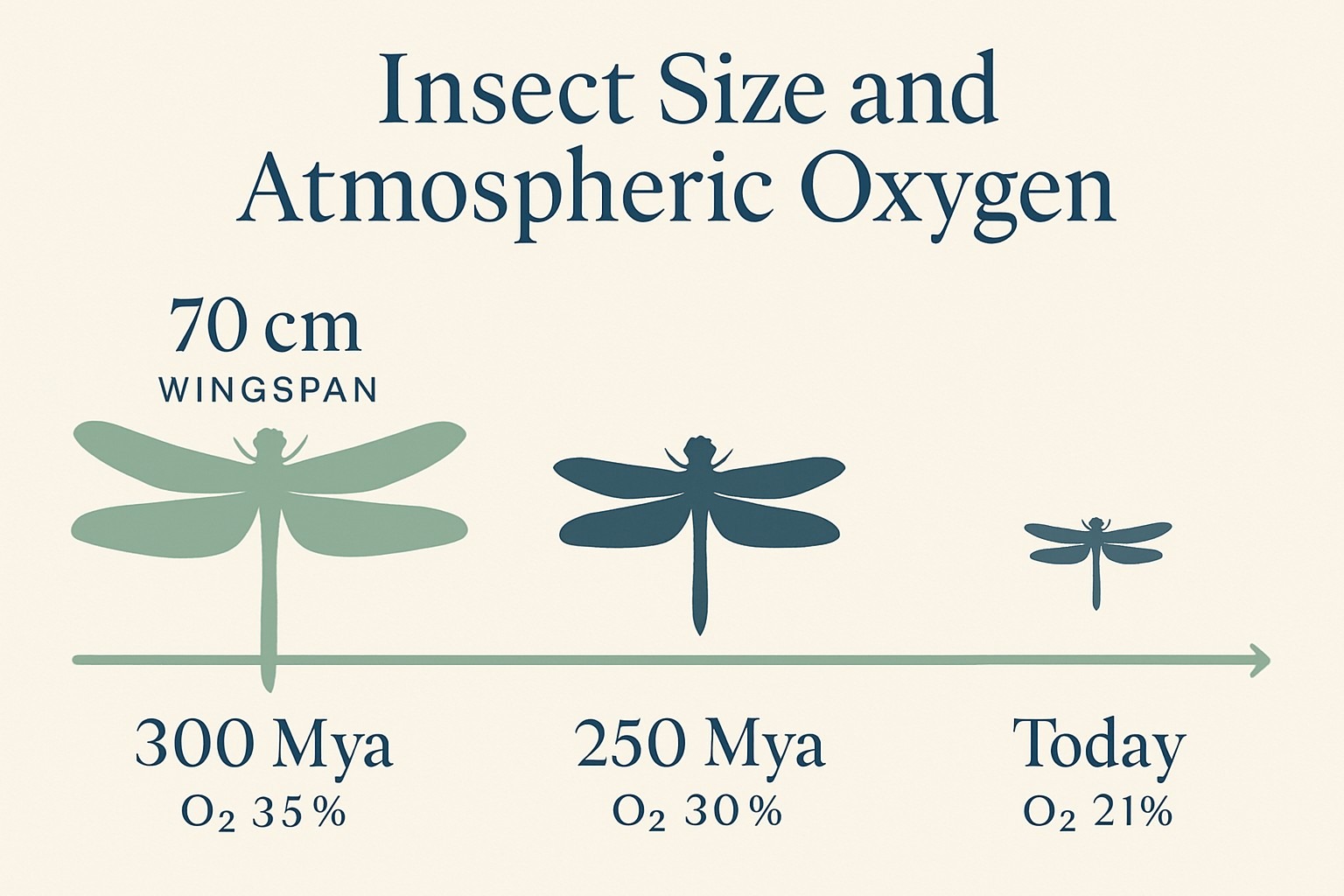
- The largest known insect, Meganeuropsis permiana, was a dragonfly-like predator with a roughly 70 cm wingspan, living when Carboniferous oxygen reached an estimated ~35 percent versus 21 percent today.
In short: Insects breathe without lungs by piping atmospheric air through valved side-of-body openings called spiracles into a branching network of tubes (tracheae) that deliver oxygen straight to each cell, skipping the bloodstream. Small species rely largely on diffusion while larger ones add muscular pumping, and a 2003 synchrotron study revealed even tiny insects actively compress their tracheae to move air. Some insects even hold their breath in cycles lasting minutes.
Why insects don’t have lungs
Vertebrates pump air into a sac, then ship the oxygen out via hemoglobin. Insects do something more elegant and stranger: they skip the bloodstream entirely. Their breathing tubes — tracheae — branch like a circulatory system, but instead of carrying liquid they carry gas. The finest branches, the tracheoles, are roughly 0.2 to 2 micrometers across, fine enough to push gas right up against the membrane of an individual cell.
That architecture explains the rest of insect biology in one stroke. It is why insect “blood” (hemolymph) is colorless and carries almost no oxygen. It is why a wasp can hover, sting, and fly off in under a second — its flight muscles are bathed in air directly, not waiting on a heartbeat. And it is why nearly every insect on Earth, alive or extinct, fits within a fairly narrow size envelope: gas diffusion has limits, and the tube system runs into them.
Anatomy of a spiracle: the doors in the side of the body
Look at a grasshopper’s side under a hand lens and you’ll see a neat row of dimples. Each one is a spiracle — a valve roughly the size of a comma. Most insects carry up to ten pairs along the thorax and abdomen, one pair per segment in the ancestral plan, though many lineages have lost some or fused others. (A flea, for instance, breathes through fewer.)
Each spiracle is more sophisticated than it looks. A typical one has a muscular closer apparatus, a filtering atrium lined with hairs or a sieve plate to keep dust and parasites out, and in many species a second valve deeper in. The closer muscle is held shut by tension; the insect “opens” a spiracle by relaxing it, which costs almost nothing. Closing tighter conserves water — a survival issue for an animal a millimeter thick.
The Tracheal System by the Numbers
- Spiracle pairs: typically 1–10, one pair per body segment in the ancestral plan
- Tracheole diameter: 0.2–2 micrometers — thinner than a human red blood cell (~7.5 µm)
- Atmospheric O₂ today: 21%
- Atmospheric O₂ in the Carboniferous (~300 Mya): estimated up to ~35%
- Largest known insect: Meganeuropsis permiana, a dragonfly-like predator with a ~70 cm wingspan
{IMAGE_2}
How air actually moves — and one recent surprise
For decades the textbook answer was that small insects breathe by simple diffusion. Oxygen, being denser at the atmosphere than inside the tracheoles, slides down its gradient straight to the cells; carbon dioxide does the reverse. Larger insects — locusts, beetles, hornets — add active pumping, squeezing their abdomens to drive air in and out.
Then in 2003 zoologist Mark Westneat and colleagues at the University of Chicago put live beetles and fruit flies into a synchrotron X-ray beam at Argonne National Laboratory and watched the tracheae compress and re-inflate in real time. Even tiny insects, it turned out, were not just diffusing. Their main tracheal trunks rhythmically collapsed and snapped back open, pushing air through advectively — a kind of micro-bellows. The “passive” insect lung was not so passive after all.
That single image session, published in Science, rewrote a chapter of physiology. Later experiments using helox (helium-oxygen mixtures, which diffuse faster than ordinary air) confirmed that advection carries a real share of the gas-exchange work in beetles, not the negligible amount theory had predicted. Jon Harrison of Arizona State University, who has studied insect respiration since the early 1980s, has shown the same logic at work in locust flight muscles, where bulk airflow appears essential to keeping up with the staggering oxygen demand of sustained flight.
Lungs versus tracheae — a side-by-side
| Feature | Mammalian lungs | Insect tracheal system |
|---|---|---|
| Gas reaches the cell via | Blood (hemoglobin) | Direct air contact at the tracheole |
| Pump | Diaphragm + chest muscles | Spiracle valves + abdominal compression in larger species |
| Surface where exchange happens | Alveoli, ~70 m² in an adult human | Tracheole tips, distributed throughout the body |
| Filters at intake | Nasal hairs and mucus | Sieve plates or hair guards at each spiracle |
| Can be sealed when not in use | No | Yes — spiracles close tightly |
| Hard size ceiling | Cardiac output, body cooling | Gas diffusion distance |
The breath-holding insects
A few insects do something even stranger: they stop breathing for minutes at a time. This is the discontinuous gas exchange cycle (DGC), first noticed in moth pupae in the 1950s and now documented across beetles, ants, grasshoppers, and many other groups.
The cycle has three phases. In the closed phase the spiracles are sealed; oxygen inside the tracheae drops while CO₂ rises. In the flutter phase, spiracles crack open in rapid micro-pulses, drawing oxygen in by suction but leaking almost no water vapor out. In the open burst, the spiracles fling wide and the accumulated CO₂ dumps out in a single puff.
Why hold your breath at all? The leading hypothesis is water conservation: every open spiracle is a tiny chimney for evaporation, and a desert beetle that throttles its breathing for ten minutes loses far less water than one that breathes evenly. A competing idea — the chthonic-hypoxic hypothesis — suggests DGC evolved for life in burrows, where oxygen is scarce and CO₂ pools. Both may be partly right. The honest answer is that the field has not settled this; recent reviews note that no single explanation fits every insect that uses DGC, and some species switch the pattern off entirely when active.
Breathing underwater: gills, bubbles, and the brilliant plastron
Drop a tracheal system into a pond and physics, in theory, should drown the animal. About half a million insect species ignore that. They breathe underwater using three different tricks, each a quietly brilliant piece of engineering.
The simplest is tracheal gills. Mayfly nymphs, dragonfly larvae, and stoneflies grow leaf- or filament-shaped extensions packed with tracheoles right at the surface. Dissolved oxygen diffuses across the thin cuticle straight into the gas-filled tubes inside. Dragonfly nymphs even pump water in and out of a rectal chamber lined with gills — and, when alarmed, fire that water out as a jet for sudden propulsion.
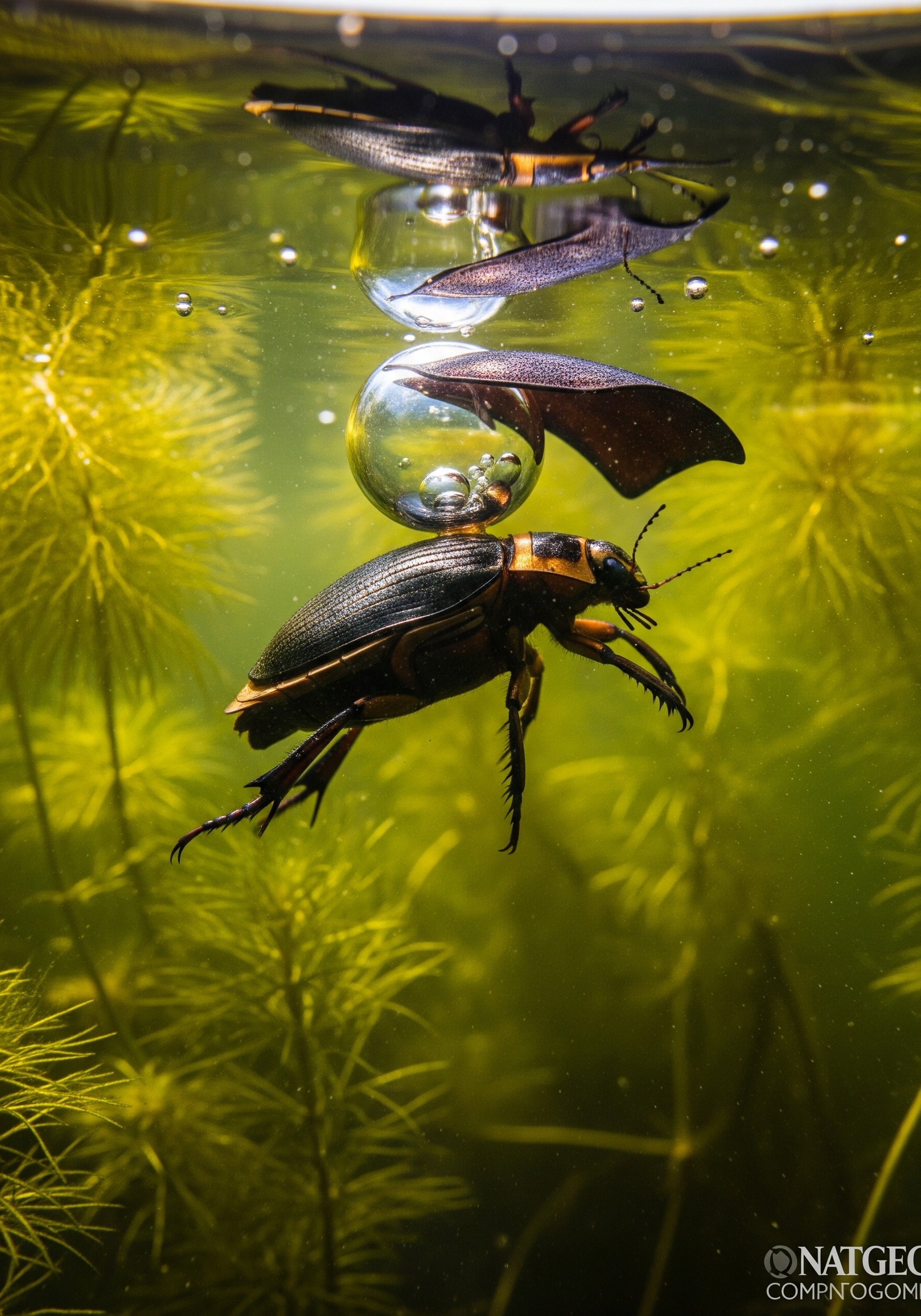
The second trick is the physical gill, more familiar as the bubble. Diving beetles like Dytiscus trap a silvery air pocket under their wing covers before submerging. Inside the bubble, the beetle breathes through its spiracles as normal. As the trapped oxygen is consumed, dissolved oxygen from the surrounding water diffuses in to top it up. Nitrogen, however, slowly leaks out, and the bubble shrinks — so the beetle must eventually return to the surface to renew it.
The third trick solves the shrinking-bubble problem altogether: the plastron. The river bug Aphelocheirus aestivalis is coated in millions of hydrophobic hairs at densities reported in the millions per square millimeter. Those hairs hold a permanent, incompressible film of air against the body that the surrounding water cannot collapse. Oxygen diffuses in continuously; the insect never has to surface. Certain water bugs, riffle beetles, and even some submerged plants exploit variations of the same physics. Turns out the elegant solution has been independently invented many times.
Why insects stay small — and what new research now questions
Every popular science article on insect size repeats the same line: insects can’t grow huge today because the atmosphere only has 21% oxygen, and tracheal diffusion taps out around the size of a Goliath beetle. The Carboniferous, 300 million years ago, hit an estimated 35% O₂ — and produced Meganeuropsis permiana, a dragonfly-like predator with a roughly 70-centimeter wingspan, plus mayflies nearly half a meter long.
Tidy story. It may be partly wrong.
Recent work using electron microscopy on flight muscles in modern flying insects — and on fossilized specimens where fine structure is preserved — found that tracheoles occupy under one percent of total muscle volume. If oxygen delivery had really been the limiting factor, evolution should have produced visibly larger tracheoles in the Carboniferous giants. It didn’t. The implication: the flight muscles of ancient giant insects probably weren’t oxygen-limited at all. Other factors — predation by newly evolved flying vertebrates, larval-stage oxygen demand (insect larvae often live in low-oxygen mud and water), and the biomechanics of a chitin exoskeleton at large size — may be doing more of the explanatory work than atmospheric oxygen alone.
The honest reading, then, is that “insects can’t be giants because oxygen” is a half-true answer that has had too long a run on textbook pages; the real story is messier and more interesting, and the simple oxygen line deserves a footnote rather than a starring role. What is clear: tracheal architecture does impose real limits, and modern atmospheres do constrain size. What the simple oxygen-percentage story misses is how many other variables — predators, larvae, growth rate, body mechanics — also weigh in.
Frequently Asked Questions
Q: Do insects have lungs?
A: No. Insects breathe through a network of branching tubes — tracheae — that deliver air directly to cells. Lungs are a vertebrate invention, and insects skip the entire blood-as-oxygen-carrier strategy that lungs depend on.
Q: Can an insect drown?
A: Yes, and surprisingly easily for terrestrial species. Water plugs the spiracles and blocks gas exchange. Aquatic insects avoid this with gills, bubbles, or plastron films — all engineering work-arounds, not exceptions to the underlying physics.
Q: How do insect larvae breathe?
A: It depends on the larva. Many terrestrial caterpillars use spiracles like adults. Aquatic larvae such as mayfly nymphs use tracheal gills. Mosquito larvae hang upside down at the water’s surface and breathe through a tail-end siphon that pokes up into the air.
Q: Why do insects suffocate in sealed jars?
A: A closed jar accumulates CO₂ and loses O₂ faster than people expect, because active insects burn oxygen at extraordinary rates per gram of body weight. A still beetle in a sealed jar may last hours; an active wasp may not last one.
Sources
- Wikipedia, “Respiratory system of insects” (overview reference)
- Westneat et al., 2003, in Science — synchrotron X-ray imaging of insect tracheal compression
- NC State University Department of Entomology, ENT 425 “General Entomology” teaching materials
- Jon F. Harrison, H. Arthur Woods, and Stephen P. Roberts, Ecological and Environmental Physiology of Insects, Oxford University Press
- The Journal of Experimental Biology — research on plastron respiration in Aphelocheirus aestivalis
Look at a fly again — two transparent wings, six legs, a body the size of a grain of rice. And inside it: a private wind-tunnel finer than spider silk, delivering air molecule by molecule to a hundred billion cells, with no lungs and no need of any. The fly does not know it is breathing. It just is.
Illustrations are AI-generated. Article fact-checked and human-edited. Our editorial standards.