The Beetle That Shoots Acid: Inside the Bombardier’s Cannon
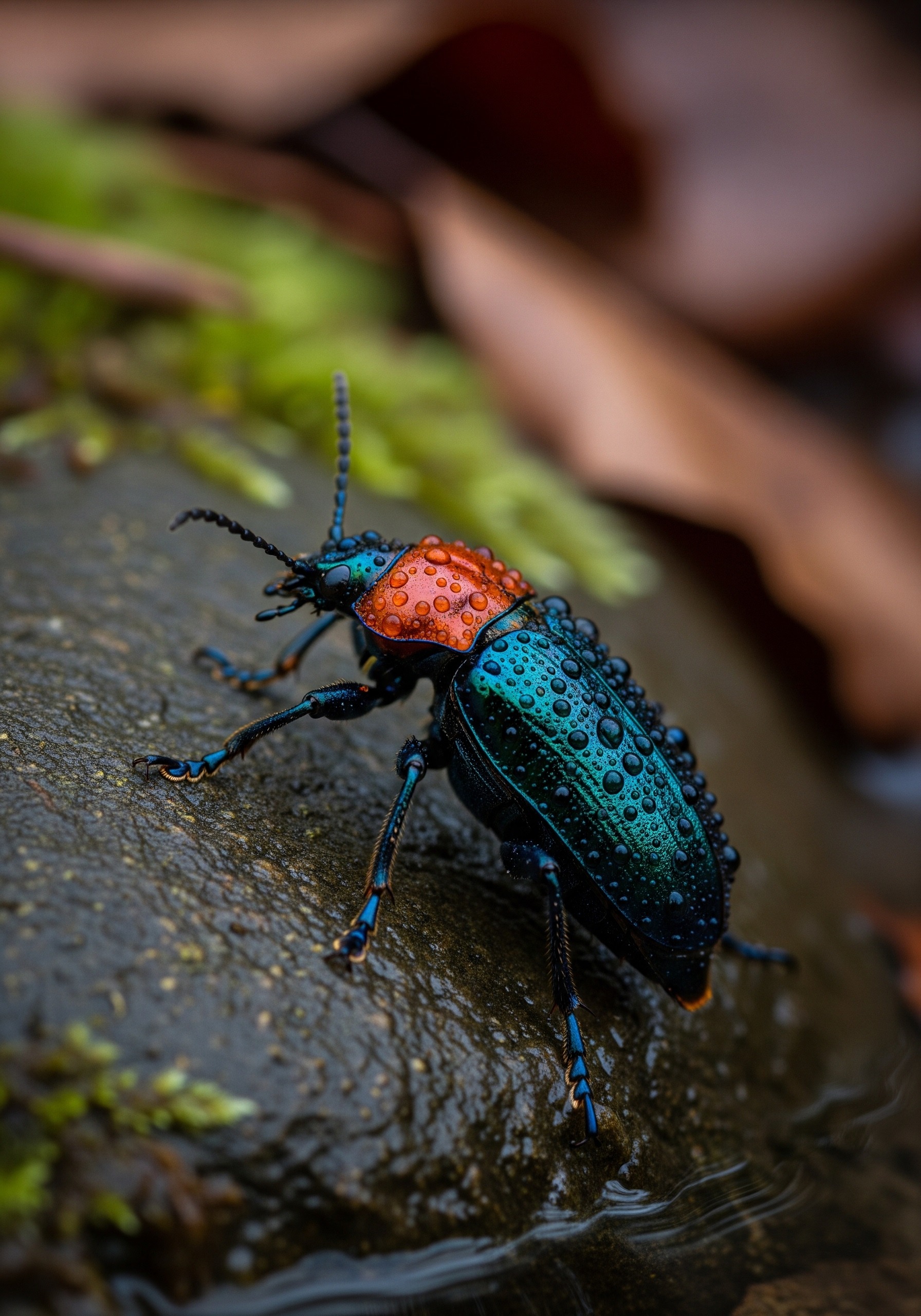
A toad flicks its tongue, swallows a small brown beetle, and a few minutes later does something most predators never get to regret — it vomits the meal back up, alive and still walking. That meal is the beetle that shoots acid, better known as the bombardier beetle, and the reason it walks away is one of the most extraordinary chemical defenses ever evolved in an animal the size of a grain of rice.
Key Facts
- Bombardier beetles are a group of more than 500 ground-beetle species in the subfamilies Brachininae and Paussinae, found on every continent except Antarctica.
- Their defensive spray is fired at roughly 100 °C — close to the boiling point of water — out of a swivelling tip at the rear of the abdomen.
- The blast is not one steady jet but a pulsed micro-explosion: about 500 pulses per second in bursts that last only milliseconds, first measured by Thomas Eisner and Daniel Aneshansley at Cornell University.
- A single beetle carries enough chemistry for roughly 20 separate shots before it has to refuel.
- In a 2018 experiment at Kobe University, 43% of toads that swallowed bombardier beetles vomited them back up between 12 and 107 minutes later — and every regurgitated beetle was still alive.
In short: The bombardier beetle mixes two ordinary chemicals — hydroquinone and hydrogen peroxide — inside an armoured chamber on its rear. Enzymes there detonate the mixture into a near-boiling, caustic, pulsed spray that drives off ants, spiders, mantises, and even predators that have already swallowed it.
Key Facts
- Bombardier beetles are a group of more than 500 ground-beetle species in the subfamilies Brachininae and Paussinae, found on every continent except Antarctica.
- The defensive spray is fired at roughly 100 C – close to the boiling point of water – out of a swivelling tip at the rear of the abdomen.
- The blast is a pulsed micro-explosion of about 500 pulses per second in bursts lasting only milliseconds, first measured by Thomas Eisner and Daniel Aneshansley at Cornell University.
- A single beetle carries enough chemistry for roughly 20 separate shots before it has to refuel.
- In a 2018 experiment at Kobe University, 43% of toads that swallowed bombardier beetles vomited them back up between 12 and 107 minutes later, and every regurgitated beetle was still alive.
In short: The bombardier beetle stores hydroquinone and hydrogen peroxide in an armoured chamber on its rear, where the enzymes catalase and peroxidase detonate the mixture into a near-boiling, caustic, pulsed spray. That spray drives off ants, spiders, mantises, and even predators that have already swallowed the beetle. It is one of the most extraordinary chemical defenses evolved in an animal the size of a grain of rice.
The “beetle that shoots acid” — and why that name is half right
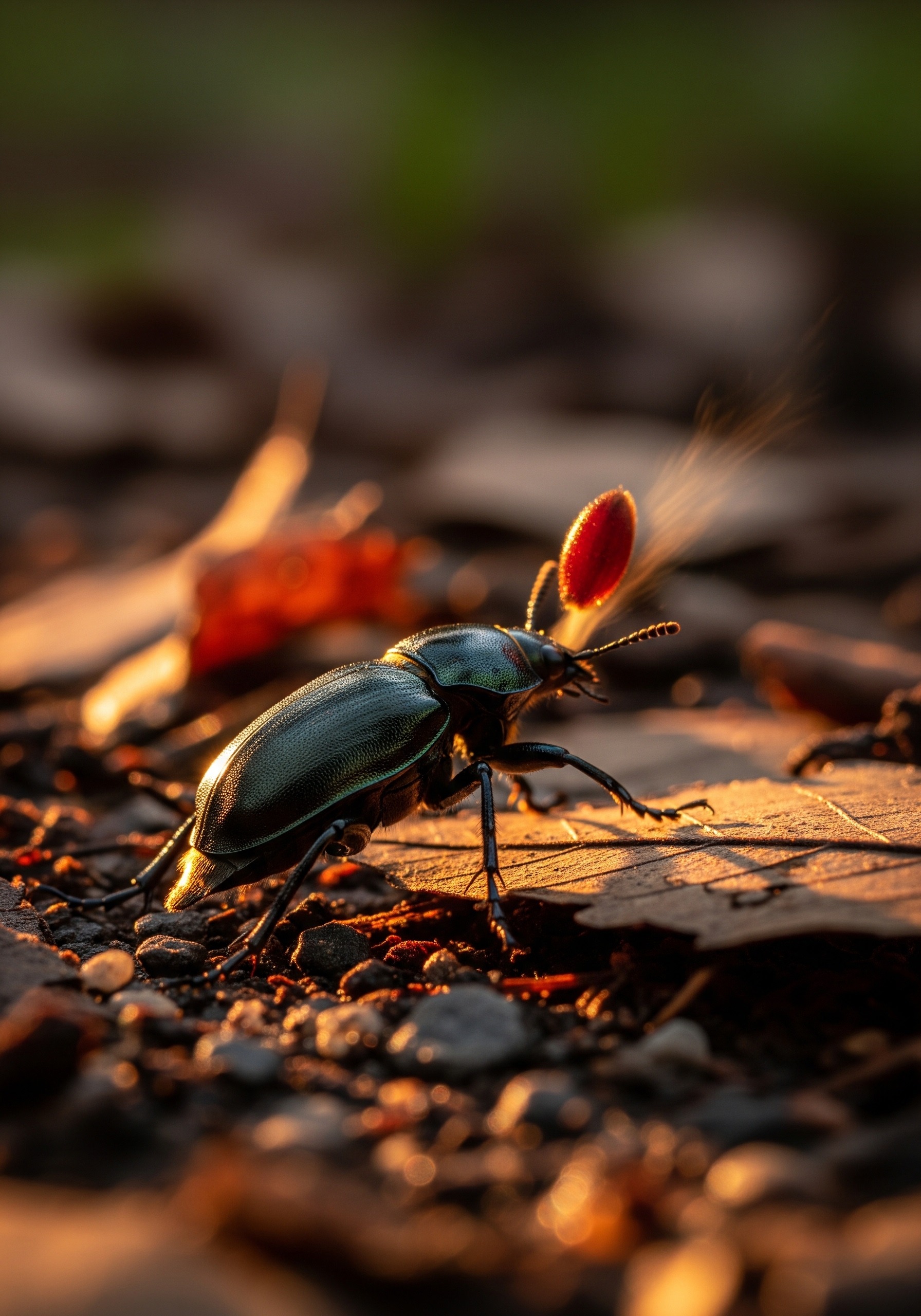
Call it acid and you’re echoing what almost every search for this insect throws back at you. Strictly speaking, though, what the bombardier sprays is not sulfuric or hydrochloric acid. It is a near-boiling aqueous mixture dominated by 1,4-benzoquinone — a corrosive, eye-burning irritant — flung out at around 100 °C with the propellant force of decomposing hydrogen peroxide. So yes, it burns. Yes, it stains skin yellow-brown for days. It just does so by a different route than the school-lab definition of “acid”.
The misunderstanding is forgivable. To anything small enough to be a target — an ant, a wolf spider, a jumping mantis — the difference is academic. Hot quinone in your face is hot quinone in your face.
What lives inside that armoured rear end
The mechanism is tucked into the last segments of the abdomen, and its geometry is what makes the whole trick possible. Each beetle carries a pair of glands, each split into two compartments. The forward compartment, the reservoir, stores a stable cocktail of hydroquinone and hydrogen peroxide in water. The rear one — the reaction chamber, sometimes called the explosion chamber — is lined with two enzymes: catalase and peroxidase.
{IMAGE_2}
Open the valve between them and the chemistry goes off almost instantly. Catalase rips the hydrogen peroxide apart into water and oxygen. Peroxidase oxidises the hydroquinone into benzoquinone. The combined reaction is wildly exothermic — exothermic enough to flash about a fifth of the liquid into vapour and shove the rest out of a hardened nozzle.
That nozzle is the part that makes the beetle look almost cybernetic. In some African species in the genus Stenaptinus, the tip of the abdomen can rotate roughly 270 degrees, so the beetle can fire forward over its own back, sideways, or straight down between its legs. It is a turret, and it almost never misses.
A pulse jet, not a water pistol
For a long time, the spray was assumed to come out as a single hot squirt. Then in 1999, Thomas Eisner and Daniel Aneshansley of Cornell University put a bombardier beetle in front of a high-speed camera with a sensitive microphone, and reported in the journal Science that the discharge is actually a rapid train of micro-explosions — about 500 pulses per second, packed into a burst that may last only ten or eleven milliseconds.
The Cornell team noted the mechanism’s uncomfortable resemblance to the pulse-jet engine of the German V-1 flying bomb of the Second World War: a chamber, an inlet valve that snaps open and shut as pressure rises and falls, an outlet, and a series of detonations rather than a continuous burn. Different scale, same physics. A beetle the length of a fingernail had been doing what 1940s engineers thought they’d invented.
That pulsing matters for the beetle, not just for the textbooks. Each tiny pulse lets fresh reactants flood the chamber and lets the chamber wall cool fractionally before the next round. Without that pause, the heat would denature the enzymes lining the chamber and the cannon would jam after a single shot. Instead, the beetle gets roughly twenty.
How the beetle that shoots acid survives being eaten
Here is the part that surprises most readers. Bombardier beetles don’t just spray attackers from the outside. They can fire from inside a predator’s stomach.
In 2018, ecologist Shinji Sugiura of Kobe University published a startling paper in the journal Biology Letters. He fed bombardier beetles (Pheropsophus jessoensis) to two species of Japanese toad and waited. Every toad swallowed every beetle. Then, somewhere between 12 and 107 minutes later, 43% of the toads vomited the beetles back up — alive, still moving, in some cases still mildly singed but otherwise fine. One beetle survived 107 minutes inside a toad’s stomach.
Sugiura even heard the muffled detonations through the toads’ bellies. Toads that vomited had triggered the internal blast; toads that digested the beetle had been swallowed before they could fire, or had run out of chemistry. The work has since been replicated against invasive bullfrogs, with similar results.
If you want a single example of why “simple” is the wrong word for evolution, this beetle is it: a creature so well-armed that being swallowed is not always the end of the story.
The myth that won’t die — “too complex to evolve”
Since the 1960s, the bombardier beetle has been waved around as proof that some structures are too intricate to have arisen step by step. The claim usually adds a vivid embellishment: that hydroquinone and hydrogen peroxide explode the moment they meet, so any intermediate ancestor would have blown itself apart.
That embellishment is wrong. William Thwaites and Frank Awbrey of San Diego State University showed decades ago, and Richard Dawkins repeated experimentally, that mixing the two chemicals on a benchtop does nothing dramatic at all without a catalyst. They sit there. The beetle’s enzymes are what turn a stable solution into a blast. That single correction collapses the “all-or-nothing” argument: each piece of the system — quinone precursors that originally just hardened the cuticle, reservoir storage, an enzymatic trigger, a stiffened nozzle — has a plausible standalone function in simpler beetles. Some living relatives in the genus Metrius still discharge a foamy, low-pressure version of the same chemistry, a partway answer to what a less-evolved bombardier might have looked like.
It is a useful reminder of a quieter rule about wonders: an animal can be genuinely astonishing and still have a traceable, gradual past.
The bombardier beetle, by the numbers
- ~100 °C — spray temperature, near the boiling point of water
- ~500 pulses / second — micro-explosion firing rate (Eisner & Aneshansley, Cornell)
- ~10 m/s — typical exit velocity of the jet
- ~270° — swivel range of the abdominal nozzle in some species
- ~20 — full-strength shots before reserves run dry
- 107 minutes — longest recorded survival inside a toad’s stomach (Sugiura, Kobe University, 2018)
- 500+ — known species across every continent except Antarctica
The bug that ended up in fuel injectors
The bombardier’s pulse-jet design did not stay in the entomology textbooks. In the late 2000s, a team led by engineer Andy McIntosh at the University of Leeds reverse-engineered the chamber-and-valve geometry and built a prototype spray nozzle that flash-evaporates a fluid in a sealed cavity, then releases it in a fine, forceful mist. The work won a Times Higher Education prize for innovation in 2010 and has been studied for applications in fuel injection, fire suppression, and pharmaceutical inhalers — places where a small, controlled, repeatable burst of vapour is more useful than a steady spray.
The beetle, in other words, is one of the more economically valuable insects most people have never seen. Its rear end is a patent.
Where to find one — and what to do if you do
Bombardier beetles are common but easy to miss. They are nocturnal carnivores, usually a centimetre or two long, with a rusty-orange thorax and dark blue-black wing covers. Lift a damp log or a stone near a stream in temperate woodland and you may find one hunting other beetle larvae. If you do, watch — don’t grab. A defensive blast will not seriously injure a human, but the quinone will stain your fingers brown for days and the burn is sharp enough to remember.
They are not the only beetles that have weaponised chemistry. Blister beetles, for instance, exude a defensive compound called cantharidin so caustic that their larvae use it to infiltrate the nests of solitary bees — an entirely different evolutionary route to the same idea, told in our piece on the beetle larvae that impersonate bees. Insects have been running a quiet arms race for a hundred million years, and the bombardier is only its loudest entrant.
Frequently Asked Questions
Q: Is the bombardier beetle’s spray really acid?
A: Not in the strict chemistry-class sense. The spray is dominated by 1,4-benzoquinone — a hot, caustic, eye-burning irritant — propelled by oxygen released from hydrogen peroxide. It behaves like an acid burn against soft tissue but isn’t a strong mineral acid like sulfuric or hydrochloric.
Q: Can a bombardier beetle hurt a human?
A: It can sting and stain. People who handle them carelessly typically describe a brief, sharp burn and yellow-brown skin discoloration that lingers for several days. There are no reported serious human injuries; the dose is calibrated for predators a few millimetres long, not for fingers.
Q: How does the beetle aim?
A: In several species, the tip of the abdomen acts as a swivelling turret with a range of motion approaching 270 degrees. Field and lab observations show beetles repeatedly hitting an attacker on a forelimb or mouthparts, suggesting they target the source of disturbance rather than firing blindly.
Q: What eats a bombardier beetle?
A: Some predators get past the cannon. Certain robber flies, antlions, and a handful of grasshopper mice can handle the spray. Many toads and frogs will also swallow them — but, as Sugiura’s 2018 work showed, a sizeable fraction of those beetles persuade the predator to vomit them up alive.
Sources
- Eisner, T. and Aneshansley, D. J. — pulsation studies of bombardier-beetle discharge, Cornell University, published in Science and Proceedings of the National Academy of Sciences.
- Sugiura, S. and Sato, T. — “Successful escape of bombardier beetles from predator digestive systems,” Biology Letters, 2018, Kobe University.
- Natural History Museum, London — “Bombardier beetles and their caustic chemical cannon.”
- MIT News (2015) — reporting on the chamber-design study by Christine Ortiz and colleagues.
- National Geographic — bombardier beetle species profile and field footage.
Most of what we call a “weapon” in the animal world is a tooth, a claw, or a sting. The bombardier beetle, alone among insects of its size, fights with hot chemistry — built piece by patient piece over millions of years, refined into a turret, and still, somehow, small enough to walk under a leaf without being noticed. Look once. Then put the leaf back.
Illustrations are AI-generated. Article fact-checked and human-edited. Our editorial standards.