How Humans Survived the Toba Supervolcano
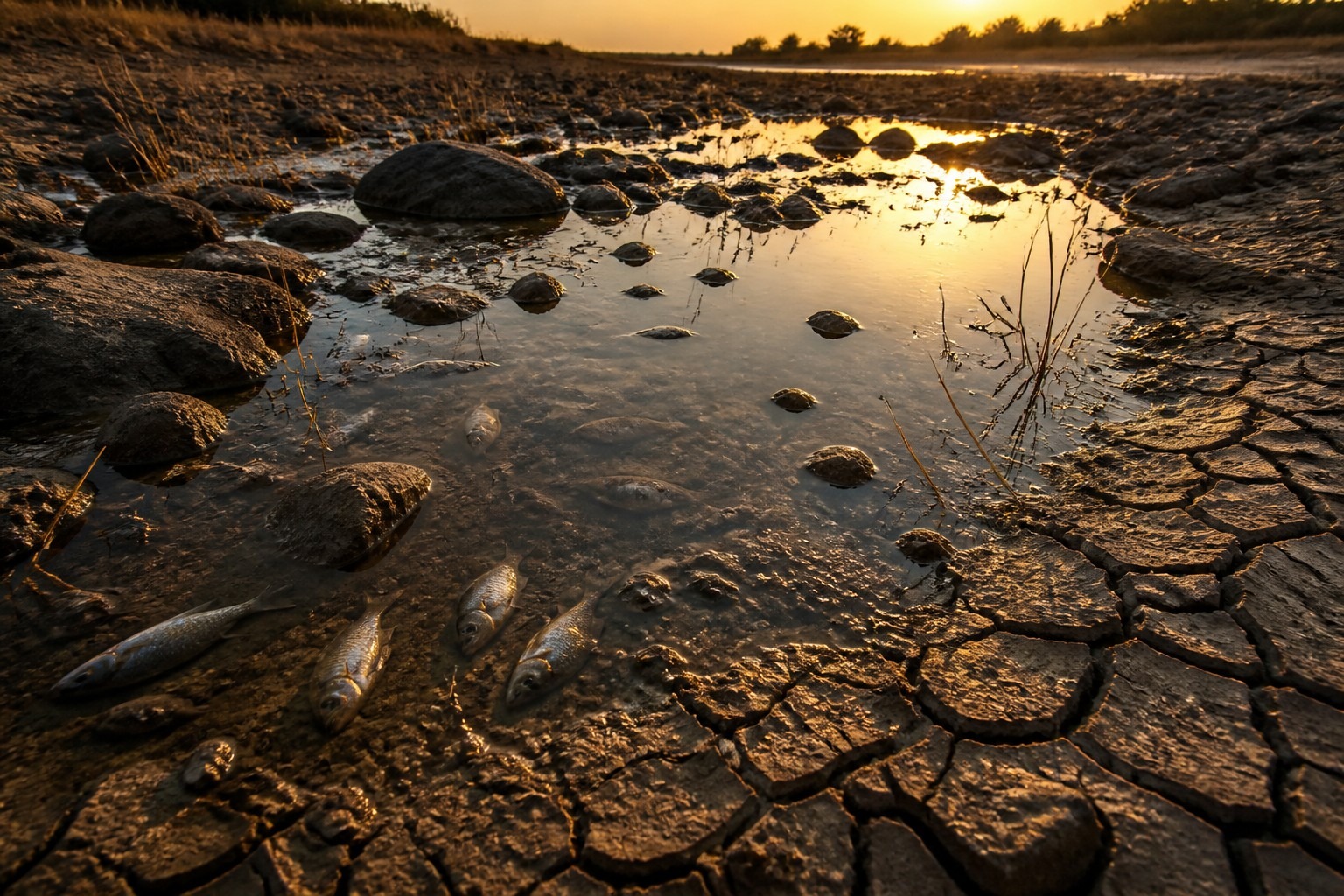
The story of how humans survived the Toba supervolcano begins not with a bang but with a fish bone. Roughly 74,000 years ago, on the banks of a shrinking river in what is now northwest Ethiopia, a small band of people crouched over a drying waterhole and speared whatever was trapped inside. Half a world away, in Sumatra, the largest eruption our species has ever witnessed had just torn a hole in the planet. And these people — going by the evidence they left in the dirt — barely broke stride.
That quiet resilience upends the tale most of us were told. For decades the standard version ran like a horror film: Toba blackened the sky, a decade-long volcanic winter set in, and humanity was squeezed down to a few thousand desperate survivors — a genetic bottleneck we only just scraped through. It is a gripping story. It is also, according to the last few years of genomic and archaeological work, almost certainly wrong. What actually happened is stranger and, honestly, more flattering to our ancestors.
Key Facts
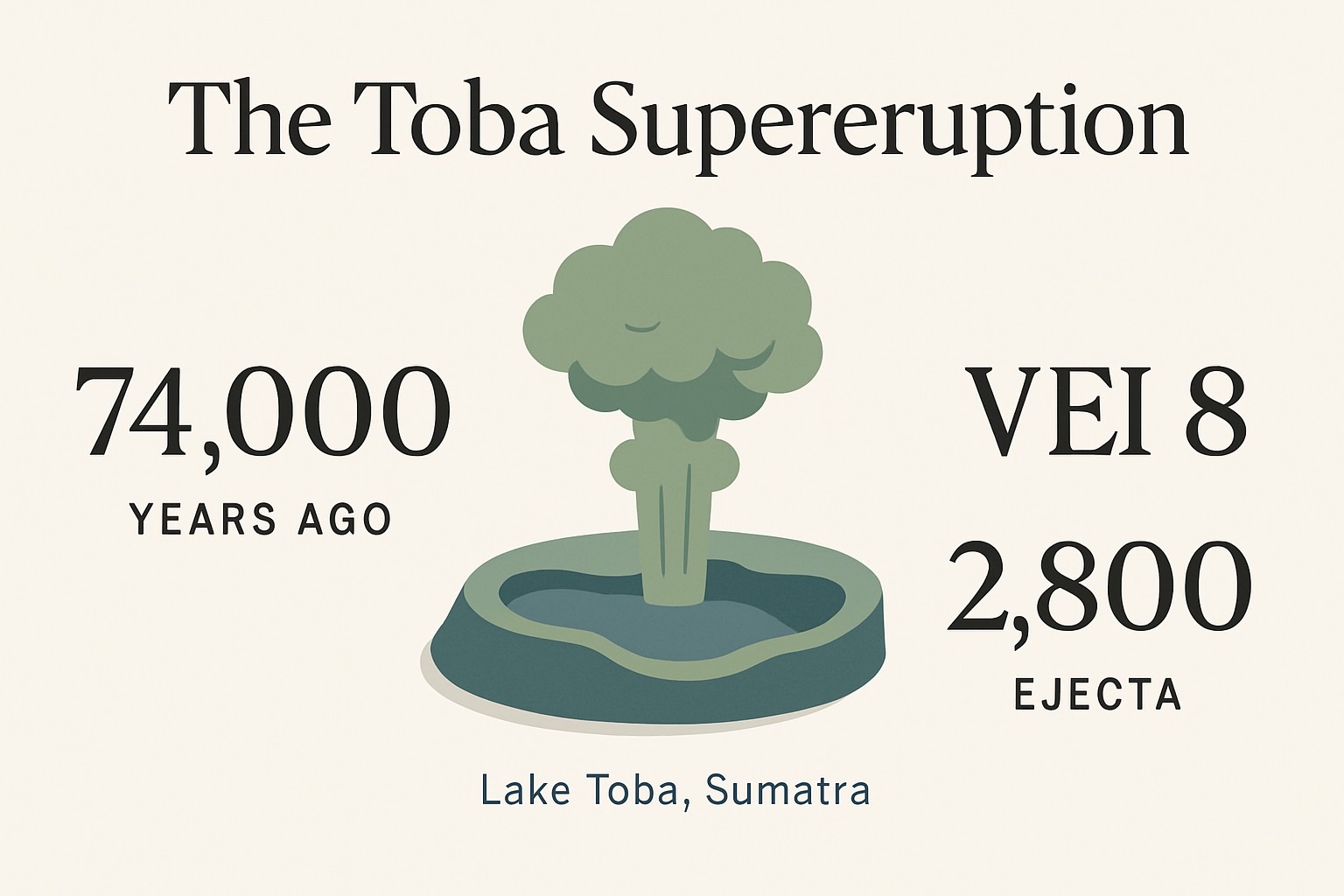
- The Toba supervolcano erupted roughly 74,000 years ago at Lake Toba, Sumatra, Indonesia, registering VEI 8, the top of the volcanic scale
- The eruption flung out on the order of 2,800 cubic kilometres of ash and rock, more than 10,000 times larger than Mount St. Helens in 1980
- Lake Toba’s caldera stretches roughly 100 by 30 kilometres
- The Toba catastrophe hypothesis claimed a volcanic winter dropped global temperatures 5 to 9 degrees C and cut the human population to 1,000 to 10,000 breeding individuals
- The Shinfa-Metema 1 study, published in Nature in 2024 by a team led by John Kappelman of the University of Texas at Austin, documented continuous human occupation through the eruption
In short: The Toba supervolcano erupted about 74,000 years ago in Sumatra at VEI 8, ejecting some 2,800 cubic kilometres of material. The old catastrophe hypothesis claimed it nearly wiped out humanity, but genetic and archaeological evidence, including sites at Pinnacle Point and Shinfa-Metema, shows human populations continued largely undisturbed.
A caldera the size of a small country
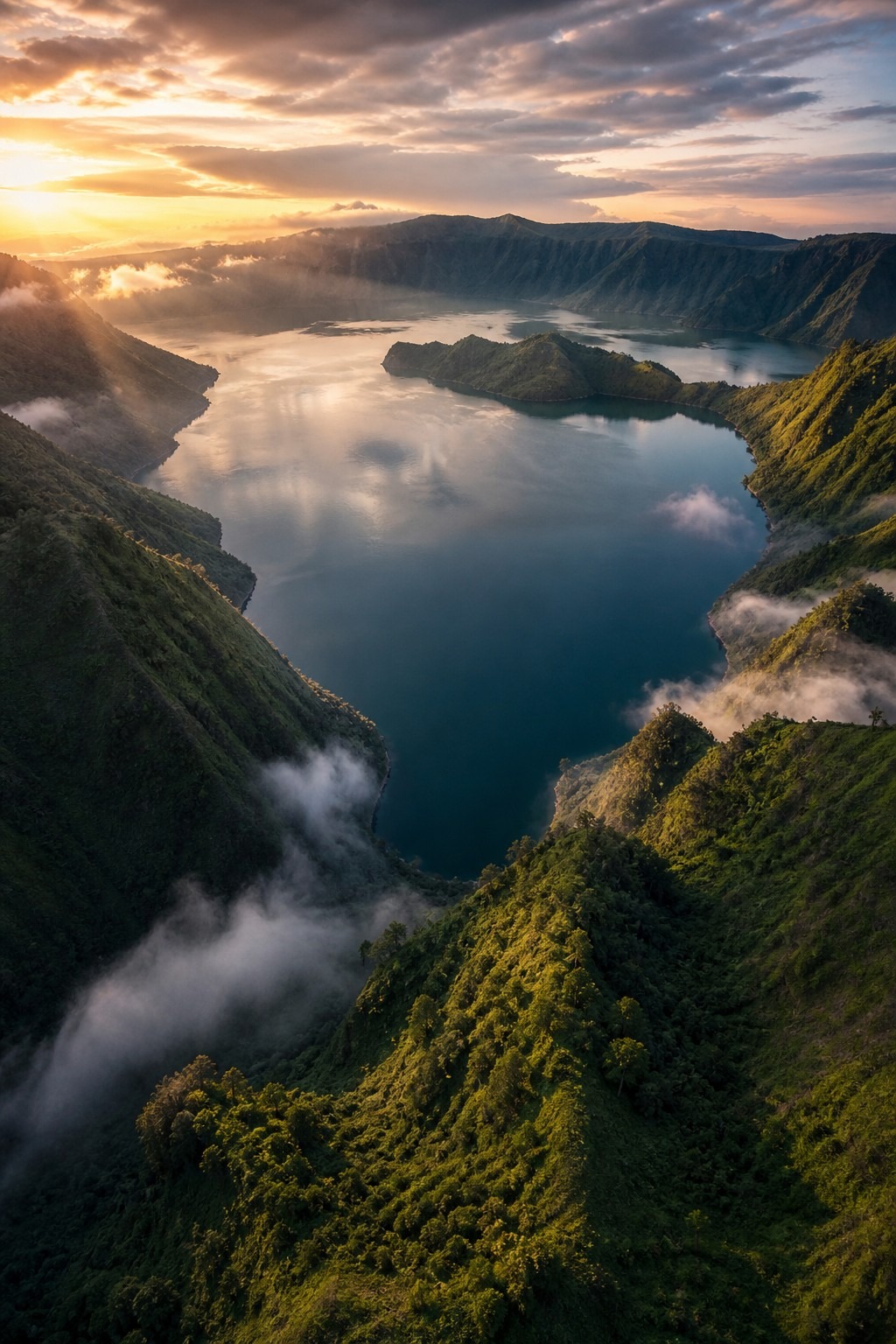
First, the eruption itself, because the raw numbers still deserve their reputation. Lake Toba is not really a lake in the ordinary sense — it is the flooded scar of a supervolcano, a caldera stretching about 100 by 30 kilometres. When it blew, it registered VEI 8, the top of the volcanic scale, the category geologists reserve for the word “mega-colossal.” It flung out on the order of 2,800 cubic kilometres of ash and rock. Mount St. Helens in 1980, which reshaped a corner of Washington State and made global headlines, was more than ten thousand times smaller.
Ash from Toba has been found blanketing the seafloor of the Indian Ocean and buried in the soils of India and Africa. This was a genuinely planetary event. The question was never whether Toba was enormous — it plainly was — but what that enormity actually did to the people alive at the time.
- When: ~74,000 years ago
- Where: Lake Toba, Sumatra, Indonesia
- Scale: VEI 8 — “mega-colossal,” the top of the eruption scale
- Ejecta: ~2,800 km³ (about 672 cubic miles) of ash and rock
- Caldera: roughly 100 × 30 km
- Versus Mount St. Helens (1980): more than 10,000× larger
The doomsday story that gripped a generation
The frightening version has a name: the Toba catastrophe hypothesis. It was popularised in the late 1990s, and its logic was elegant. Modern human DNA seemed to show that our ancestors passed through a severe population bottleneck — a moment when numbers crashed so low that our genetic diversity has never fully recovered. Toba’s date lined up. Put the two together and you get a tidy narrative: the supervolcano caused a “volcanic winter,” global temperatures fell by a claimed 5 to 9°C, and the human population collapsed to something like 1,000 to 10,000 breeding individuals.
It is easy to see why the idea spread. It connects a single geological catastrophe to the very survival of our species, and it flatters the drama of human history. For years it appeared in textbooks, documentaries, and nearly every explainer video on the subject — many of which still repeat it today as settled fact.
The number was wrong.
The plot twist: why the bottleneck no longer holds up
Here’s the thing about the bottleneck signal in our DNA — it is real, but its timing has quietly moved. As geneticists have gathered far larger samples and better models, the contraction visible in the human genome has converged on roughly 50,000 years ago, not 74,000. And a bottleneck at 50,000 years lines up not with Toba but with the great dispersal of modern humans out of Africa. When a small founding group leaves and spreads across a continent, it carries only a slice of the parent population’s diversity. That is a founder effect, not a near-extinction.
Paleoanthropologist John Hawks of the University of Wisconsin–Madison has put it about as bluntly as a scientist can: the so-called Toba bottleneck simply didn’t happen. Genetic analyses, he notes, have not turned up any population crash that coincides with the eruption. The archaeology agrees. In the Jurreru Valley of southern India, researchers found stone tools sitting both below and above a thick layer of Toba ash, with no obvious break in occupation — people were making the same tools before the eruption and after it, in the same place.
So did we nearly go extinct? The honest answer is: probably not — at least not because of Toba. The obsolete version is arguably the more dangerous of the two stories, because it is the one people still repeat.
{IMAGE_2}
Proof in the ground at Pinnacle Point and Shinfa-Metema
The strongest evidence isn’t in a lab at all. It is in two archaeological sites on opposite sides of Africa, each of which recorded the eruption directly and then kept right on recording human life.
At Pinnacle Point on the southern coast of South Africa, excavators found microscopic shards of Toba glass sealed inside sediment layers packed with human artefacts. The layers below the eruption, at the moment of the eruption, and above it all show continuous occupation. If anything, human activity at the site intensified afterward, alongside signs of new technology — the opposite of what a die-off should look like. At Shinfa-Metema 1 in the Ethiopian lowlands, the same Toba glass turns up in deposits full of stone tools, animal bones, and hearths, again spanning before, during, and after the blast.
Two continents, one eruption, and in both places the human story simply continues. That is a hard thing to reconcile with a global near-extinction.
How humans survived the Toba supervolcano: fish, arrows, and allies
The Shinfa-Metema dig, published in the journal Nature in 2024 by a team led by John Kappelman of the University of Texas at Austin, offers something the old story never did — a plausible account of the actual survival toolkit. And it is beautifully mundane.
The climate around the site was already harsh and highly seasonal, with long dry spells. As the rivers shrank into isolated waterholes during those dry seasons, fish became trapped in the shallows — easy, concentrated calories for anyone patient enough to catch them. The excavation team reported that the share of fish in the local diet climbed dramatically during the driest phases, from a modest fraction to roughly half. Alongside the fish bones sat small, finely made stone points, which the researchers interpret as evidence for the bow and arrow — some of the earliest such evidence anywhere, predating the human exodus from Africa.
Put those pieces together and a strategy emerges. When conditions tightened, these people followed the seasonal rivers like corridors across a drying landscape, fishing the shrinking pools and hunting with projectile weapons. Behavioural flexibility, not brute luck, carried them through. The researchers even suggest this river-following, dry-season adaptability may have been the very thing that primed our species to spread out of Africa and across the world soon after.
The volcanic glass that fingerprints an eruption across continents
How can anyone say a site in South Africa and a site in Ethiopia recorded the exact same eruption in Sumatra? The answer is a forensic tool called cryptotephra — volcanic glass so fine it is invisible to the naked eye, scattered by the plume and settling out thousands of kilometres downwind.
Each large eruption produces glass with a distinctive chemical fingerprint, as unique as a signature. Scientists sieve it from sediment, analyse its composition, and match it to the source. The shards from Toba’s youngest major eruption, known as the Youngest Toba Tuff, carry a signature that can be identified across Africa and Asia. Archaeologist Jayde Hirniak of Arizona State University, who works on this cryptotephra dating, has described how these invisible glass layers let researchers pin far-flung sites to the same instant in geological time. It turns a scatter of unrelated digs into a single synchronised snapshot of the ancient world — which is what makes the “people were fine” conclusion so convincing.
Not the same near-extinction: the 930,000-year-old bottleneck
One source of confusion is worth clearing up, because two very different “near-extinction” stories keep getting mixed together. The Toba event sits at 74,000 years ago. But in 2023, a study in the journal Science by Wangjie Hu and colleagues reported evidence for a genuinely severe bottleneck far deeper in our past — around 930,000 to 813,000 years ago, when the ancestral human population may have dropped to roughly 1,280 breeding individuals and stayed low for over 100,000 years.
That ancient squeeze, if it holds up, is a completely separate episode, nearly a million years before Toba and long before our species even existed in its modern form. (Even that finding is debated; some geneticists argue the signal could be a statistical artefact, and it shows up clearly only in African-derived genomes.) The takeaway is simple: if you have heard humanity “nearly went extinct,” check the date. The near-miss that may be real is the old one. The Toba one is the myth.
A patchier winter than we thought
What about the volcanic winter itself? This is where honest uncertainty matters, because the climate picture is genuinely unresolved. Climate models do predict serious cooling after an eruption of Toba’s size — some simulations show the Northern Hemisphere dropping several degrees, with regional figures running higher. A 2021 study in the journal Communications Earth & Environment also found the eruption likely tore into the tropical ozone layer, which would have spiked harmful ultraviolet radiation for a year or more.
But the high-resolution records dug out of African sediments tell a milder tale. Modelling work published in PNAS in 2021 pointed to something important: the cooling would have been regionally patchy, not a uniform blanket of dark. Parts of Africa and India appear to have been relatively sheltered, acting as climate refuges, while the higher northern latitudes bore the worst of it. The catastrophic, decade-long global winter that anchored the old story looks, on current evidence, shorter and far less even than advertised. Where the ash fell hardest, life was surely brutal. But “brutal in places” is not the same as “nearly fatal everywhere.”
Could a supervolcano do it to us?
It is fair to wonder whether we would fare as well. A VEI 8 eruption today would be a civilisational stress test of the first order — disrupting agriculture, aviation, and supply chains that our ancestors never had to worry about. Geologists watch systems like Yellowstone and the Campi Flegrei near Naples precisely because supereruptions, while extraordinarily rare, are not fictional.
The reassurance from Toba is subtle but real. Our species met the largest eruption in its history armed with nothing but fire, stone points, cooperation, and the wit to change diet and route when the world changed on them — and came through. We now have satellites, science, and shared warning systems those people could not have dreamed of. The lesson of Toba is not that catastrophe is impossible. It is that adaptability is our oldest and best inheritance.
Questions Readers Ask
Did the Toba eruption cause a human genetic bottleneck?
On current evidence, no. The bottleneck once blamed on Toba is now dated to around 50,000 years ago and is best explained as a founder effect from the out-of-Africa migration, not a volcanic catastrophe at 74,000 years.
How did humans survive Toba?
The clearest record, from Shinfa-Metema 1 in Ethiopia, shows people following seasonal rivers, fishing the shrinking waterholes for a large share of their food, and hunting with early bow-and-arrow technology — flexible behaviour that carried them through the disruption.
How do we know a site recorded the Toba eruption?
Through cryptotephra — microscopic volcanic glass with a chemical fingerprint unique to the eruption. Matching that fingerprint across sites in Africa and Asia lets scientists tie them all to the same moment.
Is the “humanity nearly went extinct” story ever true?
There is a separate, much older candidate: a proposed bottleneck around 930,000 years ago, reported in 2023. It is unrelated to Toba and is still debated.
Sources and Notes
- Nature (2024) — “Adaptive foraging behaviours in the Horn of Africa during Toba supereruption,” Kappelman et al. (Shinfa-Metema 1 evidence)
- John Hawks, University of Wisconsin–Madison — analysis of genomic evidence against a Toba-coincident bottleneck
- Jayde Hirniak, Arizona State University — cryptotephra dating and the volcanic-glass method (via The Conversation)
- Science (2023) — Hu et al., “Genomic inference of a severe human bottleneck during the Early to Middle Pleistocene transition”
- Communications Earth & Environment (2021) — “The Toba supervolcano eruption caused severe tropical stratospheric ozone depletion”
- PNAS (2021) — “Global climate disruption and regional climate shelters after the Toba supereruption”
Strip away the doomsday soundtrack and Toba becomes a better story, not a lesser one. Our ancestors did not survive the largest eruption in human history by luck or by the skin of a thousand teeth — they survived it by being clever, mobile, and willing to eat differently when the rivers ran low. That, more than any near-extinction, is worth remembering the next time the ground reminds us who is really in charge.
Frequently Asked Questions
Q: How big was the Toba eruption?
The Toba supervolcano erupted roughly 74,000 years ago at Lake Toba in Sumatra, Indonesia, registering VEI 8, the top of the volcanic scale, the category geologists reserve for mega-colossal. It flung out on the order of 2,800 cubic kilometres of ash and rock, more than ten thousand times larger than Mount St. Helens in 1980. Its caldera stretches roughly 100 by 30 kilometres. Ash from Toba has been found on the Indian Ocean seafloor and in the soils of India and Africa, making it a genuinely planetary event.
Q: Did Toba nearly cause human extinction?
Probably not, at least not because of Toba. The Toba catastrophe hypothesis claimed a volcanic winter dropped global temperatures 5 to 9 degrees C and crashed the human population to 1,000 to 10,000 breeding individuals. But larger genetic samples have moved the DNA bottleneck to roughly 50,000 years ago, aligning with the out-of-Africa dispersal, a founder effect rather than a near-extinction. Paleoanthropologist John Hawks states bluntly that the Toba bottleneck simply didn’t happen.
Q: What archaeological evidence shows humans survived Toba?
Two sites on opposite sides of Africa recorded the eruption directly and kept recording human life. At Pinnacle Point in South Africa, microscopic Toba glass shards were sealed in sediment layers packed with human artefacts, showing continuous occupation, with activity intensifying afterward. At Shinfa-Metema 1 in the Ethiopian lowlands, the same Toba glass appears in deposits full of stone tools, animal bones, and hearths spanning before, during, and after the blast. In India’s Jurreru Valley, stone tools sit below and above the ash with no break.
Q: How did humans survive the Toba supervolcano?
The Shinfa-Metema 1 dig, published in Nature in 2024 by a team led by John Kappelman of the University of Texas at Austin, offers a plausible survival account. The climate around the site was already harsh and highly seasonal, with long dry spells. As rivers shrank into isolated waterholes, people speared trapped fish and adapted their toolkit. Rather than a global near-extinction, the evidence shows ancestors adjusting to seasonal scarcity and carrying on largely undisturbed by the distant eruption.
Illustrations are AI-generated. Article fact-checked and human-edited. Our editorial standards.