Oldest Stone Tools Before Humans: Lomekwi’s 3.3M Years
The oldest stone tools before humans are 3.33 million years old — and that single number quietly dismantled a line science had guarded for a century. They were struck from rock at a place called Lomekwi 3, on the baking western shore of Kenya’s Lake Turkana, roughly half a million years before the first member of our own genus, Homo, ever walked the Earth. Somebody, or something, was making sharp stone hundreds of millennia before anyone we would comfortably call human.

The short answer: the oldest known stone tools are the Lomekwian artefacts from Lomekwi 3 in West Turkana, Kenya, dated to about 3.3 million years — around 700,000 years older than the famous Oldowan tools, and older than the genus Homo itself. They were almost certainly made by a small-brained hominin, not a human.
- 3.33 ± 0.11 million years — the age of the Lomekwi 3 tools, the oldest ever found
- ~500,000 years — how far they predate the genus Homo
- ~700,000 years — the gap between them and the next-oldest Oldowan tools
- 149 stone artefacts — recovered from the site in the 2011–2012 field seasons
- up to 15 kg (33 lb) — the weight of the heaviest cores and anvils, hand-rotated blocks, not pebbles
- ~350 cc — the brain size of the leading toolmaker candidate, about a chimpanzee’s
Key Facts
- The Lomekwi 3 stone tools are dated to 3.33 +/- 0.11 million years, the oldest known anywhere.
- They predate the genus Homo by roughly 500,000 years and the Oldowan tools by about 700,000 years.
- 149 stone artefacts, including 83 cores, were recovered in the 2011-2012 field seasons and published in Nature in 2015.
- The heaviest cores and anvils weigh up to 15 kg (33 lb); cores averaged around 3 kg.
- The leading toolmaker candidate, Kenyanthropus platyops (KNM-WT 40000, found by Meave Leakey’s team in 1999), had a brain of about 350 cc.
In short: The Lomekwian tools from Lomekwi 3 in West Turkana, Kenya, dated to about 3.3 million years, are the oldest known stone tools, predating the genus Homo by roughly 500,000 years. Published in Nature in 2015, they were likely made by a small-brained hominin, not a human.
3.33 million years: the oldest stone tools before humans

In July 2011, a team led by archaeologists Sonia Harmand and Jason Lewis of Stony Brook University took a wrong turn in the dry hills west of Lake Turkana. Looking for a different fossil site, they wandered up a slope and started noticing stone that did not belong there — angular, deliberately broken rock in a place where nature leaves rounded cobbles. By the end of the 2012 season they had 149 artefacts, published in the journal Nature in 2015.
The pieces were not subtle. Harmand’s team recovered 83 cores — the parent blocks from which flakes are struck — along with sharp flakes and heavy anvils. The cores averaged around three kilograms; the largest tipped the scale near fifteen. These are not things you carry in a pocket. To make them, a knapper set a lump of rock on a stationary anvil and hammered flakes off it, or swung one block against another. Crucially, the cores had been rotated as work went on, and the flakes fit back onto them like puzzle pieces. That refit is the tell. Trampling, rockfall, and river tumbling do not produce a sequence of removals from a rotated core. Intent does.
Harmand’s team gave the technology its own name: the Lomekwian. It sits before, and apart from, everything archaeology had catalogued. For a discipline that had treated flaked stone as the fingerprint of Homo, that was not a small footnote. It was the quiet demolition of a defining line.
How do you date a rock that old?
A stone flake carries no date stamp. So how do you pin an object to a moment 3.3 million years in the past — and why should anyone believe the number? The answer is that you never date the tool. You date the ground it sits in, using two independent clocks that happen to agree.
The first is tephrostratigraphy. East Africa’s Rift Valley was, and is, volcanically restless. Every major eruption dusted the landscape with a chemically unique layer of ash, or tephra, that settled and hardened into a datable marker. Minerals in those ash beds can be measured by argon isotope decay, giving each layer a hard age in years. Find a tool sandwiched between two dated ash layers, and you have bracketed it in time. At Lomekwi 3, the artefacts sat just below a well-characterised tuff tied to the wider Turkana Basin sequence.
The second clock is magnetostratigraphy. Earth’s magnetic field flips polarity at irregular intervals, and each flip is frozen into the iron minerals of sediment as it settles. Geologists have built a global calendar of these reversals. The Lomekwi 3 layers record a specific magnetic signature that matches a known interval, cross-checking the ash dates. Two unrelated methods, one answer: 3.33 ± 0.11 million years. That is why the figure holds up.
Who made them? A brain a third the size of ours
Here is where the story turns genuinely strange. At 3.3 million years, our genus did not yet exist. The oldest fossils confidently assigned to Homo come in around 2.8 million years. So the toolmaker was somebody else.
Two suspects share the neighbourhood and the era. One is Australopithecus afarensis — Lucy’s species, upright walkers with brains around 400 to 500 cubic centimetres. The other is more provocative. In 1999, at a spot within the very same Lomekwi locality, a team led by palaeoanthropologist Meave Leakey found a flat-faced skull, catalogued KNM-WT 40000, and named a new species: Kenyanthropus platyops. Its brain, by some estimates, was around 350 cc — roughly a chimpanzee’s, about a third the volume of yours.
{IMAGE_2}
No fossil hand was found clutching a core, so the maker’s identity is honestly unresolved; the strongest claim is proximity, not proof. But sit with the implication either way. A creature with an ape-sized brain understood conchoidal fracture — the physics of how glassy rock breaks in predictable arcs. It selected the right raw stone, judged the right angle, and struck with enough control to detach usable flakes. Toolmaking, it turns out, did not wait for a big brain. It may have helped build one.
Lomekwi and Dikika: making and using, both older than Homo
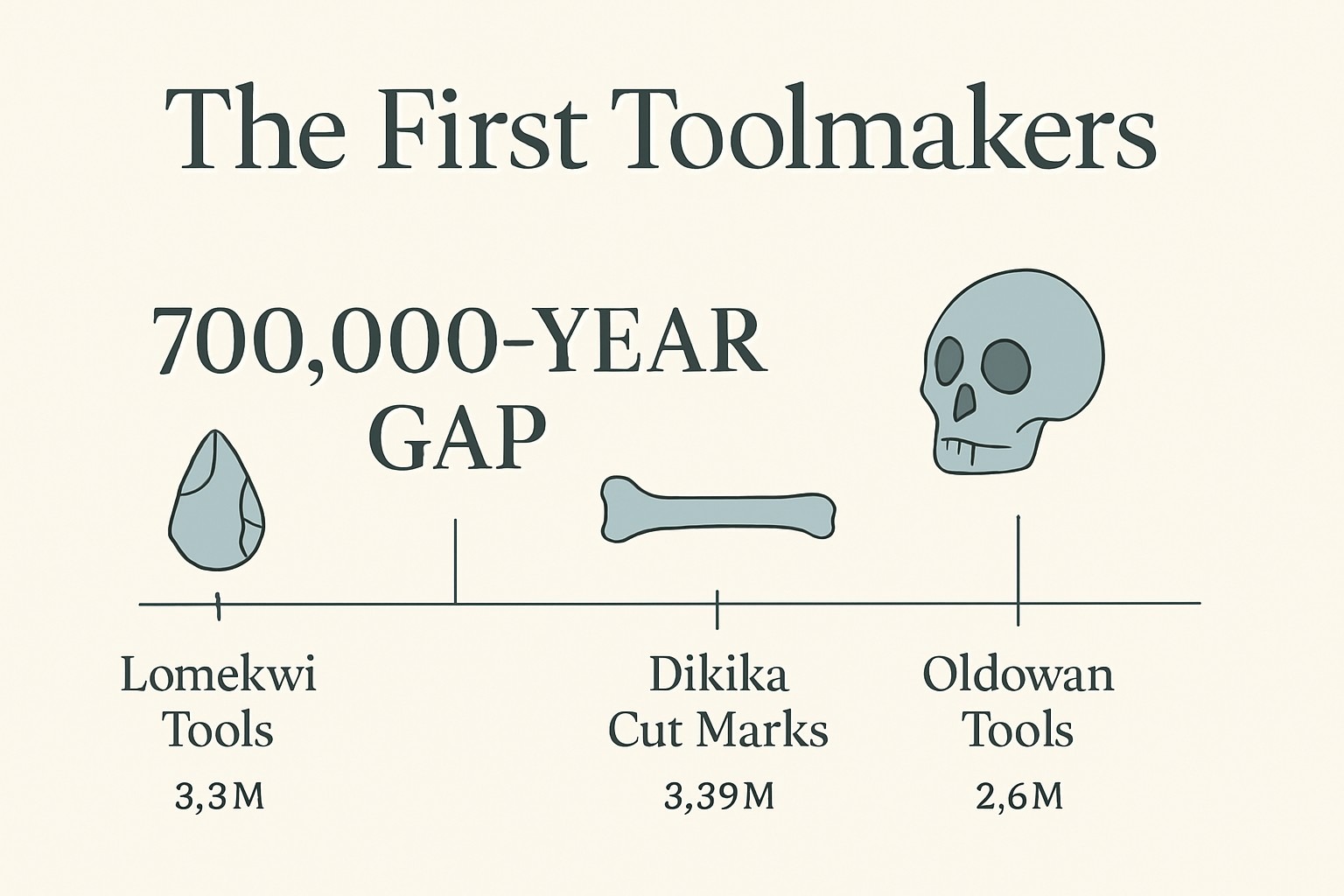
Lomekwi did not arrive alone. Five years earlier, in 2010, a separate team reported something that now reads like the other half of a sentence. At Dikika in Ethiopia, palaeoanthropologist Zeresenay Alemseged and archaeologist Shannon McPherron described animal bones bearing cut marks and percussion damage — the signatures of a stone edge slicing meat and cracking bone for marrow. They dated the bones to before 3.39 million years ago, and the only hominin known from that layer was, again, Australopithecus afarensis.
Put the two sites side by side and the picture sharpens. Dikika, at roughly 3.39 million years, hints at stone tools being used. Lomekwi, at 3.3 million years, shows stone tools being made. Almost no earlier coverage connected them, yet together they push both halves of the behaviour — the cutting and the crafting — firmly back before Homo. That combined narrative is the real headline, and it is one most accounts still miss.
The 700,000-year gap nobody can explain
After Lomekwi, the archaeological record goes quiet for an uncomfortably long time. The next stone-tool tradition, the Oldowan, appears around 2.6 million years ago in Ethiopia — smaller, more refined, and long credited as humanity’s first technology. Between the Lomekwian and the Oldowan yawns a gap of roughly 700,000 years with little to fill it.
So what happened in those seven millennia of centuries? Nobody knows, and the honest options are all unsettling. Perhaps the technique was invented, lost, and reinvented — a flash of insight that flickered out and had to be rekindled. Perhaps the toolmaking never stopped and we simply have not found the sites, which is entirely plausible given how few square kilometres of the right-aged rock are exposed and searched. The gap may be real, or it may be a hole in our sampling. Here is how the two traditions compare:
| Feature | Lomekwian | Oldowan |
|---|---|---|
| Age | ~3.3 million years | ~2.6 million years |
| First found | Lomekwi 3, West Turkana, Kenya | Gona & Ledi-Geraru, Ethiopia |
| Likely maker | Kenyanthropus / Australopithecus (pre-Homo) | Early Homo (and possibly others) |
| Technique | Anvil-resting & block-on-block, heavy cores | Freehand hard-hammer, smaller cores |
| Typical size | Large — cores up to 15 kg | Smaller, more portable |
The catch: what skeptics still argue
A discovery this large invites scrutiny, and it should. Most public accounts froze at the triumphant 2015 announcement and never mention that the science kept arguing — so here is the part competitors leave out.
The sharpest challenge lands on Dikika, not Lomekwi. Archaeologist Manuel Domínguez-Rodrigo and colleagues ran experiments suggesting the Dikika bone marks could be mimicked by trampling — the grinding of bone against grit as animals walk over it — or by crocodile bites, rather than a stone blade. Alemseged’s team defended the cut marks as genuine, and the debate never fully closed. For Lomekwi itself, most researchers accept the flaked stone as deliberately made, but some have called for closer re-examination of a few ambiguous flakes and the site’s formation history.
None of this erases the finds. It sharpens them. Honest science leaves the door open, and a claim that survives a decade of skeptical poking is stronger for it, not weaker. The current weight of evidence still places intentional stone technology comfortably before Homo.
Why this rewrites what makes us human
For generations, the textbook logic ran in a tidy line: big brain, then tools, then humanity — a species clever enough to remake the world. The oldest stone tools before humans snap that line. Toolmaking came first, carried out by a small-brained hominin with a chimp-sized cranium, and the big brain arrived later, over hundreds of thousands of years, in the company of the sharpened stone.
That reordering matters beyond a museum caption. It suggests that the capacity to see a tool inside a rock — to plan a strike, read the fracture, and hold a goal in mind — is older and more deeply rooted than our own genus. We did not invent technology and then become human. We may have become human, in part, because something older than us had already started making tools. The next flake pulled from the Turkana sediments could push that story back further still.
Frequently asked questions
What are the oldest stone tools ever found?
The oldest confirmed stone tools are the Lomekwian artefacts from Lomekwi 3 in West Turkana, Kenya, dated to about 3.33 million years old and reported in Nature in 2015 by Sonia Harmand’s team.
Who made the first stone tools?
Not humans. The maker was a pre-Homo hominin — most likely Kenyanthropus platyops or Australopithecus afarensis, both of which lived in the region 3.3 million years ago. No fossil hand was found with the tools, so the identity remains unproven.
Are stone tools older than humans?
Yes. The Lomekwi tools predate the genus Homo by roughly 500,000 years, and cut-marked bones from Dikika, Ethiopia, hint that stone was being used to butcher animals even earlier, before 3.39 million years ago.
How old are the Lomekwi tools?
They are dated to 3.33 ± 0.11 million years, fixed by volcanic-ash (tephra) layers and by Earth’s magnetic-reversal record — two independent dating methods that agree.
Sources and notes
- Harmand, S., Lewis, J.E., et al. (2015). “3.3-million-year-old stone tools from Lomekwi 3, West Turkana, Kenya.” Nature 521. Stony Brook University / CNRS.
- McPherron, S.P., Alemseged, Z., et al. (2010). “Evidence for stone-tool-assisted consumption of animal tissues before 3.39 million years ago at Dikika, Ethiopia.” Nature 466. Max Planck Institute for Evolutionary Anthropology.
- Leakey, M.G., et al. (2001). Description of Kenyanthropus platyops, West Turkana. National Museums of Kenya.
- Domínguez-Rodrigo, M., et al. Experimental analyses questioning the Dikika bone-surface marks (butchery vs. trampling), Journal of Human Evolution.
- Smithsonian Magazine and Stony Brook University coverage of the Lomekwi 3 discovery (2015); Smithsonian Human Origins Program species profiles.
Three million years ago, on a lakeshore that no longer exists, a hand with a small brain behind it lifted one rock and struck another — and left the oldest evidence we have of a mind reaching past instinct toward a plan. The tools outlasted the toolmaker by a thousand millennia, and we are still, only now, learning to read them.
Illustrations are AI-generated. Article fact-checked and human-edited. Our editorial standards.