How Stonehenge Bluestones Were Transported From Wales
How were Stonehenge bluestones transported from Wales? Stand on the rocky spine of Carn Goedog on a grey Preseli morning — wind flattening the grass, sheep picking through the scree — and the question feels almost insane. Salisbury Plain is 240 kilometres east of here. That is 150 miles of river, ridge, bog and forest. And roughly 5,000 years ago, someone decided that around 80 chunks of this exact Welsh hillside, each weighing about two tonnes, belonged there instead of here. They were right. Those same stones are still standing today — older than the finished pyramids at Giza.
Key Facts
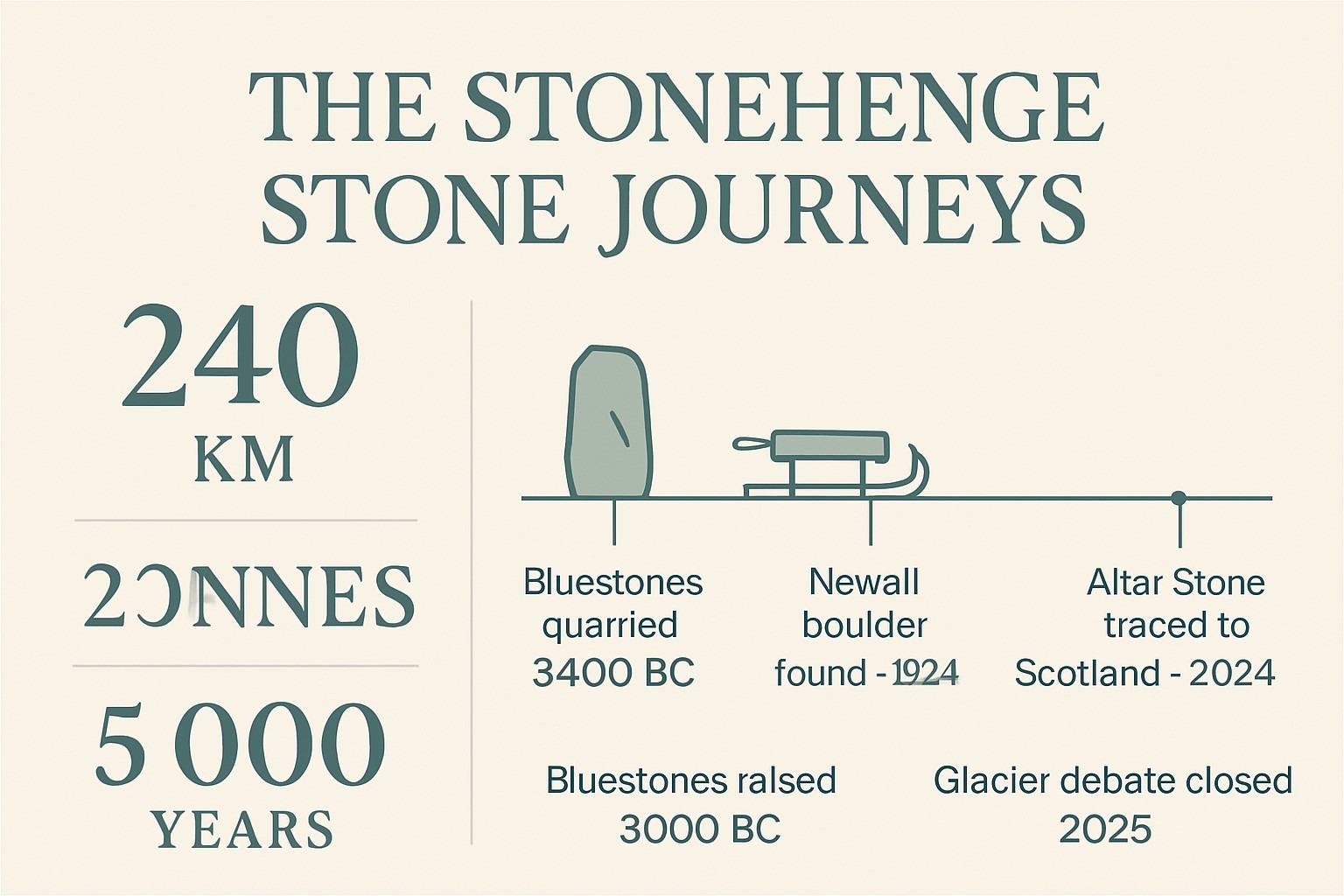
- The Stonehenge bluestones travelled about 240 km (150 miles) from the Preseli Hills in Wales to Salisbury Plain, with roughly 80 monoliths each weighing about two tonnes and standing about two metres tall
- The bluestones were quarried around 3400 to 3000 BC and raised at Stonehenge around 3000 to 2400 BC, before the Great Pyramid was finished around 2560 BC
- Two source quarries have been identified: Carn Goedog (spotted dolerite) and Craig Rhos-y-felin (rhyolite); a team led by Mike Parker Pearson of University College London published the evidence in a 2019 paper in Antiquity
- The favoured transport reconstruction is an overland drag using timber sledges on rollers, estimated at roughly 60 or more people per stone on level ground
- In July 2025 a team led by Richard Bevins, Nick Pearce and Rob Ixer of Aberystwyth University reassessed the Newall boulder (22 x 15 x 10 cm, found in 1924) in the Journal of Archaeological Science: Reports, concluding it is rhyolite debitage from Craig Rhos-y-felin, not a glacial erratic
In short: Around 80 two-tonne Stonehenge bluestones were moved about 240 km from the Preseli Hills in Wales roughly 5,000 years ago. Quarries at Carn Goedog and Craig Rhos-y-felin were confirmed in a 2019 study, and a July 2025 reassessment of the Newall boulder undercut the rival glacier theory, favouring human overland transport.
Older than the pyramids you’re picturing
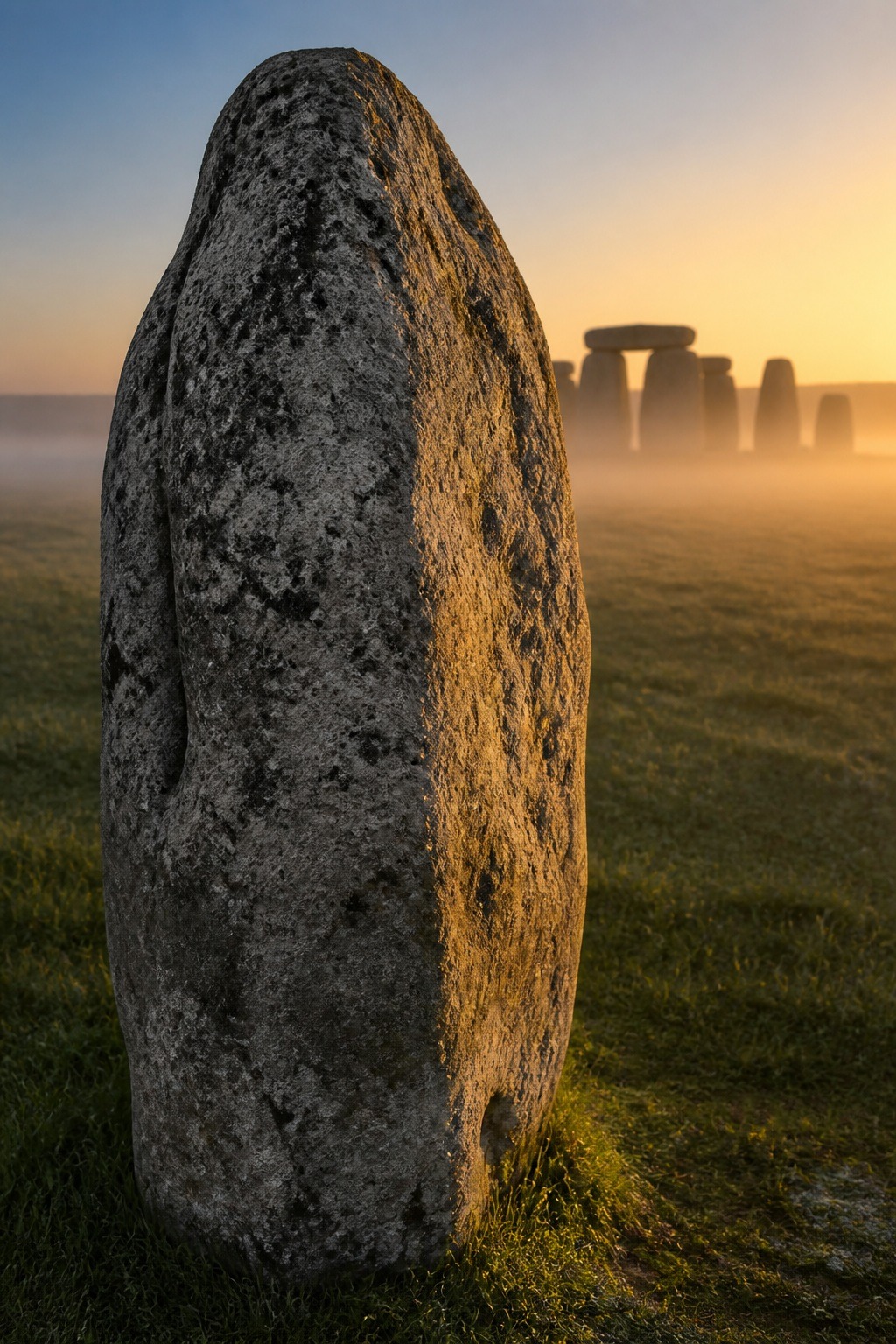
Here’s the thing most people get backwards. When we say Stonehenge is ancient, we usually picture the huge grey trilithons — the giant “doorway” shapes that make the postcard. Those big sarsens went up later. The bluestones came first, hauled from Wales and raised on Salisbury Plain somewhere between about 3000 and 2400 BC. The Great Pyramid wasn’t finished until roughly 2560 BC. So for a stretch of deep time, a ring of Welsh rock was already standing in Wiltshire while Egyptian masons were still stacking their most famous monument.
The bluestones are the small ones — around two metres tall, a metre or so wide, about two tonnes each. Small, that is, only next to the sarsens. Compared to a human being trying to move one across a country without a wheel, a horse team or a metre of tarmac, “small” stops meaning anything.
And that is the paradox that makes this the strangest logistics story in prehistoric Britain. The heaviest stones at Stonehenge travelled the shortest distance. The lightest ones travelled the farthest. Convenience was clearly not the point.
Where the bluestones actually began: Carn Goedog and Craig Rhos-y-felin
For a long time “the Preseli Hills” was as precise as anyone could be. Not any more. Two specific quarries have now been pinned down, and the detail is what makes the human story believable.
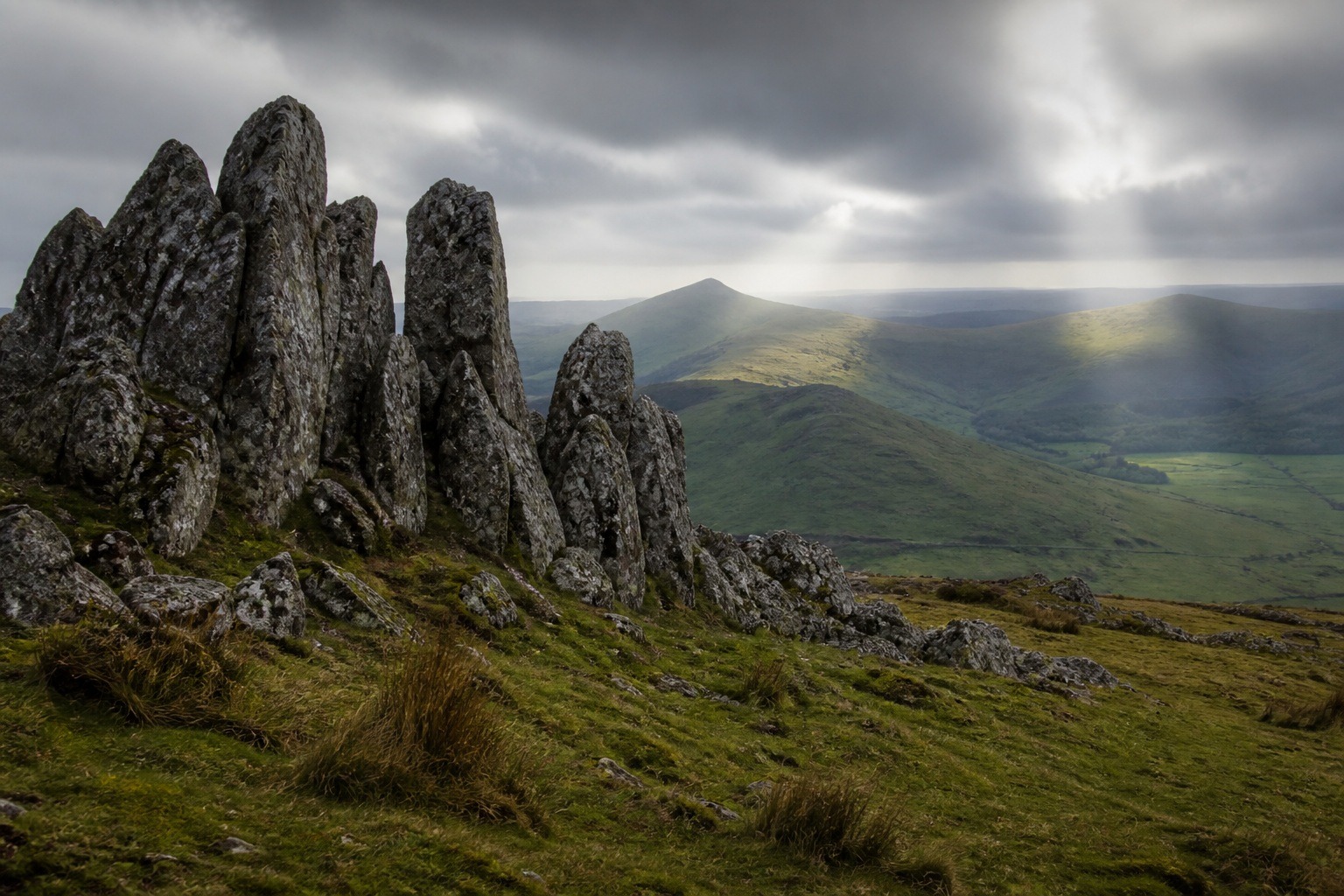
Carn Goedog is the main source — a craggy outcrop of spotted dolerite, the classic bluestone speckled with pale feldspar blobs. A short walk away sits Craig Rhos-y-felin, a natural cliff of rhyolite. A team led by archaeologist Mike Parker Pearson of University College London excavated both and, in a 2019 paper in the journal Antiquity, laid out the evidence: stone wedges, worked platforms, and pillars that had been levered off the rock face along their natural vertical joints. The geologists Richard Bevins and Rob Ixer matched the chemistry of specific Stonehenge bluestones to specific spots on these outcrops — not “somewhere in Wales,” but to the metre.
Turns out the rock almost quarried itself. Both outcrops fracture into ready-made pillars, so Neolithic workers didn’t need to carve monoliths from scratch — they needed to lever loose what the cliff already offered, then get it moving.
{IMAGE_2}
How were Stonehenge bluestones transported from Wales — the 240 km haul
No wheel. No draught horse (horses weren’t yet used that way in Britain). No metal tools. So the honest answer is that we are reconstructing a method, not reading a manual — but the working consensus is human muscle, and a lot of it.
The favoured reconstruction is an overland drag. A stone is lashed to a timber sledge, the sledge runs over wooden rails or rollers, and teams of people haul on ropes of twisted plant fibre or hide. Estimates put it at roughly 60 or more people per stone on level ground, more on slopes. Parker Pearson has argued for a broadly overland route — out of the Preseli uplands and eastwards through the valley corridors that later became the line of the A40 — rather than a risky sea voyage around the Welsh coast, where a two-tonne stone on a raft in open water is a very bad day waiting to happen.
- ~240 km / 150 mi — Preseli Hills to Salisbury Plain
- ~80 monoliths — each about 2 tonnes, ~2 m tall
- 60+ people — estimated haulers per stone on the flat
- ~3400–3000 BC quarried · ~3000–2400 BC raised at Stonehenge
Put that beside a modern flatbed lorry — one driver, one two-tonne stone, roughly a three-hour drive up the M4 — and the gap is almost comic. What a fork-lift and an afternoon do now took a coordinated crowd, weeks or months, and a level of shared purpose that is genuinely hard to imagine mustering for a pile of rock.
A century-old argument, settled by a hand-sized rock
For about a hundred years there was a rival explanation, and it was a good one: maybe humans didn’t carry the bluestones at all. Maybe glaciers did. During the Ice Age, the theory went, ice sheets scraped Welsh rock eastward and dumped it as “erratics” somewhere near Salisbury Plain, leaving Neolithic people to simply gather local stones lying around. The geologist Brian John has been the most persistent modern defender of this glacial idea, most recently in a 2024 paper.
The debate hinged, oddly, on one small lump. The Newall boulder — a rhyolite cobble just 22 by 15 by 10 centimetres, dug up at Stonehenge back in 1924 — was long cited as a possible glacial erratic, its worn surface read as ice-scarring.
In July 2025, a team led by Richard Bevins, Nick Pearce and Rob Ixer of Aberystwyth University published a reassessment in the Journal of Archaeological Science: Reports. Their conclusion was blunt: the boulder is rhyolite debitage from Craig Rhos-y-felin — the same quarry — and its surface wear is weathering and burial, not glacial striation. They also noted the plain simple problem the glacial theory never solved: there is no independent evidence of glaciation reaching Salisbury Plain at all. The boulder, they suggest, may even be the broken-off top of a buried bluestone stump still in the ground.
That is why 2026 is a good year to tell this story. Most of the popular videos and articles online were made before that paper, and still present glacier-versus-human as a live, open mystery. On the current evidence, it isn’t a coin-flip any more — human transport is the standing explanation, and the burden of proof has shifted onto the glacier.
Waun Mawn and the ghost of a “first Stonehenge”
One irresistible idea deserves careful handling, because it’s the part most likely to be told to you as settled fact. In 2021, Parker Pearson’s team proposed that a dismantled stone circle at Waun Mawn, in the Preseli Hills, was a kind of proto-Stonehenge — that Welsh people took their own monument apart and rebuilt it in Wiltshire, stones and all. It’s a spellbinding image: a whole sacred circle, migrating.
But the Welsh geologists pushed back. Follow-up work by Bevins, Ixer and John between 2022 and 2024 argued that the geochemical link between Waun Mawn’s stones and Stonehenge’s is far weaker than the headlines suggested, and that Waun Mawn was likely a small, never-completed local circle rather than Stonehenge’s parent.
So where does it stand in 2026? Contested. The quarries at Carn Goedog and Craig Rhos-y-felin are solid, evidenced fact. The romantic “they moved an entire earlier monument” version is a hypothesis under real strain — worth knowing, not worth believing outright. Honest uncertainty here is not a weakness in the story; it’s the actual state of the science.
The Altar Stone twist: 700 km from the wrong direction
And now the plot turn that reframes everything. If you think 240 km is the headline number, meet the Altar Stone — the large, pale slab lying flat at the heart of Stonehenge, half-buried under a fallen sarsen.
For decades it was lumped in with the “Welsh” bluestones. In August 2024, a study in Nature led by Anthony Clarke of Curtin University, working with Aberystwyth researchers, blew that up. By matching the mineral ages and chemistry of the Altar Stone to sedimentary rock formations, they traced it not to Wales but to the Orcadian Basin of north-east Scotland — roughly 750 km away. Given the sheer difficulty of dragging a six-tonne slab overland across the length of Britain, the team suspects it came at least partly by sea.
Sit with that. The single most central stone at Stonehenge is not a bluestone and is not from Wales. It came three times farther, from the opposite end of the island. Suddenly the bluestone haul from Preseli looks less like a one-off feat and more like one chapter in a much larger Neolithic logistics network — people and materials moving across the whole of Britain around 3000 BC.
Why drag a two-tonne stone across a country
Which brings us back to the maddening “why.” Why not use local rock? Salisbury Plain had perfectly good stone within a day’s walk. The sarsens prove it: those 25-tonne giants came from West Woods near Marlborough, only about 25 kilometres away, a source confirmed in 2020 by geologist David Nash of the University of Brighton.
Here is the asymmetry laid out plainly.
| Stone at Stonehenge | Approx. weight | Where it came from | Distance |
|---|---|---|---|
| Bluestones (~80) | ~2 tonnes each | Preseli Hills, Wales | ~240 km |
| Sarsens (the giants) | up to ~25 tonnes | West Woods, Marlborough | ~25 km |
| Altar Stone (1) | ~6 tonnes | Orcadian Basin, NE Scotland | ~750 km |
The favoured explanation is that the stones themselves carried meaning. In Parker Pearson’s “ancestor” hypothesis, the bluestones may have embodied ancestral identity or the authority of a particular people and place — a monument you could disassemble and carry, so that where the stones went, the ancestors went too. Erecting them at Stonehenge, on this reading, was an act of unification, pulling distant communities into one shared centre. If convenience had driven these people, they would have used the good rock at their feet — they didn’t, and that single choice tells you the meaning of the stones outweighed the murder of moving them.
What we still don’t know
Plenty. We don’t have the exact route, the exact year, or the exact size of the workforce — those numbers are careful reconstructions, not records. We don’t know for certain whether any stretch of the bluestone journey went by water. We don’t fully know how the Altar Stone made it from Scotland, only that it did. And we don’t know precisely why these particular hills, these particular stones, mattered enough to justify the effort.
That’s not a failure of the science. It’s the honest edge of it — and it’s why the story keeps changing. Twice in the last 18 months, in fact.
Quick Answers
How far were the Stonehenge bluestones transported? About 240 km (150 miles), from the Preseli Hills in Pembrokeshire, west Wales, to Salisbury Plain.
Were they moved by people or by glaciers? Human transport is the current consensus. A July 2025 Aberystwyth reassessment of the “Newall boulder” found no evidence of glaciation on Salisbury Plain and tied the rock to the Craig Rhos-y-felin quarry.
Which quarries did the bluestones come from? Two confirmed: Carn Goedog (spotted dolerite, the main source) and Craig Rhos-y-felin (rhyolite).
Is the Altar Stone a Welsh bluestone? No. A 2024 Nature study traced it to north-east Scotland, roughly 750 km away — a separate, even longer journey.
Sources and notes
- Clarke, A. J. I., et al. (2024). “A Scottish provenance for the Altar Stone of Stonehenge.” Nature, 632. (Curtin University & Aberystwyth University)
- Bevins, R. E., Pearce, N. J. G., Ixer, R. A., et al. (2025). Reassessment of the Newall boulder. Journal of Archaeological Science: Reports. (Aberystwyth University)
- Parker Pearson, M., et al. (2019). “Megalithic quarries for Stonehenge’s bluestones,” and (2021) the Waun Mawn study. Antiquity. (UCL & University of Southampton)
- Nash, D. J., et al. (2020). Origin of the sarsen stones at West Woods. Science Advances. (University of Brighton)
- John, B. S. (2024). Bluestone boulder and the glacial transport theory. E&G Quaternary Science Journal.
Stand back on Carn Goedog one more time and the maths refuses to add up — until you accept that these people weren’t solving a transport problem, they were making a statement, and they were willing to spend generations of effort to make it. The stones from this Welsh ridge are still standing on an English plain, five millennia on. Whatever they meant, the message clearly stuck.
Frequently Asked Questions
Q: How were the Stonehenge bluestones transported from Wales?
There was no wheel, draught horse or metal tools, so researchers reconstruct a method rather than read a manual. The working consensus is human muscle via an overland drag: a stone is lashed to a timber sledge that runs over wooden rails or rollers, and teams haul on ropes of twisted plant fibre or hide. Estimates put it at roughly 60 or more people per stone on level ground. Mike Parker Pearson argues for a broadly overland route through valley corridors rather than a risky sea voyage around the Welsh coast.
Q: Where exactly did the bluestones come from?
Two specific quarries in the Preseli Hills of Wales have been pinned down. Carn Goedog is the main source, a craggy outcrop of spotted dolerite speckled with pale feldspar. A short walk away sits Craig Rhos-y-felin, a natural cliff of rhyolite. A team led by archaeologist Mike Parker Pearson of University College London excavated both and laid out the evidence in a 2019 paper in Antiquity, while geologists Richard Bevins and Rob Ixer matched the chemistry of specific Stonehenge bluestones to precise spots on these outcrops.
Q: Are the bluestones older than the pyramids?
Yes, for a stretch of deep time. The bluestones were hauled from Wales and raised on Salisbury Plain somewhere between about 3000 and 2400 BC, while the Great Pyramid at Giza was not finished until roughly 2560 BC. So a ring of Welsh rock was already standing in Wiltshire while Egyptian masons were still stacking their most famous monument. The bluestones came first; the huge grey sarsen trilithons that make the postcard image went up later at Stonehenge.
Q: Did glaciers move the bluestones instead of humans?
For about a century the glacial theory held that Ice Age ice sheets scraped Welsh rock eastward and dumped it near Salisbury Plain. The debate hinged on the Newall boulder, a rhyolite cobble just 22 by 15 by 10 cm dug up at Stonehenge in 1924 and read as ice-scarred. In July 2025 a team led by Richard Bevins, Nick Pearce and Rob Ixer of Aberystwyth University concluded it is rhyolite debitage from Craig Rhos-y-felin, its wear from weathering, not glacial striation, and noted there is no independent evidence of glaciation reaching Salisbury Plain.
Illustrations are AI-generated. Article fact-checked and human-edited. Our editorial standards.