The Humpback Whale Who Said Thank You to Her Rescuers
Forty tons of wild ocean animal, choosing to stay. That’s what stopped the divers cold off the Farallon Islands in 2011—not the rescue itself, which took hours of methodical knife work in open water beside a panicked humpback whale, but what came after. When the last line fell away, she circled back. Then she found each diver, one by one, and pressed her body gently against them. The behavior had no name yet. It still doesn’t.
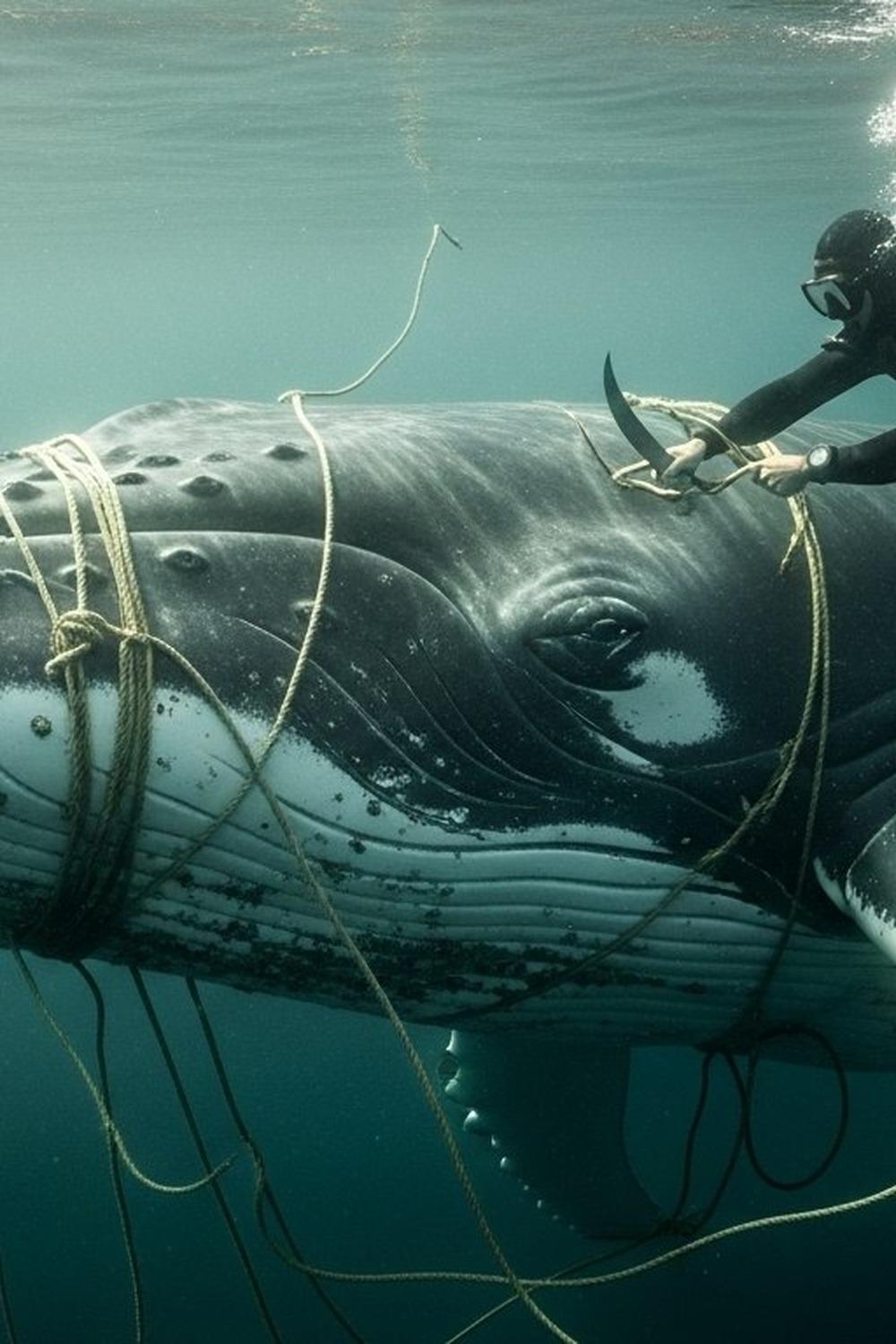
Roughly 27 miles west of San Francisco, a crew from the Marine Mammal Center made a decision that most people would never make: enter open water beside an entangled, panicked whale and cut her free by hand. Commercial Dungeness crab gear—heavy-gauge lines running from surface buoys down to weighted traps on the seafloor—had wrapped around her pectoral fins, looped beneath her tail, and threaded directly through her mouth. Not caught on the outside. Through it. The lines had been there long enough to cut into her flesh, leaving visible grooves.
Key Facts
- In 2011, a crew from the Marine Mammal Center freed a humpback whale entangled in Dungeness crab gear roughly 27 miles west of San Francisco near the Farallon Islands.
- Humpback whales can hold their breath up to 45 minutes, reach 16 meters (52 feet) in length, and weigh up to 40 metric tons.
- A 2006 study by Patrick Hof and Estel Van der Gucht at Mount Sinai confirmed humpbacks possess spindle neurons at concentrations roughly 3 times higher than human brains relative to brain mass.
- The World Wildlife Fund estimated in 2021 that about 300,000 whales, dolphins, and porpoises die from fishing gear entanglement every year.
- North Pacific humpback populations recovered from fewer than 1,500 individuals in the 1960s to an estimated 21,000 by 2015.
In short: A humpback whale rescued from fishing rope near the Farallon Islands in 2011 stunned divers by circling back and gently touching each rescuer after the lines were cut. The Marine Mammal Center freed her from Dungeness crab gear, and the behavior, paired with humpback spindle-neuron research, fuels scientific debate about whale cognition and affiliative contact.
The Rope Had Passed Through Her Mouth
Whale entanglement in commercial fishing gear is now recognized as one of the leading causes of large cetacean mortality worldwide, but cases where rope has penetrated the oral cavity represent some of the most technically difficult rescues on record. The Marine Mammal Center, based in Sausalito, California, has been responding to marine mammal emergencies since 1975. Even their most experienced teams describe entanglements like this one as genuinely life-threatening for rescuers.
Humpback whales can hold their breath for up to 45 minutes. Their flukes—the tail fins—can generate enough force to capsize a small vessel or shatter a diver’s ribcage with a single reflexive strike. These aren’t exaggerations. They’re the calculations that run through every rescue diver’s head before they enter the water. The team used specialized curved knives designed specifically for cutting through braided line under tension, working methodically from the least to most dangerous contact points.
One wrong move. One surge of panic from the animal. That’s all it would take.
She didn’t panic. According to the divers present, the whale became increasingly still as the work progressed—almost as if she registered that the pressure was easing, line by line. Whether that’s accurate or a projection of human narrative onto animal behavior is a question worth asking. But it’s also one that researchers have begun studying with serious rigor.
What Her Eyes Were Doing the Whole Time
Positioned on the side of her massive head, her eye tracked the divers throughout the operation. Not randomly—specifically. When a diver moved to cut a new section of rope, her eye followed. When two divers worked in tandem, witnesses reported that she appeared to monitor both of them in sequence. This kind of deliberate ocular tracking in a high-stress situation is striking.
Why does this matter? Because it connects to something broader happening in cetacean research right now.
The intelligence of whales isn’t a new claim, but the evidence has been accumulating in ways that are genuinely reshaping the science. Much like the remarkable navigational and social abilities documented in other ocean species—the kind of hidden complexity you find when you look closely at creatures we tend to underestimate, whether it’s a pygmy seahorse hiding in plain sight on a coral reef or a 40-ton whale choosing to remain still while strangers cut ropes from her body—the humpback’s behavior that day fits a pattern researchers are only beginning to document systematically.
Humpbacks possess spindle neurons—large, fast-conducting brain cells previously thought to exist only in humans and great apes. A 2006 study by Patrick Hof and Estel Van der Gucht at the Mount Sinai School of Medicine confirmed their presence in cetacean brains, specifically in regions associated with social cognition, empathy, and self-awareness. These neurons are found in higher concentrations in humpbacks than in any other studied whale species.
That finding recontextualized a lot of previously anecdotal behavior reports—including accounts of whales appearing to seek out and sustain human contact after distress events. After the last rope was cut, she didn’t surface explosively and sprint for open water. She descended, then rose again slowly. She began swimming in wide, unhurried arcs around the divers. Wide enough to make full circles. Slow enough that each person could see her clearly. Then she began returning to individuals—approaching each diver, touching them briefly with her rostrum or pectoral fin, and moving on to the next.
Whether This Counts as Gratitude Is the Wrong Question
Marine biologists get careful here—and rightly so. The word “gratitude” carries a specific cognitive weight. It implies the animal understood the cause of her distress, recognized the divers as agents who resolved it, and chose to communicate appreciation. That’s a chain of inference that requires extraordinary evidence.
Researchers at institutions like the Whale Center of New England and the Cetacean Research & Rescue Unit in Scotland have argued instead that the behavior is better framed as affiliative contact—a documented social response in humpbacks that typically occurs within their own pods. Whales touch each other. They maintain physical contact as a form of social bonding, stress regulation, and communication. When a whale initiates that contact with humans following a high-stress event, the most conservative interpretation is that she was doing what humpbacks do: seeking the kind of tactile reassurance her own species would provide. National Geographic’s investigation into animal gratitude outlines why that distinction matters scientifically—and why it doesn’t make the behavior any less remarkable.
A humpback whale rescued from fishing rope is already under enormous physiological stress. Cortisol levels spike. Muscle tissue may be damaged from prolonged struggling. The immune system is taxed. In that state, remaining calm enough to initiate non-aggressive contact with multiple humans—beings she has no evolutionary reason to trust—represents a behavioral choice that doesn’t fit simple models of animal response.
Fear should dominate. Flight instinct should dominate. In this case, neither did, and watching a species choose connection over survival panic at that moment, you realize something fundamental has shifted in how we need to think about whale consciousness.
That’s the part that keeps researchers thinking. Not whether she was “grateful” in the human sense—but why, under extreme stress, she did something that looked, from every observable angle, like the opposite of what fear should produce.
How Often This Happens—and Why It Still Surprises Us
The Farallon rescue wasn’t isolated. Diver James Moskito gave detailed interviews about the experience afterward, describing how the whale found each diver individually, how her eye tracked him while he worked. His account traveled through media cycles in 2011 and has been cited in cetacean behavior literature since.
Similar post-rescue contact appears elsewhere in the record. A 2005 event off the coast of San Diego involved a freed gray whale remaining near the rescue boat for nearly two hours. The NOAA Fisheries Entanglement Response Program, which coordinates large whale disentanglement efforts across U.S. waters, has logged hundreds of successful rescues since the program’s formal establishment in the 1990s—and anecdotal reports of prolonged whale contact following release appear in a significant subset of those records.
What makes these events scientifically interesting isn’t their rarity. It’s their consistency.
By definition, a humpback whale rescued from fishing rope is a whale that survived a process with a very low survival rate. The World Wildlife Fund estimated in 2021 that approximately 300,000 whales, dolphins, and porpoises die from entanglement in fishing gear every year globally. For humpbacks specifically, entanglement is considered a primary driver of population stress in feeding grounds from Alaska to the Gulf of Maine. The whales that disentanglement teams reach represent a fraction of those entangled—most are never found, or are found too late. Each rescue is both a genuine victory and a reminder of how many go unrecorded.
What the Encounter Changes About How We See Them
There’s a particular kind of discomfort that comes with attributing rich inner experience to non-human animals. Science has good reasons for that caution—anthropomorphism has led researchers badly astray before, producing conclusions that tell us more about human wishful thinking than animal reality. But the opposite error is equally available: the assumption that because an animal can’t report its experience in language we recognize, it has no experience worth accounting for.
Evidence from humpback neuroscience, behavioral ecology, and a growing archive of documented post-rescue contact events is pushing researchers toward a more nuanced position. A 2019 study published in the journal Animal Cognition by researchers at the University of Queensland examined decision-making complexity in baleen whales and found evidence of flexible behavioral responses to novel social situations—exactly the category into which a post-rescue encounter with humans would fall.
Humpbacks already have one of the most complex vocal repertoires in the animal kingdom. Their songs—produced only by males, lasting up to 20 minutes, and evolving culturally across populations—have been compared structurally to human musical composition. They cooperate in multi-individual hunting strategies, coordinating bubble-net feeding with apparent role differentiation. Mothers have been documented carrying dead calves at the surface for days.
These are not the behaviors of an animal operating purely on reflex and instinct.
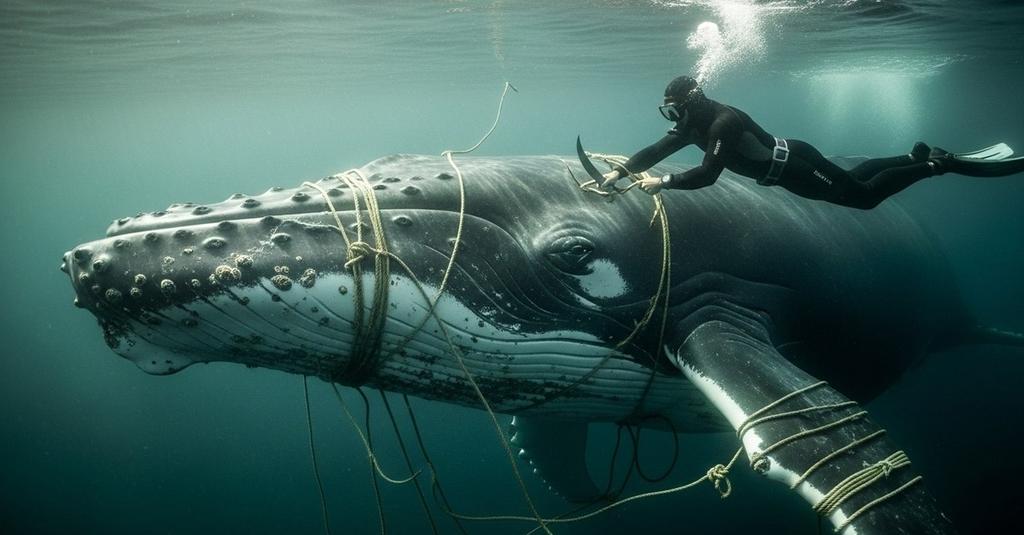
What the Farallon encounter adds to this picture is something harder to quantify: the possibility that a wild humpback, freed from a potentially fatal entanglement, chose to remain with the beings who freed her—not out of confusion, not out of residual fear, but out of something that, whatever we call it, looked an awful lot like connection.
Where to See This
- The Farallon Islands National Marine Sanctuary, California—humpbacks are regularly sighted in feeding season from July through November; whale-watching tours depart from San Francisco and Half Moon Bay with permitted operators.
- The Marine Mammal Center (marinemammalcenter.org) in Sausalito, California—the organization that led the Farallon rescue operates public education programs and publishes its rescue data openly.
- NOAA’s Large Whale Entanglement Response Program maintains a publicly accessible database of disentanglement events; their training resources and incident logs offer the most comprehensive picture of where and how these rescues occur across U.S. waters.
By the Numbers
- 300,000 whales, dolphins, and porpoises die from fishing gear entanglement annually, according to WWF estimates published in 2021.
- Humpback whales can reach 16 meters (52 feet) in length and weigh up to 40 metric tons—making manual disentanglement one of the most physically dangerous wildlife rescue operations in the world.
- The Marine Mammal Center has responded to more than 23,000 marine mammal cases since its founding in 1975.
- Humpback spindle neuron concentrations are roughly 3× higher than those found in human brains, relative to brain mass, according to the 2006 Hof and Van der Gucht study.
- Humpback populations in the North Pacific recovered from fewer than 1,500 individuals in the 1960s to an estimated 21,000 by 2015—a conservation success story now threatened by entanglement and vessel strikes.
Field Notes
- In 2011, diver James Moskito described the Farallon whale’s behavior in detail to the San Francisco Chronicle—specifically noting that she approached each diver separately, not as a group, which suggests a level of individual recognition that researchers found difficult to dismiss as coincidence.
- Humpback whales have a documented behavior called “echelon swimming,” in which young whales position themselves in their mother’s hydrodynamic slipstream—a form of physical proximity that biologists now believe functions partly as emotional regulation, not just energy conservation.
- The curved knives used in large whale disentanglement were specifically designed by NOAA engineers to cut braided polypropylene line—the most common type used in Dungeness crab fisheries—without requiring the diver to saw, which would risk destabilizing an already-stressed animal.
- Researchers still can’t fully explain why some entangled whales remain calm during rescue while others thrash violently throughout. Whether individual temperament, prior human exposure, or the degree of physical pain plays the determining role remains an open question in disentanglement science.
Frequently Asked Questions
Q: How common is it for a humpback whale rescued from fishing rope to survive long-term?
Survival rates for disentangled humpbacks are difficult to track precisely because tagging every rescued animal isn’t always feasible. NOAA data suggests that whales freed from entanglements in relatively early stages—before deep tissue damage or infection sets in—have good survival prospects. The Farallon whale’s injuries, while serious, were survivable. Follow-up sightings confirmed she was alive and mobile weeks after the rescue in 2011.
Q: Why do humpback whales get entangled in crab fishing gear specifically?
Dungeness crab fisheries use vertical lines connecting surface buoys to submerged traps—lines that run through the water column at depths humpbacks regularly travel during feeding dives. Whales don’t see the lines as obstacles until contact is made. Once a line wraps around a fin or flukes, the whale’s instinctive response to pull away tightens the entanglement. Crab fishing season overlaps significantly with humpback feeding migrations along the U.S. West Coast, making the Farallon Islands area a recurring collision zone.
Q: Does the whale’s behavior after the rescue actually prove she was grateful?
No—and that’s an important distinction. Marine biologists are careful not to use the word “gratitude” without qualification, because it implies a specific cognitive chain that’s hard to verify in a non-verbal species. What can be said is that the behavior—affiliative contact initiated by the whale toward individual humans following a stress event—is consistent with documented humpback social behavior and inconsistent with simple fear responses. Whether that constitutes gratitude in any meaningful sense is a philosophical question as much as a scientific one.
Editor’s Take—Alex Morgan
The story gets told as a feel-good rescue narrative, and it is that. But what makes it genuinely important is the part that comes after the ropes fall away—a 40-ton animal making a choice that doesn’t fit the model we’ve built for how wild creatures behave toward us. We want clear categories: instinct or intelligence, reflex or intention. The humpback near the Farallons didn’t cooperate with those categories. That’s the detail worth sitting with long after the warm feeling passes.
Every year, entanglement teams enter open water beside some of the largest animals on Earth and perform surgeries with knives, in swells, on creatures that could end them without meaning to. They do it because the alternative is watching a whale die slowly in gear that was never meant for her. What happened off the Farallons in 2011 was a rescue. But it was also something rarer: a moment of contact between two kinds of intelligence, meeting each other across an enormous gap, in the middle of the sea. What do you call it when a wild animal, finally free, decides to stay?
Illustrations are AI-generated. Article fact-checked and human-edited. Our editorial standards.