Japan’s School Lunch Program Is Teaching Kids to Respect Food
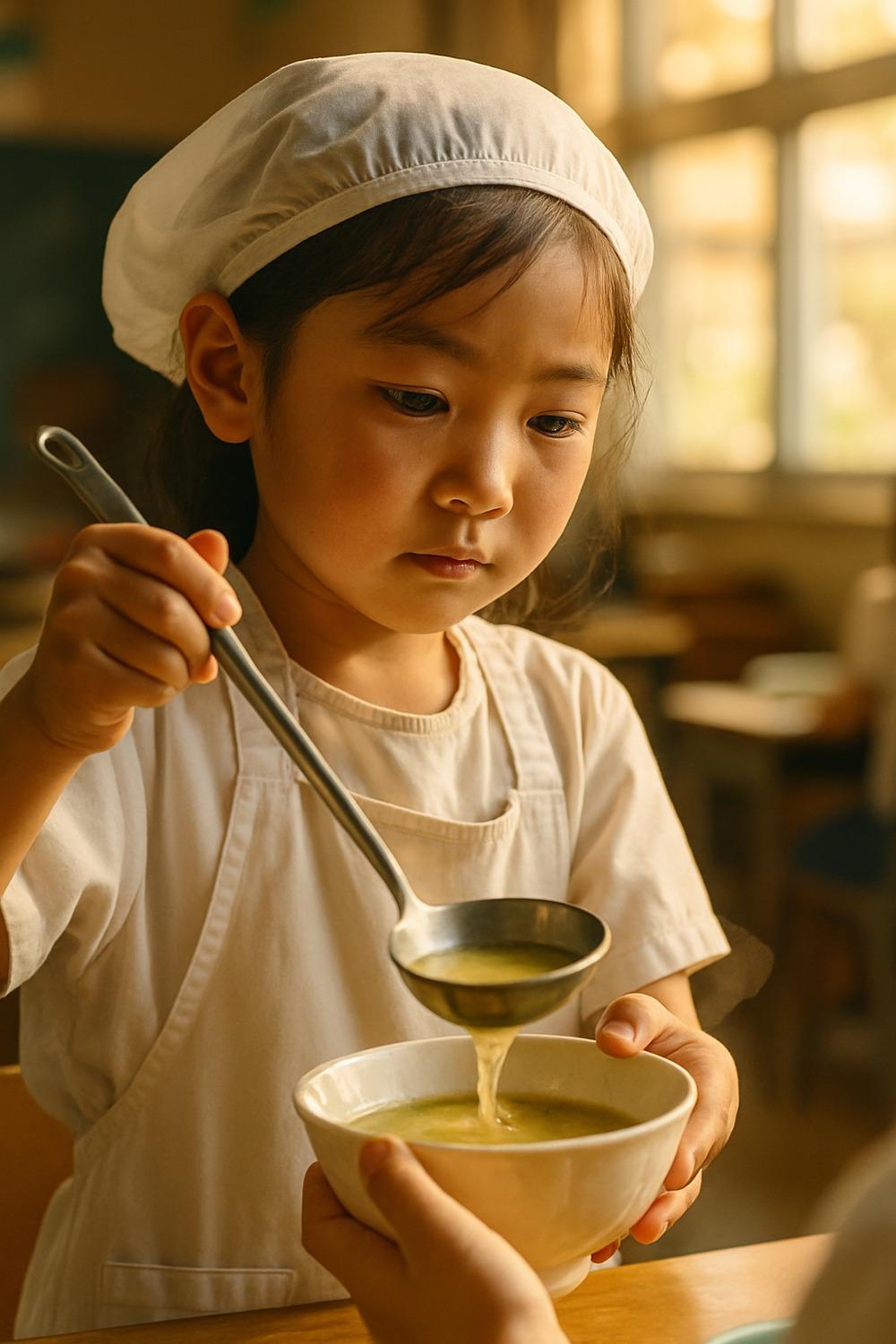
In a school kitchen in Osaka this morning, a seven-year-old tied an apron over her uniform and picked up a ladle to serve her classmates. That single gesture — repeated 180 times a year, in 9.6 million Japanese schools — is the Japan school lunch program. Except it’s never been about lunch. It’s a seventy-year experiment in whether you can teach citizenship one meal at a time.
Since 1954, Japan has fed its schoolchildren this way: fresh food cooked daily, portions calibrated by age and development, menus designed by licensed nutritionists whose jobs exist because parliament decided that how children eat is a matter of state concern. The legislation is straightforward. The budget is transparent. But underneath all of it sits a philosophy that most Western countries abandoned decades ago — the idea that a meal is not a transaction, but a relationship.
Key Facts
- The Japan school lunch program served 9.6 million elementary school students daily as of the 2023 academic year, per the Ministry of Education.
- Japan’s School Lunch Law was enacted in 1954, making the program one of the longest-running institutionalized school nutrition systems at 70 years of continuous operation.
- The Basic Act on Shokuiku, passed in 2005, wrote food education into national law and required a licensed nutritionist in every public school.
- Japan’s childhood obesity rate sits at approximately 4 to 5 percent, compared to 20 percent in the United States and 17 percent in the United Kingdom.
- Families pay roughly 250 to 300 yen (about USD $2) per meal, heavily subsidized by municipal governments.
In short: The Japan school lunch program has fed schoolchildren fresh, nutritionist-designed meals since 1954, with students serving each other and cleaning up as a daily civic ritual called shokuiku. Serving 9.6 million students at about $2 a meal, it links Japan’s low 4 to 5 percent childhood obesity rate to a values-based system rather than a health intervention.
How Japan’s School Lunch Program Actually Works
The legal backbone traces to 1954, when the School Lunch Law passed. But the real pivot came in 2005. That’s when the Basic Act on Shokuiku — food education — was written into national law, and suddenly every public elementary and junior high school had to employ a shokuiku shidouin, a licensed school nutritionist. These aren’t distant consultants. They walk the kitchens daily. They watch how students respond to umeboshi plums and daikon greens. They write menus that shift with the seasons and reflect the region’s agriculture and history. The Ministry of Education sets nutritional standards by grade level — a first-grader’s portion is calculated entirely differently from a sixth-grader’s. Nothing is approximate.
What lands on a tray varies radically by prefecture and month. Coastal towns serve grilled mackerel and wakame miso soup. Agricultural regions feature root vegetables pulled from local soil. Shokuiku explicitly teaches children to trace food backward — to the soil, the farmer, the season. Many schools invite farmers in as guests. Some maintain vegetable plots that feed directly into the lunch kitchen. Geography and ecology arrive via rice bowl.
But here’s what most people outside Japan miss entirely: nothing processed appears on those menus.
No packaged snacks. No reconstituted anything. Kitchens employ trained cooks. Every meal is freshly prepared before dawn. A standard school lunch in Japan looks like what a thoughtful adult would cook for themselves at home — because that’s structurally, functionally, exactly what it is.
Children Who Serve Are Children Who Learn
The ritual of kyushoku — the school lunch ceremony — carries as much weight as the food itself. Students don’t shuffle through cafeteria lines. They remain in their classrooms. A rotating group of students dons white aprons and chef’s hats, wheels a cart down the hallway, and serves their peers directly. Soup is ladled with care. Rice is portioned with intention. Milk cartons are distributed by hand. Why does this matter? Because an abstract value — care, responsibility, community — becomes a physical habit that nine-year-old hands can hold.
And there’s something genuinely strange about how a daily embodied practice can quietly reshape character in ways that no classroom lecture reaches. Research into how two biological systems moving in opposite directions can synchronize through shared physical ritual suggests something deeper is happening: repeated collective acts — whether singing or serving soup — rewire how people relate to one another. The mechanism isn’t magical. It’s neurological.
Before eating comes itadakimasu — “I humbly receive” — spoken together by the entire class. It’s directed at the cooks, the farmers, the ecosystem. After eating, gochisousama deshita — “thank you for the feast.” These are old phrases, inherited. Spoken 1,620 times across nine years of compulsory school, they stop being politeness formulas and start becoming genuine cognitive habits. The National Institute of Health and Nutrition in Tokyo documented this in a 2018 comparative study: children with regular shokuiku exposure showed measurably stronger food literacy — understanding of nutritional balance, portion control, sourcing — than children without it.
Students must finish their plates. Mottainai — the concept of not wasting — runs through the entire system like a thread. Leftovers get composted. Even cleanup becomes the students’ responsibility: wiping tables, stacking trays, sweeping. The meal has a beginning, a middle, an ending. Each child is accountable for all three.
The Obesity Numbers Don’t Lie
Japan’s childhood obesity rate hovers around 4–5%. According to the World Health Organization, this places it among the least affected wealthy nations on Earth. Meanwhile: McDonald’s arrived in Tokyo in 1971. Convenience store culture exploded through the 1990s. Fast food became ubiquitous. Yet the obesity trajectory that reshaped the United States, the United Kingdom, and Australia didn’t replicate in Japan at the same scale. Experts consistently point to one structural cause: one meal daily, cooked fresh, eaten slowly, with intention. Multiplied across 180 school days for nine consecutive years, that’s not nothing. It’s actually everything.
The counterintuitive part deserves sitting with: Japan’s school lunch program has never been positioned as a health intervention. Parents don’t hear about it as a weight management tool. Schools don’t frame it around calories or BMI charts or obesity prevention. They frame it around culture, community, respect for food. The health outcomes appear to be a consequence of a values system, not the goal of a nutrition program. For a Western policy world obsessed with targeting specific health metrics, this is a genuinely foreign logic. Here, the cultural values come first. The health results follow. That reversal is rare enough to matter.
Waseda University researchers published findings in 2021 showing that students in prefectures with stronger shokuiku implementation had significantly lower rates of skipping breakfast — an early metabolic marker that tracks across lifespans. The meals at school don’t just feed children at noon. They reset how children think about eating across the entire day.
Japan School Lunch Program Seventy Years On
The history actually predates 1954. Yamagata Prefecture has documented school lunches appearing in 1889 — Buddhist monks provided rice balls and grilled fish to impoverished students. These were survival meals. Post-World War II food shortages gave the program urgency. Starting in 1946, American aid organizations (UNICEF, LARA) shipped powdered skim milk and flour into Japanese schools. For a moment in history, school lunch was famine relief.
The 1954 law changed everything. Emergency feeding transformed into cultural formation. That pivot — from survival mechanism to values pedagogy — ranks as one of the more remarkable institutional reinventions of the twentieth century. By 2023, approximately 9.6 million elementary students were eating these lunches daily. Families pay 250 to 300 yen per meal, roughly two dollars, heavily subsidized by municipal governments. It’s not a luxury. It’s unremarkable and foundational, as ordinary as showing up. In rural prefectures where depopulation has drained the tax base, entire municipalities now offer school lunches completely free, recognizing that children who eat well in school become adults who sustain communities. The lunch line — except there isn’t one — has quietly become a policy tool.
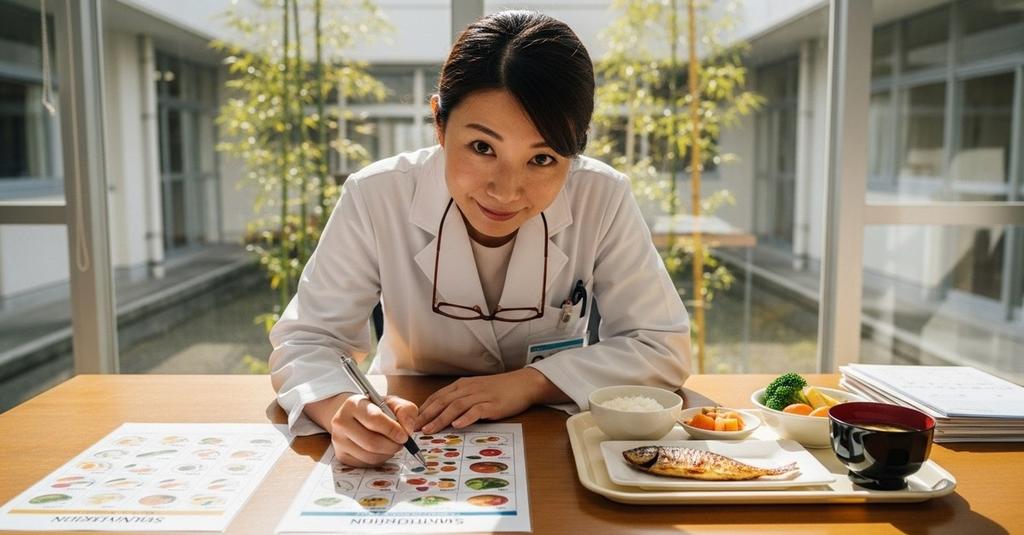
School nutritionists describe their work as among the most creatively demanding positions in public health. Seasonal menus, regional sourcing, age-specific portions, cultural storytelling, all compressed into a two-dollar budget. It requires mastery. The best school nutritionists in Japan are respected figures in their communities — not bureaucratic functionaries but people who quietly shape thousands of young palates, year after year, one miso bowl at a time. Watching this kind of precision applied to something as ordinary as lunch, you start to understand how a nation decides what matters.
How It Unfolded
- 1889 — Buddhist monks in Yamagata Prefecture provide rice balls and grilled fish to low-income students, marking the earliest recorded school lunch in Japan.
- 1946 — Post-World War II, international aid organizations including UNICEF begin supplying powdered milk and flour to Japanese schools, establishing lunch as a national priority.
- 1954 — Japan’s School Lunch Law is formally enacted, creating the legal and institutional framework for a national program in public elementary and junior high schools.
- 2005 — The Basic Act on Shokuiku is passed, writing food education into national law and requiring licensed nutritionists in every participating school.
By the Numbers
- 9.6 million Japanese elementary school students received school lunches daily as of the 2023 academic year (Ministry of Education, Culture, Sports, Science and Technology, Japan).
- Approximately 250–300 yen (roughly USD $2) — the average daily cost to families, heavily subsidized by municipal government funding.
- Japan’s childhood obesity rate sits at approximately 4–5%, compared to 20% in the United States and 17% in the United Kingdom (WHO Global School-Based Student Health Survey, 2022).
- The Basic Act on Shokuiku, passed in 2005, mandated shokuiku programming in all public schools within three years — one of the fastest national rollouts of a food education policy in recorded history.
- 70 years of continuous operation under the 1954 School Lunch Law, making Japan’s program one of the longest-running institutionalized school nutrition systems in the world.
Field Notes
- In Kyoto Prefecture in 2019, a middle school nutritionist named Yuki Nakamura made headlines after redesigning her school’s entire annual menu around endangered traditional vegetable varieties — Kyo-yasai — sourcing directly from heirloom farmers. Student interest in local food culture measurably increased, tracked through post-semester surveys. The menu became a curriculum.
- Japanese school lunches include cold milk every day, a practice that began with the American aid shipments of 1946 and became so embedded that changing it triggers genuine cultural resistance — even as lactose intolerance affects a significant portion of the student population.
- The aprons and chef’s hats worn by serving students are washed and returned by families each week — a detail that seems minor but extends the ritual of food responsibility into the home, making parents partners in the practice rather than passive recipients of it.
- Researchers still can’t fully quantify how much of Japan’s dietary health outcomes should be attributed to the school lunch program versus other cultural factors like family eating habits, urban walkability, and traditional home cooking. The variables are deeply entangled, and isolating the school lunch effect alone remains an open methodological problem.
Frequently Asked Questions
Q: What makes the Japan school lunch program different from school food programs in other countries?
Three elements operate simultaneously: fresh daily cooking with no processed food, licensed nutritionists writing every menu by age group and season, and an embedded philosophy of food education called shokuiku. Most school food systems worldwide prioritize cost management or basic caloric sufficiency. Japan’s system prioritizes values formation. The structural difference matters profoundly — students don’t just eat. They serve, they express gratitude, they clean up. The meal becomes an active civic practice rather than passive consumption.
Q: What is shokuiku, and how is it taught in Japanese schools?
Shokuiku translates roughly as “food education” and was formalized under Japan’s Basic Act on Shokuiku in 2005. Here’s the thing: it’s not a separate class you attend. It’s woven directly into the lunch ritual — the serving rotation, the expressions of gratitude before and after eating (and this matters more than it sounds, since these phrases become embodied habits across years), the seasonal and regional menus, and sometimes visits from local farmers. Children understand food as something grown by people, shaped by seasons, deserving attention and respect. It’s taught through repetition and physical participation rather than instruction.
Q: Does the Japan school lunch program actually reduce childhood obesity?
Evidence is strongly correlational, though not cleanly causal. Japan has one of the lowest childhood obesity rates among developed nations — around 4–5% — while countries with less structured school food policies sit considerably higher. Waseda University and the National Institute of Health and Nutrition have documented connections between shokuiku exposure and better overall dietary habits. But it’s important to note that the program has never been designed as an obesity intervention. The health outcomes appear to follow from a values system, not from a weight management strategy. That distinction matters.
Editor’s Take — Sarah Blake
What strikes me most about the Japan school lunch program isn’t the food itself — it’s that a government sat down in 1954 and decided that how a child learns to eat is a matter of national importance. Not national health. National character. Seventy years later, the evidence suggests they were right, and the rest of the developed world is still arguing about whether pizza counts as a vegetable. The distance between those two positions is not nutritional. It’s philosophical.
Food policy almost always speaks in the language of deficits — what children are missing, what nutrients are absent, what risks need managing. Japan’s system quietly proposes something different: that a meal is a relationship, and teaching children to inhabit that relationship with attention and care produces outcomes that no fortified cereal or calorie-counted tray can replicate. Somewhere in Osaka right now, a seven-year-old is tying an apron, picking up a ladle, and learning — without knowing she’s learning — what it means to take care of someone else. What would the world look like if every child had that moment, every single day, for nine years?
“
Illustrations are AI-generated. Article fact-checked and human-edited. Our editorial standards.