The Dolphins Who Kept Waiting: A Ritual for No One
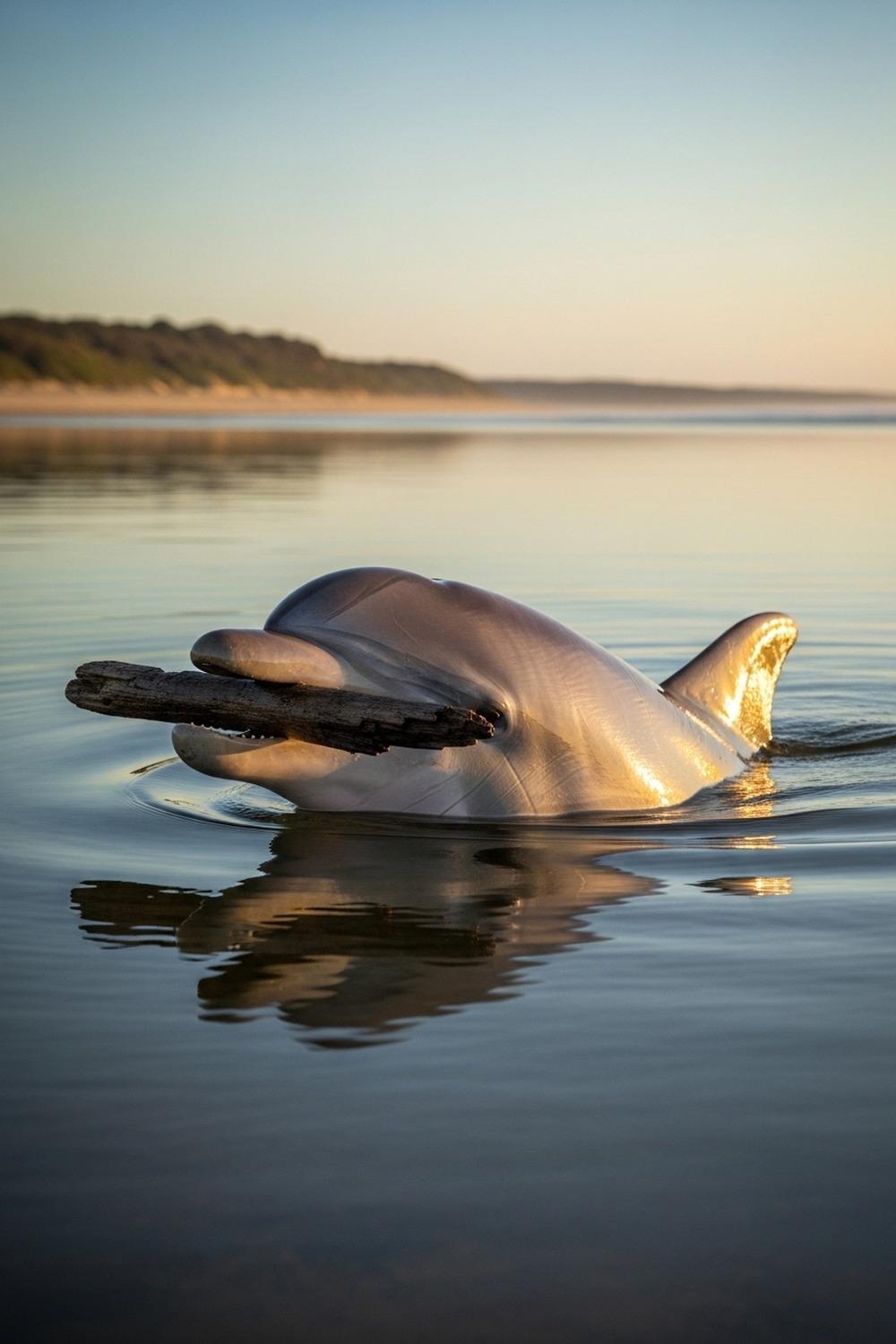
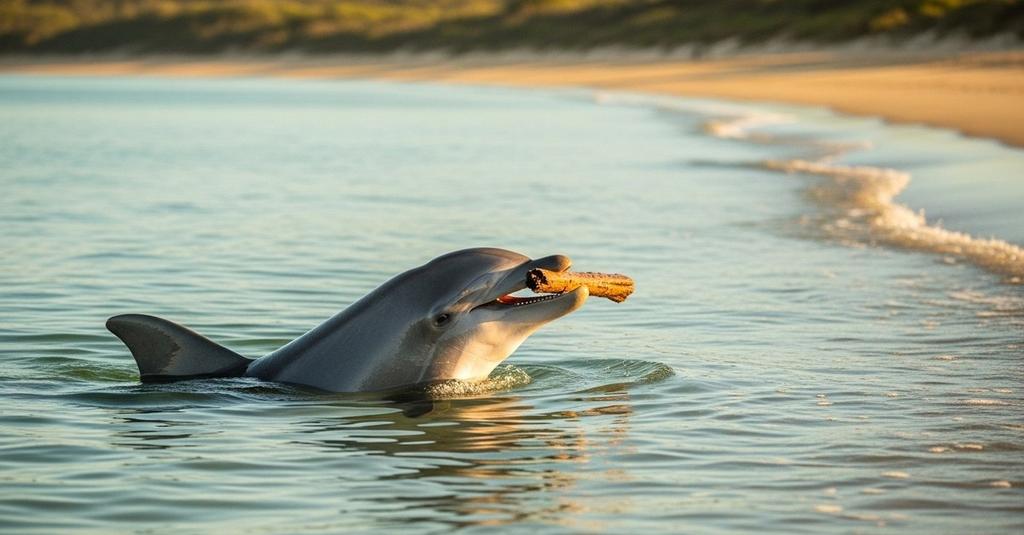
What happens to a ritual when one participant vanishes? This question haunted researchers watching the Tin Can Bay dolphins gift-giving behavior during the 2020 lockdowns, when something no scientist had thought to measure suddenly demanded explanation. A dolphin named Mystique kept surfacing with objects — driftwood, shells, sea sponges pulled from the seafloor — and offering them to an empty shore. No tourists. No fish reward waiting. Just the gesture, repeated, into absence.
Tin Can Bay sits on Queensland’s coast, a small town that had spent decades building something genuinely rare: a working exchange between species. Wild Indo-Pacific bottlenose dolphins would surface each morning with gifts retrieved from below. Visitors would watch. Fish would be offered in return. A transaction. A ritual. Then 2020 arrived, tourists vanished, and the dolphins did something the conditioning models hadn’t predicted.
Key Facts
- Voluntary dolphin-human contact at Tin Can Bay, Queensland dates to the 1950s, beginning with a dolphin researchers call Old Scarry.
- The core resident pod numbered approximately 8–10 individuals during the 2020 lockdown period (Dolphin Research Australia, 2021).
- Object-gifting presentations increased rather than declined during the March–June 2020 lockdown, overturning simple conditioning models.
- The Shark Bay Dolphin Research Project has run for over 40 years since 1984, the longest continuous dolphin study in the Southern Hemisphere.
- Indo-Pacific bottlenose dolphins (Tursiops aduncus) use unique signature whistles that function like individual names.
In short: During the 2020 COVID lockdowns, the wild Tin Can Bay dolphins kept surfacing with gifts — driftwood, shells, sponges — for an empty Queensland shore. The roughly 8–10 dolphin pod actually increased this object-gifting behavior, overturning simple conditioning models and suggesting a culturally transmitted ritual maintained for absent human partners.
How the Tin Can Bay Gift Exchange First Took Shape
In the 1950s, a single dolphin approached the Tin Can Bay shoreline. Researchers call this animal Old Scarry. She came back. Others watched. The behavior spread through generations like something learned, not instinctive — a tradition passed hand to flipper, eye to eye. By the 1980s, the Barnacles Café had formalized what had been happening informally: managed morning interactions with a wild pod that seemed willing, even eager, to participate. The dolphins weren’t simply conditioned animals in a lab. They were part of what researchers describe as a true reciprocal exchange, one of the few documented places where wild dolphins and humans had developed something approaching socially learned behavior — knowledge passed between individuals who watched, imitated, and refined the exchange across decades. The University of Queensland had already flagged the site as scientifically significant long before COVID made it visible.
What struck researchers most was the specificity of what the dolphins brought. They didn’t just surface and wait. They selected. They brought things with no nutritional value, no survival purpose — items chosen from the seafloor with apparent deliberation. Dr. Holly Smith-Wild and colleagues at Dolphin Research Australia noted that the objects varied widely in type and size, suggesting real selection rather than random retrieval. Some dolphins returned repeatedly with the same category of object.
Others experimented. The behavior looked less like a learned trick and more like something being developed in real time — an attempt, however imperfect, to speak across a species boundary.
Mystique had become one of the pod’s most recognizable individuals. Volunteers at the centre knew her on sight. Her driftwood offerings were ritualistic in their consistency. When the lockdowns began in March 2020, staff expected the behavior to fade within days.
It didn’t.
Mystique kept coming. So did the others.
Rituals Held Across a Species Boundary
Why does this matter? Because the question embedded here goes far beyond dolphin cognition — it connects to something old in us. What does it mean to maintain a ritual for an absent partner? Humans know this. We set a place at the table for someone dead. We keep a phone number in our contacts years after someone is gone. We walk a route alone because the walking itself carries meaning. The Tin Can Bay dolphins were doing something that rhymes uncomfortably with that. Watching a species deliberately hold a gesture for a missing other, you stop calling it a trend.
It raises the possibility that the capacity for ritual — not habit, but meaningful, maintained, directed behavior toward an expected other — isn’t uniquely human at all. Research on attachment and grief in other species offers parallels: a dog who walked 2,347 miles alongside Buddhist monks on pilgrimage, maintaining behavioral routines far beyond what survival required. Where does instinct end and something else begin?
At Tin Can Bay, between March and June 2020, researchers documented the pod surfacing with objects on multiple consecutive days. Some individuals presented items multiple times in a single session to the handful of staff permitted on site under essential-worker provisions. The frequency of object-presenting behavior actually increased during the lockdown period, according to observations logged by Dolphin Research Australia volunteers. That detail matters enormously — a decrease would suggest classical conditioning, stimulus removed and behavior fades. An increase suggests something more interior.
The dolphins weren’t just failing to unlearn a habit. They were doubling down on it.
Researchers estimated the resident pod at Tin Can Bay numbered around eight to ten individuals during this period. Not all participated equally. But multiple animals — not just Mystique — maintained the behavior independently. That distribution across individuals rules out the simplest explanation: one habitually conditioned animal persisting out of individual quirk. The ritual had become collective.
What Dolphin Cognition Research Actually Tells Us
Indo-Pacific bottlenose dolphins — Tursiops aduncus — rank among the most cognitively sophisticated animals on Earth. The Shark Bay Dolphin Research Project, running since 1984, has documented tool use, unique signature whistles that function as individual names, alliance-building across three-tier social networks, and evidence of cultural transmission between generations. A 2022 study in Nature Human Behaviour placed bottlenose dolphins in a cohort alongside chimpanzees, elephants, and ravens — the most sophisticated minds we know. The paper noted that dolphins demonstrate forward-planning behavior and emotional responses to social loss that bear comparison with human grief responses. This context doesn’t make the gift-giving metaphorical or sentimental.
It makes it scientifically legible.
What researchers hadn’t modeled before 2020 was what would happen when a socially learned, culturally transmitted behavior lost its human counterpart. The assumption was reasonable, if unexamined: the exchange existed because it was reinforced by fish rewards. The lockdowns ran a natural experiment no ethics board would have approved: remove the reward, remove the audience, and observe. The behavior persisted and intensified, suggesting the dolphins had internalized the exchange as something beyond transaction. Whether that constitutes genuine expectation, something like anticipation, or a more basic form of behavioral momentum — the data can’t yet fully resolve. Scientists aren’t claiming Mystique was grieving human absence the way a person grieves. But they’re also no longer comfortable claiming she simply wasn’t.
That honest uncertainty is what matters most.
Tin Can Bay Dolphins Gift-Giving Behavior After Lockdown
Visitors returned to Queensland in mid-2020 as restrictions eased. The dolphins adjusted within days, not weeks. Fish were offered. Objects were received. The transaction resumed as though the silence had never happened. But the researchers had changed. The 2021 internal report by Dolphin Research Australia, presented at the Queensland Museum’s natural history symposium, formally recommended reclassifying the object-gifting as a potential example of culturally embedded social behavior rather than purely operant conditioning. That reclassification carries weight: it changes how the site should be managed, what responsibilities humans carry, and how long the tradition might persist if interactions were permanently discontinued.
The long-term question isn’t theoretical anymore. Indo-Pacific bottlenose dolphins in Queensland face documented threats from boat strike, bycatch, and coastal development. The Tin Can Bay pod exists in a relatively protected inlet, but surrounding waters carry real pressure. If the pod were disrupted — by disease, by habitat change, by the loss of key individuals who carry the tradition — the gift-exchange behavior might not pause the way it did in 2020. It might not come back. Cultural transmission in animal populations depends on living carriers. When they’re gone, the knowledge goes with them. There’s no archive. There’s no text. There’s only the next dolphin watching the one before her, and deciding, somehow, that this is what we do here. Staff at the Dolphin Centre now conduct regular monitoring sessions, logging which individuals surface, what objects they carry, and how long they wait.
It’s painstaking work. Unglamorous. But it’s exactly the kind of long-term observational record that makes moments like 2020 interpretable in retrospect — and that will make future disruptions, if they come, something other than a mystery.
Where to See This
- Tin Can Bay, Queensland, Australia — the Barnacles Café and Dolphin Feeding Centre operates managed morning dolphin interactions year-round, with the most reliable sightings between 7 and 9 a.m. Australian winter months (June to August) tend to offer calmer conditions and smaller crowds.
- Dolphin Research Australia (dolphinresearch.org.au) coordinates long-term behavioral monitoring of the Tin Can Bay pod and publishes findings accessible to the public; volunteers can apply to assist with observational fieldwork.
- Queensland Museum’s marine mammal archive holds photographic records of individual dolphin identification spanning more than 20 years — one of the most complete visual records of a semi-wild dolphin population in the Southern Hemisphere.
By the Numbers
- Approximately 8–10 individual dolphins make up the core resident pod at Tin Can Bay during the 2020 lockdown period (Dolphin Research Australia, 2021).
- The Shark Bay Dolphin Research Project has run for over 40 years since 1984 — the longest continuous dolphin study in the Southern Hemisphere.
- Object-gifting presentations during the March–June 2020 lockdown increased compared to the equivalent pre-lockdown period — a result that overturned simple conditioning models.
- Indo-Pacific bottlenose dolphins (Tursiops aduncus) use unique signature whistles to identify individuals — a vocal naming system analogous in function to human personal names, documented across populations in at least three ocean basins.
- The Tin Can Bay interaction tradition spans more than 60 years, beginning with Old Scarry’s voluntary approaches in the 1950s — one of the longest documented human-wild dolphin relationships on record.
Field Notes
- During the 2020 lockdowns, at least one dolphin was observed presenting the same piece of driftwood on multiple consecutive mornings to an nearly empty shore — not spontaneous but repeated, directed, deliberate in a way that volunteers on site found difficult to interpret as anything but intentional waiting.
- Not all objects the dolphins bring hold equivalent status within the pod. Younger dolphins watch older individuals select and carry specific items — suggesting the choice of gift itself, not just the act of offering, may be transmitted socially.
- The Shark Bay population (geographically distinct but closely related) uses marine sponges as foraging tools, a behavior passed exclusively through maternal lines. Tin Can Bay gift behavior transmits more broadly across pod members, suggesting a different social learning mechanism (and this matters more than it sounds).
- Researchers still can’t definitively answer whether the dolphins experience something like anticipation — a directed mental state oriented toward expected human presence — or whether the behavior is better described as a deeply ingrained social routine lacking an off-switch. The distinction matters scientifically, but the data collected so far doesn’t support either interpretation cleanly.
Frequently Asked Questions
Q: What exactly is the Tin Can Bay dolphins gift-giving behavior, and how long has it been documented?
The Tin Can Bay dolphins gift-giving behavior refers to wild Indo-Pacific bottlenose dolphins retrieving objects from the seafloor — shells, driftwood, bottles, sponges — and presenting them to humans at the shoreline in exchange for fish. The behavior has been documented since at least the 1980s, with voluntary dolphin-human contact at Tin Can Bay dating back to the 1950s. It’s considered one of the most sustained examples of a culturally transmitted interspecies exchange anywhere in the world.
Q: Why did the dolphins keep offering gifts when no tourists were there during COVID lockdowns?
Researchers are still working through this question. The simplest explanation — that the dolphins were conditioned by food reward — doesn’t fully account for the behavior increasing during lockdown rather than declining. One leading interpretation is that the exchange had been socially internalized by the pod as a meaningful routine, not just a transaction. Dolphins maintain complex social behaviors independent of immediate reward, particularly in groups where cultural traditions are transmitted between individuals over years and generations.
Q: Is this behavior unique to Tin Can Bay, or do other dolphins do this?
Object presentation toward humans has been observed anecdotally in other captive and semi-wild dolphin populations, but Tin Can Bay is unusual in its scale, duration, and the fact that genuinely wild animals choose to participate voluntarily. The behavior isn’t hardwired into the species — dolphins in other Queensland waters don’t do this. It’s a local cultural tradition, which is precisely what makes the 2020 lockdown data so significant: it suggests the tradition has internal logic that doesn’t depend entirely on human participation to sustain it.
Editor’s Take — Alex Morgan
What stops me about this story isn’t the dolphins. It’s the direction of the gesture. Mystique wasn’t seeking food — the exchange had already broken down, the fish weren’t coming. She was maintaining a relationship with someone who wasn’t there. We tell ourselves that’s a human capacity: the impulse to keep the ritual alive even when the other person is absent, because letting it go feels like a second loss. The lockdowns didn’t prove that dolphins feel that. But they made the question a lot harder to dismiss.
The beach at Tin Can Bay looks like any other Queensland inlet at dawn — flat water, mangroves at the edge, pelicans working the shallows. But just below the surface, a small group carries a tradition at least sixty years old, handed down not through genes but through watching and learning and doing. They don’t know what a pandemic is. They don’t know why the hands disappeared. They only knew the ritual, and they kept it anyway. The real question the lockdowns left behind isn’t what the dolphins were feeling. It’s what we owe to a species that waited for us.
Illustrations are AI-generated. Article fact-checked and human-edited. Our editorial standards.