Ladybug Life Cycle Facts: From Egg to Spotted Beetle
Ladybug life cycle facts hide a stranger story than most garden books let on: the bug you call a ladybug starts life as a yellow bead crammed onto the underside of a leaf — and sometimes the very first thing it eats is one of its own siblings. Between that egg and the red, polka-dotted beetle that lands on your sleeve sits one of nature’s tightest survival schedules. Roughly four to eight weeks from speck to shell, with the pace set almost entirely by temperature.
Key Facts
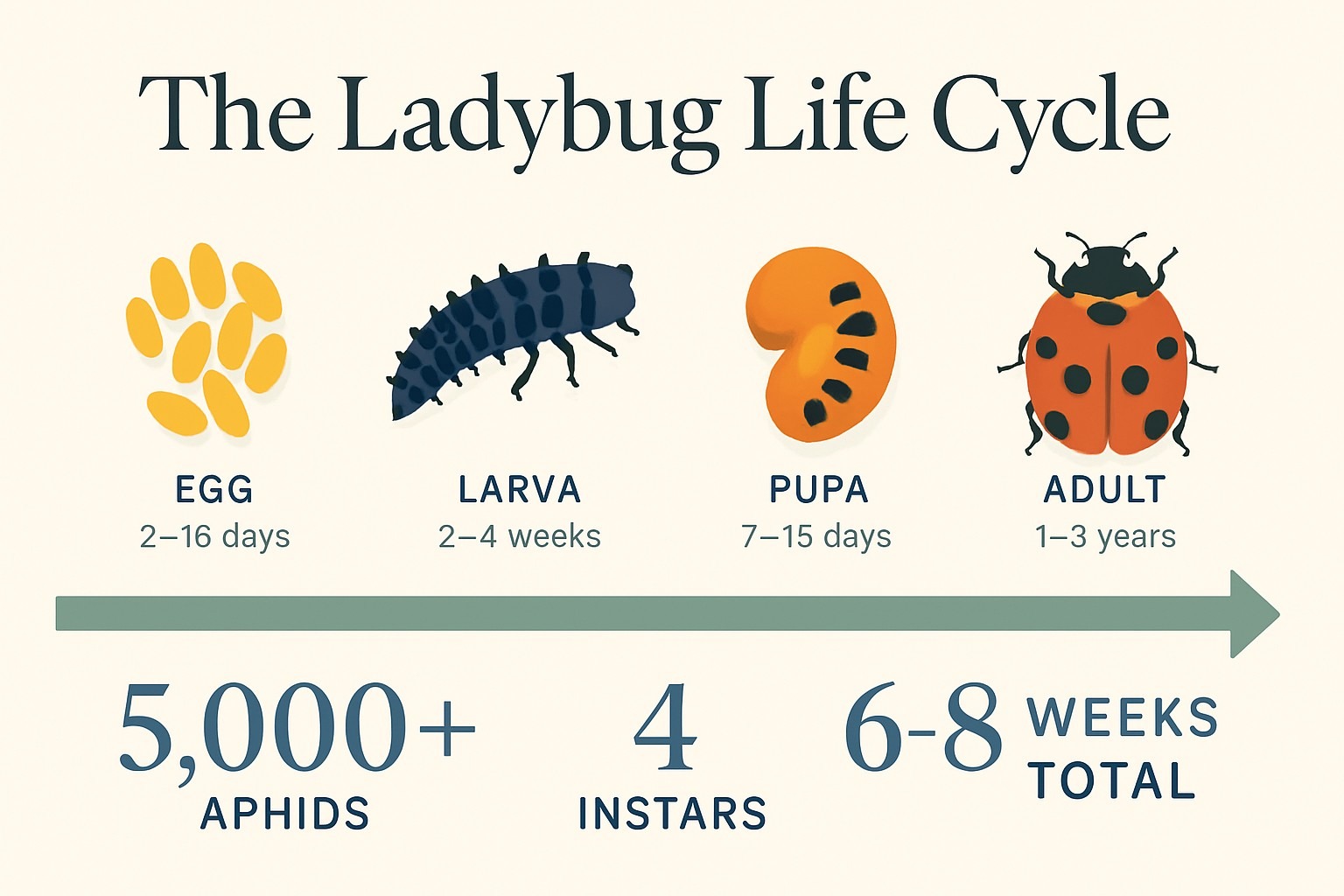
- A single female lady beetle typically lays 250 to 500 eggs in her lifetime, deposited in tight clusters of 5–30 on aphid-infested leaves.
- The full life cycle — egg, larva, pupa, adult — runs about 4 to 8 weeks, and warmth, not species, is the main throttle.
- The larval stage has 4 sub-stages, called instars, packed into 2–4 weeks of almost nonstop eating.
- One ladybug larva can devour 350–400 aphids before it pupates; across a lifetime an adult can take 5,000 or more.
- Many lady beetle mothers lay infertile “trophic” eggs mixed into the clutch — pre-positioned food for whichever siblings hatch first.
In short: Ladybugs go through complete metamorphosis in four stages — egg, larva, pupa, adult — usually finishing in 4 to 8 weeks. The most interesting part isn’t the timing. It’s the strategy: planned cannibalism, four hunter “outfits” during the larva, and a quiet pupa that is quietly liquefying and rebuilding itself inside an orange shell.
Key Facts
- A single female lady beetle typically lays 250 to 500 eggs in her lifetime, deposited in tight clusters of 5-30 on aphid-infested leaves.
- The full life cycle – egg, larva, pupa, adult – runs about 4 to 8 weeks, with warmth, not species, being the main throttle.
- The larval stage has four sub-stages called instars, packed into 2-4 weeks of almost nonstop eating.
- One ladybug larva can devour 350-400 aphids before it pupates, and across a lifetime an adult can take 5,000 or more.
- Many lady beetle mothers lay infertile ‘trophic’ eggs mixed into the clutch as pre-positioned food for whichever siblings hatch first.
In short: Ladybugs go through complete metamorphosis in four stages – egg, larva, pupa, adult – usually finishing in 4 to 8 weeks, with temperature setting the pace. The most interesting part is the strategy: planned cannibalism using trophic eggs, four hunter ‘outfits’ during the larval instars, and a quiet pupa that liquefies and rebuilds itself inside an orange shell.
Ladybug Life Cycle Facts: What Drives the Schedule

Ladybugs are beetles, and like roughly 80% of insects they go through holometabolous development — complete metamorphosis. Egg, larva, pupa, adult. Each stage looks like a completely different animal because each is solving a different problem. The egg hides. The larva eats. The pupa rebuilds. The adult finds a mate.
How fast that all happens comes down to a few real numbers. Around 18–25°C (65–77°F), a healthy clutch of seven-spotted ladybugs (Coccinella septempunctata) finishes the whole pipeline in roughly three to four weeks. Drop the temperature to a cool spring of around 15°C and that same pipeline can stretch to six weeks or more. Food matters too — a larva on thin aphid pickings just takes longer to bulk up to pupation weight.
Here’s the thing most coverage skips: a ladybug isn’t on one schedule, it’s on the schedule its mother chose. Field observations summarized by the University of Michigan’s Animal Diversity Web indicate that females will hold back oviposition until they spot an aphid colony worth committing to. The clock you’re watching starts only when she decides it’s worth starting.
Stage 1 — The Egg, and the Siblings Born to Be Eaten
A lady beetle egg is about one millimetre long, oval, and the colour of an old school bus — bright yellow shading to soft orange. Mothers cement them upright in neat clusters, almost always on the underside of a leaf, and almost always within crawling distance of aphids. Leaf hides them from birds. Aphids feed whoever wakes up hungry.
This is where it gets dark. A clutch of 10–30 eggs is rarely all fertile. Many lady beetle species — including the seven-spotted in Europe and the Asian harlequin (Harmonia axyridis) across North America — deliberately mix in infertile “trophic eggs.” When the first viable larvae hatch, those unfertilized eggs become their starter meal. No hunting required. No journey required. First calories already laid out beside them.
Hatching takes 2 to 10 days. Warmer leaf, faster clock. And the first larva out usually eats whichever eggs haven’t cracked yet — even fertile ones (yes, really). Peer-reviewed entomology literature on Harmonia axyridis reproductive biology, indexed in the NCBI PubMed Central archive, notes that this early cannibalism is so common it functions as part of the life cycle, not a malfunction of it.
{IMAGE_2}
Stage 2 — The Larva: A Tiny Hunter in Four Outfits
Whatever climbs out of that egg looks nothing like a ladybug. It is long, segmented, dark grey or black, often patterned with bright orange or yellow flecks, with six legs and a head that points forward like a bumper. Garden writers reliably describe them as “little black alligators with orange spots,” and once you’ve seen one in profile, you can’t unsee the resemblance.
Turns out the alligator look does a job. The shape and warning colours mimic toxic, foul-tasting insects, and bristles on some species discourage birds from taking a second bite. So even at 4 mm long, the larva is broadcasting don’t.
It needs the protection because it eats more than the adult ever will. Across roughly two to four weeks, the larva passes through four instars — four growth stages, each separated by a moult — and at every stage it gets bigger and hungrier. By the late instars, a single larva can take down 50 to 60 aphids a day. Total aphid count before pupation: typically 350 to 400. Frankly, the marketing has it backwards — the larva does most of the aphid-killing work the adult gets credit for.
This is the engine behind the lady beetle’s long history as a biological control agent, a story walked through in detail in our piece on ladybugs as nature’s tiny pest controllers.
Stage 3 — The Pupa: A Statue That Is Rebuilding Itself
When a fourth-instar larva has eaten enough, it picks a leaf, glues its rear end to the surface, hunches into a comma shape, and stops moving. Within hours the old larval skin splits down the back and slides off. What is left underneath is the pupa — usually orange and black, about the size of a small bean, roughly the shape of the adult-to-be.
From the outside it looks like nothing is happening. Inside, almost everything is. Larval muscle, gut, and skin tissue are being chemically dismantled and reassembled into beetle wings, beetle elytra, beetle reproductive organs. Pupa runs 7 to 15 days, again temperature-dependent.
It is also the most vulnerable stage in the whole life cycle. A pupa cannot run. It cannot fight. It cannot meaningfully hide. So why does any pupa survive at all? Two reasons: the larva’s warning colours are kept (predators that “learned” not to eat the bristly grub also avoid the orange comma), and the leaf-underside placement makes it physically awkward for birds. Even so, this is where most lady beetle mortality happens. Adult lady beetles will readily eat pupae of their own species — the cannibalism documented across multiple species accounts on the University of Michigan’s Animal Diversity Web ranks among the top killers of immature lady beetles, alongside interspecific predation.
Stage 4 — The Adult, and the First 15 Minutes of Flight
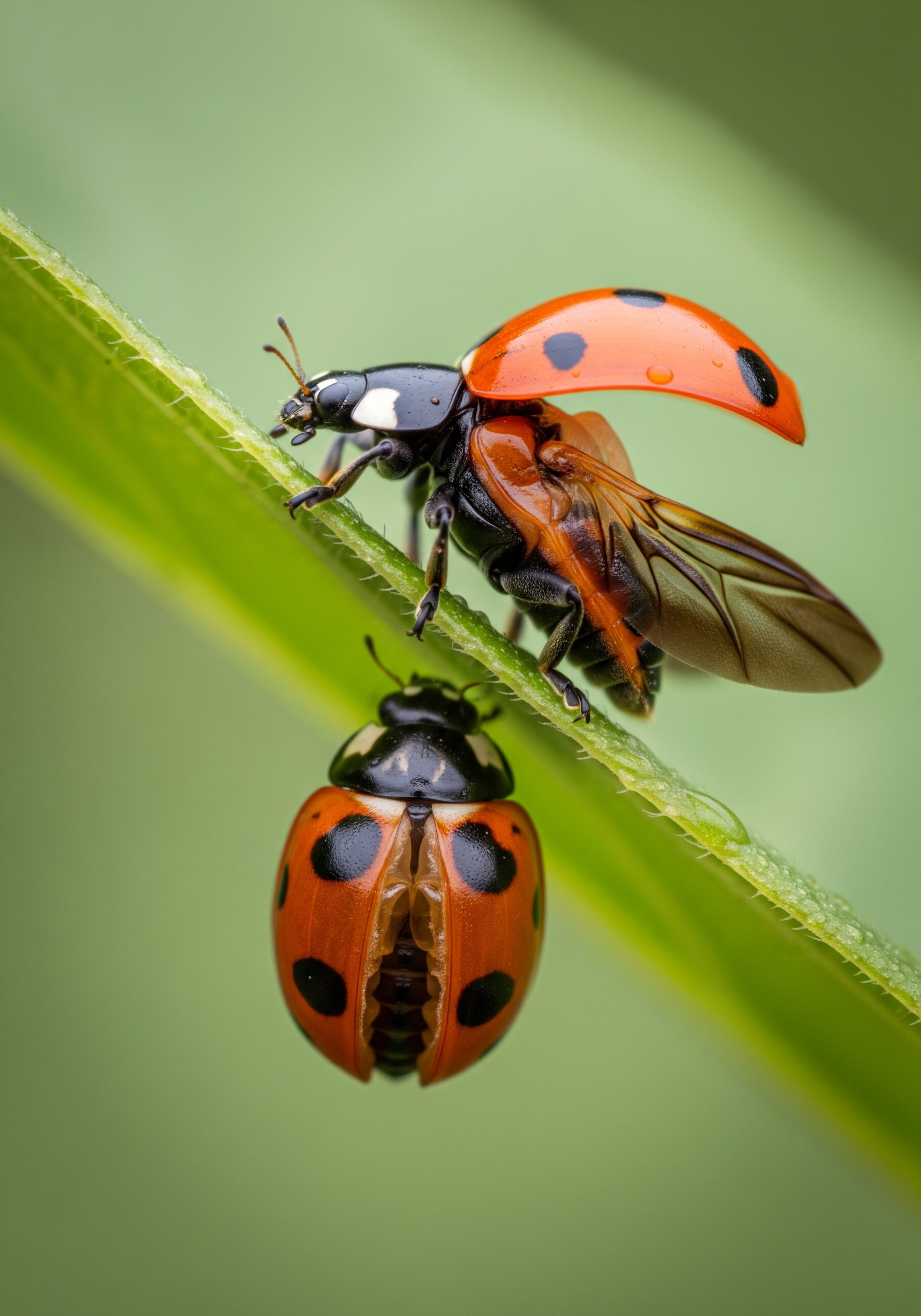
When the pupa finally splits, what climbs out doesn’t look right. The new adult is pale — soft yellow, sometimes almost cream — with barely a hint of the spots to come. Its shell, the elytra, is still flexible. Wings are crumpled and wet.
Then it pumps. Hemolymph (insect blood) is forced into the wings until they unfold, the elytra hardens, and pigments migrate to the surface over the next several hours. By the time the colour locks in, you have the lady beetle that has been on a million children’s drawings — red, orange, sometimes yellow, with the species-specific spot pattern fully visible.
How fast? Within about 15 minutes the adult can fly. Within 8.8 to 11.4 days, the seven-spotted ladybug is sexually mature, according to the species account on the University of Michigan’s Animal Diversity Web. Then the whole loop starts over.
Two Species, Two Schedules — A Side-by-Side
Most articles on the ladybug life cycle treat “ladybug” as a single animal. It isn’t — there are more than 6,000 lady beetle species worldwide. Two dominate the conversation in Europe and North America, and their timetables aren’t identical. Here’s a side-by-side most general coverage won’t show you:
| Stage | Seven-spotted (C. septempunctata) | Asian harlequin (H. axyridis) |
|---|---|---|
| Egg | 2–4 days at 25°C | 3–5 days at 25°C |
| Larva (4 instars) | ~2–3 weeks | ~2–4 weeks |
| Pupa | 5–10 days | 7–15 days |
| Eggs per female (lifetime) | ~250–500 (avg ~440) | Up to ~1,600 in ideal conditions |
| Adult lifespan | 1–2 years | 1–3 years |
Big-picture: the harlequin is a faster, more fertile breeder. That’s a big part of why it spread so aggressively across North America after being introduced as a biological control — a story stitched through our longer piece on 50 million years of ladybug evolution.
Mating, Diapause, and How Long Ladybugs Really Live
Adult lady beetles don’t live a single fast summer and then die. Most live through one winter. Some live through two.
Diapause is the trick — a kind of insect dormancy. As autumn cools, adults stop eating, stop breeding, and aggregate. The University of Michigan’s Animal Diversity Web records seven-spotted lady beetle clusters of 10–15 individuals tucked into thick grass or between boulders, with occasional “super-aggregations” of more than 200. The harlequin is famous for the same behaviour at uglier scales — sometimes thousands jammed into the south-facing wall of a barn or attic, a pattern the Ohio State University Extension’s Ohioline fact sheet on lady beetles documents as a routine autumn problem in the U.S. Midwest.
Come spring, mating starts. A female can mate multiple times across her active season, storing sperm and laying clutches in waves as aphid populations explode. That is why, in a single garden, you can see fresh yellow eggs and overwintered adult beetles in the same week of April. The cycle isn’t a line. It is a loop with several rotations spinning at once.
Lifespan, honest answer: a wild lady beetle that survives its first winter generally lives 1–2 years; harlequin adults occasionally push past 3. Most never make it out of the larva or pupa stage at all. That isn’t failure. It is the math of laying 500 eggs to net two surviving breeding adults.
Ladybug life cycle at a glance (Coccinella septempunctata at 25°C):
- Egg: 2–4 days · 1 mm · yellow to orange · clusters of 10–30
- Larva: 2–3 weeks · 4 instars · eats 350–400 aphids
- Pupa: 5–10 days · orange/black · immobile
- Adult: 1–2 years · 5–8 mm · 5,000+ aphids over lifetime
- Sexual maturity: 8.8–11.4 days after emergence
Frequently Asked Questions
Q: How long does the ladybug life cycle take from egg to adult?
A: Typically 4 to 8 weeks. At a steady 25°C with plenty of aphids, the seven-spotted ladybug finishes in about 3 to 4 weeks; in a cool spring it can stretch past 6.
Q: Do ladybug larvae really eat their unhatched siblings?
A: Yes. Mothers commonly mix infertile “trophic eggs” into the clutch as deliberate first food, and the earliest-hatching larvae will also eat fertile eggs that have not cracked yet. Entomologists consider this a normal part of lady beetle biology, not a malfunction.
Q: How do you tell a ladybug larva from a pest?
A: Lady beetle larvae are long, segmented, dark grey to black with orange or yellow markings, six legs, and a forward-pointing head — often described as “little alligators.” If it is hunched on a leaf eating aphids, it is almost certainly a friend, not a foe.
Q: How long do adult ladybugs live?
A: In the wild, generally 1 to 2 years for the seven-spotted, sometimes up to 3 for the Asian harlequin. Most of that lifespan is spent in adult form, and most survival depends on getting through diapause — the winter dormancy adults rely on.
Sources
- Animal Diversity Web, University of Michigan Museum of Zoology — species accounts for Coccinella septempunctata and Harmonia axyridis.
- Ohio State University Extension — Ohioline fact sheet ENT-45, “Lady Beetles.”
- Washington State University — “Ask Dr. Universe: What is the life cycle of a ladybug?”
- Insect Lore — “Life Cycle of a Ladybug: Mating & Life Stages.”
- NCBI PubMed Central — peer-reviewed entomology studies on Harmonia axyridis reproductive biology, including trophic eggs, cannibalism, and micropyle variation.
Next time a lady beetle lands on your sleeve, remember what you’re actually holding: a survivor of an egg cluster where it likely ate at least one sibling, a former alligator-shaped hunter that took 400 aphids before reinventing its own body inside a still orange shell. The polka-dot beetle is real. The story behind it is wilder than the cartoon.
Illustrations are AI-generated. Article fact-checked and human-edited. Our editorial standards.