The Fastest Bird in the World: Peregrine Falcon at 242 MPH
The fastest bird in the world is the peregrine falcon, and the number attached to it — 242 miles per hour, recorded in a 1999 skydive over the Mojave Desert — is one of the most quoted statistics in zoology. It is also, on closer reading, more complicated than most encyclopedia entries admit.
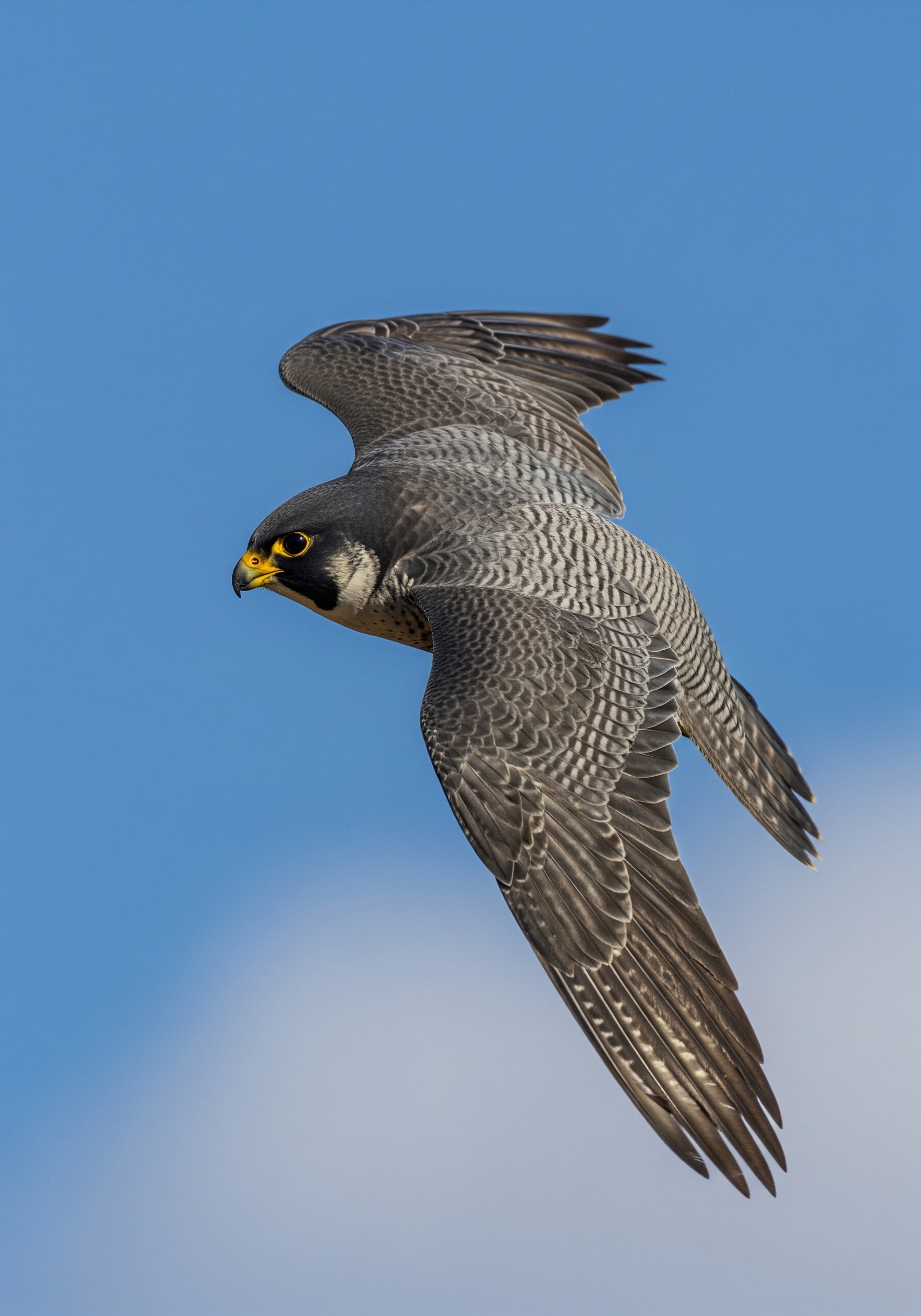
Key Facts
- Top measured stoop: 389.46 km/h (242.0 mph), achieved by a tame six-year-old peregrine named Frightful in 1999 after release from a Cessna at 17,000 ft, owned by falconer Ken Franklin.
- Typical estimated terminal velocity: approximately 320 km/h (200 mph) in a wild hunting stoop, according to Britannica and the Cornell Lab of Ornithology.
- Highest radar-confirmed wild dive: roughly 184 km/h (114 mph) — a reminder that the headline numbers come from instrumented experiments, not routine fieldwork.
- Body plan: 34–58 cm long, 74–120 cm wingspan, 330–1,500 g; females are up to 30% larger than males.
- Global range: the most widespread raptor on Earth, present on every continent except Antarctica and missing only from New Zealand among ice-free landmasses.
In short: The peregrine falcon is unambiguously the fastest bird in the world when measured by terminal-velocity dive, with credible numbers between 320 and 389 km/h. Yet the same bird is beaten in level, flapping flight by a common swift — and the gap between those two facts is the most interesting thing about it.
Key Facts
- The top measured stoop was 389.46 km/h (242.0 mph), achieved by a tame six-year-old peregrine named Frightful in 1999 after release from a Cessna at 17,000 ft, owned by falconer Ken Franklin.
- The typical estimated terminal velocity in a wild hunting stoop is approximately 320 km/h (200 mph), according to Britannica and the Cornell Lab of Ornithology.
- The highest radar-confirmed wild dive is roughly 184 km/h (114 mph), a reminder that headline numbers come from instrumented experiments rather than routine fieldwork.
- The peregrine is 34-58 cm long with a 74-120 cm wingspan and weighs 330-1,500 g, and females are up to 30% larger than males.
- The peregrine is the most widespread raptor on Earth, present on every continent except Antarctica and missing only from New Zealand among ice-free landmasses.
In short: The peregrine falcon is unambiguously the fastest bird in the world when measured by a terminal-velocity dive, with credible numbers between 320 and 389 km/h. The famous 242 mph record came from a single 1999 experiment with a tame bird released from a plane, not a wild hunt, where radar-confirmed dives are closer to 114 mph. In level flapping flight the peregrine is actually beaten by the common swift.
Why the peregrine falcon is the fastest bird in the world
Speed in birds is not one thing. It is at least three. There is level flapping flight, the kind a swift uses when it crosses Africa in October. There is wind-aided ground speed, which sometimes inflates record claims. And there is gravity-assisted diving — the stoop — where a falcon converts altitude into velocity by falling, on purpose, in a teardrop posture so tight the wings nearly disappear into the body.
The peregrine wins the third category by a margin so wide nothing else in the air competes. A typical stoop, estimated by ornithologists across multiple field studies, reaches around 320 km/h (200 mph). The bird does this with a body the size of a crow.
That is the headline. The footnote is more useful: speed alone is not why peregrines catch ducks at midair angles their prey never sees coming. Speed is the *means*. The actual weapon is what speed lets the bird do once it gets there.
The 242-mph dive: what Ken Franklin actually did
The number cited everywhere — 242 mph, 389 km/h — does not come from a wild falcon hunting a teal. It comes from a single experiment in 1999 conducted by Ken Franklin, a commercial pilot and falconer from Friday Harbor, Washington. Franklin and a film crew working for National Geographic Explorer’s documentary Terminal Velocity (filmed 1999, aired 2002) released his hand-raised peregrine, Frightful, from a Cessna 172 at roughly 17,000 feet over the desert.
To clock her, they attached a 113-gram skydiver’s altimeter — a Pro-Track recording chip — to Frightful’s tail. Identical units rode on Franklin himself, a cameraman, and a falling lure for cross-check. The fastest run produced the 389.46 km/h figure that Guinness World Records now lists as the fastest dive ever measured for a bird.
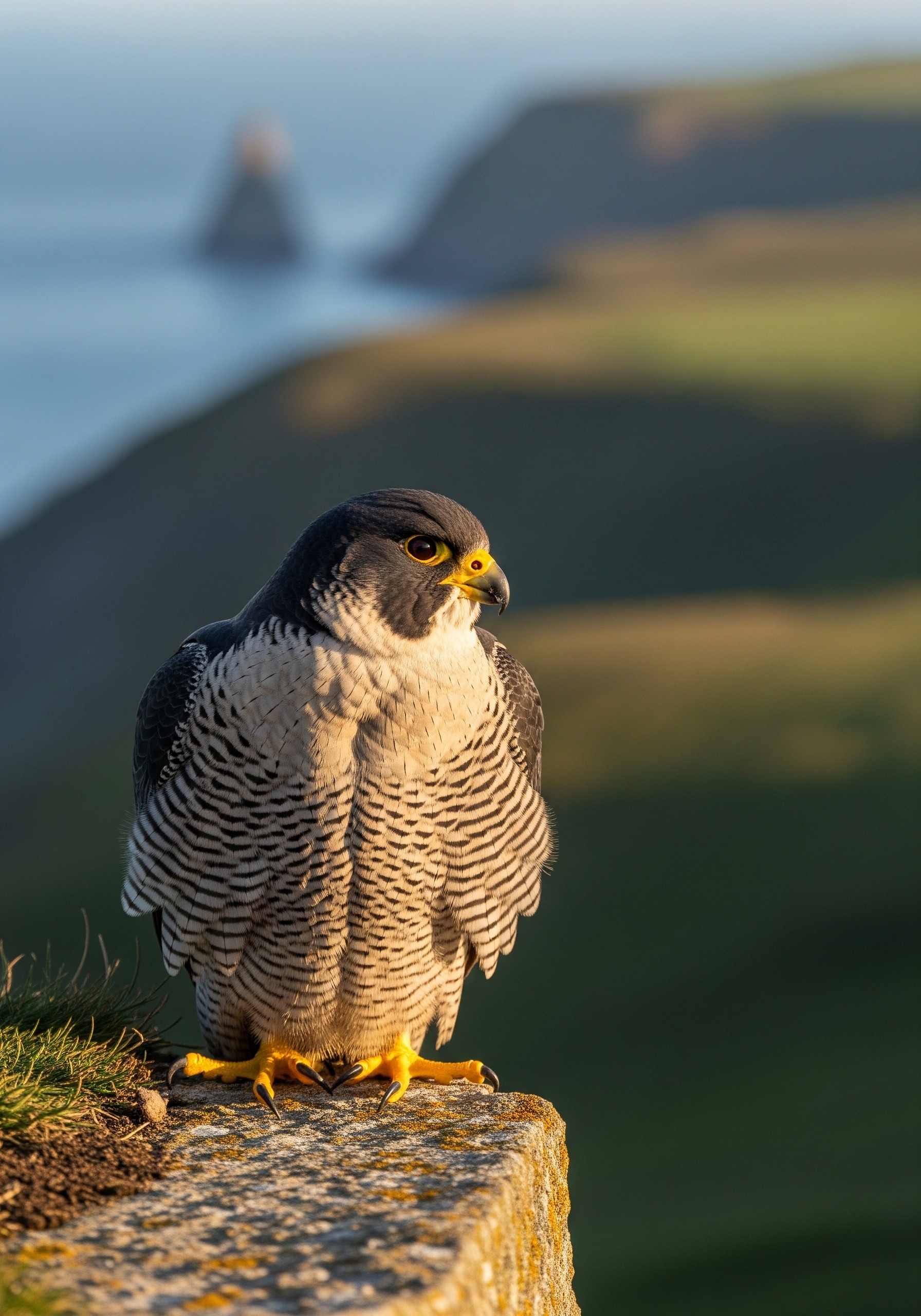
{IMAGE_2}
Frightful was a six-year-old female weighing just under one kilogram (997.9 g) with a 104 cm wingspan. None of this is a wild record. It is a tame, well-conditioned bird, released from a plane, falling through clean desert air toward a lure she knew. The number is real. It is also, as a description of what falcons routinely do over a cliff in Wales, an overstatement.
Honest uncertainty: 114, 200, or 242 mph?
Here’s the thing most “fastest bird” articles glide over. Radar tracks of wild peregrines hunting have never confirmed the 242 mph figure. The highest reliably radar-measured stoop in the wild sits closer to 184 km/h — about 114 mph. The 200-mph Britannica estimate sits in between, drawn from physics models of terminal velocity for a falcon-shaped object falling from sufficient altitude.
None of these numbers are wrong. They measure different things: a film-set skydive at altitude (Franklin), a theoretical maximum (Britannica), an instrumented hunt on a typical cliff (radar). The honest version is that a peregrine in a real, gravity-assisted dive almost certainly clears 300 km/h under the right conditions, and absolutely can exceed 200 mph when conditions stack — but the 242-mph headline is a ceiling, not an average. Anyone who tells you a wild peregrine routinely hits 240 mph chasing a pigeon is selling certainty the data does not support.
How fast peregrine falcons actually dive — the body that makes it possible
The dive begins with a choice of altitude. Peregrines are deliberate hunters: they climb above their prey, sometimes by several hundred meters, and then convert that potential energy into a downward attack. The wings fold against the body in a sequence German aerospace researchers documented in a 2014 Karlsruhe Institute of Technology wind-tunnel study of a trained falcon. Up to about 190 km/h the wings hold a classic diamond shape. Above that, they tuck flat against the flanks. The bird becomes a feathered missile.
The biology backing this is surprisingly specific:
- Tubercles in the nostrils. Small bony cones project into each nare, breaking the air into a spiral and slowing it before it reaches the lungs — a baffle, in effect, that prevents the pressure shock you would feel breathing through a fire hose. Engineers studying jet-engine intakes have cited the structure for decades.
- A nictitating membrane. A transparent third eyelid sweeps across the eye during the stoop, clearing dust and tears and keeping the prey visually locked.
- Stiff, pointed wings and tight covert feathers that resist flutter at speeds where ordinary plumage would tear.
- A keel-driven flight muscle oversized for a bird this size, which is why a falcon can pull out of a 200 mph dive without disintegrating.
That last point matters more than people realize. The pull-out is the hardest part. A peregrine ending a stoop can experience lateral acceleration of around 15 g — a figure published in 2018 by Robin Mills and colleagues at the University of Groningen and the University of Oxford in PLOS Computational Biology. Fifteen g would gray-out a fighter pilot. The bird absorbs it with skeletal architecture and pulls the curve.
The 2018 finding nobody quotes: peregrines steer like guided missiles
Mills’s 3D simulation answered a question that had quietly nagged ornithologists for years: why dive so fast that you might miss? Faster prey-pursuit usually means worse precision. The trade-off is brutal in human-built systems.
The Oxford-Groningen team ran the math and found the opposite. At high speed, the falcon can recruit enormous aerodynamic forces by tilting flight feathers a few degrees — and those forces let it match every twitch of a panicked starling without ever turning sharply itself. The steering rule the simulation extracted from real GPS-logged hunts is the same proportional-navigation algorithm used in heat-seeking missiles since the 1950s.
In plain English: a peregrine does not chase its prey. It calculates the interception point in real time, the way a Sidewinder calculates an aircraft, and arrives there. Stooping at 300 km/h is what makes the geometry work. Slower would mean less force to spend on last-second corrections, and a missed strike.
That is the editorial verdict the encyclopedia entries miss: the peregrine is not the fastest bird because evolution rewards speed. It is the fastest bird because, at this exact velocity, it becomes a guided weapon.
Fastest bird in level flight: the swift takes the second medal
Pull gravity out of the equation and the leaderboard reshuffles. In sustained level flight — flapping, not falling — the peregrine cruises somewhere around 90 km/h, with bursts toward 110. The common swift (Apus apus) clocks a confirmed 111.5 km/h in true level flapping flight, a record documented by Swedish ornithologist Anders Hedenström at Lund University in radar-tracked migration studies. Swifts can also stay airborne for ten months without landing — eating, sleeping and mating on the wing.
It is a useful reminder. “Fastest bird in the world” depends entirely on whether you are talking about the stoop, level flight or, in the case of an Anna’s hummingbird, the courtship plunge measured in body-lengths per second (where the hummingbird, scaled, beats fighter jets). The peregrine wins because the stoop is what the public means.
The peregrine falcon by the numbers
- 389 km/h (242 mph) — Frightful’s instrumented stoop, 1999, the official Guinness record.
- ~320 km/h (200 mph) — modeled terminal velocity in an ideal wild dive.
- ~184 km/h (114 mph) — highest radar-confirmed wild stoop.
- 15 g — lateral acceleration during pull-out, per Mills et al., 2018.
- 17,000 ft — release altitude in the Cessna experiment.
- 1,402 — UK breeding pairs estimated by the RSPB in 2011, up from near-zero in the 1960s.
How the peregrine compares to other “fastest bird” claimants
The list below uses the most defensible single figures from peer-reviewed work and major ornithological references. Sources disagree at the second decimal; the ranking does not.
| Species | Speed | Type | How measured |
|---|---|---|---|
| Peregrine falcon | 389 km/h (242 mph) | Stoop dive | Skydive experiment, 1999 |
| Golden eagle | ~240–320 km/h | Stoop dive | Estimated, mixed sources |
| Common swift | 111.5 km/h (69 mph) | Level flapping flight | Radar tracking, Lund Univ. |
| Common eider | ~113 km/h (70 mph) | Level migratory flight | Field observation |
| Anna’s hummingbird | ~98 km/h (61 mph) | Courtship dive | High-speed video, UC Berkeley |
If you want a fuller picture of what 200-mph flesh-on-feathers physics actually does to a duck, our companion piece on the peregrine’s clenched-fist strike walks through the biomechanics of impact. The architecture of the stoop itself — wing tuck, eye lock, pull-out — is dissected in our deeper feature on the stoop as Earth’s fastest predatory maneuver.
The comeback nobody expected
The peregrine was effectively gone from the eastern United States by 1965. DDT, sprayed across mid-century agriculture, accumulated in the falcons’ tissue and thinned eggshells until clutches collapsed under the parents’ weight. Britain’s population fell by more than half. The species was placed on the U.S. Endangered Species list in 1970.
The recovery is the cleanest conservation success story in raptor history. Following the 1972 U.S. DDT ban and a captive-breeding program led by Cornell University’s Tom Cade — co-founder of The Peregrine Fund in 1970 — peregrines were reintroduced to wild and, unexpectedly, urban habitat. The skyscraper turned out to be a synthetic cliff. By 1999, the species was removed from the U.S. Endangered list. By 2011, the RSPB counted 1,402 breeding pairs in the United Kingdom. Today peregrines nest on cathedrals in Manchester, on bridges in New York, on the side of the Salesforce Tower in San Francisco.
The bird that became the fastest animal on Earth did it twice: once over millions of years of evolution, and once in fifty years of policy.
Frequently Asked Questions
Q: Is the peregrine falcon really the fastest bird in the world?
A: Yes — in a stoop dive. The 389 km/h (242 mph) figure measured on Ken Franklin’s falcon Frightful in 1999 remains the fastest recorded flight by any bird and the fastest movement by any animal. In level flapping flight, the common swift beats it.
Q: How fast can a peregrine falcon dive in the wild?
A: Estimates of typical wild stoops cluster around 300–320 km/h (185–200 mph), based on terminal-velocity physics and field observation. Radar-tracked stoops have been confirmed up to about 184 km/h (114 mph), suggesting the true maximum in routine hunting is usually below the experimental ceiling.
Q: What is the second fastest bird?
A: For diving speed, the golden eagle and Saker falcon are the closest contenders, both estimated above 240 km/h. For level flapping flight, the common swift holds the confirmed record at 111.5 km/h.
Q: Why doesn’t the peregrine die from its own dive?
A: Bony tubercles inside the nostrils slow the air entering its lungs, a third eyelid keeps the eyes clear, and an oversized flight musculature lets the bird absorb roughly 15 g of force during pull-out without injury. These are not separate features — they evolved together as a stoop-tolerance package.
Sources
- Guinness World Records — “Fastest bird (diving)” entry, documenting the Ken Franklin / Frightful 1999 measurement.
- Mills, R. et al. (2018). “Physics-based simulations of aerial attacks by peregrine falcons reveal that stooping at high speed maximizes catch success against agile prey.” PLOS Computational Biology — University of Groningen and University of Oxford.
- Encyclopædia Britannica — “Peregrine falcon: Speed, Diet, & Facts.”
- Cornell Lab of Ornithology, All About Birds — Peregrine falcon species profile.
- Royal Society for the Protection of Birds (RSPB) — UK population data and DDT recovery history.
- National Geographic Explorer documentary, Terminal Velocity (1999/2002).
The peregrine falcon is the fastest bird in the world. It is also, on closer inspection, an animal whose record depends entirely on how you measured it and who was holding the stopwatch. That nuance does not diminish the bird. If anything, it sharpens what makes the peregrine extraordinary — a creature built so precisely for one act, the headline-grabbing dive, that scientists now study it the way they study missile guidance, and conservationists hold it up as proof that a species written off in 1965 can return to nest on a glass tower fifty years later.
Illustrations are AI-generated. Article fact-checked and human-edited. Our editorial standards.