Venice Is Built on a Forest — And It Never Rotted
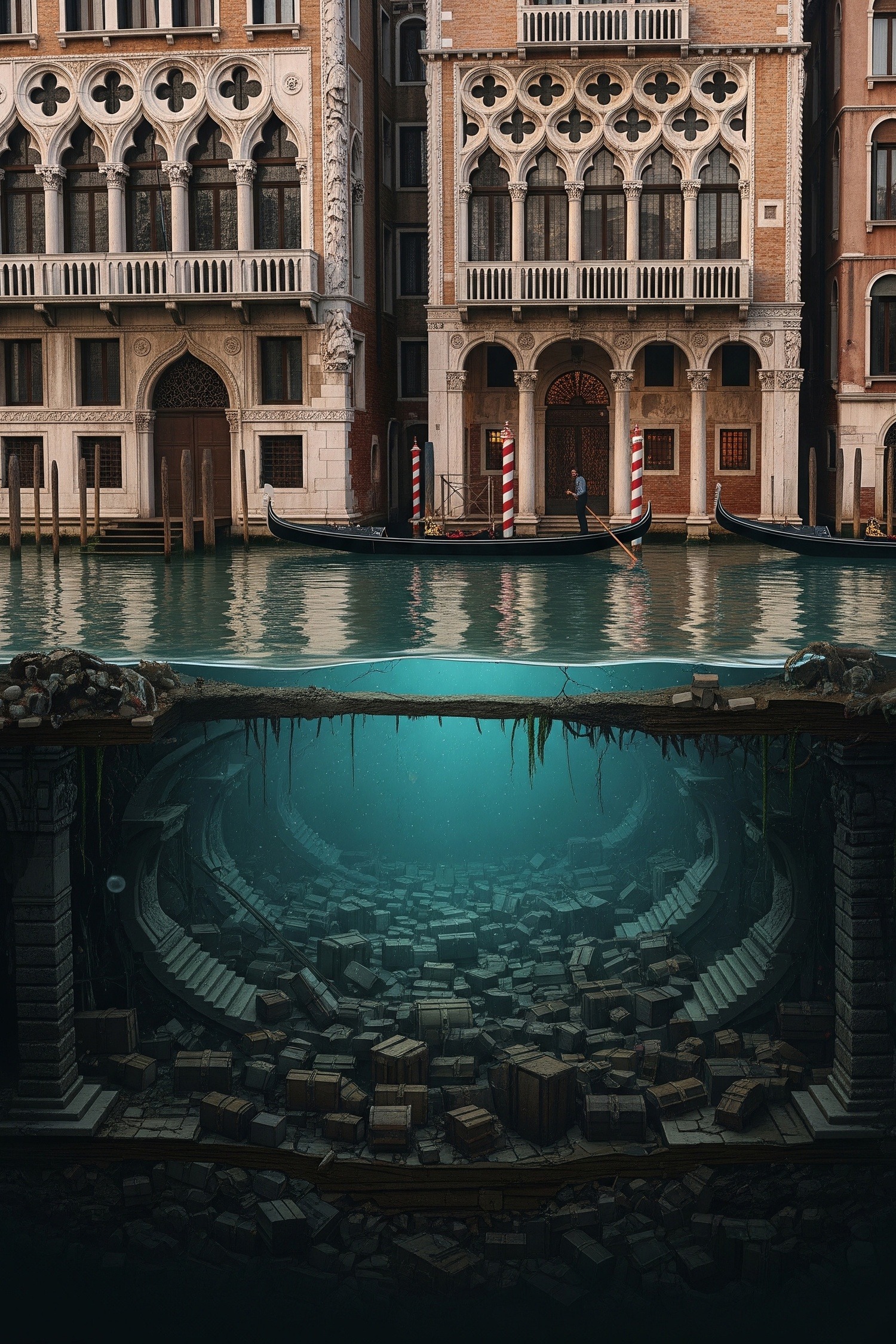
Venice’s foundation isn’t a blueprint. It’s a forest. Millions of trees, hammered into lagoon mud starting in the early Middle Ages, that somehow never rotted — they turned to stone instead.
So I fell down this rabbit hole at 2am, and here’s where it starts: beneath every photograph you’ve ever seen of Venice, beneath the marble and the candlelit water and the impossible architecture, there are trees. Actual trees. Millions of them. Standing upright in the dark. Holding an entire city.
Not metaphorically holding it. Actually holding it.
To understand why anyone would build this way, you have to picture the place before the palazzos. The Venetian Lagoon is a shallow, brackish basin at the head of the Adriatic Sea, roughly 550 square kilometers of water, mud, and salt marsh threaded with shifting channels. It is not solid ground. It is barely ground at all. According to the city’s founding traditions, the first refugees arrived here in the 5th century, fleeing waves of invaders pushing into northern Italy — Goths, and later the Lombards and the Huns who scoured the mainland. The marsh that nobody wanted became the one place an army of horsemen could not easily follow. Safety came first. The engineering came after.
Key Facts
- Venice’s historic center sits on millions of alder and oak trunks driven into lagoon mud since the early medieval period, at a density of nine wooden piles per square meter
- The Venetian Lagoon is a shallow brackish basin at the head of the Adriatic Sea, roughly 550 square kilometers of water, mud, and salt marsh
- City founding traditions hold that the first refugees arrived in the 5th century, fleeing invaders such as Goths, Lombards, and Huns
- The piles do not reach bedrock but stop in a dense compacted clay layer called caranto, topped by larch or oak platforms and waterproof Istrian limestone
- Construction of Santa Maria della Salute began in 1631 after plague killed roughly a third of Venice’s population, requiring between one hundred thousand and over a million trunks
In short: Venice’s historic center stands on millions of wooden trunks hammered into lagoon mud at nine piles per square meter. Sealed in oxygen-starved, salty clay, the wood never rotted; instead minerals infiltrated it over centuries, hardening it toward stone through permineralization, the same process that creates petrified wood.
Nine Piles Per Square Meter
That’s the density. Nine wooden stakes driven into lagoon mud, in every single square meter beneath Venice’s historic center. Engineers have documented it. The number’s so precise it sounds made up until you do the math and realize what that means when you scale it across the entire city — we’re talking millions of alder and oak trunks, hand-hammered into soft clay since the early medieval period, packed so tightly they interlocked into something structurally unified. Something that shouldn’t have worked. Geologists describe the Venice wooden foundation system in detail on Wikipedia, but what actually matters is this: the trunks were packed so densely they became one object.
Here is the part that is easy to miss. The piles themselves are not what holds Venice up. They are not long enough to reach bedrock — that would be impossible in a lagoon where firm rock sits dozens of meters down. Instead, the trunks pass through the soft surface ooze and stop in a deeper, denser layer of compacted clay the Venetians call caranto. The wood acts like a bundle of fingers gripping that stiff clay, spreading the building’s weight across a wide footing. On top of the piles, builders laid horizontal timber platforms — usually larch or oak planks — and on those platforms they stacked waterproof Istrian limestone, a dense white marble-like stone that does not soak up water. Only then did the brick and marble of the visible city begin to rise. Trees, then planks, then stone, then everything you photograph.
The obvious question: what happens to wood after it’s been underwater for a thousand years?
Most people know the answer. Wood rots. Water plus time plus organic material equals decay. Basic biology. But the lagoon beneath Venice doesn’t follow basic rules.
Why Submerged Wood Refuses to Rot
The villain in the rotting of wood is oxygen, or more precisely the fungi and aerobic bacteria that need oxygen to digest cellulose and lignin. A fence post rots at the soil line, where air and moisture meet, because that is where the wreckers can breathe. Bury the same post completely below the water table and the air disappears. The microbes that turn wood to mush simply cannot operate.
That’s exactly the trick beneath Venice. The piles sit permanently below the lagoon’s waterline, sealed inside dense, oxygen-starved clay. There is almost no dissolved oxygen down there, the salt suppresses biological activity, and the fine clay chokes off any fresh supply. The wood is not preserved despite the mud — it is preserved because of it. This is the same principle that protects ancient shipwrecks in the cold, low-oxygen depths of the Baltic Sea, and the same reason “bog bodies” pulled from European peat marshes can still show fingerprints and stubble after two thousand years. Take oxygen out of the equation and decay nearly stops.
The Wood Became Stone
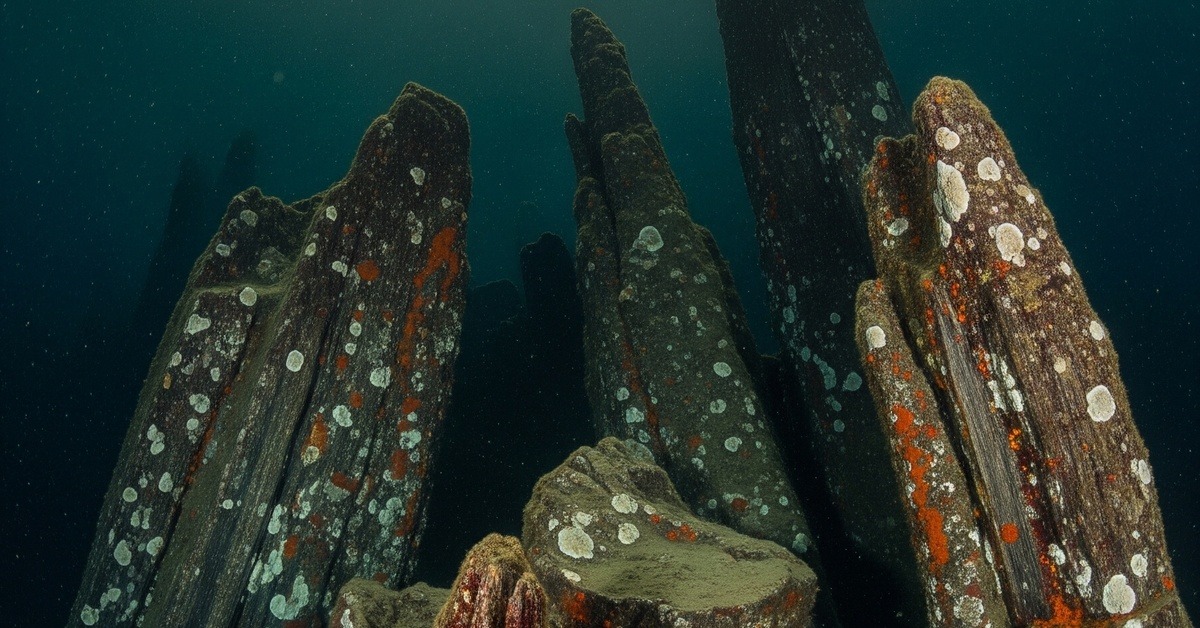
The oxygen-poor saltwater, the dense clay, the near-zero biological activity — it all combined into something like a preservation chamber. And over centuries, something wild happened: the wooden piles mineralized. Dissolved minerals in the groundwater — silica and carbonates carried through the clay — slowly infiltrated the cellular structure of the wood. Molecule by molecule, organic material was replaced or impregnated by stone-like compounds. The wood didn’t weaken. It hardened.
That last fact kept me reading for another hour.
This is the same broad process — permineralization — that turns fallen trees into petrified wood over geological time. In a forest, it takes hundreds of thousands of years. In the Venetian Lagoon, the conditions were so aggressive that the wood began behaving like stone within centuries. Engineers who’ve extracted samples say the material is closer to stone than wood now. Petrified. After a thousand years underwater, the foundation of Venice became, in practical terms, harder than it started.
The weird part? Medieval builders couldn’t have known the chemistry would unfold this way. They hammered trees into mud because they had to build somewhere, and the lagoon was what they had. The earth finished the job for them.
The Basilica della Salute
It is 1631. Plague has just killed something like a third of Venice’s population, and the Republic vows to build a great church to the Virgin in thanks for deliverance. Construction of Santa Maria della Salute begins on the narrow tongue of land at the entrance to the Grand Canal — and before a single block of Istrian stone is laid, the ground has to be made to carry it. Somewhere between one hundred thousand and well over a million wooden trunks are driven into the mud. Nobody fully counted at the time.
Builders in the 1600s didn’t keep inventory like modern engineers do. They drove timber until the mud pushed back. Until they felt the resistance and knew: this will hold. And it did. The basilica, finally consecrated in 1687 after half a century of work, still rests on that submerged forest today, its enormous dome perched on ground that has no right to support it.
St. Mark’s Campanile — the bell tower in every Venice photograph — tells the same story from a darker angle. It stands on thousands of individual piles in ground that has no business holding anything upright. On the morning of 14 July 1902, after years of cracks creeping up the brickwork, the entire 99-meter tower folded in on itself and collapsed into the Piazza San Marco. Remarkably, almost nothing else was hurt — the rubble fell neatly, and the only casualty was the caretaker’s cat. When engineers cleared the debris and examined the base, they found the medieval pile foundation essentially intact. The tower above had failed; the roots beneath had not. Venice rebuilt the campanile on the very same foundation, dov’era e com’era — “where it was and how it was” — and it reopened in 1912.
What Medieval Builders Understood
Here’s what makes this interesting: they weren’t guessing entirely. Generations of observation taught Venetian builders that submerged wood in the lagoon behaved differently than wood anywhere else. Alder, specifically — they chose it deliberately. They knew it resisted water damage; alder is famously durable when kept wet, which is why it was prized for waterwheels, mill races, and pilings all across medieval Europe. They also understood compression. As the city’s weight pressed down, the clay tightened around each pile. The whole lattice became more stable over time, not less. The city was designed to become stronger as it aged.
That’s not luck. That’s intuition operating at scale.
The work itself was brutal and human. Crews of laborers called battipali raised heavy weights on ropes and dropped them onto the pile heads, again and again, often singing rhythmic work chants to keep the swings in time — the maritime ancestor of a sea shanty, set to the beat of a hammer. Each trunk was sharpened at one end, set upright in the muck, and pounded down until it refused to sink further. Then the next, and the next, until a marsh became a building site. To raise even a modest house, a Venetian family might sink hundreds of trees. To raise a basilica, a forest.
Modern geotechnical engineers now apply this principle with computer models and soil mechanics formulas. Controlled compression of saturated clay creates long-term load-bearing capacity, and “friction piles” that grip dense soil rather than reaching bedrock are a standard tool in coastal construction worldwide. Venice’s founders figured it out by feel, by tradition, by watching the lagoon across generations.
By the Numbers
- The Basilica della Salute was anchored on an estimated 1,156,650 wooden piles — a count so precise it suggests someone, somewhere, was keeping careful track.
- Venice’s lagoon holds somewhere around 10 million timber piles across the historic city. In places, there is more wood than mud beneath your feet.
- Some recovered piles date back well over a thousand years. Certain timbers have been submerged since the early medieval period and remain structurally sound.
- Much of the alder and larch came from the forests of Slovenia, Croatia, and the Alpine foothills — trees floated down rivers like the Piave for tens of miles before being hammered into a Venetian lagoon forever.
- The piles aren’t long: many are only a few meters, just enough to punch through the soft surface ooze and bite into the stiff caranto clay below.
Field Notes
- When restoration crews extract original piles, the mineralized wood can be so hard and dense that tools struggle against it — closer to working stone than working timber. Living trees never feel like that.
- The compression system has a weakness: if water levels drop during droughts, the tops of the piles can be exposed to air again, and decay can begin where the wood meets the oxygen. Venice’s water-management struggles are tied to this in ways most visitors never realize.
- Amsterdam was built on the same idea — the Dutch capital rests on millions of wooden piles driven through soft peat and clay into firm sand below. The Royal Palace on Dam Square famously stands on 13,659 of them. Whether Northern Europe borrowed the technique or rediscovered it independently, the physics is identical.
The Slow-Motion Threat: Subsidence and Rising Seas
The forest beneath Venice has held for fourteen centuries, but the relationship between the city and its water is changing faster than at any time in its history — and the foundation is caught in the middle. Two pressures are squeezing it. The first is subsidence: the city is very slowly sinking. Through the mid-20th century, factories on the nearby mainland at Marghera pumped vast amounts of groundwater from beneath the lagoon, and the land settled as the aquifer drained. That pumping was largely banned in the 1970s, which slowed the sinking dramatically, but natural compaction of the soft sediments continues at a gentle creep.
The second pressure is the sea rising to meet it. Combine the two and you get acqua alta — the high tides that periodically flood Piazza San Marco. On 12 November 2019, an exceptional surge pushed the water to 1.87 meters above normal, the second-highest level ever recorded, swamping the basilica and much of the city. In response, Italy completed MOSE, a system of 78 mobile barriers at the lagoon’s three inlets that rise from the seabed to seal Venice off from the Adriatic during dangerous surges. The barriers have already shut the gates against major floods — a 21st-century answer to a problem the original pile-drivers could never have foreseen. The medieval forest still does its job. The challenge now is keeping the water around it within the range that forest was built to survive.
What This Actually Means
Venice’s foundation is a story about desperation becoming design. The lagoon was hostile. The builders looked at it and decided: we’ll use the water, we’ll use the mud, we’ll drive trees into the earth until the earth agrees to hold us. They created preservation conditions they couldn’t fully explain, and those conditions have now outlasted every explanation for why they shouldn’t work.
Every great city sits on something unexpected. London on Roman ruins and plague pits. New York on the schist ridges that determined where everything tall could rise — which is why the skyscrapers cluster downtown and in Midtown, where the bedrock is shallow, and thin out in between, where it dives deep.
Venice on a medieval forest that decided to become stone.
Frequently Asked Questions
Q: Why didn’t the wooden piles under Venice rot away? Because they sit permanently below the waterline, sealed in dense, oxygen-starved clay. The fungi and bacteria that decompose wood need oxygen to survive, and there is almost none down there. With the wreckers shut out, the wood not only survived — over centuries, minerals seeping through the clay gradually infiltrated it and turned it nearly to stone. Decay only becomes a real risk if the water table drops and the pile tops are exposed to air.
Q: How deep do the piles go, and what holds the city up if they don’t reach bedrock? The piles are surprisingly short — often just a few meters. They don’t reach bedrock, which lies far too deep. Instead they punch through the soft surface mud and grip a firm, compacted clay layer called caranto. On top of the piles sit horizontal timber platforms, then a course of waterproof Istrian stone, and only then the brick and marble buildings. The weight is spread across the whole interlocked lattice, and the clay actually tightens around the piles under load, so the foundation grows more stable with age.
Q: How many trees are buried under Venice, and where did they come from? Estimates run to roughly 10 million piles across the historic city, with single structures swallowing staggering numbers — the Basilica della Salute is said to rest on more than 1.1 million trunks alone. The timber was mostly alder, oak, and larch, much of it floated down rivers from the forests of Slovenia, Croatia, and the Alpine foothills before being hammered, one trunk at a time, into the lagoon floor.
The next time you see a photograph of Venice — golden light, gondolas, a skyline that looks accidental — you know what’s actually happening. A forest is holding its breath. Trees that were saplings when Rome still mattered are standing in the dark, mineralized and silent, doing exactly what they were asked to do fourteen centuries ago. More stories like this at this-amazing-world.com — and honestly, the next one is even stranger.
Illustrations are AI-generated. Article fact-checked and human-edited.