How Frostbite Writes an Opossum’s Age on Its Body
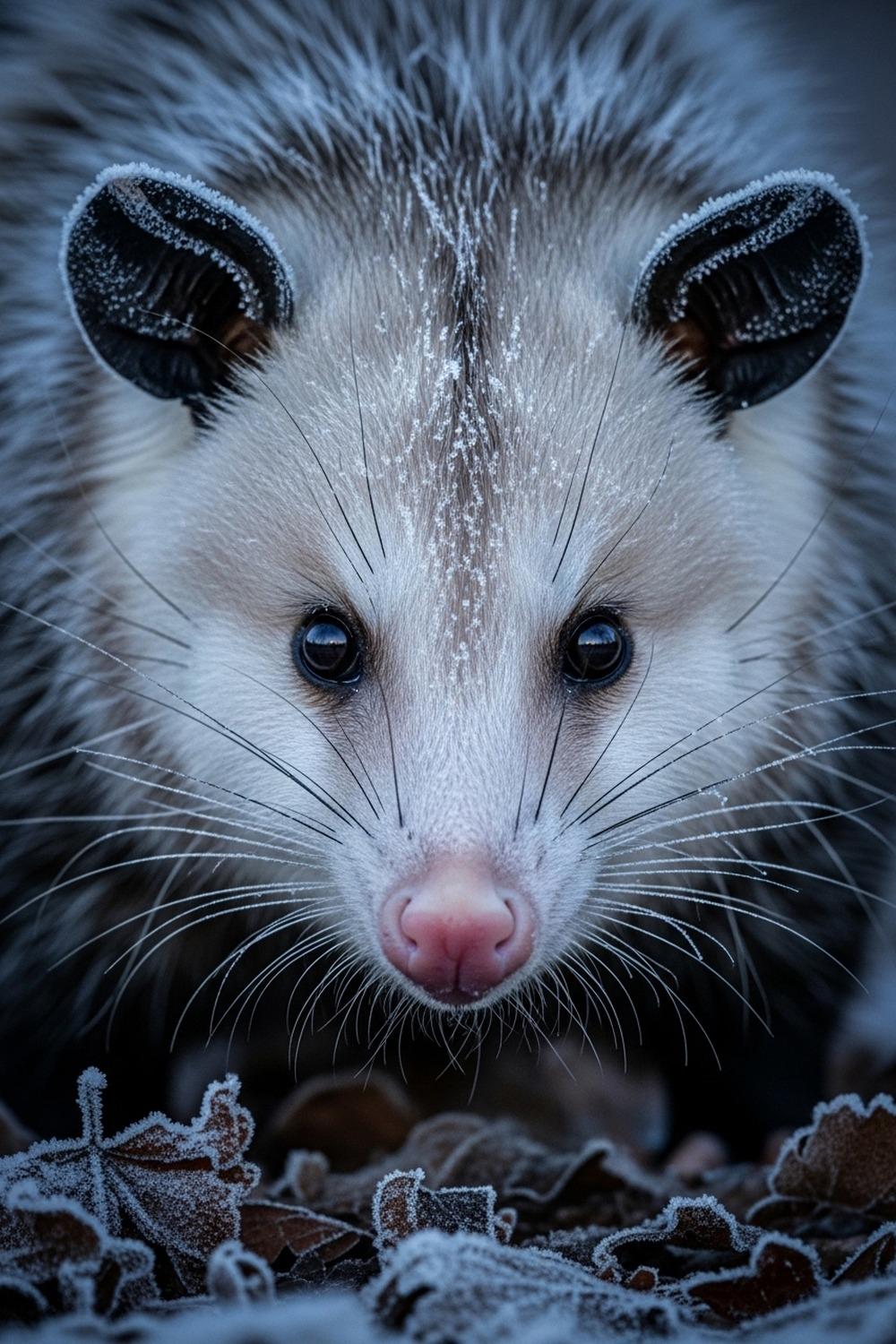
Every winter, a small gray animal shuffles through frozen leaves at 2 a.m., its ears already dying. This is opossum frostbite survival in winter — not a rare event, but a biological contract written in blackened cartilage, signed every single season north of the Ohio River. A marsupial’s body becomes a clock, and cold becomes the mechanism that measures time.
Virginia opossums, Didelphis virginiana, are evolutionary outsiders in the American north. They arrived from South America roughly three million years ago, long before ice ages reshaped the continent’s climate. Their ears, tails, and feet evolved for humid subtropical forests — not Ohio in January. Yet here they are, year after year, pushing deeper into Canada, paying a toll in tissue every time the temperature drops below freezing. What biologists have discovered is that toll leaves a record. A readable one.
Key Facts
- Virginia opossums crossed into North America roughly three million years ago via the Great American Interchange across the Central American land bridge.
- The opossum’s resting body temperature runs 94 to 97 degrees Fahrenheit (34 to 36 Celsius), lower than most placental mammals.
- Opossum sightings above the 42nd parallel increased 34% between 2010 and 2020, per a University of Illinois Urbana-Champaign analysis of iNaturalist data (2021).
- Breeding opossum populations are now confirmed as far north as Ontario, Canada, about 600 miles north of their historical core range.
- A 2019 Minnesota rehabilitation study found 78% of opossums admitted between December and February showed frostbite damage to at least one extremity.
In short: Opossum frostbite winter survival turns a marsupial’s body into a readable record: each freezing season blackens and removes cartilage from hairless ears and tails. Biologists use this accumulated damage as a non-lethal aging signal, and milder winters have helped opossums expand 600 miles north into Ontario despite the visible toll.
Why Opossums Were Never Built for Frost
Evolutionary history made opossums a study in geographical mismatch. According to research published by the Smithsonian’s National Museum of Natural History, Didelphis virginiana belongs to a lineage that diverged from South American marsupials around three million years ago, crossing into North America via the Central American land bridge as part of the Great American Interchange — the dramatic geological event that connected two previously isolated continents. The animals that made that crossing were adapted to forest floors, warm rains, and rotting fruit. Cold was never in their blueprint.
Their body temperature runs between 94°F and 97°F (34–36°C), distinctly lower than most placental mammals, which makes them less capable of generating metabolic heat when ambient temperatures plunge. Their ears and tails are almost entirely hairless, with only minimal subcutaneous fat insulating the underlying tissue. That’s a catastrophic combination when winter arrives.
Hairless extremities lose heat rapidly through radiation and convection. When blood vessels constrict in the cold — the body’s reflex to protect core temperature — peripheral tissue in the ears and tail goes without oxygen. Ice crystals form inside the cells themselves. The damage is irreversible. Tissue dies, darkens, and eventually sloughs away.
It doesn’t heal back to its original state. The opossum doesn’t regrow what winter takes.
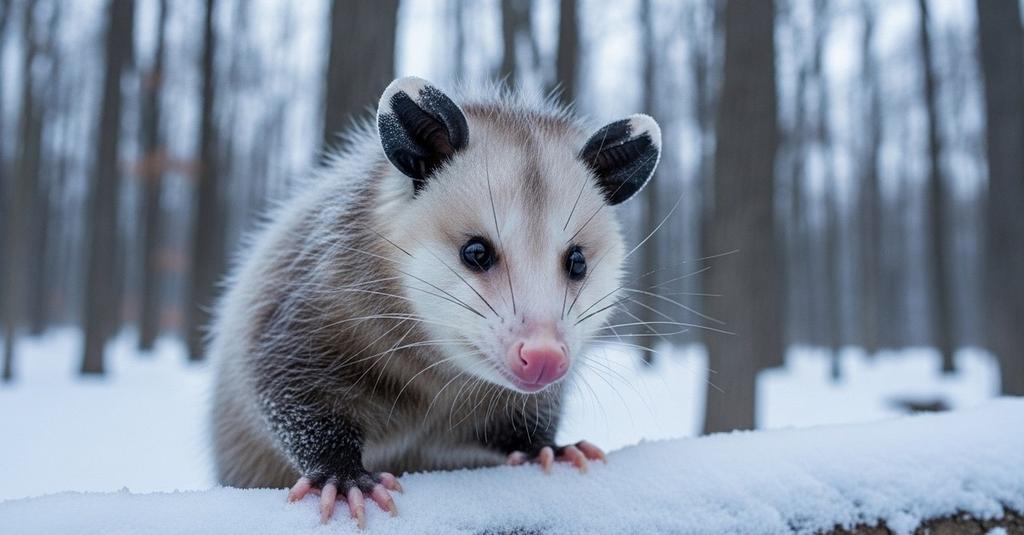
Watch one on a trail camera in January and it’s easy to see the evidence. Ear edges gone ragged. Tail tip shortened. An older animal moving through the dark with a body that’s been visibly rewritten by multiple winters. It looks injured. It isn’t — not in any way that slows it down. It’s just older than it looks, carrying the scar forward season after season, like a tally mark carved into cartilage.
Reading Frost Damage Like a Field Biologist
What makes opossum frostbite survival in winter genuinely useful to researchers: it creates a legible aging system in a species that’s notoriously difficult to age by conventional means. Most wildlife biologists rely on tooth wear or body mass to estimate age in small mammals, both of which are imprecise in opossums due to their varied diets and the plasticity of their body condition across seasons. Here’s the thing — the discovery that frostbite damage accumulates in a predictable pattern offers a non-lethal, visually accessible aging tool. Heavier damage appears in older animals. Absent in animals experiencing their first winter. It’s not so different from how ecologists read tree rings, or how desert-adapted animals use ear anatomy as a thermal map — body parts as environmental diaries, written by physics rather than biology.
Wildlife ecologist Dr. Roger Powell at North Carolina State University has noted in field studies that opossum ear condition correlates strongly with estimated age class. Juvenile animals caught in late autumn show clean, fully intact ear margins. Adults trapped the following spring increasingly show evidence of necrotic damage. The pattern isn’t perfectly linear — a severe winter in 2019 produced unusually heavy damage across age classes in the upper Midwest, blurring the signal temporarily. But across multiple seasons, the trend holds.
By the time an opossum has survived two winters in Pennsylvania or Indiana, its ears carry the record of both of them. Field workers at wildlife rehabilitation centers — including the Opossum Society of the United States, which tracks injury patterns at facilities across 30 states — confirm that animals admitted in late winter consistently show damage proportional to their estimated age. Young animals lose just the very tips. Old ones lose centimeters. The body keeps score.
The Strange Calculus of Not Hibernating
Almost every other mammal in the northern United States found a way around winter. Bears den. Groundhogs hibernate. Bats drop their metabolic rate to near zero. The Virginia opossum does none of this. Why? Because it stays active year-round, foraging every night regardless of temperature, driven by a metabolic rate that demands constant caloric intake.
A 2018 review published by the Smithsonian’s National Museum of Natural History noted that opossums have one of the lowest encephalization quotients among North American mammals, limiting complex behavioral adaptations. They can’t plan for scarcity. They don’t cache food. When winter arrives, they simply keep moving and eating whatever the frozen landscape offers — berries, carrion, invertebrates, garbage. Opossum frostbite survival in winter is a passive strategy, not a clever one. Just a biological willingness to absorb punishment.
Watching a species survive winter by accepting systematic tissue damage season after season, you stop describing it as mere adaptation. And here’s what counterintuition reveals: this strategy works, at least well enough to sustain range expansion. Opossums have pushed their northern range boundary steadily since the mid-20th century. In 1900, they were largely absent north of the Ohio River. By 2020, breeding populations were established in Ontario, Canada.
That’s not despite frostbite — it’s alongside it. Every winter thins the population at the margins. Every mild spring allows survivors to push slightly further north. The animals carrying the heaviest ear damage are the ones that survived. The ones that didn’t are gone. Natural selection, playing out in real time, measured in millimeters of missing cartilage. There’s something uncomfortable and honest about that arithmetic. Winter isn’t a threat to the opossum as a species. It’s a filter. The damage accumulates on individuals. The species expands anyway. These are two different stories happening in the same cold forest, simultaneously.
What Opossum Frostbite Survival Reveals About Range Expansion
Conservation biologists tracking climate-driven range shifts have attracted serious attention to the link between opossum frostbite, survival, and winter range dynamics. A 2021 study from the University of Illinois Urbana-Champaign, using citizen science data aggregated through iNaturalist between 2010 and 2020, found that opossum sighting frequency above the 42nd parallel — roughly the latitude of Chicago and Boston — increased by 34% over that decade. Years with above-average January temperatures corresponded to upticks in confirmed northern sightings the following spring, according to researchers who cross-referenced temperature anomaly records. Milder winters mean more survivors. More survivors mean more breeding adults the following season.
The frostbite damage, visible in field photographs submitted to iNaturalist, provided an ancillary aging signal the team hadn’t originally anticipated using. What the data revealed was a feedback loop. Opossums with moderate frostbite damage — enough to suggest at least one winter survived, but not so severe as to compromise foraging ability — showed up disproportionately in the northernmost sighting clusters. The badly damaged animals were more likely to appear in core range areas farther south, possibly because the most severe winter conditions filter out the animals reaching peripheral zones. The ones making it furthest north weren’t the youngest, most pristine animals. They were experienced survivors, carrying the visible record of previous winters on their bodies (and this matters more than it sounds — age becomes a northern advantage). Age, in this species, is a passport northward.
Rehabilitation specialists at the wildlife clinic at the University of Wisconsin-Madison began documenting frostbite severity scores in admitted opossums in 2017. They created what may be the only longitudinal dataset tracking tissue damage patterns by season and geography in a single population. That dataset is still being analyzed, with results expected in a forthcoming paper that will likely add granularity to what field biologists have observed anecdotally for decades.
Where to See This
- Great Smoky Mountains National Park (USA, Tennessee/North Carolina border) — opossums are abundant year-round, and winter trail camera stations frequently capture animals showing ear and tail damage from previous seasons. Best observed October through March.
- The Opossum Society of the United States (opossumsociety.org) coordinates with rehabilitation centers in 30+ states and documents injury patterns, including frostbite presentations, from admitted animals each winter.
- iNaturalist’s Virginia Opossum observation portal contains thousands of field photographs, many submitted during winter months, in which ear condition and tail damage are clearly visible — a free, searchable archive of range-wide frostbite documentation.
By the Numbers
- 34% increase in Virginia opossum sightings above the 42nd parallel between 2010 and 2020, per University of Illinois Urbana-Champaign analysis of iNaturalist data (2021).
- 3 million years: approximate time since opossums crossed into North America via the Great American Interchange, entering a continent with no prior marsupial presence in the north.
- 94–97°F (34–36°C): the opossum’s resting body temperature — lower than most placental mammals and a core driver of their vulnerability to cold-induced tissue damage.
- Frostbite onset in opossums begins at approximately 28°F (-2°C) sustained air temperature — a threshold regularly exceeded across most of their current northern range for weeks at a time.
- Breeding opossum populations are now confirmed as far north as Ontario, Canada — a range expansion of roughly 600 miles (966 km) north of their historical core territory over the past century.
Field Notes
- In a 2019 rehabilitation intake study in Minnesota, wildlife workers found that 78% of opossums admitted between December and February showed frostbite damage to at least one extremity — ear, tail, or foot — with older estimated-age animals showing damage to multiple sites simultaneously. Younger animals rarely showed multi-site damage in their first winter admission.
- Opossums don’t vocalize distress when frostbitten. Unlike humans, they show no behavioral change from the injury until necrosis is advanced — field workers frequently handle animals with severely damaged ears that show no signs of pain response, possibly because nerve damage accompanies the tissue death.
- The opossum’s immune system is unusually robust — they show near-complete resistance to rabies and rattlesnake venom — yet that immunological strength does nothing to prevent frostbite, which is a purely physical process, not a pathogen-based one.
- Researchers still can’t reliably determine whether individual opossums modify their behavior after experiencing frostbite in a first winter — whether repeated damage accumulates because behavior doesn’t change, or because the animals genuinely have no physiological capacity to detect cold-induced tissue damage as a feedback signal.
Frequently Asked Questions
Q: Does opossum frostbite survival in winter actually affect their lifespan or fitness?
Moderate frostbite damage doesn’t appear to significantly reduce an opossum’s foraging ability or reproductive output. Most animals lose only the very tips of ears and tail segments, which doesn’t impair function. However, severe cases involving foot damage — which occurs in particularly harsh winters — can compromise mobility and reduce survival odds. Opossums in the wild rarely live beyond two to three years, so even one winter of heavy damage represents a meaningful fraction of their total lifespan.
Q: Why don’t opossums just avoid going out in freezing temperatures?
They can’t. Opossums don’t hibernate and don’t cache food, so their metabolic needs force nightly foraging regardless of temperature. Their brain structure — opossums have a notably low encephalization quotient — limits the kind of anticipatory behavioral flexibility that would allow them to adjust activity patterns based on cold forecasts. They respond to immediate stimuli, not predicted conditions. When it’s cold and they’re hungry, they go out. The frostbite is a consequence of a nervous system that was never wired for winter planning.
Q: Is the idea that frostbite can “age” an opossum a proven scientific method?
It’s a widely used field heuristic, not a peer-reviewed aging protocol — an important distinction. Biologists use ear condition as one signal among several, alongside body mass, reproductive status, and tooth wear. The method works directionally: clean ears suggest a young animal, layered damage suggests an older one. But individual variation, injury, and regional climate differences all introduce noise. No laboratory has yet validated it as a standalone aging tool. It’s best understood as a useful shorthand, not a precise instrument.
Editor’s Take — Alex Morgan
What stays with me about this story isn’t the biology — it’s the inversion. We spend a lot of time talking about animals that are exquisitely adapted to their environments. The opossum is the opposite: a species succeeding in an environment it was never designed for, paying a visible physical price every year, and expanding its range anyway. Those blackened ear tips aren’t signs of failure. They’re proof of something stranger — that persistence can outperform optimization, at least over a century or two. That’s not a comfortable lesson, but it’s a real one.
A Virginia opossum doesn’t know it’s a biological record-keeper. It doesn’t experience its damaged ear as data. It’s just cold, and hungry, and moving through the dark toward whatever the night offers. But that ear carries three million years of evolutionary history colliding with a climate it was never meant to meet — and the collision is legible, millimeter by millimeter, to anyone who knows how to look. The question worth sitting with is this: as winters shorten and northern ranges keep expanding, what happens to the record when the pen runs out of ink?
Illustrations are AI-generated. Article fact-checked and human-edited. Our editorial standards.