The World’s Rarest Wolf Is Also a Secret Pollinator
There are fewer than 500 Ethiopian wolves left on Earth, and nobody was supposed to find them doing this. A predator. A flower. Pollen on its snout. The whole thing started by accident — a field scientist watching the wrong thing at exactly the right moment.
In the misty Afroalpine highlands of Ethiopia’s Bale Mountains, something was happening that contradicted every textbook definition of what this animal was supposed to be. The Ethiopian wolf, Canis simensis, is a specialist. A hunter. A predator so narrowly focused on Afroalpine rodents that it barely eats anything else. And yet researchers kept filming it stopping — deliberately, methodically — at tall flame-colored flowers. Pressing its long narrow snout into the blooms. Lapping nectar. Walking away with its muzzle dusted orange with pollen.
Key Facts
- Fewer than 500 Ethiopian wolves remain in the wild, making it the rarest canid on Earth
- Individual wolves were filmed visiting up to 30 Kniphofia foliosa flower spikes in a single morning (IUCN Red List, 2024)
- Ethiopian wolves spend roughly 70% of their active time hunting Afroalpine rodents
- The Bale Mountains Afroalpine ecosystem sits above 3,200 meters elevation
- Bale Mountains National Park holds roughly 50% of the entire global Ethiopian wolf population
In short: The Ethiopian wolf pollinator discovery shows the rarest canid on Earth, with fewer than 500 left, lapping nectar from Kniphofia foliosa flowers and visiting up to 30 spikes a morning. Documented in Ethiopia’s Bale Mountains, it is among the first records of a large carnivore acting as a pollinator in the wild.
How This Started (By Accident)
Wildlife biologist Claudio Sillero-Zubiri and colleagues working in Bale Mountains National Park were already watching these wolves obsessively — disease tracking, territory mapping, population counts. The usual desperate work of trying to keep a species from blinking out entirely. But then the footage came back and nobody quite knew what to do with it.
There it was. A wolf at a Kniphofia foliosa plant — the Ethiopian red hot poker. Then another wolf. Then the same wolf, forty minutes later, at a different spike. Then thirty flower visits in a single morning outing.
You can read the full species profile on Wikipedia’s Ethiopian wolf page, but here’s the thing nobody mentions yet: this pollinator chapter is brand new.
The nectar in those flowers is thick. Sugary. The kind of thing that normally draws sunbirds and bees — insects and birds with the right anatomy, the right instincts, the right evolutionary history. Wolves were not on that guest list.
What the Footage Actually Shows
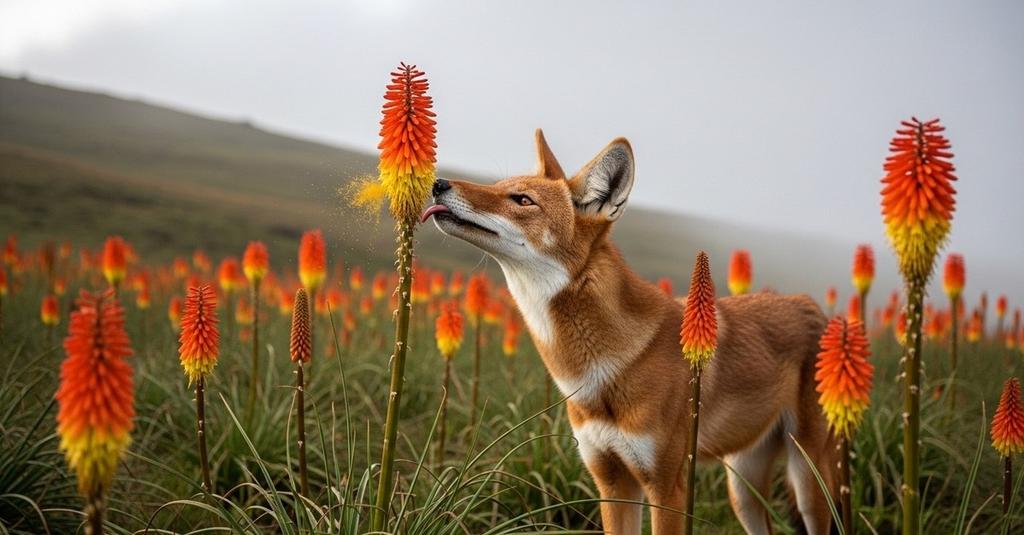
It’s specific. Undeniable. Individual Ethiopian wolves visiting up to 30 flower spikes in a single morning, lapping nectar from the base of each bloom. That long, narrow snout — shaped over millions of years for probing rodent burrows — turned out to be perfect for reaching deep into a Kniphofia floret. Each visit deposited pollen. Each subsequent visit transferred that pollen forward. That’s cross-pollination.
That’s a pollinator.
The wolves weren’t being careless. They were methodical. Moving spike to spike with a kind of quiet focus that looked, honestly, like work. Which raises an obvious question: how long has this been happening? Weeks? Years? Generations?
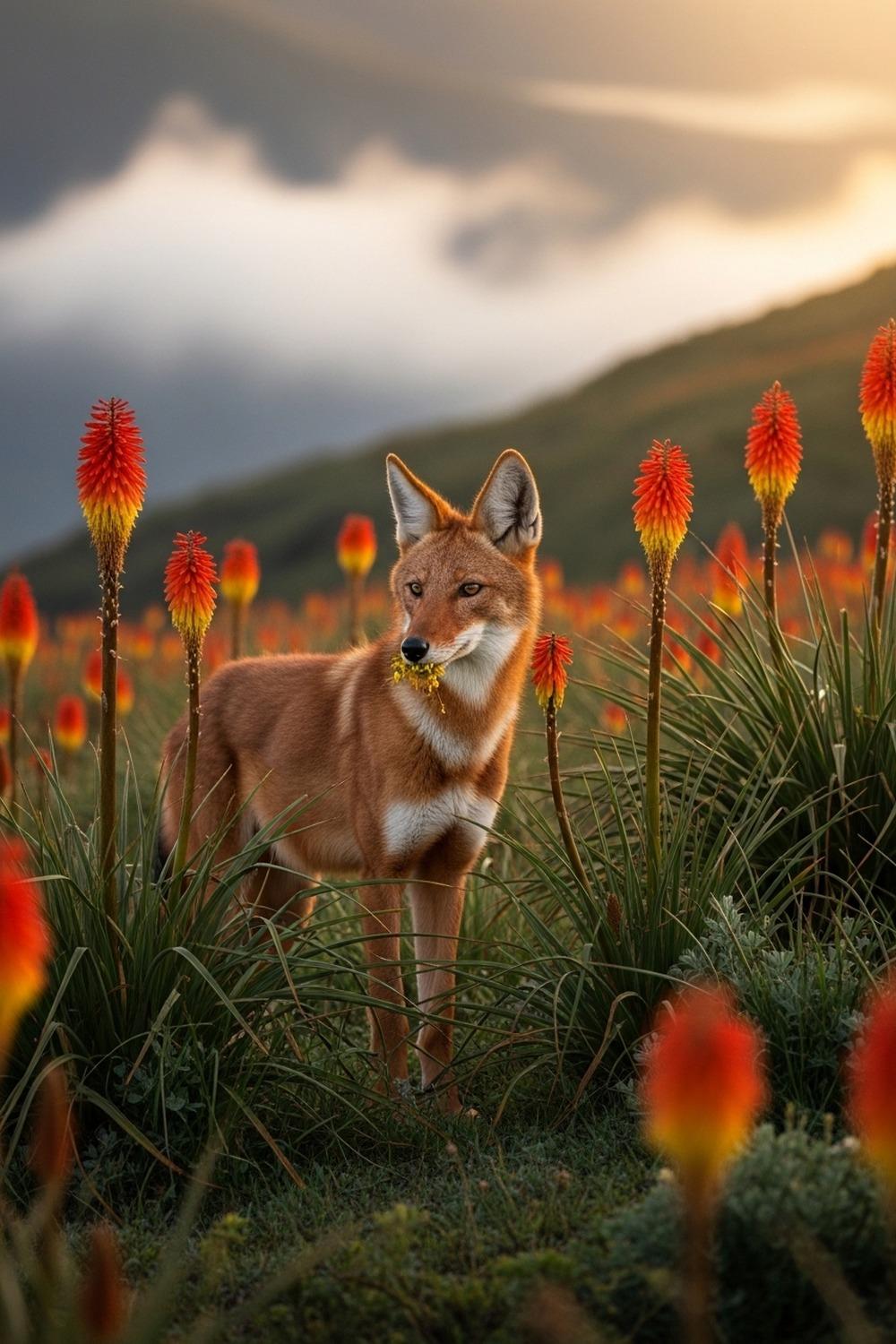
And here’s where it gets weird — the wolves weren’t being watched for nectar feeding. They were being watched because they’re dying out. If the observation hadn’t been that intense, this behavior might never have been recorded. This-amazing-world.com covers surprising animal behaviors regularly, but this one raises a different kind of question entirely. How many other interactions like this are happening right now, in species we’re barely watching closely enough to notice?
A Predator Doing Work Nobody Assigned It
Here’s what makes this genuinely strange. Ethiopian wolves are specialists. Not generalists. They spend roughly 70% of their active hours hunting rodents. They don’t scavenge much. They don’t eat fruit. The idea that an animal so narrowly adapted to one ecological role would also fill a completely separate niche — one normally occupied by sunbirds and insects — breaks something fundamental about how we categorize animals and their places in an ecosystem.
The Afroalpine zone sits above 3,200 meters. It’s fragmented. Isolated. Species there are extraordinarily adapted to each other. Every interaction is tighter, more specific. When a wolf starts visiting 30 flowers in a morning, that’s not random noise.
That’s a signal.
What signals are we still missing?
The Rarest Canid on Earth
With fewer than 500 Ethiopian wolves remaining in the wild — scattered across just a handful of isolated mountain ranges in Ethiopia — every individual is an irreplaceable data point. Every behavior. Every interaction. Every unexpected ecological role.
The Ethiopian wolf pollinator behavior was documented only because researchers were watching so intensely for other reasons. If they hadn’t been, if funding had dried up, if attention had shifted elsewhere — this would still be happening. Undocumented. Unknown. Just wolves visiting flowers in the highlands while we assumed we already knew what they were.
And here’s the thing that keeps ecologists awake: if this wolf disappears, the flowers it pollinates lose a vector. The wolves lose a caloric supplement during lean hunting periods. One thread pulled. The whole fabric shifts.
Mammal Pollination Is More Common Than You’d Think
Mammal pollination — called theriophily — is far more widespread than most people realize. It’s just usually associated with bats, small rodents, primates. Animals with a pollinator-shaped job description. A large carnivore functioning as a pollinator is genuinely rare in documented literature.
The Ethiopian wolf case is among the first recorded examples of a canid performing this role in the wild.
It reframes what we think about large predators in high-altitude ecosystems. We’ve always studied them through trophic cascades — how their predation regulates prey, which shapes vegetation. Top-down pressure on the food web. But if a predator is also directly interacting with plant reproduction, that’s a different kind of influence entirely. Lateral connection. A wolf woven into the life cycle of a flower. That last fact kept me reading for another hour, chasing down papers on ecosystem function and ecological roles I’d forgotten existed.
By the Numbers
- Fewer than 500 Ethiopian wolves remain in the wild.
- Individual wolves were filmed visiting up to 30 Kniphofia foliosa flower spikes in a single morning — behavior consistent with deliberate nectar foraging rather than incidental contact (IUCN Red List, 2024).
- The Afroalpine ecosystem of the Bale Mountains sits above 3,200 meters elevation, one of Africa’s highest and most isolated wildlife habitats.
- Ethiopian wolves spend approximately 70% of their active time hunting Afroalpine rodents, yet nectar feeding appears to be regular supplemental behavior, not a rare anomaly.
- They’re the rarest canid on Earth and one of Africa’s most endangered carnivores.
Field Notes
- The Ethiopian wolf’s narrow, elongated snout — evolved for probing rodent burrows — happens to be nearly ideal for accessing nectar deep inside Kniphofia foliosa florets. Accidental anatomical fit that became functional relationship.
- Bale Mountains National Park is home to roughly 50% of the entire global Ethiopian wolf population, meaning a single disease outbreak or climate event could devastate the species’ survival chances almost overnight.
- Ethiopian wolves are diurnal hunters operating during daylight hours, which means their flower visits overlap perfectly with peak nectar production windows of Kniphofia foliosa — a timing coincidence that may have deepened this ecological relationship over generations.
Why This Matters Beyond the Novelty
This discovery is a concrete, documented example of something ecologists have suspected but struggled to prove: endangered species often hold ecological roles we haven’t identified yet. Every extinction isn’t just a number subtracted from a population count. It’s a function removed from a system.
Sometimes that function is obvious. A predator. A prey species. A seed disperser. But sometimes it’s a wolf visiting flowers on a cold highland morning, doing something we didn’t think to look for until almost too late.
The Afroalpine habitat these wolves depend on is contracting under climate pressure. Warmer temperatures push vegetation zones upward, squeezing the cold-adapted ecosystem into smaller patches of mountain summit. The wolves lose ground. The flowers may lose their unlikely pollinator.
And we lose something we’re only just beginning to understand.
There are probably hundreds of ecological relationships like this one still undocumented. Interactions hiding in plain sight because we assumed we already knew what an animal was for. We didn’t know a wolf could be a pollinator. We didn’t know to look. That’s the most unsettling part of this story. Not the discovery itself. Everything the discovery implies about what else we’re missing.
Nature doesn’t hand out single job descriptions. A wolf can be a predator, a pollinator, and a mystery all at once. The Ethiopian wolf has been doing this work quietly in the highlands for who knows how long. We almost missed it entirely. If this keeps you reading at 2am chasing down papers on ecosystem function, there’s more at this-amazing-world.com — and the next one is even stranger.
Frequently Asked Questions
Q: How is the Ethiopian wolf a pollinator?
Researchers in Ethiopia’s Bale Mountains filmed individual Ethiopian wolves visiting up to 30 Kniphofia foliosa flower spikes, the Ethiopian red hot poker, in a single morning, lapping sugary nectar from each bloom. Their long, narrow snouts, evolved for probing rodent burrows, fit deep into the florets and pick up pollen. As the wolves move between flowers, they transfer that pollen forward, performing cross-pollination, a role normally filled by sunbirds and insects.
Q: How rare is the Ethiopian wolf?
The Ethiopian wolf, Canis simensis, is the rarest canid on Earth, with fewer than 500 individuals remaining in the wild, scattered across a handful of isolated mountain ranges in Ethiopia. Bale Mountains National Park alone holds roughly 50% of the entire global population, which means a single disease outbreak or climate event could devastate the species almost overnight. Every individual is considered an irreplaceable data point for researchers.
Q: Why is a predator acting as a pollinator so significant?
Ethiopian wolves are specialists that spend about 70% of their active hours hunting Afroalpine rodents and rarely scavenge or eat fruit. A large carnivore directly interacting with plant reproduction is genuinely rare in scientific literature, and this is among the first recorded examples of a canid pollinating in the wild. It reframes how ecologists understand large predators, suggesting they can hold lateral ecological roles beyond the top-down predation of trophic cascades.
Q: How was the pollinator behavior discovered?
The behavior was documented by chance. Wildlife biologist Claudio Sillero-Zubiri and colleagues were already watching the wolves intensely in Bale Mountains National Park for disease tracking, territory mapping, and population counts, because the species is endangered. The nectar-feeding footage emerged from that close observation. Had funding dried up or attention shifted, the behavior might have remained undocumented, raising the question of how many similar ecological interactions go unnoticed in less-studied species.
Illustrations are AI-generated. Article fact-checked and human-edited. Our editorial standards.