Why Penguins Wait at the Ice Edge Before Diving In
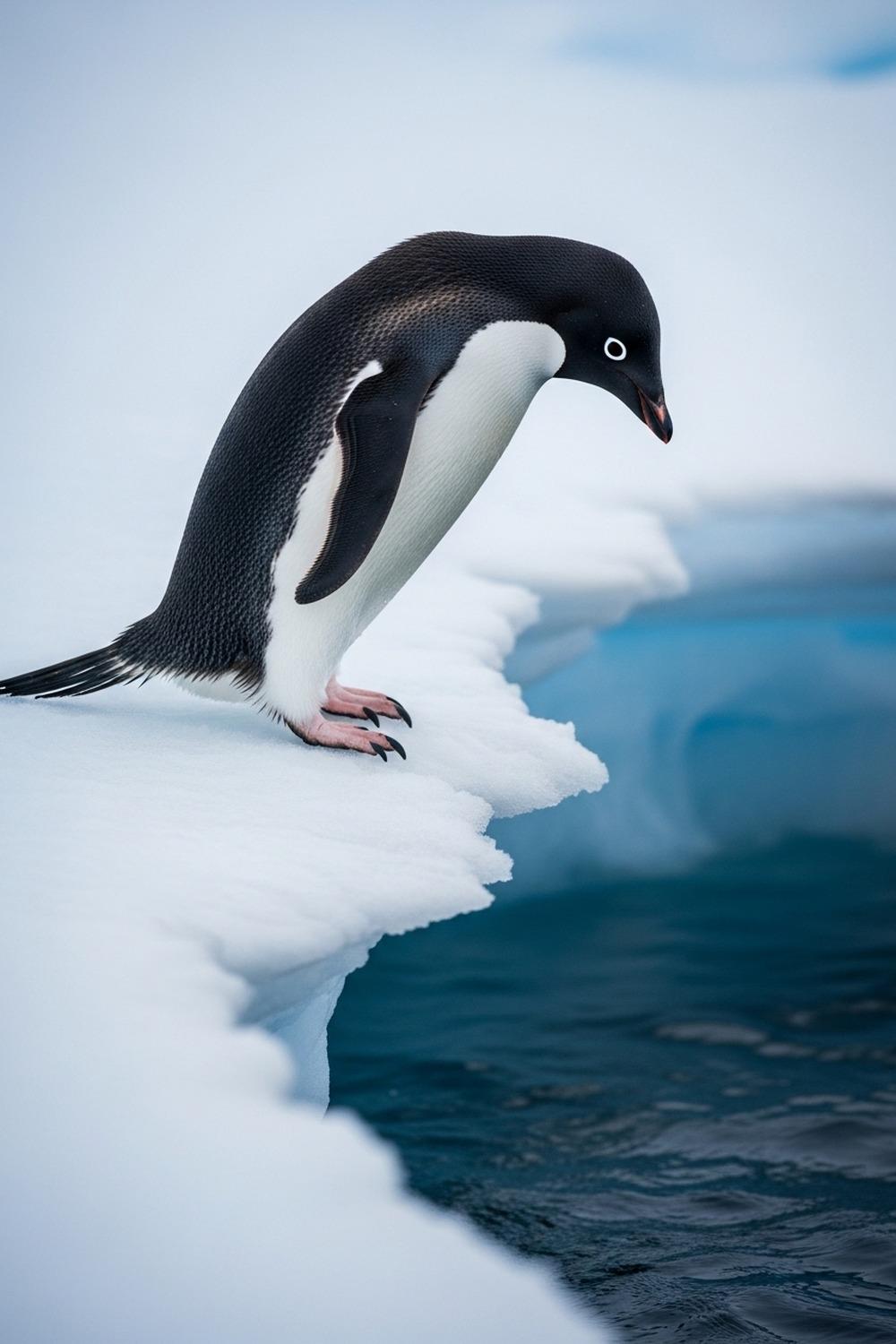
Something waits beneath the ice. A leopard seal, motorcycle-sized, patient as stone — and above it, on the frozen surface, an Adélie penguin calculates whether the next ten seconds will end in survival or become the last thing it ever does. This is Adélie penguin leopard seal behavior in its rawest form: not instinct, not panic, but mathematics dressed up in feathers and rendered visible at the ice edge of the Ross Sea.
Every morning, the same scene repeats itself in Antarctica’s largest penguin colonies. Hundreds of thousands of birds gather at a single chokepoint where the ice meets open water. A shuffle becomes a crowd. A crowd becomes pressure. And in the midst of that pressure, a decision calculates itself without conscious thought — because evolution has already done the thinking, across millions of years.
For decades, researchers watched this hesitation at the ice edge and called it fear. They were wrong about what it meant.
Key Facts
- A 2003 University of Washington study identified the danger window as the first 10 seconds after an Adelie penguin enters the water.
- Leopard seals reach nearly 25 mph (40 km/h) in short bursts, roughly five times faster than Olympic swimmers.
- Ice-edge hesitation periods in Ross Sea colonies ranged from 2 to 8 minutes before first water entry (U.S. Antarctic Program).
- Western Antarctic Peninsula Adelie populations declined more than 65% since the 1970s, while Ross Sea numbers stayed relatively stable (Scripps Institution, 2022).
- Approximately 10 million Adelie penguins inhabit Antarctic regions, making them the continent’s most abundant penguin species (IUCN, 2023).
In short: Adelie penguin leopard seal behavior is the group risk-assessment ritual at the Antarctic ice edge, where penguins hesitate for 2 to 8 minutes until an accidental first-jumper reveals whether a predator waits below. Within seconds of that bird surviving, the whole colony cascades into the water, distributing predation risk statistically.
The Predator That Teaches Its Prey
Start with the leopard seal. The leopard seal (Hydrurga leptonyx) stretches nearly 12 feet from snout to tail. It can weigh up to 840 pounds. In the water, it accelerates to 25 miles per hour in bursts that last only seconds — but those seconds are exactly when a penguin is most vulnerable, when it’s still adjusting to the shift from air to water, when its body hasn’t yet found its advantage.
What makes a leopard seal genuinely dangerous isn’t speed alone. It’s patience. These are ambush specialists, not chasers. They stake out the exact entry points where penguins enter the water and wait, hovering just below the ice shelf, sometimes in the same location day after day. Dr. Wayne Trivelpiece documented in the early 2000s how individual leopard seals would return to the same ice-edge positions with the consistency of a commuter catching a train.
The penguins know this. Evolution has wired them to behave as if they know it, which amounts to the same survival outcome. A 2003 study from the University of Washington modeled predation risk along Antarctic ice edges and pinpointed the danger window: the first ten seconds after a penguin enters the water. After that, the bird’s agility begins to matter more than the seal’s raw speed.
So the pause isn’t panic.
It’s a ten-second risk calculation rendered visible.
How Groups Become Probability Machines
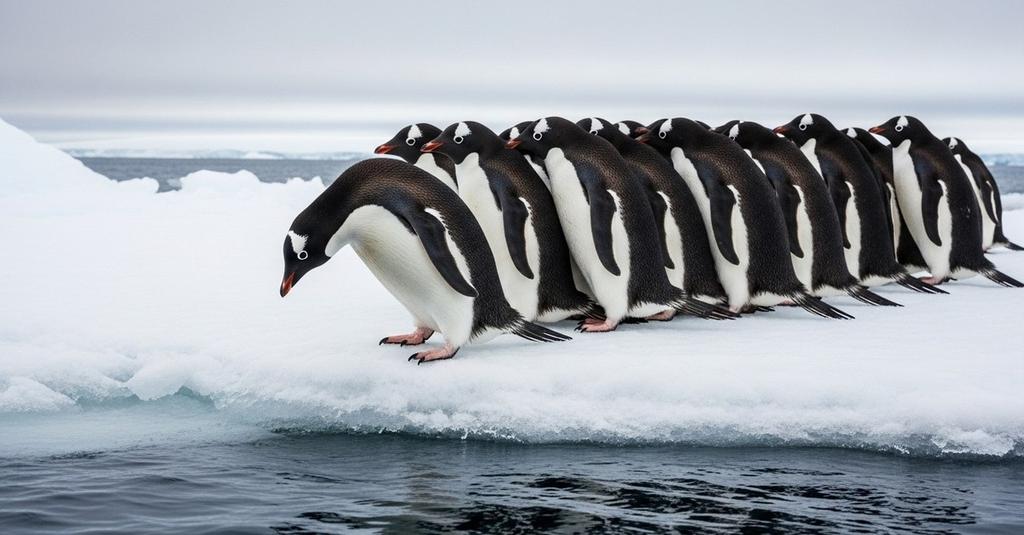
There’s a concept in behavioral ecology called the many-eyes effect — more nervous systems scanning simultaneously means more likely detection of threat. Here’s the thing: Adélie penguin leopard seal behavior doesn’t just use this principle. It weaponizes it. These birds aren’t merely watching together. They’re using each other as test subjects. Every bird at the front of the crowd increases the sample size of observed outcomes. Every bird waiting behind is collecting data that will inform its own decision the moment it hears the result.
It’s the logic of trying food someone else has already eaten. It’s a version of social information transfer that appears across the animal kingdom — salmon in predator-dense rivers, starlings shifting direction in murmuration — but the sophistication of it in penguin colonies is striking.
Then comes the accidental first-jumper. As bodies compress against the ice edge, physics intervenes. A bird at the front gets nudged by momentum, not courage, and topples into the water. It doesn’t choose to jump. Researchers observing Ross Sea colonies documented hesitation periods lasting between two and eight minutes before this moment. The nudge happens. The crowd holds its breath.
If the bird surfaces, everything collapses.
Within three to five seconds — sometimes fewer — the cascade begins. Dozens of penguins pour off the edge in rapid succession. One bird’s accidental survival becomes permission for the entire group. That’s all the data they needed.
Risk Pooling and Why the Mob Isn’t Cowardly
The behavior appears irrational until you model the mathematics. If a leopard seal is present on 30% of mornings, the first jumper runs a 30% risk alone. Every subsequent penguin runs a statistically discounted version of that risk — the first bird already survived it. The mob isn’t being timid. It’s being actuarial. Risk pooling, the same logic that created insurance industries, turns out to be something a bird with a brain smaller than a walnut has essentially solved through evolutionary pressure.
A 2018 study published in Scientific Reports examined how colonial seabirds process social information under predation pressure. The authors found that the threshold for collective action drops dramatically once a single successful event is observed — they called it “information cascades.” For Adélie penguins, the ice edge is precisely this kind of cascade trigger. The behavior mirrors models developed to explain stock market panics, crowd evacuations, and viral trends — contexts where aggregated social signals override individual private information.
What makes this more than nature trivia is what it reveals about collective intelligence in non-human animals. That’s the counterintuitive finding researchers keep circling back to: intelligence doesn’t require a large brain. It requires the right selective pressure over enough generations.
Antarctica provided both.
When the Rules Break Down
Adélie penguins and leopard seals have co-evolved for millions of years, developing a balance between predator and prey that both sides understood. But that balance assumes something: that the ice stays where evolution expects it to stay. A 2019 study from the British Antarctic Survey documented substantial shifts in sea ice extent across the Ross Sea — the primary habitat for the world’s largest Adélie colonies. When the ice edge moves, the geographical anchor that supports the entire risk-assessment protocol collapses. The learned patterns — where colonies gather, where seals patrol, which entry points have historically been safer — begin to misalign with physical reality.
Leopard seals adapt faster. They’re mobile solitary predators who recalibrate hunting grounds in response to prey distribution within weeks. Adélie colonies are bound to fixed breeding sites. Their collective behavioral memory takes multiple seasons to rebuild. In years following significant ice disruption events, mortality data from the Western Antarctic Peninsula showed elevated predation rates during foraging transitions — exactly the window when ice-edge hesitation should be providing protection. The system works when the environment is stable.
When it isn’t, the mob’s caution becomes liability.
Watching a species’ survival mechanism fail because the world it evolved for is disappearing — you stop calling it a trend and start calling it what it is: a crisis.
Researchers at Scripps Institution of Oceanography and New Zealand’s National Institute of Water and Atmospheric Research are combining satellite ice-mapping with penguin GPS tracking to model how colonies shift under ice-change scenarios. As of 2024, the data is still being compiled. What it may tell us is whether these birds can adapt their behavioral protocols fast enough, or whether they’re running an algorithm designed for a climate that no longer exists.
Where to See This
- Cape Royds and Cape Bird, Ross Island, Antarctica — home to the southernmost Adélie penguin colonies, most accessible between October and February during Antarctic summer breeding season.
- The Long-Term Ecological Research (LTER) program at Palmer Station, operated by the U.S. National Science Foundation, conducts ongoing Adélie penguin population monitoring with annual reports accessible through the NSF’s Polar Programs website.
- For those unable to reach Antarctica, the New Zealand Antarctic Heritage Trust offers virtual expedition content, and David Attenborough’s Frozen Planet II (2022, BBC) includes vivid leopard seal ambush footage.
By the Numbers
- Approximately 10 million Adélie penguins inhabit Antarctic regions, making them the most abundant penguin species on the continent (IUCN, 2023).
- Leopard seals reach nearly 25 mph (40 km/h) in short bursts — roughly five times faster than Olympic swimmers.
- Ice-edge hesitation periods in Ross Sea colonies ranged from 2 to 8 minutes before first water entry, documented by U.S. Antarctic Program field researchers.
- Western Antarctic Peninsula Adélie populations declined more than 65% since the 1970s, versus relatively stable numbers in the colder Ross Sea region (Scripps Institution, 2022).
- Individual leopard seals consume between 8 and 16 penguins daily during peak predation periods near colony entry points.
Field Notes
- In 2011, researchers at Cape Crozier observed a leopard seal deliberately herding Adélie penguins along the ice edge by surfacing repeatedly at one end of the entry zone — effectively manipulating the crowd toward a preferred ambush point. The behavior recurred over three consecutive mornings with the same individual seal.
- Adélie penguins recognize individual leopard seals by behavior pattern, not merely by presence. Colonies adjacent to particularly active seal territories show significantly longer hesitation periods than lower-risk areas, even when current seal activity is undetectable.
- The “first-jumper” mechanism parallels human crowd psychology: emergency evacuation studies show the first person through an unknown exit dramatically increases the rate others follow, regardless of whether that route is actually safe.
- How individual penguins deep within a crowd — sometimes 50 birds deep — receive the signal that the first bird survived safely remains unexplained. Visual line-of-sight is blocked. Whether sound, vibration through ice, or crowd ripple effects carry the information is still an open question in research.
Frequently Asked Questions
Q: Why does Adélie penguin leopard seal behavior involve waiting in groups rather than diving individually at random times?
Diving alone eliminates the social information safety net. An Adélie entering without knowing whether a leopard seal is present faces full predation risk unshared. Group waiting with an accidental first entry — even if it costs that bird — allows each subsequent penguin to benefit from observed survival data. The group delay is a collective investment that pays off statistically for the majority, despite occasionally costing the first-jumper its life.
Q: How fast does the cascade actually happen after the first penguin survives?
Field observations from the Ross Sea show cascades beginning within three to five seconds of the first bird surfacing unharmed. The delay collapses almost instantly once survival signal registers. The watching birds aren’t consciously deliberating — the decision threshold has already been reached through accumulated waiting. One successful entry pulls the trigger. Within thirty seconds, dozens may have followed.
Q: Don’t leopard seals just wait until the cascade begins and then take their pick?
Mass entries actually disadvantage the seal. A single penguin is far more vulnerable than fifty entering simultaneously from multiple angles. Chaos disrupts the seal’s ability to isolate a target — ambush predators rely on specificity, knowing exactly which prey to commit to. A cascade floods the system with too many signals at once, and the statistical advantage briefly shifts back toward the penguins.
Editor’s Take — Alex Morgan
What stays with me about this story isn’t the predator or even the physics of the nudge. It’s the accidental pioneer — the bird that didn’t choose to jump, that became the most important individual in the group through sheer bad luck. There’s something uncomfortable in that. We construct narratives around courage and leadership, and then a penguin colony shows us that sometimes survival runs on the sacrifice of the involuntary volunteer. Evolution is not sentimental about its data collection methods.
The ice edge is a threshold crossed every morning in one of the remotest places on Earth, by birds solving the same predator problem for millions of years. What they’ve arrived at isn’t bravery. It isn’t strategy in the way we usually mean it. It’s something stranger and more honest — a system where uncertainty gets distributed until it becomes manageable, where one bird’s luck becomes an entire colony’s signal to move. As the ice beneath their feet shifts in ways their evolution never anticipated, the question isn’t whether they’re intelligent enough to adapt. It’s whether they have time.
Illustrations are AI-generated. Article fact-checked and human-edited. Our editorial standards.