The Pompeii Frescoes That Burned Too Bright to Die
In 2018, archaeologists in Pompeii uncovered a fresco so vivid that the colors seemed to still be wet. Two thousand years had passed. The plaster didn’t know it.
Deep reds that hadn’t faded. Electric blues that punch you. A dinner party scene — figures reclining, wine being poured, someone wearing jewelry you could actually identify — all of it sealed under volcanic ash since the moment Vesuvius decided to end everything.
The weird part? The volcano didn’t destroy these walls. It saved them.
Key Facts
- A vivid fresco depicting a Roman feast was uncovered in Pompeii’s Regio V dig in 2018
- Vesuvius erupted in 79 AD, with a pyroclastic surge moving at 700 km/h and temperatures of 250 to 300 degrees Celsius
- Over 1,000 individual frescoes have been catalogued from Pompeii as of 2023
- Cinnabar red was sourced from mines in Almaden, Spain, over 2,500 kilometers from the Bay of Naples
- Egyptian blue was one of the first synthetic pigments, made by heating copper, calcium, and silica
In short: This article explains how Pompeii frescoes preserved by the 79 AD Vesuvius eruption survived nearly 2,000 years. A 700 km/h pyroclastic surge created an anaerobic seal that froze vivid reds and blues mid-moment, including a 2018 Regio V dinner-party scene, turning catastrophe into an accidental archive of Roman life.
Why These Walls Survived When Nothing Else Did
It is 79 AD. A pyroclastic surge hits Pompeii at 700 kilometers per hour. The temperature reaches 300 degrees Celsius. Everything dies. Everything burns. Everything seals.
Massimo Osanna, who directed the Pompeii Archaeological Park, calls the preservation “almost surgical.” The speed matters. The heat matters. But what really matters is that the eruption created an anaerobic seal — no oxygen, no light, no slow chemical decay eating away at pigments the way time normally does. Walls that should have deteriorated to nothing instead froze mid-moment. The city of Pompeii became a time capsule that nobody built on purpose.
Except here’s what kept me reading for another hour: wealthier families had better frescoes, and it wasn’t about skill. It was about plaster. The rich layered on three, four, sometimes five coats. Each layer was insulation. Each layer was preservation. Even in death, Roman class structure held.
These Weren’t Art. They Were Weapons.
Romans painted walls the way we do everything now. Status signaling. Proof of taste. Cultural literacy on display for anyone who walked through your door. A mythological scene wasn’t decoration — it was an argument. It said: I read. I’ve traveled. I can afford Egyptian blue.
In a baker’s house, you got red-and-black geometric borders. Modest. Safe.
In a merchant’s villa, hunting scenes. In the grand houses — the ones with multiple atriums and reception rooms designed for impressing people — the walls became doctoral theses in pigment. Myth layered on myth. Meaning that educated guests would recognize immediately. You couldn’t miss the message. It was painted on your dining room wall.
A painted room was a financial decision made visible. Every color was imported. Every pigment was expensive.
The Pigments Tell Their Own Story
Cinnabar — that’s mercury sulfide, ground fine — made the reds. Imported from Spain. Cost a fortune.
Egyptian blue, one of the first synthetic pigments humans ever created, came from heating copper, calcium, and silica together. The yellows were ochre. Greens were malachite. Transported across the Mediterranean. Each one representing a supply chain, a trade relationship, a decision about where money was going to go.
Some of these pigments cost more per ounce than the food on the table.
That’s not exaggeration. That’s just what the Pompeii frescoes reveal when you look at the economics of color. Every brushstroke carried a price tag. The walls weren’t just beautiful — they were balance sheets made visible, and every brush of cinnabar red was proof that you had the kind of money that could afford to waste it on making your dining room look good.
Then Everything Changed. Or Did It?
Here’s the bargain the volcano made: catastrophe as preservation.
Walls that might have been whitewashed over in twenty years, renovated and repainted and erased over centuries, were instead locked in time. Perfect. Waiting. The same scene — the same dinner party, the same mythology, the same proof of wealth — has been sitting there untouched for nearly 2,000 years.
But the real damage came after excavation.
Once exposed to air, to light, to humidity and tourists and time, frescoes that survived two millennia underground started deteriorating within decades. The race to document, stabilize, protect everything that’s been found — it’s ongoing. And not all of it is being won.
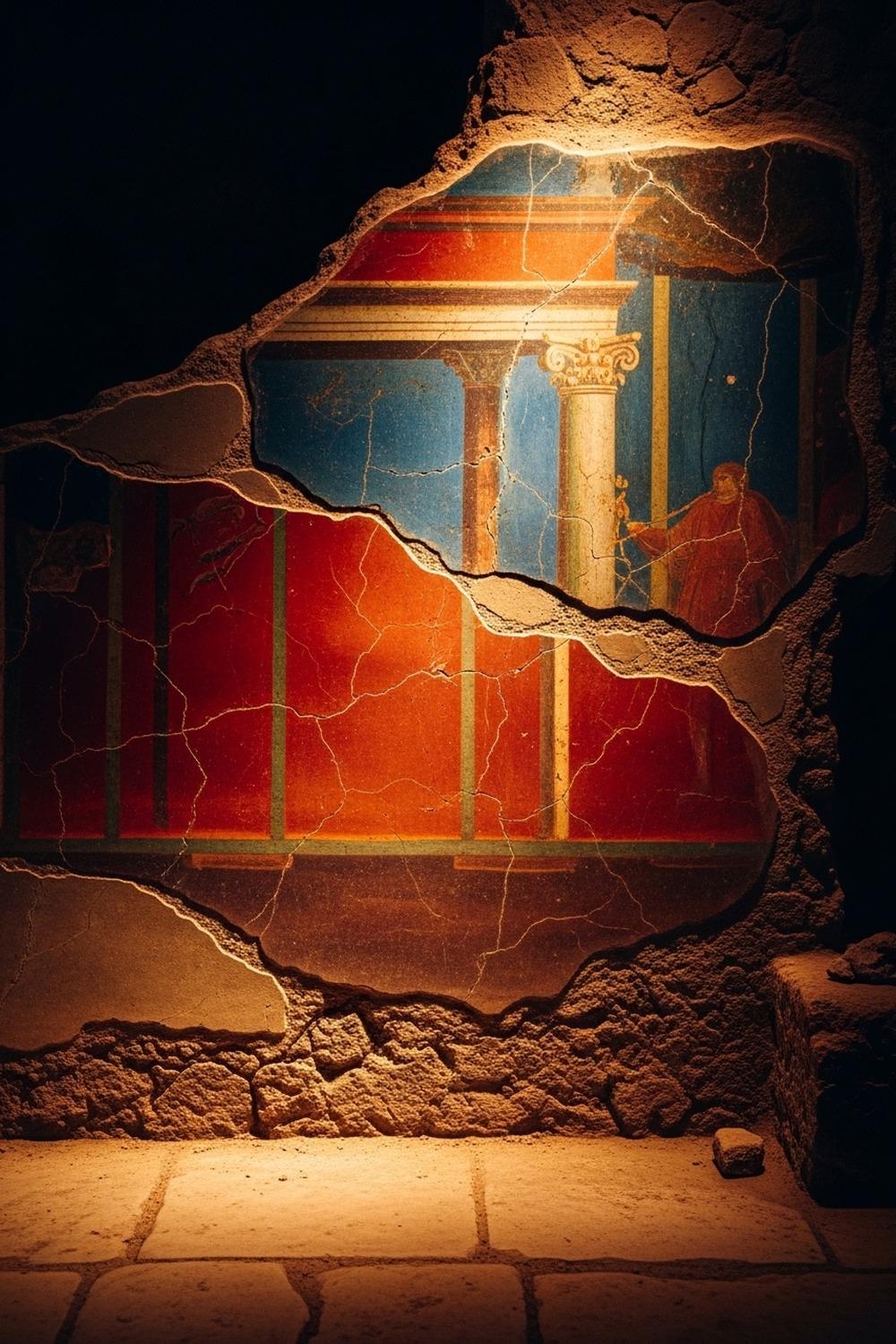
The 2018 Find Nobody Expected
Turns out, Pompeii still has secrets buried in sections that haven’t been fully excavated since the 1800s.
The Regio V dig uncovered a fresco depicting a Roman feast with extraordinary detail. Figures reclining. Wine being poured. A woman wearing jewelry that archaeologists could identify as belonging to a specific style. The plaster held. The colors held. And the scene offered something rare — not mythology, not status signaling, but an actual domestic moment. A dinner party that never ended. A conversation that stopped mid-word.
You can see what they were eating. You can almost hear the room.
That single fresco shifted how archaeologists think about what survives and what matters. Not because it’s the most elaborate or the most famous. Because it’s recognizably human.
By the Numbers
- Over 1,000 individual frescoes catalogued from Pompeii as of 2023, with new sections still being excavated under the EU-funded Great Pompeii Project.
- Egyptian blue found in Pompeii frescoes reveals hidden layers under multispectral imaging — some walls have up to four distinct painted phases beneath the visible surface, meaning walls were repainted, updated, adjusted to taste over decades before the eruption.
- Cinnabar red sourced from mines in Almadén, Spain. Over 2,500 kilometers from the Bay of Naples. One of the longest documented ancient supply chains for an art material.
- The pyroclastic surge moved at 700 km/h.
- Temperatures between 250°C and 300°C — fast enough to kill in seconds, also fast enough to seal surfaces before chemical decay could start.
Field Notes
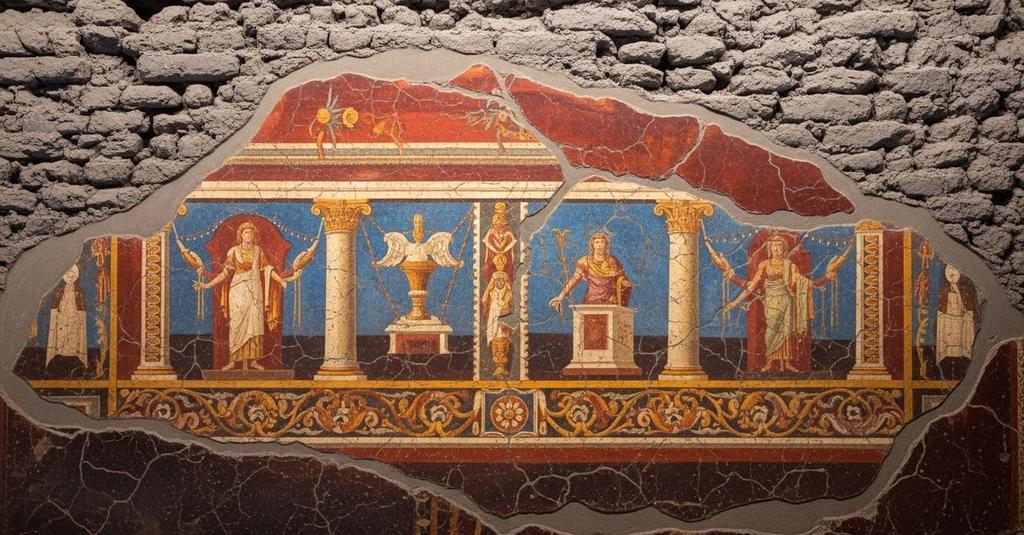
- Several Pompeii frescoes depict scenes from Homer with such precision that scholars believe the painters were working directly from illustrated manuscripts — meaning an entire visual tradition of Greek literature existed that we’ve almost completely lost.
- The Fourth Style of Roman fresco painting — the most elaborate, theatrical version featuring impossible architecture and floating figures — was at peak fashion in Pompeii exactly when Vesuvius erupted. The city became a time capsule of one specific aesthetic moment, frozen mid-trend.
- Some frescoes show evidence of repair and repainting. Not treated as permanent. Updated. Adjusted. Refreshed. Like how we’d redo a room today.
What Survives, and Why It Matters
The Pompeii frescoes aren’t just art history. They’re proof that ordinary life — dinner parties, family mythology, the colors you choose for your walls — is worth preserving. Every fresco that made it through the volcano and the excavations and the exposure and the tourism and the underfunding is a small miracle. Three conditions had to align: how the walls were made, when they were buried, how carefully they’ve been handled since. All three rarely survive together.
What’s strangest isn’t that these walls survived. It’s that they were never meant to be seen by anyone but the people living there. These were private spaces. Intimate choices about color and mythology and meaning, displayed only for family and invited guests. And yet here we are, reading the walls of strangers, understanding their taste because a volcano happened to seal everything mid-moment.
A catastrophe became a record. Loss became preservation. History keeps making this bargain with us, over and over.
The volcano didn’t destroy Pompeii’s frescoes. It sealed them. That strange accident — catastrophe as archive — is what makes these walls still matter. If this kind of story stays with you, there’s more waiting at this-amazing-world.com. The next one is even stranger.
Frequently Asked Questions
Q: How did the Pompeii frescoes survive nearly 2,000 years?
When Vesuvius erupted in 79 AD, a pyroclastic surge moving at 700 km/h and reaching 250 to 300 degrees Celsius sealed Pompeii under volcanic ash within seconds. This created an anaerobic environment with no oxygen, no light, and no slow chemical decay that normally eats away at pigments. As Pompeii Archaeological Park director Massimo Osanna described, the preservation was almost surgical. The volcano did not destroy these walls; it froze them mid-moment, turning catastrophe into preservation.
Q: What pigments did Roman painters use in Pompeii?
Roman frescoes used expensive, imported pigments that doubled as status symbols. Reds came from cinnabar, mercury sulfide imported from mines in Almaden, Spain, over 2,500 kilometers away. Egyptian blue, one of the first synthetic pigments humans created, was made by heating copper, calcium, and silica together. Yellows came from ochre and greens from malachite, transported across the Mediterranean. The article notes some pigments cost more per ounce than the food on the table, making painted rooms financial decisions made visible.
Q: What was the 2018 Pompeii fresco discovery?
In 2018, the Regio V dig uncovered a fresco depicting a Roman feast with extraordinary detail: figures reclining, wine being poured, and a woman wearing identifiable jewelry. Unlike most surviving frescoes, which depict mythology or status signaling, this one captured an actual domestic moment, a dinner party frozen mid-conversation. Archaeologists said it shifted how they think about what survives and what matters, precisely because it is recognizably human rather than elaborate or famous.
Q: Why do frescoes deteriorate after excavation?
Once exposed to air, light, humidity, and tourists, frescoes that survived two millennia underground can begin deteriorating within decades. The anaerobic seal that protected them is broken the moment they are uncovered. The article notes the ongoing race to document, stabilize, and protect each find, work funded in part by the EU-backed Great Pompeii Project. Survival requires three rare conditions aligning: how the walls were originally made, when they were buried, and how carefully they have been handled since excavation.
Illustrations are AI-generated. Article fact-checked and human-edited. Our editorial standards.