Why This Puppy and Calf Are Actually Best Friends
There’s a nine-week window where a puppy’s brain is basically a sponge for whoever happens to be standing nearby. A calf. A duck. Another species entirely. And somehow, nobody talks about this.
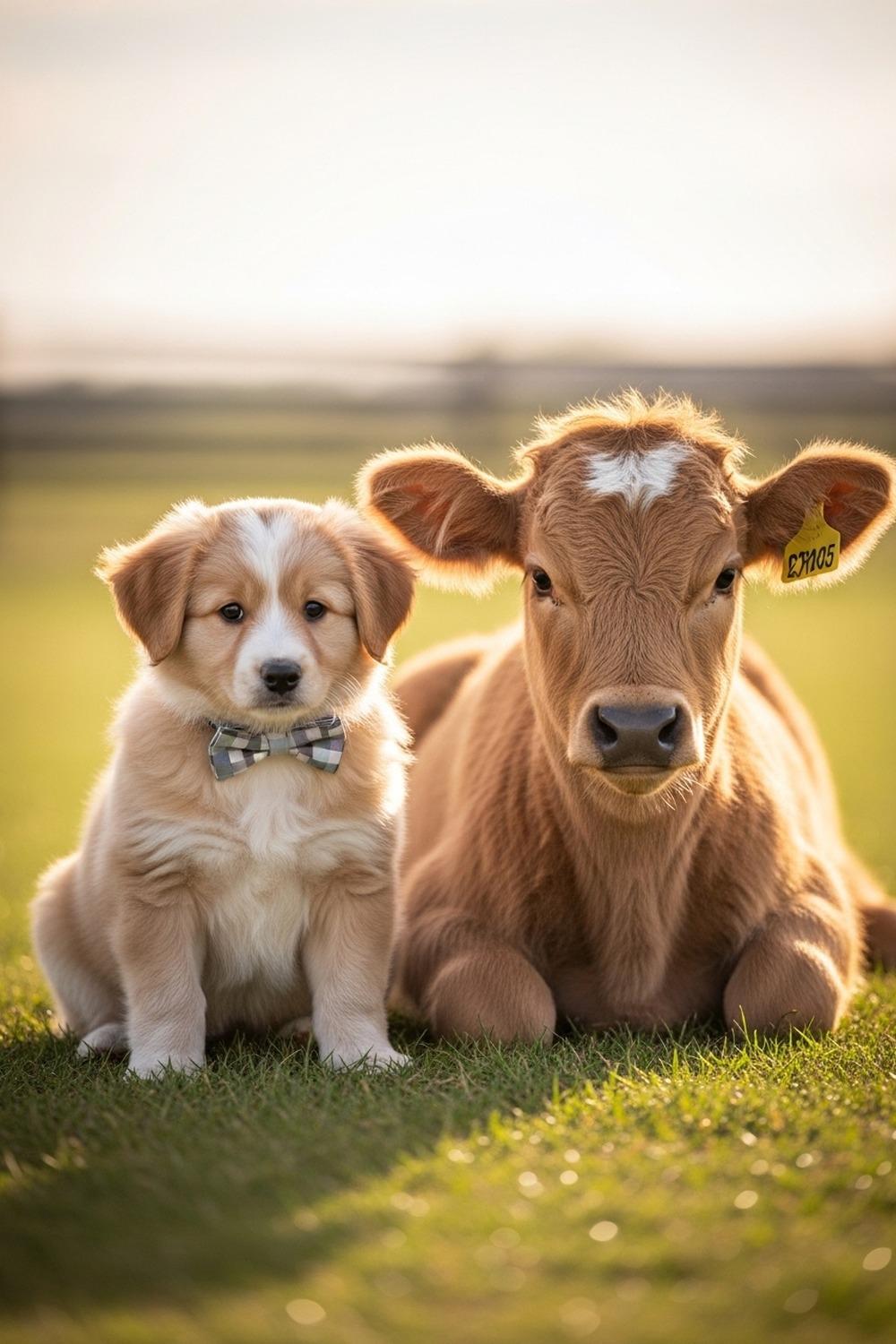
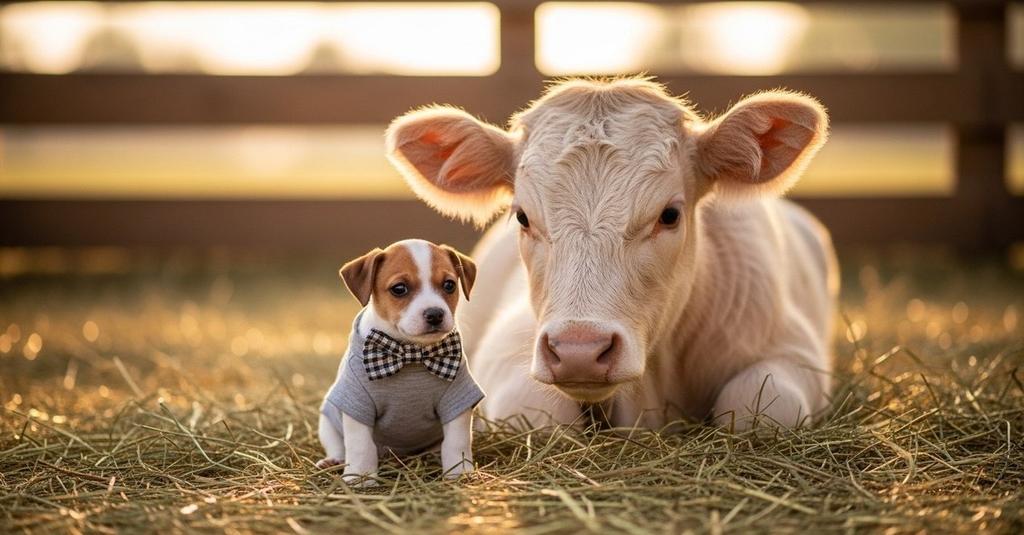
So there’s this photo. A puppy wearing a bow tie next to a calf. Both of them look genuinely comfortable, and the internet did what the internet does — shared it to death, tagged friends, made it the fifth cutest thing they’d seen all week. But here’s what nobody mentions in the comments: these two animals probably actually like each other. Not in a staged way. Not because someone trained them. Because their brains decided, at exactly the right moment in their development, that the other one was family.
Key Facts
- A puppy’s critical socialization window runs from about three weeks to twelve weeks of age
- Cattle can distinguish between up to 100 individual faces, including human, dog, and cow faces
- Livestock guardian dogs have been used in Turkey for over 3,000 years
- Puppies exposed to non-canine species before 12 weeks show reduced fear responses for life (Journal of Veterinary Behavior, 2018)
- Both dogs and cattle experience oxytocin spikes during positive social contact
In short: Cross-species animal bonding explains why a puppy and calf can form a genuine attachment. During a puppy’s three-to-twelve-week socialization window, its brain files any companion as family. Cattle, able to recognize up to 100 faces, bond back, a mechanism humans have exploited in livestock guardian breeds for over 3,000 years.
The Critical Window Nobody Warns You About
Animal behaviorists call it the “critical socialization window.” For puppies, it runs from about three weeks to twelve weeks old. During this stretch, a puppy’s brain is wired to form social attachments with literally whoever is there. Researcher Clarence Pfaffenberger documented this decades ago, and the science still holds. A puppy isn’t just bonding with other dogs during this window. It’s bonding with whatever moves, whatever makes noise, whatever shares space with it.
That calf? It becomes family. Neurologically, not metaphorically.
According to research on dog behavior, early exposure to non-canine animals actually rewires how a puppy’s brain categorizes “safe.” The developing neural pathways file away “large, warm, slow-moving bovine creature” as a companion, and that filing cabinet doesn’t get reorganized just because the puppy got older. The bond can last a lifetime.
Which raises the obvious question: does the calf feel the same way back?
Cattle Aren’t Just Standing There
Turns out they’re not.
Researchers at the University of Northampton ran studies on cattle cognition and found something worth sitting with. Cows can recognize individual faces — human faces, dog faces, other cow faces — and they remember them. More than that: they show measurably lower heart rates around animals they recognize as familiar. This isn’t passive tolerance. This is actual recognition.
Young bovines in low-stress environments display what researchers call “calm baseline posture” — relaxed ears, soft eyes, weight distributed evenly. It’s not an act. The calf in that photo isn’t performing unbothered. It actually is unbothered. That’s what real bonds look like. They don’t require performance.
This Isn’t Rare. It’s a Three-Thousand-Year-Old Agricultural Strategy
Cross-species bonding between dogs and livestock has been happening for centuries, long enough that humans started breeding for it intentionally. The Kangal. The Great Pyrenees. The Maremma. All of these breeds were developed to imprint on sheep and cattle instead of on humans or other dogs. Puppies were raised inside the herd on purpose, because a dog that bonded with sheep would protect them like family.
The socialization window is the mechanism. The bow tie is optional.
Here’s the thing that kept me reading for another hour: three weeks of consistent exposure during that early window can outweigh months of later experience. The brain doesn’t renegotiate. It doesn’t say “well, let’s look at all the evidence.” It just locks in.
- Puppies exposed to non-canine species before 12 weeks show reduced fear responses to those species for life — a finding replicated across multiple studies in the Journal of Veterinary Behavior (2018)
- Cattle can distinguish between up to 100 individual faces, a cognitive capacity most people thought only primates and certain birds possessed
- Livestock guardian dogs have been used in Turkey for over 3,000 years — making cross-species bonding one of humanity’s oldest agricultural technologies
- Dogs and cattle both experience oxytocin spikes during positive social contact. That’s the hormone associated with affection. Both species feel something recognizable as actual bonding
What the Puppy Actually Knows
The “smiling” puppy in the photo isn’t proud of the bow tie. Dogs don’t smile the way humans do. What we interpret as a smile — relaxed mouth, soft eyes, slightly open jaw — is actually a signal of low arousal. Comfort. Safety. The puppy knows one thing on some deep mammalian level: the large warm creature beside it won’t hurt it.
That’s the whole story.
We project happiness onto these photos because it draws us in. Because it makes us care. But we’re actually underselling what’s happening. The real thing is stranger. Two young mammals from entirely different species, during a narrow developmental window that evolution built into both of them for completely different reasons, have formed a genuine social attachment. That’s the actual story worth telling.
Field Notes
- Dogs raised with livestock don’t just tolerate the animals. They actively choose to sleep near them, follow movement patterns, and vocalize in ways that mirror herd communication. Behavioral assimilation, not coexistence
- Calves separated from a bonded dog companion show elevated cortisol levels within hours — the same stress response observed when calves are separated from their own mothers
- Cross-species bonding isn’t just a mammal thing. Dogs have formed documented bonds with ducks, deer, owls, and one very committed tortoise, suggesting the socialization window might interact with curiosity responses that go beyond species-specific programming
What This Means
Cross-species animal bonding tells us something odd about how brains work during development. Socialization isn’t learning who your own species is. It’s learning who your world contains. A puppy and a calf raised together aren’t confused about what they are. They just have an expanded definition of who belongs.
And once something enters that circle during the critical window, the bond has a kind of permanence that’s hard to break.
For us, watching from outside, there’s something worth sitting with in that. These animals didn’t decide to be friends. They didn’t weigh pros and cons. They were just present with each other at the right moment, and their brains did the rest.
A puppy in a bow tie stopped millions of people from scrolling. But the reason it works — the reason it feels true — is that it is true. Not performed. Not staged. Two young mammals caught in a genuine bond that started before anyone picked up a camera. The science behind it is even stranger than the photo itself, and there’s more at this-amazing-world.com.
Frequently Asked Questions
Q: What is cross-species animal bonding between a puppy and a calf?
Cross-species animal bonding is when animals of different species form a genuine social attachment. With a puppy and calf, it happens during the puppy’s critical socialization window, roughly three to twelve weeks of age, when its brain is wired to form attachments with whoever is present. If a calf shares that space, the puppy’s developing neural pathways file the calf as a companion. The bond is neurological rather than staged, and it can last a lifetime.
Q: Do cows actually recognize and bond with other animals?
Yes. Researchers at the University of Northampton found that cattle can recognize individual faces, including human, dog, and cow faces, and can distinguish between up to 100 individuals, a capacity once thought limited to primates and certain birds. Cows show measurably lower heart rates around familiar animals, indicating genuine recognition rather than passive tolerance. Both dogs and cattle also experience oxytocin spikes during positive social contact, the hormone associated with affection and bonding.
Q: Is cross-species bonding between dogs and livestock common?
It is both common and ancient. Cross-species bonding between dogs and livestock has been deliberately bred into guardian breeds like the Kangal, Great Pyrenees, and Maremma, which imprint on sheep and cattle rather than humans or other dogs. Livestock guardian dogs have been used in Turkey for over 3,000 years, making cross-species bonding one of humanity’s oldest agricultural technologies. Puppies were raised inside herds on purpose so they would protect the animals like family.
Q: Why does early-life exposure create such lasting bonds?
During the critical socialization window, a puppy’s brain locks in social categories rather than weighing evidence over time. Three weeks of consistent exposure during this early period can outweigh months of later experience. Studies in the Journal of Veterinary Behavior (2018) found that puppies exposed to non-canine species before 12 weeks show reduced fear responses to those species for life. The brain essentially expands its definition of who belongs, and that filing does not get reorganized later.
Illustrations are AI-generated. Article fact-checked and human-edited. Our editorial standards.