Why Hippos Spin Their Tails While Defecating
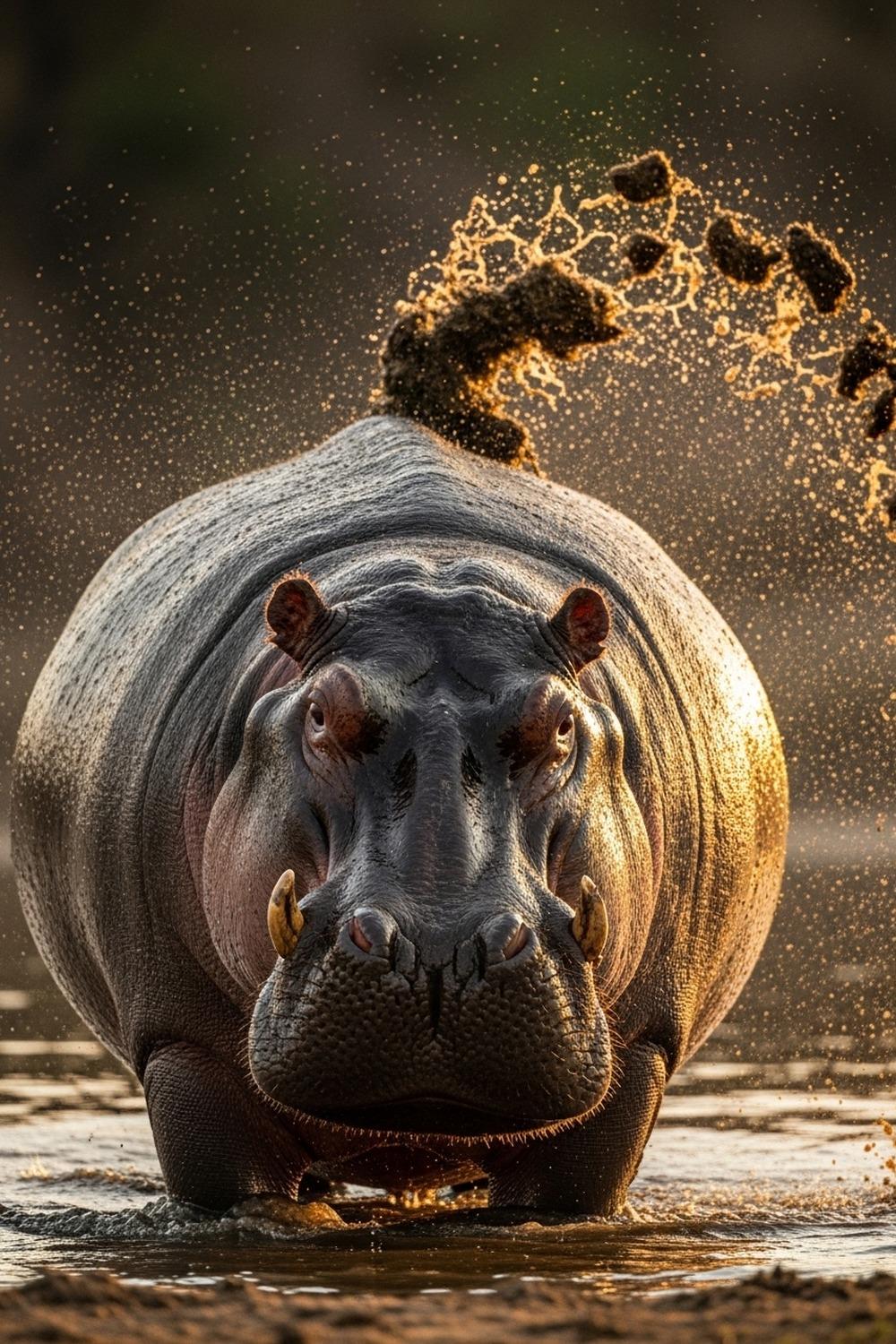
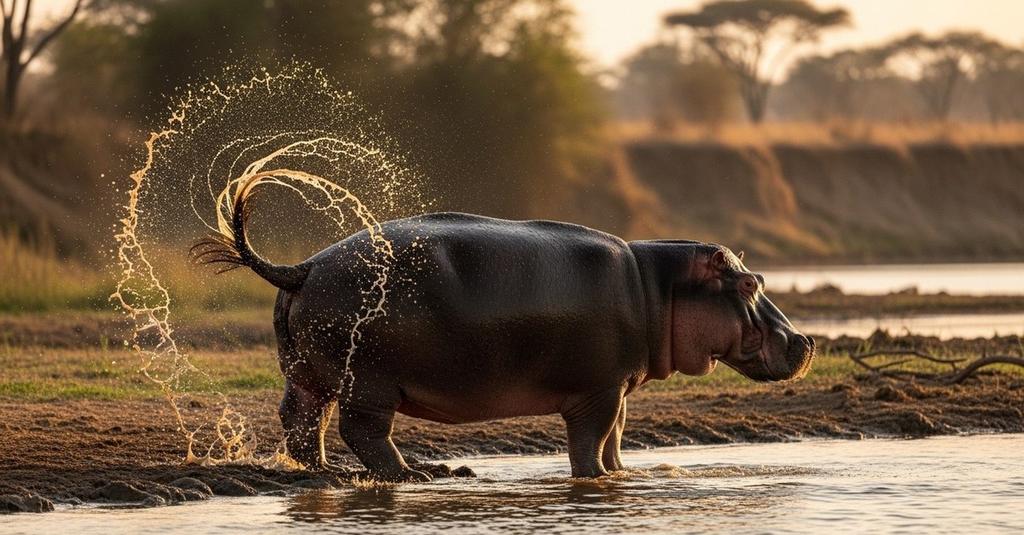
Tail spinning. Urine and feces spraying across the riverbank in a centrifugal arc. What most observers see as an undignified moment is actually one of the animal kingdom’s most sophisticated multipurpose communication systems — and hippo dung showering behavior broadcasts information that rivals decode within seconds, often without ever approaching the bull responsible for the display.
Along the riverbanks of sub-Saharan Africa, dominant bulls weighing over 3,000 kg perform a biomechanical feat that biologists have spent decades trying to fully decode. They call it “dung-showering”: a simultaneous spray of urine and feces, tail whipping like a rotor blade, flinging waste in every direction at once. The question isn’t why hippos do it.
How much information can a single moment actually hold?
The answer: everything a rival needs to know about fitness, territory, and dominance rank. The spray reaches several meters in every direction. No bull can miss it. No bull can ignore it.
Key Facts
- A single hippo pod can deposit up to 8.5 tonnes of organic matter into a river system per day (University of Zurich, 2019).
- A dominant bull hippo can weigh over 3,200 kg and hold a territory stretching up to 250 meters of riverbank.
- Wild hippo populations are estimated at 115,000-130,000 individuals, after declining roughly 7-20% between 1996 and 2006 (IUCN Red List, 2023).
- Hippos spend approximately 16 hours per day submerged in water, performing most territorial displays during their remaining active hours.
- A 2021 Nature Communications study documented dissolved oxygen in Kenya’s Mara River dropping to near-zero within hours of peak hippo dung input during low-flow conditions.
In short: Hippo dung showering behavior is the simultaneous spray of urine and feces while a dominant bull spins its paddle-shaped tail, scattering waste several meters in every direction. It serves three functions at once: marking territory, signaling fitness to females, and fertilizing African river systems with up to 8.5 tonnes of organic matter daily.
The Science Behind Hippo Dung Showering Behavior
Hippos — Hippopotamus amphibius — are classified among the most dangerous large mammals in Africa. Their social lives are structured around hierarchy, territory, and chemical signaling. Dung-showering behavior sits at the intersection of all three.
Researchers at the Max Planck Institute for Animal Behavior have studied chemical communication in large African megafauna for years, and their findings consistently point to scent marking as the dominant language of territorial negotiation. A 2021 study published in chemical ecology confirmed that hippopotamus waste contains a suite of volatile organic compounds — short-chain fatty acids and other molecules — that carry detailed biological information: sex, reproductive status, individual identity, and almost certainly, dominance rank. The spinning tail isn’t incidental. It’s the delivery mechanism.
What makes the display so striking is its sheer intentionality. The tail rotation doesn’t happen casually — it’s a sustained, deliberate motion that begins before defecation and continues throughout, spraying waste across a radius that can reach several meters. That coverage matters. A bull isn’t just marking a single rock or tree the way a dog marks a lamppost. He’s saturating a zone. He’s making the environment itself carry his message: short and total, overwhelming and impossible to miss. Field observers in Zambia’s South Luangwa National Park have recorded bulls returning to the same latrinal zones repeatedly, each visit building a layered chemical archive that carries information across days, weeks, and seasons.
A rival approaching that bank isn’t reading a single note. He’s reading a full paragraph — and often deciding to retreat before contact is ever made.
Territory, Courtship, and What the Spray Actually Says
Here’s where it gets genuinely complex. When directed toward a rival bull, hippo dung showering behavior is a territorial declaration — an olfactory fence post reinforced with every visit. When directed toward a female in estrus, it transforms into something closer to courtship. A dominant bull will position himself near a receptive cow and perform the full display, apparently communicating fitness and availability through the exact same physical mechanism.
Turns out, the behavior is remarkably similar to scent-marking strategies documented in other large mammals — including the complex social signaling observed in spotted hyenas, which researchers have studied with equally obsessive attention. If you’ve read about the four years a zoo spent attempting to breed two striped hyenas, you’ll recognize the pattern: chemical communication in social mammals is rarely simple, and it’s rarely just about one thing.
The dual-use nature of hippo dung showering is unusual even by animal behavior standards. Most territorial displays and courtship displays are distinct — different postures, different vocalizations, different timing. Hippos collapse them into one. A 2019 behavioral ecology paper from the University of Pretoria noted that the chemical composition of hippo waste doesn’t appear to change significantly between territorial and courtship contexts, suggesting that females and rivals alike are interpreting the same chemical signature through different social lenses (researchers actually call this context-dependent decoding, not a change in the signal itself). Subordinate males rarely perform the full display. When they do, dominant bulls respond quickly — sometimes within minutes — with a counter-display or direct confrontation. The hierarchy enforces itself in real time, scent by scent, spin by spin.
Why the Spinning Tail Changes Everything
Remove the tail spin and you’ve removed the point. That’s not hyperbole — it’s what the biomechanics actually suggest. Researchers studying megafaunal scent dispersal, including teams affiliated with the Smithsonian’s National Zoo, have noted that the fan-like motion of a hippo’s paddle-shaped tail creates a centrifugal spray pattern that dramatically increases dispersal radius compared to passive deposition. Smithsonian Magazine’s coverage of hippopotamus communication has highlighted how this behavior functions as an amplification system — not just scattering waste but aerosolizing it, allowing volatile chemical compounds to travel further on air currents and adhere more broadly to vegetation, rocks, and water surfaces. Territory marking at scale requires scale. The tail delivers it.
But hippo dung showering behavior is also notably social in its timing. Bulls perform most frequently during and after confrontations, when territories are actively contested, and during the dry season when hippo populations compress around shrinking water sources. Competition intensifies. Display frequency rises. It’s a behavioral pressure valve — a way of establishing and re-establishing dominance through chemical messaging rather than risking the catastrophic physical injuries that direct combat between 3,000 kg animals can cause. Broken tusks. Torn skin. Death. The spray is cheaper than the fight.
That paddle-shaped tail with its stiff hair fringe behaves almost like a fan blade when spun rapidly. Evolution rarely produces elegant structures by accident.
Hippo Dung Showering Behavior and Ecosystem Impact
A bull hippo depositing waste in and around a river system isn’t just communicating. He’s fertilizing. Hippos are classified as ecosystem engineers — species whose behavior physically shapes the environment around them — and their dung is one of the primary nutrient inputs for many African river systems.
Research published in Nature Communications in 2019 by a team from the University of Zurich quantified the scale: a single pod of hippos can deposit up to 8.5 tonnes of organic matter into a river system per day. That waste feeds algae, fish, and invertebrates. It drives the productivity of entire aquatic food webs. The dung-showering that happens along riverbanks distributes that nutrient load across a wider riparian zone, reaching terrestrial plants and soils that wouldn’t otherwise receive it. There’s a counterintuitive dimension here — at high concentrations, particularly during dry seasons when water volumes drop, hippo dung can deplete oxygen levels in rivers severely enough to trigger mass fish kills. A 2021 study in Nature Communications documented this phenomenon in Kenya’s Mara River, tracking dissolved oxygen crashes directly linked to hippo pod density and dung load. The same biological output that sustains ecosystems in normal conditions becomes a stressor under pressure. Watching a species multiply nutrients and destruction through the exact same behavior, you stop separating the two.
Conservation managers in the Okavango Delta and Kruger National Park now factor hippo distribution patterns into river health assessments. The animal that looked like a comedy act turns out to be a keystone player. The spray isn’t separate from the ecology. It is the ecology.
Where to See This
- South Luangwa National Park, Zambia — one of Africa’s highest hippo densities; territorial displays are most frequent during the dry season (June–October) when hippos cluster around the Luangwa River. Dawn and dusk are prime observation windows.
- The Mara River corridor in Kenya’s Masai Mara National Reserve offers exceptional viewing, particularly during the wildebeest migration season (July–October), when hippo pod competition intensifies around river crossing points.
- The IUCN SSC Hippo Specialist Group (iucnhsg.org) maintains updated population data and research resources for anyone wanting to go deeper into hippo behavioral ecology beyond field observation.
By the Numbers
- Hippopotamus populations declined by approximately 7–20% between 1996 and 2006, with current estimates placing the wild population at 115,000–130,000 individuals (IUCN Red List, 2023).
- A dominant bull hippo can weigh over 3,200 kg and hold a territory stretching up to 250 meters of riverbank.
- A single hippo pod can deposit up to 8.5 tonnes of organic matter into a river system per day (University of Zurich, 2019).
- Hippos spend approximately 16 hours per day submerged in water, performing most territorial displays at the water’s edge during the remaining active hours.
- Dissolved oxygen in Kenya’s Mara River dropped to near-zero levels within hours of peak hippo dung input events during low-flow conditions (Nature Communications, 2021).
Field Notes
- In 2019, researchers studying the Mara River installed continuous dissolved oxygen sensors and captured, for the first time, the real-time oxygen crash caused by hippo dung pulses during dry-season low flows — a finding that reframed hippos from passive background actors to active drivers of river chemistry.
- Hippos produce a natural skin secretion sometimes called “blood sweat” — it’s neither blood nor sweat, but a reddish oily fluid that acts as a sunscreen and antimicrobial agent. The same secretion coats the waste flung during dung-showering, potentially adding another chemical layer to the signal.
- Female hippos have also been observed performing partial dung-showering displays, though less frequently and with less tail-spin intensity than dominant males — suggesting the behavior isn’t exclusively male, which researchers are still working to explain fully.
- Scientists still don’t know precisely which volatile compounds in hippo waste encode individual identity versus dominance rank. The chemical library is understood in broad strokes, but the specific molecular “words” remain unresolved — and field sampling conditions make controlled analysis genuinely difficult.
Frequently Asked Questions
Q: What exactly is hippo dung showering behavior, and why do hippos do it?
Hippo dung showering behavior is the simultaneous release of urine and feces while rapidly spinning the tail, scattering waste across a wide area. Dominant bulls use it primarily to mark territory along riverbanks, broadcasting chemical information about their identity, size, and reproductive status to rivals. The behavior also functions as courtship signaling directed at receptive females. It’s one of the most efficient multi-purpose communication systems documented in large African mammals.
Q: Does the tail spinning actually make a difference to how the signal spreads?
Yes — significantly. The hippo’s paddle-shaped tail, fringed with stiff hair, acts as a biological fan blade. Rapid spinning during defecation creates a centrifugal spray pattern that scatters waste several meters in every direction, rather than depositing it in a single location. This wider distribution increases the chemical signal’s reach, allowing volatile compounds to adhere to vegetation, rocks, and water surfaces across a much larger zone. Passive deposition would be far less effective as a territorial broadcast.
Q: Is hippo dung showering only about territory, or is there more to it?
It’s not purely territorial — that’s a common misconception. The same display is used in courtship, with bulls directing the spray toward females during breeding periods. It also contributes — unintentionally — to ecosystem nutrient cycling, as hippo waste is a major organic input for African river systems. The display that looks like chaos is simultaneously a social message, a reproductive signal, and an ecological force. The hippo doesn’t know it’s doing all three at once. Evolution did the math for it.
Editor’s Take — Alex Morgan
What stays with me here isn’t the spectacle — it’s the economy of it. One behavior. Three simultaneous functions: territorial, reproductive, ecological. Evolution compressed all of that into a spinning tail. The hippo isn’t performing; it’s solving multiple problems with a single solution that took millions of years to refine. We tend to describe animal behavior as “fascinating” and move on. But this one deserves a longer look, because the more you pull at it, the more the whole river system starts to reorganize itself around what one animal does when it needs to go.
Hippos are already threatened — populations fragmented by habitat loss, poaching for ivory teeth, and conflict with expanding human agriculture. As those pressures intensify, the river systems that depend on hippo dung for their base productivity will feel the absence. The fish will feel it. The algae will feel it. The whole chemical conversation along the riverbank goes quiet. What looks like one animal’s undignified moment turns out to be load-bearing infrastructure for an entire ecosystem. What else are we underestimating?
Illustrations are AI-generated. Article fact-checked and human-edited. Our editorial standards.