Axolotl Limb Regeneration: How It Actually Works (2026)
Cut off an axolotl’s front leg, and within about forty days a perfect new one — bones, nerves, blood vessels, even fingerprint-grade skin patterning — will be standing in for the missing one. No scar. No prosthetic compromise. Axolotl limb regeneration is the closest thing biology has to a working time-machine for tissue, and it is the reason this small pink salamander has become one of the most-watched animals in modern medicine.
Key Facts
- The axolotl (Ambystoma mexicanum) can fully regrow amputated limbs, parts of its heart, spinal cord, jaw, gills, eye tissue, and sections of its brain — without forming scar tissue.
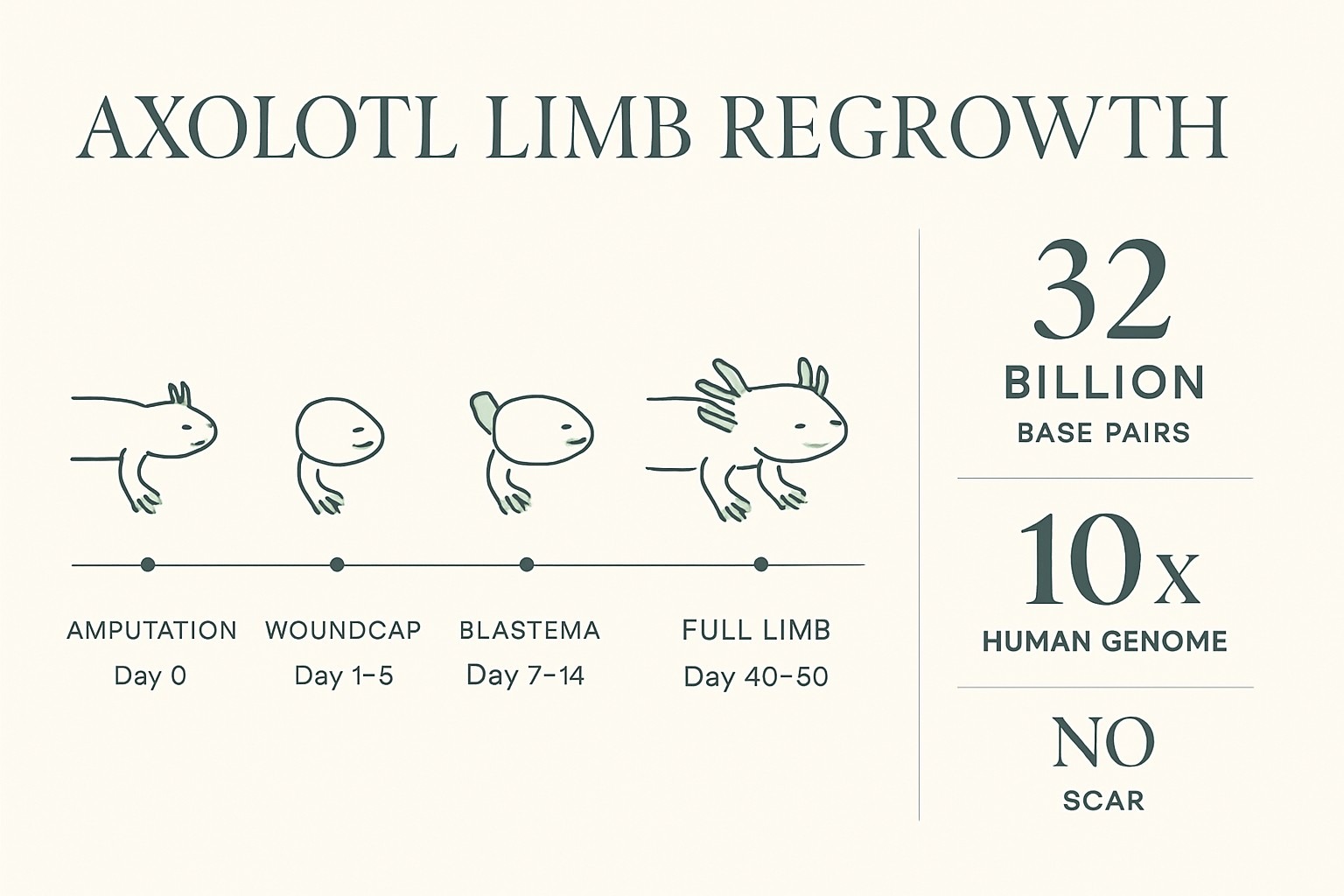
- A complete limb typically regenerates in roughly 40–60 days in a young adult; the new limb arrives correctly oriented, correctly sized, and correctly patterned every time.
- The animal’s genome is about 32 billion base pairs — roughly ten times the human genome — and was the largest ever fully assembled when an IMP Vienna and MPI-CBG team published it in 2018.
- A 2025 study from James Monaghan’s lab at Northeastern University identified retinoic acid and the enzyme CYP26B1 as the chemical “GPS” that tells a regenerating axolotl whether to build a hand or a whole shoulder.
- In the wild, the species is critically endangered: surveys in Lake Xochimilco, near Mexico City, estimate 50–1,000 individuals remaining — down from about 6,000 per square kilometre in 1998.
In short: the axolotl rebuilds lost body parts by forming a mass of “reset” cells called a blastema at the wound. Chemical signals — chiefly retinoic acid — tell those cells what to become and where to stop. Decoding that recipe is now one of the hottest tracks in regenerative medicine.
Key Facts
- The axolotl (Ambystoma mexicanum) can fully regrow amputated limbs, parts of its heart, spinal cord, jaw, gills, eye tissue, and sections of its brain, without forming scar tissue.
- A complete limb typically regenerates in roughly 40 to 60 days in a young adult, arriving correctly oriented, sized and patterned every time.
- The animal’s genome is about 32 billion base pairs, roughly ten times the human genome, and was the largest ever fully assembled when published by an IMP Vienna and MPI-CBG team in 2018.
- A 2025 study from James Monaghan’s lab at Northeastern University identified retinoic acid and the enzyme CYP26B1 as the chemical GPS guiding regeneration.
- In the wild the species is critically endangered: Lake Xochimilco surveys estimate 50 to 1,000 individuals remaining, down from about 6,000 per square kilometre in 1998.
In short: Axolotls regrow lost limbs by forming a blastema a mass of reset, dedifferentiated cells at the wound, which replays embryonic limb development. A complete limb regenerates in roughly 40 to 60 days, correctly sized and patterned. A 2025 study from James Monaghan’s lab identified retinoic acid and the enzyme CYP26B1 as the chemical GPS guiding the rebuild.
A salamander that never grows up
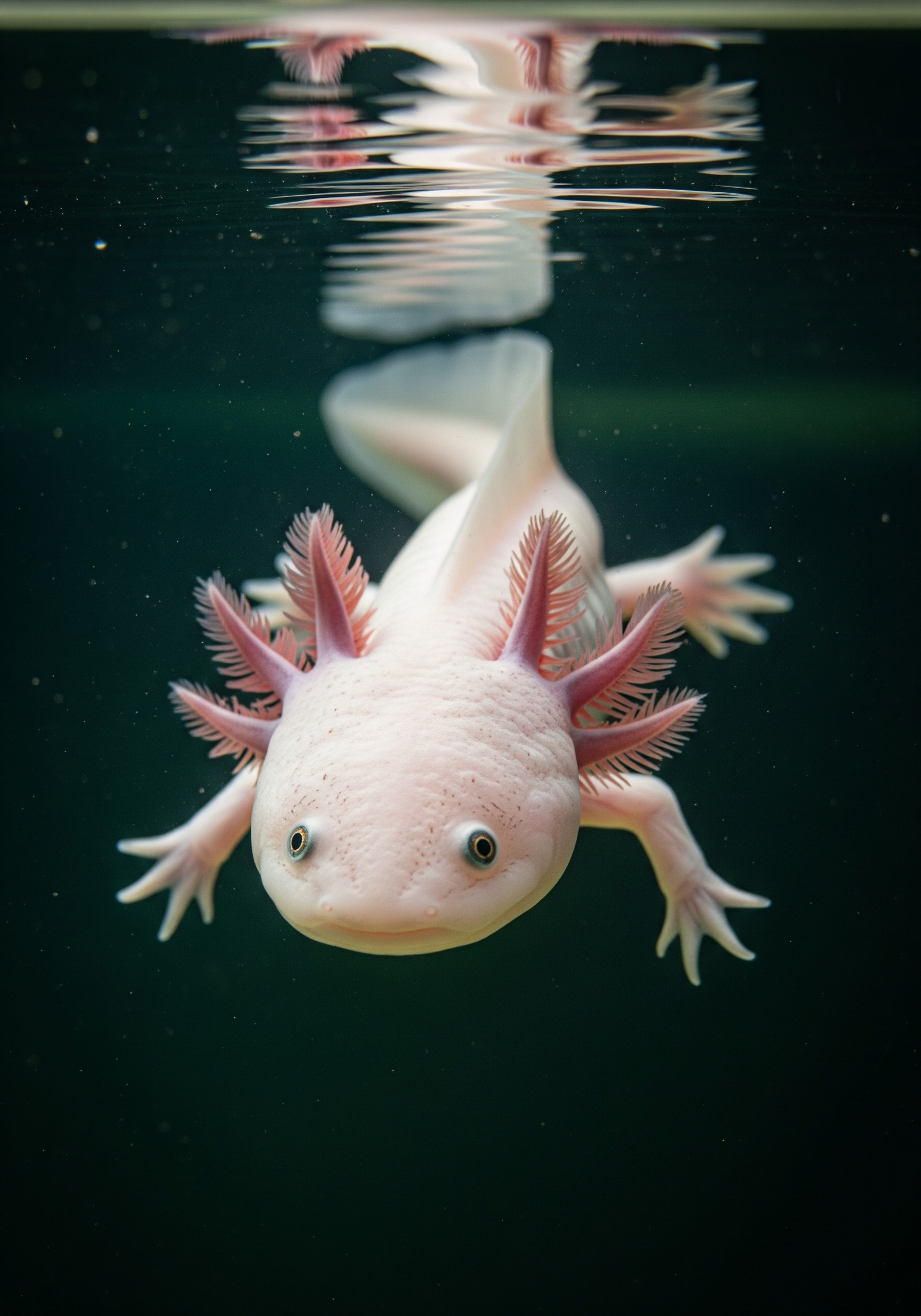
The axolotl is a paedomorphic salamander: it keeps its larval traits — feathery external gills, finned tail, aquatic lifestyle — for life, instead of metamorphosing onto land like its cousins. Native to a single high-altitude lake system in the Valley of Mexico, it was sacred to the Aztecs and named for the god Xolotl, who, in the myth, hid in the water disguised as one.
That eternal-larva biology is not just charming. It is mechanically central to why the animal regenerates so well. Larval salamanders across many species can regrow limbs; most lose the ability when they metamorphose. The axolotl never does. It carries embryo-grade tissue plasticity into adulthood — and that is the trait the world’s biologists have been quietly trying to borrow for decades.
Inside the wound: how axolotls regrow limbs
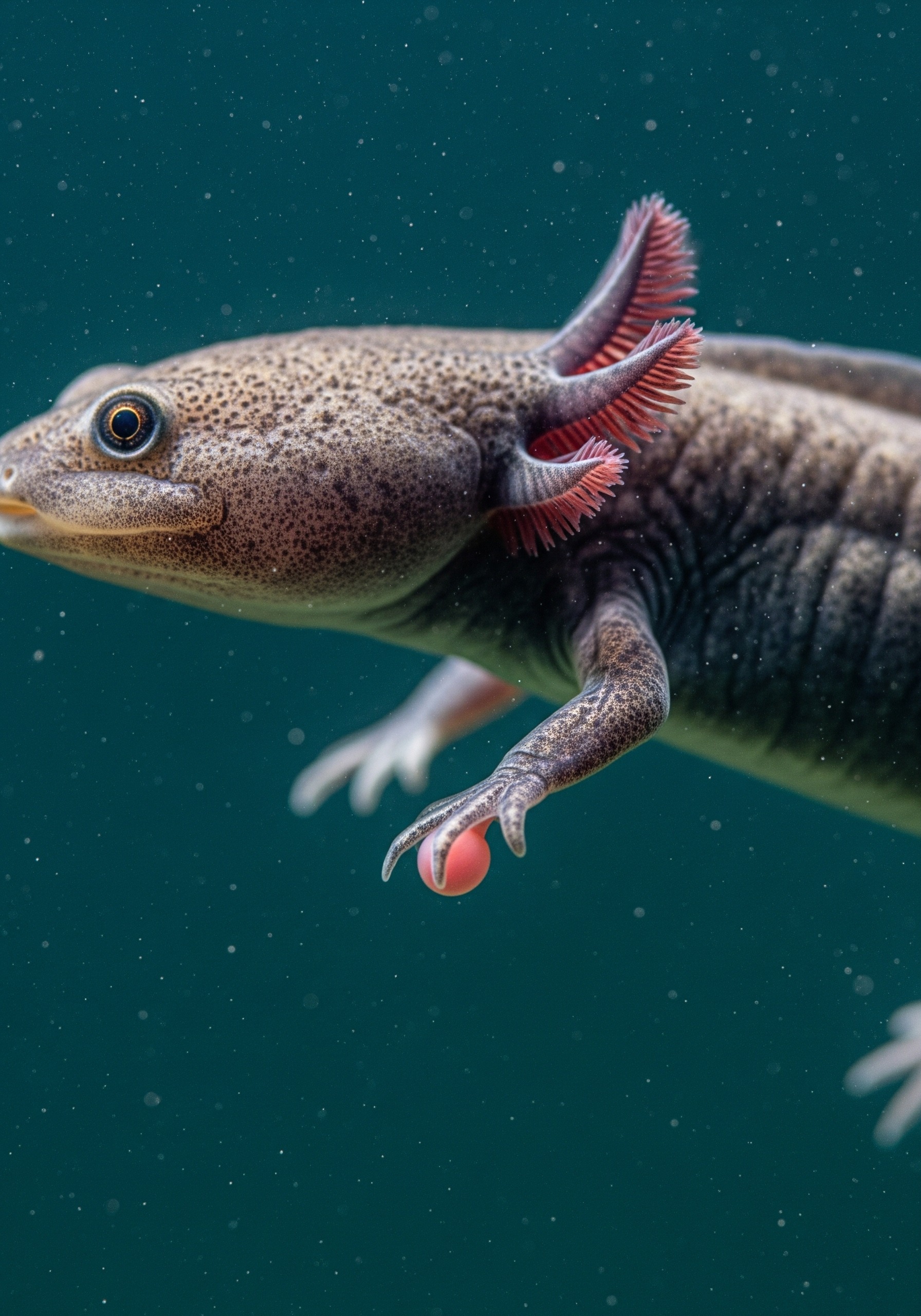
Watch a regenerating axolotl arm under a microscope and you will see something stranger than healing. Cells near the wound do not just multiply — they go backwards. Mature skin, muscle and connective-tissue cells dedifferentiate: they shed their adult identity and revert to a more embryonic state, then pool into a small bud beneath a special wound covering called the apical epithelial cap.
That bud is the blastema — the engine room of axolotl regeneration. It is roughly equivalent to the cell population that builds your limbs in the womb, except the axolotl can summon one on demand, decades after development is “supposed” to be over.
{IMAGE_2}
The blastema then runs a fast-forward replay of embryonic limb development. Cells at the tip stay proliferative and undifferentiated; cells at the base begin to specialise, rebuilding bone, cartilage, muscle, vessels and nerves outward in the correct order. A 2025 paper from Elly Tanaka’s group at the Research Institute of Molecular Pathology in Vienna showed that connective-tissue cells, not muscle or skin, are the indispensable backbone of this process — strip them out and the blastema collapses.
One detail still astonishes researchers: positional memory. A cell from a regenerating shoulder “knows” it is a shoulder cell and will not build a hand. A cell from a wrist will not build an elbow. The wound knows where on the body it is, and only the missing portion is rebuilt — never too much, never too little.
The retinoic-acid clock that decides “hand or whole arm”
How does the wound know? For most of the last century, the honest answer was: we don’t, exactly. That changed in May 2025, when James Monaghan, chair of biology at Northeastern University, and colleagues published in Nature Communications what looks like the long-missing piece. The signal is retinoic acid — a small, well-known vitamin-A derivative — distributed along the limb in a gradient: highest near the shoulder, lowest at the fingertips.
An enzyme called CYP26B1 is the gradient’s editor. It breaks retinoic acid down at a precise local rate, so each point along the limb sits at a specific concentration. The cells of the blastema read that concentration like a thermometer reads a temperature and rebuild only what is missing from that point outward. Higher reading: rebuild a whole arm. Lower reading: rebuild just a fingertip. Downstream, the team showed, retinoic acid switches on a gene called shox, which drives long-bone elongation.
Here is the part that matters for medicine: humans have retinoic acid too. We have CYP26B1. We have fibroblasts — connective-tissue cells — sitting under every patch of our skin. We just don’t run the program. As Monaghan has put it, the question is no longer whether the chemistry exists in us, but whether our cells can be persuaded to listen.
Limbs are only the beginning
The headline trick is the leg. The real story is the inventory. In the lab, axolotls have successfully regrown — at the tissue level, scar-free — limbs, tail, gills, jaw, teeth, parts of the heart, sections of the spinal cord, eye lens and retina, parts of the lung, liver, ovary, and the telencephalon (the forebrain region that, in mammals, corresponds to the cerebral cortex).
Brain regrowth is the part that sounds like science fiction. In 2022, teams at ETH Zurich (Treutlein Lab) and IMP Vienna (Tanaka Lab) surgically removed a chunk of axolotl telencephalon and tracked the recovery with single-cell RNA sequencing. Over roughly one to twelve weeks, progenitor cells proliferated, differentiated into neuroblasts, and matured into the same neuron subtypes that had been removed. Severed connections re-formed; original function returned. Mammalian brains do not do this. Ours patch the hole with a glial scar and move on.
Heart tissue is similarly striking. A damaged human heart heals by laying down inert scar tissue that never beats again — the reason heart attacks cause permanent loss of function. An axolotl rebuilds beating muscle.
It is, frankly, hard to overstate how unusual all this is among vertebrates with a backbone like ours.
Axolotl healing vs. human healing
This is where the comparison becomes blunt:
| Injury | Axolotl outcome | Human outcome |
|---|---|---|
| Amputated limb | Full regrowth, bones + nerves + skin, ~40–60 days | Stump heals; no regrowth (fingertips in young children: limited) |
| Heart muscle damage | Functional muscle rebuilt; no scar | Permanent fibrous scar; function lost |
| Severed spinal cord | Axons regrow across the gap; mobility restored | Glial scar blocks regrowth; paralysis below the lesion |
| Brain tissue loss | Telencephalon section can be rebuilt, neuron types restored | No regrowth; deficit is permanent |
| Skin wound | Scar-free re-formation of skin, hair-equivalent and glands | Fibrotic scar; appendages do not return |
The axolotl, by the numbers
- 32 billion — base pairs in the axolotl genome (~10× human)
- 40–60 days — typical time to regrow an adult forelimb
- 50–1,000 — estimated wild individuals in Lake Xochimilco (Mexico)
- ~170× — decline in axolotl density per km² from 1998 to 2020
- 1864 — year the first live axolotls reached European labs from Mexico
Why salamanders kept the trick mammals lost
Every embryo, including yours, can do something like this. We arrive in the world from a single cell. The cellular machinery for building a limb from scratch is in our DNA — it is in the axolotl’s DNA too. The honest answer to “why don’t we regenerate?” is that nobody fully knows. Two long-standing hypotheses are worth naming, and both are still debated.
The first is the immune-system trade-off: mammals invest in fast, aggressive wound closure to keep blood-borne infections out. Scar tissue is the price of speed. Salamanders, living wet, can afford to heal slower and rebuild properly. The second is a tumour-suppression trade-off: large, long-lived warm-blooded animals carry stricter brakes on cell proliferation, because uncontrolled regrowth is exactly what cancer looks like. Axolotls, oddly, are remarkably cancer-resistant despite their regenerative cells — and that is itself a puzzle researchers want to crack.
Either way, the program is not gone in mammals. It is silenced. That is why the field has moved from “can we copy axolotls?” to “can we wake up what’s already in us?”
The catch: the species saving medicine is dying in the wild
The irony is sharp. Hundreds of thousands of axolotls live in research aquariums and home tanks around the world. The wild axolotl, however, exists in essentially one place on Earth — the canals of Lake Xochimilco, a remnant of the old Aztec lake system south of Mexico City — and it is critically endangered. The IUCN classes the species one step from “extinct in the wild.” Survey numbers from the Universidad Nacional Autónoma de México (UNAM) put the remaining wild population somewhere between roughly 50 and 1,000 individuals; sample counts collapsed from about 6,000 per square kilometre in 1998 to around 35 per square kilometre by 2020.
The causes are unglamorous and human: urban runoff and sewage entering the canals, water-quality collapse, and invasive tilapia and carp introduced in the 1970s that eat juvenile axolotls and outcompete the adults. A 2025 paper in PLOS One reported a rare piece of good news — 18 captive-bred axolotls released into restored chinampas (the floating-garden farm plots that once kept the lake healthy) and an artificial wetland at La Cantera Oriente survived and dispersed. It is a foothold, not a recovery.
The animal that may eventually help humans regrow tissue cannot, right now, regrow its own habitat. That is not a poetic flourish; it is a problem the field has to face head-on.
Could humans ever do this?
Honest answer: not soon, and probably never in the “regrow a whole arm in the clinic” sense. Realistic answer: pieces of it, maybe within our lifetimes. The near-term targets are not science-fiction limbs. They are scar-free wound healing, partial heart-muscle recovery after infarction, optic-nerve regrowth in the eye, and limited spinal-cord repair. Each is a place where understanding axolotl signalling — retinoic acid, CYP26B1, the connective-tissue cell programs identified by Tanaka’s group, the sympathetic-nervous-system “alarm” that primes regeneration body-wide reported by MDI Biological Laboratory researchers — gives human medicine a concrete lever to test.
The catch in translating any of this is that humans aren’t axolotls. Our cells are bigger, our genomes are more streamlined, our immune systems are louder, and we run hotter. A signal that triggers clean regrowth in a 17 °C aquarium salamander can trigger fibrosis or tumour growth in a 37 °C mammal. The work is real; the timeline is honest scientists shrugging.
Frequently Asked Questions
Q: How many times can an axolotl regrow the same limb?
A: Many. In laboratory work, axolotls have regrown the same limb on the order of five or more times in a row with little quality loss. Very old animals regenerate more slowly and somewhat less perfectly, but the fundamental ability does not vanish.
Q: Do all salamanders regrow limbs, or just axolotls?
A: Many salamanders can regrow limbs as larvae, and several species retain the ability as adults. The axolotl is famous because it stays in its larval form for life (a condition called neoteny) and so keeps its regenerative powers at full strength throughout adulthood.
Q: Does the axolotl feel pain when it regenerates?
A: Axolotls have a nervous system and respond to noxious stimuli, so the assumption in research and pet care is yes — injuries hurt them, and procedures are done under anaesthesia. Regrowth itself is not thought to be painful, but the field is appropriately cautious.
Q: If axolotls can regrow limbs, why are they endangered?
A: Because regeneration is an individual superpower, not a population one. An axolotl can fix a chewed leg, but it cannot survive a polluted canal, an invasive tilapia eating its eggs, or the disappearance of its only native habitat. The species is threatened by ecology, not by injury.
Sources
- Monaghan Lab, Northeastern University — 2025 study in Nature Communications on retinoic acid, CYP26B1 and the shox gene in axolotl regeneration.
- Tanaka Lab, Research Institute of Molecular Pathology (IMP), Vienna — connective-tissue cell work and the 32-billion-base-pair axolotl genome assembly.
- Treutlein Lab, ETH Zurich — single-cell RNA sequencing of axolotl telencephalon regeneration.
- IUCN Red List and Universidad Nacional Autónoma de México (UNAM) population surveys of Ambystoma mexicanum in Lake Xochimilco.
- PLOS One, 2025 — first documented survival of captive-bred axolotls released into restored Xochimilco chinampas.
A salamander barely longer than a hand is rewriting what mammals — including us — believe a wound has to mean. Whether human medicine ever borrows the full trick or only a sliver of it, the axolotl has already done the harder job: it has proven, in living tissue, that “permanent damage” is a choice biology made, not a law it had to obey.
Illustrations are AI-generated. Article fact-checked and human-edited. Our editorial standards.