These Women Turn Fish Scales Into Luxury Accessories
Women in Tanzania are turning fish waste into accessories that sell internationally. Not because anyone told them to. Because the waste was there, the material was free, and nobody else was looking at it.
Here’s the part that kept me reading: in fishing communities along Lake Victoria and the Indian Ocean coast, what gets discarded by the tonne — scales, skin, tissue — has quietly become the foundation of a cottage industry that’s competing with mass-produced goods in London and New York. It starts with observation. It starts with a single iridescent scale that most people would step over. And it ends with someone realizing that the thing everyone’s been throwing away is actually valuable.
Key Facts
- Tanzania’s fishing industry processes over 400,000 tonnes of fish annually (FAO, 2022), generating large volumes of scale and skin waste.
- Fish scales are 41–54% collagen by dry weight, depending on species.
- Marine collagen from fish byproduct is projected to make up over 30% of the global collagen market by 2027.
- The global ethical fashion market was valued at over $8.5 billion in 2023.
- Fish scales shimmer because of the stratum argenteum, a reflective layer of guanine crystals — the same compound that gives pearls their luster.
In short: Women in Tanzania’s fishing communities turn discarded fish scales into earrings, necklaces, wallets and handbags sold internationally. Scales are 41–54% collagen by dry weight, a high-quality biomaterial the cosmetics industry prizes. With Tanzania processing over 400,000 tonnes of fish a year, the craft converts waste into products fitting the growing ethical fashion market.
Fish Scale Accessories Nobody Thought Were Possible
Tanzania’s commercial fishing operations generate enormous volumes of biological waste. Scales pile up. Skin rots in equatorial heat. Viscera leaches into waterways. The industrial fishing trade treats this as a disposal problem — something to move away from the processing zones as quickly as possible.
According to the circular economy model, which economists have spent decades studying and governments billions trying to incentivize, this represents trapped value. Collagen-rich material. Structural biomatter. Resources that industrial systems haven’t learned to recapture.
But some women in East Africa didn’t wait for theory. They started experimenting with what was free. What was everywhere. What nobody wanted.
The Process Is More Complex Than It Looks
Making fish scale accessories requires patience that doesn’t fit into an afternoon.
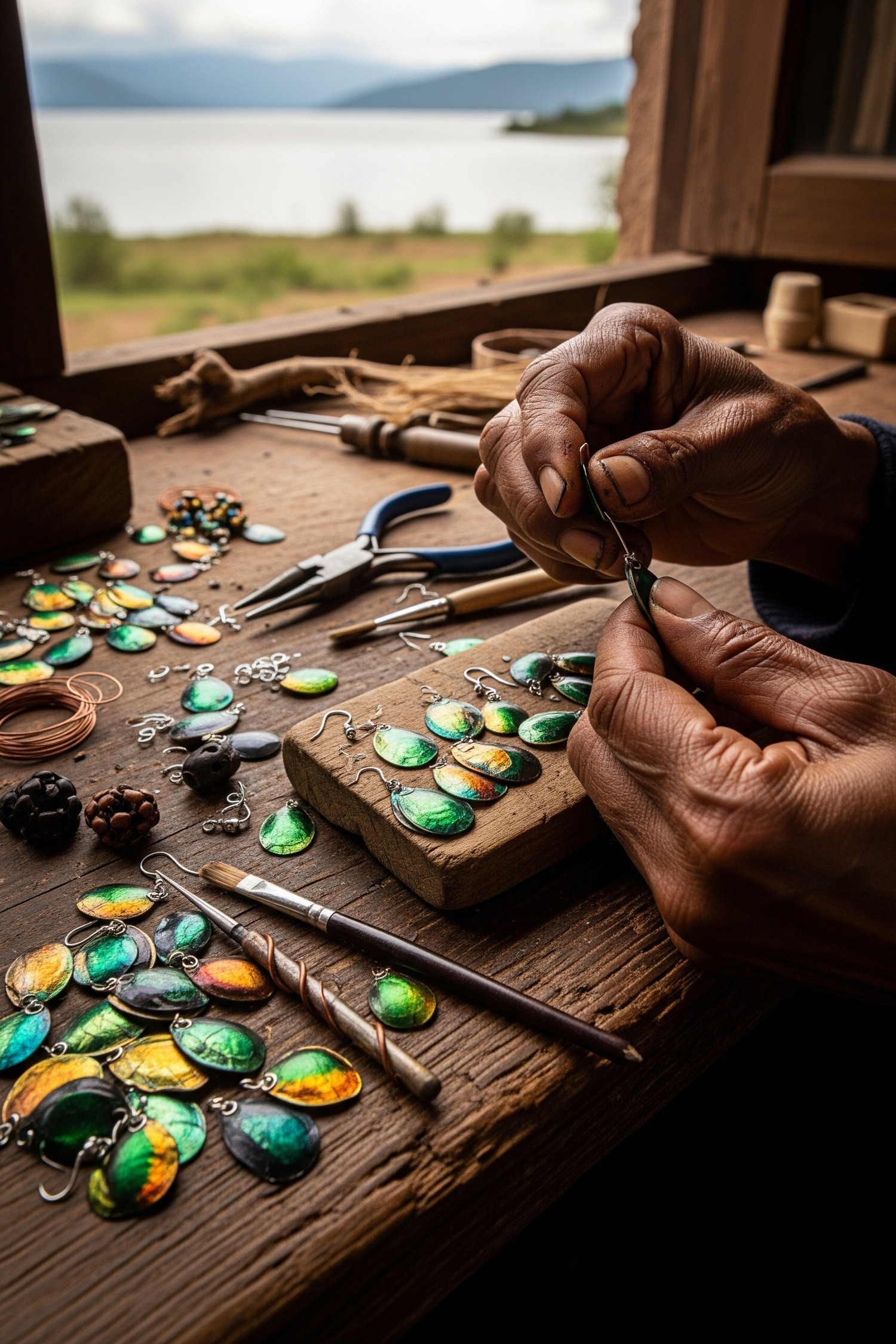
Each scale is harvested by hand, scrubbed clean of tissue, treated to remove odor and bacteria. Then comes the dyeing — and here’s where most people would give up. You can’t rush the drying. Temperature matters. Humidity matters. Get it wrong and the scales warp, crack, lose their structural integrity. Get it right and what emerges is flexible, surprisingly tough, and has a natural iridescent shimmer that synthetic materials spend millions trying to replicate.
The women doing this didn’t have a lab or a grant. They had time, scales, and a problem that needed solving. Trial and error. Ruined batches. The slow accumulation of knowledge.
You can read more about unexpected natural materials being repurposed at this-amazing-world.com.
Why Fish Scales Behave Like Luxury Material
Here’s where it gets strange. Fish scales are roughly 50% collagen by dry weight — the same structural protein that gives luxury leather its flexibility, and the same compound that high-end cosmetic brands synthesize at significant cost. The collagen in fish scales isn’t some inferior cousin to bovine collagen. It’s biologically similar enough that researchers have studied it as a low-cost alternative for medical applications.
In other words, fish scale accessories aren’t made from “waste” in any meaningful chemical sense. They’re made from a concentrated, high-quality biomaterial that just happens to come attached to dinner.
Nobody told the fishing industry that.
The women figured it out themselves.
From the Shores of East Africa to Global Markets
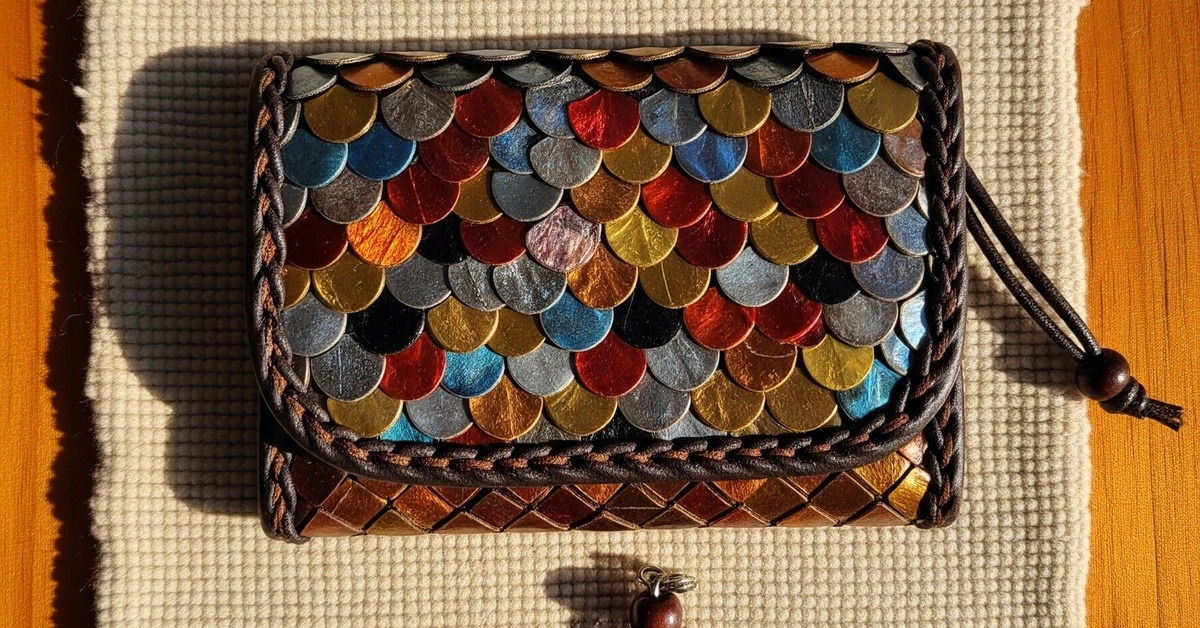
The finished products aren’t craft-fair trinkets or novelties. Fish scale accessories coming out of Tanzanian workshops include earrings, necklaces, cuffs, small wallets, and structured handbags — items with clean lines and confident design. Several cooperatives have connected with fair-trade networks and ethical fashion buyers who specifically seek materials with a documented waste-reduction story.
International consumers, particularly in Europe, have shown consistent appetite for products that can demonstrate a measurable environmental benefit. Fish scales, which would otherwise decompose in the open air near fishing docks, deliver that story — and the aesthetic to back it up. The iridescence doesn’t fade the way you’d expect. The texture is unlike anything mass-produced. Every piece is different, because every scale is different.
That’s the selling point.
The Collagen Secret the Beauty Industry Already Knows
It turns out the cosmetics and pharmaceutical industries have been quietly interested in fish-derived collagen for years. Marine collagen — extracted from fish skin and scales — has become a significant ingredient in anti-aging skincare, with global market projections running into the billions. The collagen extracted industrially from fish byproduct is chemically processed, concentrated, sold at significant markup.
The women crafting fish scale accessories in Tanzania are working with the same base material, in its most structurally elegant form, without any of that processing. They’re using the whole thing. Intact. As it was designed by biology. That’s not a coincidence. It’s what happens when people who live close to a resource pay close enough attention to understand what it actually is.
By the Numbers
- Tanzania’s fishing industry processes over 400,000 tonnes of fish annually (FAO, 2022). That’s an enormous volume of scale and skin waste with historically no formal recovery pathway.
- Marine collagen from fish byproduct is projected to represent over 30% of the global collagen market by 2027 — driven by consumer demand for non-bovine alternatives in cosmetics and nutraceuticals.
- Fish scales are 41–54% collagen by dry weight, depending on species. Comparable to processed collagen supplements sold commercially.
- The global ethical fashion market was valued at over $8.5 billion in 2023. Waste-derived and upcycled materials are among the fastest-growing categories.
Field Notes
- Fish scales contain a reflective layer called the stratum argenteum, composed of guanine crystals — the same compound that gives pearls their luster. This is why fish scale accessories have that distinctive natural shimmer that’s nearly impossible to fake with synthetic coatings.
- Experienced Tanzanian dyers read a batch of scales visually before dyeing, adjusting concentration based on the scale’s layered microstructure, which absorbs color differently than fabric or leather. This is a skill developed entirely through practice.
- Nile perch scales found in Lake Victoria can reach sizes comparable to a large coin. Their larger size and uniform curvature make them viable for structured pieces like bag panels.
Why This Story Is Bigger Than One Earring
The fish scale accessories coming out of Tanzania represent something that economists have been trying to model for decades: a genuinely circular material loop, running entirely on local knowledge, local labor, and material that costs nothing to source. No subsidy. No external investment. No technology that wasn’t already available.
Just careful observation and the willingness to treat discarded material as a resource instead of a problem. That shift in perspective sounds simple. It’s actually the hardest part.
The women aren’t waiting to be discovered. They’re running cooperatives, training other women, expanding product lines, navigating international supply chains on their own terms. The circular economy isn’t an idea they read about. It’s the business they built.
A fish scale is one of the most overlooked objects on the planet. It’s also collagen-rich, structurally elegant, and capable of being transformed into something a buyer in another hemisphere will choose over mass-produced plastic every single time. That’s not small. That’s a reminder that the solutions to some of our most stubborn waste problems might already exist — sitting in a pile, waiting for someone to look at them differently. More at this-amazing-world.com.
Frequently Asked Questions
Q: How are fish scale accessories made?
Each scale is harvested by hand, scrubbed clean of tissue, and treated to remove odor and bacteria, then carefully dyed. The drying stage is the hardest: temperature and humidity must be controlled, or the scales warp, crack and lose integrity. Done right, the result is flexible, surprisingly tough and naturally iridescent. The women refined the process through trial and error, ruined batches and slow accumulation of knowledge, without a lab or grant.
Q: Why are fish scales considered a valuable material?
Because they are 41–54% collagen by dry weight — the same structural protein that gives luxury leather its flexibility and that cosmetic brands synthesize at significant cost. Marine collagen extracted from fish skin and scales is already a major skincare ingredient, projected to make up over 30% of the global collagen market by 2027. So fish scale accessories aren’t really made from waste but from a concentrated, high-quality biomaterial.
Q: Why do fish scale accessories shimmer?
Fish scales contain a reflective layer called the stratum argenteum, composed of guanine crystals — the same compound that gives pearls their luster. This is why the accessories have a distinctive natural shimmer that synthetic materials struggle to fake. The iridescence doesn’t fade the way you’d expect, and because every scale is different, every finished piece is unique, which has become a key selling point in international markets.
Q: Where are these accessories sold?
They are made in Tanzanian workshops along Lake Victoria and the Indian Ocean coast and sold internationally, competing with mass-produced goods in cities like London and New York. Several cooperatives have connected with fair-trade networks and ethical fashion buyers who seek materials with a documented waste-reduction story. European consumers in particular have shown consistent appetite for products that demonstrate a measurable environmental benefit, which discarded fish scales deliver.
Illustrations are AI-generated. Article fact-checked and human-edited.