The Day the U.S. Navy Delivered Mail by Missile (1959)
What if the United States military’s most fearsome weapon could deliver birthday cards? On June 8, 1959, it did exactly that — a Regulus I cruise missile packed with roughly 3,000 letters, launched from a submarine, arcing across the Atlantic in 22 minutes to land at a Florida airfield. The experiment was real. The future it promised never arrived.
The USS Barbero surfaced briefly off the Atlantic coast, launched the missile, and made history in the most American way imaginable: by pointing a weapon at a problem that didn’t need solving. Postmaster General Arthur Summerfield called it the future. The U.S. Postal Service eventually called it a stunt.
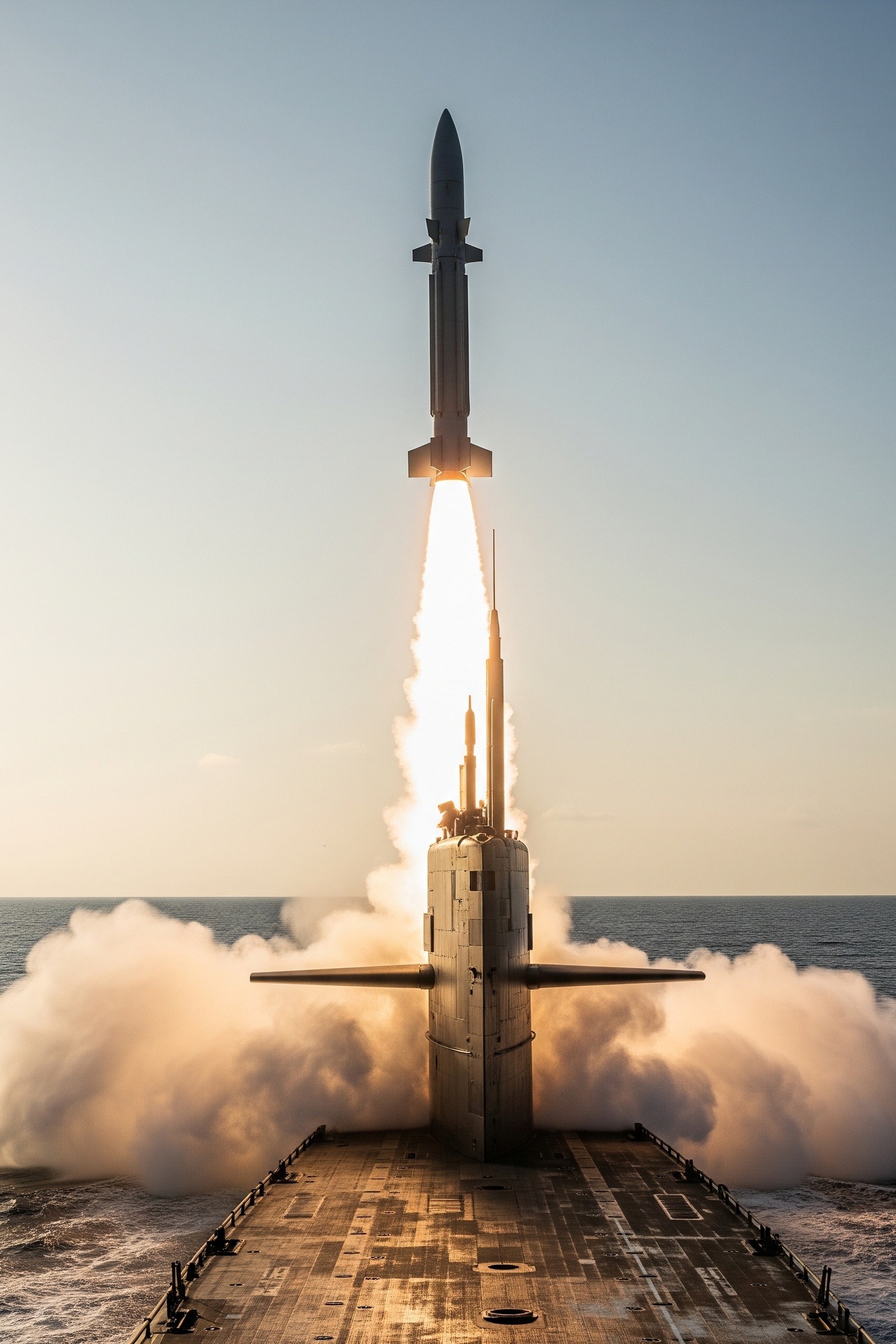
Both assessments were correct.
Key Facts
- On June 8, 1959, the submarine USS Barbero launched a Regulus I cruise missile carrying roughly 3,000 letters.
- The missile covered more than 100 miles in about 22 minutes, landing at Mayport Naval Auxiliary Air Station in Florida.
- The Regulus I, built by Chance Vought and deployed by the U.S. Navy in 1955, had a range of roughly 500 nautical miles.
- Postmaster General Arthur Summerfield championed missile mail as the future of postal delivery.
- The Regulus I cruised at roughly 600 mph and was guided by active radio command from ground stations.
In short: On June 8, 1959, the submarine USS Barbero fired a Regulus I cruise missile carrying about 3,000 letters, which crossed over 100 miles in 22 minutes to Mayport, Florida. Postmaster General Arthur Summerfield hailed missile mail as the future, but the economics — each delivery consumed a weapons system — meant it never scaled beyond a Cold War publicity stunt.
A Weapon Designed for Something Else Entirely
Developed by Chance Vought Corporation and first deployed by the U.S. Navy in 1955, the Regulus I was a subsonic cruise missile with a range of roughly 500 nautical miles. Originally designed to carry a nuclear warhead with a yield sufficient to level a city block, it had been the Navy’s primary nuclear deterrent in the years before submarine-launched ballistic missiles made it obsolete. The Regulus missile program represented frontline Cold War anxiety at its most concrete — a weapon that could cross oceans, evade detection, arrive without warning.

By 1959, its days as a serious deterrent were numbered. But before the program wound down, someone in Washington had a very different idea for it.
Arthur Summerfield, Postmaster General, had already made a name for himself as a modernizer — someone who believed the postal service could be transformed by technology in the same way the military had been. He wasn’t wrong about technology changing delivery. He was just spectacularly wrong about which technology. Summerfield had access, ambition, and a gift for the dramatic. When the Navy offered him a missile, he didn’t ask whether it made sense.
He asked how many letters it could carry.
The answer was approximately 3,000. Special commemorative covers, each stamped and addressed, each destined for government officials across the country. They were loaded into a repurposed missile body and sealed inside the warhead compartment. Someone’s correspondence was about to travel faster than sound.
Twenty-Two Minutes Over the Atlantic Sky
A submarine crew trained for nuclear warfare was preparing to fire a weapon at Florida so that postal workers could sort letters. The USS Barbero — a Tunny-class submarine already modified to carry Regulus missiles — had positioned itself off the eastern seaboard for launch. Think about the gap between the scale of the machinery and the domesticity of the mission. It’s genuinely dizzying.
The missile launched on June 8, 1959, covering more than 100 miles in approximately 22 minutes before touching down at the Naval Auxiliary Air Station in Mayport, Florida. The Regulus I had a cruising speed of roughly 600 miles per hour — close to the speed of sound at sea level. This was not autopilot. Someone was manually flying the mail.
Guidance required active radio command from ground stations, meaning there were people on the ground actively steering it toward a runway rather than a target. Someone’s correspondence was about to arrive, and it would get there because of human hands on controls, calculating trajectory and drift in real time.
Postal workers at Mayport received the missile, extracted the letters, and sorted them by hand. The mundane conclusion to an extraordinary flight. Summerfield was there in person to accept the first delivery. He described it, without irony, as a proud moment for the United States. What he didn’t say — what nobody said out loud that morning — was that the entire premise had already been abandoned by everyone who mattered.
The Vision That Never Scaled
Arthur Summerfield genuinely believed in missile mail. That’s the part the history books tend to understate. He wasn’t simply staging a press event — he was articulating a vision, however impractical, of a postal network that moved at military speed. In a Smithsonian Magazine retrospective on the event, the experiment is framed as a collision between Cold War optimism and the hard arithmetic of infrastructure.
Summerfield predicted that missile mail 1959 would be the blueprint for a global delivery system within years. He envisioned missiles arcing between continents, delivering correspondence in hours rather than days. The technology, he argued, already existed. The will just needed to follow.
Why does economics matter more than vision? Because it has to. Each Regulus I missile cost significantly more than a conventional aircraft delivery. The guidance infrastructure — the ground stations, the trained operators, the naval coordination required to launch and recover a missile safely — would have required an investment that dwarfed any postal savings. And that’s before addressing the fundamental problem: missiles aren’t recoverable. You don’t land them, repack them, and launch again. Every delivery consumed a weapons system.
No serious study by the Navy or the Post Office Department in 1959 suggested the economics were defensible. The experiment was, at its core, a Cold War publicity move. The message wasn’t really about mail. It was about capability — a demonstration that U.S. technology could deliver anything, anywhere, at speed. The letters were almost incidental to the point. And watching a government bureau devote resources to proving a capability it would never use, you start to understand something essential about that era’s machinery: it was built as much to reassure itself as to intimidate anyone else.
What Actually Survived
The Regulus program itself was shuttered by 1964, replaced by far more capable submarine-launched ballistic missiles like the Polaris. The USS Barbero was decommissioned in 1964 as well, its brief career as a postal vehicle long forgotten by the Navy’s strategic planners.
But the missile mail 1959 experiment has endured in the cultural record not because it succeeded, but because it so perfectly encapsulates a specific kind of Cold War thinking — one in which the same object could simultaneously represent existential threat and domestic optimism. The Regulus carried nuclear warheads and birthday cards. It was designed to end cities and to connect families. The era demanded that its machines be capable of both, and the era’s promoters were happy to demonstrate either on any given morning.
Soviet planners in the same period pursued parallel experiments in applying military logistics to civilian problems — with similarly uneven results. But the missile mail event has a particular American quality to it: the showmanship, the Postmaster General’s personal presence, the commemorative covers addressed to officials who would frame them rather than read them. It was designed to be witnessed. The actual delivery was secondary to the image of delivery.
The commemorative covers themselves are now collector’s items. Philatelists — stamp and postal history collectors — prize them as genuine artifacts of Cold War culture. A piece of mail that traveled by nuclear-capable missile is, it turns out, exactly the kind of object people want to own. The irony would not have been lost on Summerfield.
How It Unfolded
- 1955 — The Regulus I missile enters active U.S. Navy service as the fleet’s primary sea-launched nuclear deterrent, carried by submarines and surface ships along Soviet-facing patrol routes.
- June 8, 1959 — The USS Barbero launches a Regulus I packed with 3,000 commemorative letters from the Atlantic, completing the missile mail 1959 experiment with a landing at Mayport, Florida, 22 minutes later.
- 1959–1961 — Postmaster General Arthur Summerfield continues to advocate publicly for missile mail as a viable future delivery system, though no further test launches are conducted.
- 1964 — The Regulus missile program is officially decommissioned, replaced by the Polaris submarine-launched ballistic missile; the USS Barbero is retired the same year, ending any theoretical possibility of a missile mail network.
By the Numbers
- 3,000 — approximate number of commemorative letters carried in the Regulus I missile on June 8, 1959 (U.S. Post Office Department, 1959)
- 22 minutes — total flight time from Atlantic launch to landing at Naval Auxiliary Air Station Mayport, Florida
- ~100 miles — distance covered by the missile during the postal delivery flight
- ~600 mph — cruising speed of the Regulus I, close to the speed of sound at sea level
- 500 nautical miles — maximum operational range of the Regulus I missile, giving theoretical reach across large stretches of ocean and coastline
Field Notes
- The commemorative covers from missile mail 1959 were individually addressed from Postmaster General Arthur Summerfield to government officials and dignitaries across the United States — making each one both a historical artifact and a piece of functioning mail that actually went through the postal system after landing.
- The Regulus I missile used in the experiment had its warhead section converted into a sealed mail container, meaning the letters traveled in exactly the same physical space designed to carry a nuclear device. No structural modification was made to the fuselage itself.
- The guidance system for the June 8 flight required active radio control from ground stations — the missile wasn’t autonomous. Human operators at Mayport were effectively “flying” the mail in real time, making corrections until touchdown.
- Historians of Cold War technology still debate whether Summerfield genuinely believed in the scalability of missile mail or whether the stunt was always primarily about optics — and no internal Post Office Department memo from 1959 has surfaced to conclusively settle the question.
Frequently Asked Questions
Q: What exactly was the missile mail 1959 experiment, and did it really work?
Approximately 3,000 commemorative postal covers were loaded into a Regulus I cruise missile and launched from the submarine USS Barbero off the Atlantic coast on June 8, 1959. The missile covered more than 100 miles and landed at Naval Auxiliary Air Station Mayport, Florida, in about 22 minutes. By the narrow definition — did the letters arrive? — yes. By any practical measure of postal viability, it never had a chance.
Q: Why was the Regulus I missile used for mail delivery instead of a conventional aircraft?
Spectacle over efficiency, every time. The Regulus I was the Navy’s frontline nuclear deterrent missile, and repurposing it for mail delivery sent an unmistakable Cold War message: U.S. technology was so advanced, so abundant, that it could deliver your correspondence faster than any rival nation could deliver anything. Postmaster General Arthur Summerfield wanted to demonstrate American capability on a global stage. A propeller plane wouldn’t have made the front pages.
Q: Was missile mail ever seriously considered as a real postal system after 1959?
Summerfield publicly promoted the idea for at least two years after the experiment, predicting routine intercontinental missile delivery within a decade. But here’s the thing: no serious infrastructure planning was ever undertaken. The cost per delivery, the one-time-use nature of missiles, and the rapid development of jet aircraft made the idea economically indefensible. The U.S. Postal Service later acknowledged the event was primarily a publicity demonstration, and the Regulus program itself was decommissioned by 1964 without a single follow-up postal flight.
Editor’s Take — Sarah Blake
What stays with me about missile mail 1959 isn’t the absurdity — it’s the sincerity. Summerfield wasn’t performing optimism. He actually believed the same technology designed to end the world could be domesticated into something as ordinary as a letter carrier. There’s something almost tender about that. An era so saturated with existential dread that it needed its weapons to double as symbols of normalcy. The Cold War asked a lot of its objects. Not least, that they be reassuring.
A cruise missile carrying birthday cards. A naval crew trained for nuclear strikes guiding mail to a Florida runway. Twenty-two minutes that meant everything and changed nothing. The missile mail 1959 experiment failed as logistics and succeeded as mythology — proof that an era’s deepest anxieties tend to surface in its most theatrical gestures. Sixty-five years later, the commemorative covers sit in collectors’ frames. Somewhere in a drawer, there’s a piece of mail that once flew faster than sound, addressed to a world that was trying very hard to believe in its own future.
Illustrations are AI-generated. Article fact-checked and human-edited.