He Collects Trash Off the Street to Build Dog Shelters
A teenager in Spain started collecting trash and somehow ended up solving hypothermia for stray dogs through the winter. Nobody asked him to. He just kept noticing.
Murcia gets cold at night. Not blizzard cold, but the kind of cold that kills when you’re sleeping on concrete with no blanket. Hundreds of dogs do exactly that. One kid walked past them enough times that he stopped being able to look away, so he did what made sense: he grabbed the plastic bottles people threw on the sidewalk and built shelters from them.
No nonprofit. No budget. No permission slip.
Key Facts
- Spain has between 100,000 and 150,000 abandoned dogs on its streets, with abandonment spiking after summer vacations in August and September.
- A single plastic bottle dog shelter uses 200 to 400 recycled bottles that would otherwise spend 450 to 1,000 years decomposing in a landfill.
- Layered plastic panels compressed to 10 to 15 cm thick achieve thermal resistance comparable to polystyrene insulation at zero cost.
- Hypothermia in dogs can start at 7 degrees Celsius (45 degrees Fahrenheit) when conditions are wet and windy.
- The teenager built the shelters in Murcia, Spain, with no nonprofit, no budget, and no permission, inspiring copycat projects in Portugal and Italy.
In short: A teenager in Murcia, Spain builds plastic bottle dog shelters from sidewalk trash to keep stray dogs from freezing on cold winter nights. Each shelter uses 200 to 400 recycled bottles and achieves insulation comparable to polystyrene. The idea spread to Portugal and Italy as proof that zero-budget innovation works.
Why This Actually Works (The Physics Part)
Here’s where it gets interesting. Trapped air is one of the best insulators we know about — it’s literally why double-pane windows exist, why your thermos keeps coffee hot, why you don’t freeze to death in a down jacket. According to the physics of thermal insulation, dead air spaces prevent heat from escaping through conduction and convection. Dr. Anna Folch, a materials researcher who actually studies this stuff, has noted that layered plastic can match basic foam insulation when you pack it right.
So what happens when a teenager with zero engineering training stuffs bottles together?
A lot more than should be possible. Pack the bottles tight. Orient them consistently. Seal them between outer layers. You get a matrix of air pockets that don’t breathe cold in — they keep warmth locked where it needs to be. It’s not magic. It’s just physics that nobody told him was hard.
The Design Is Weirdly Deliberate
The shelters aren’t just boxes stuffed with bottles, and that matters.
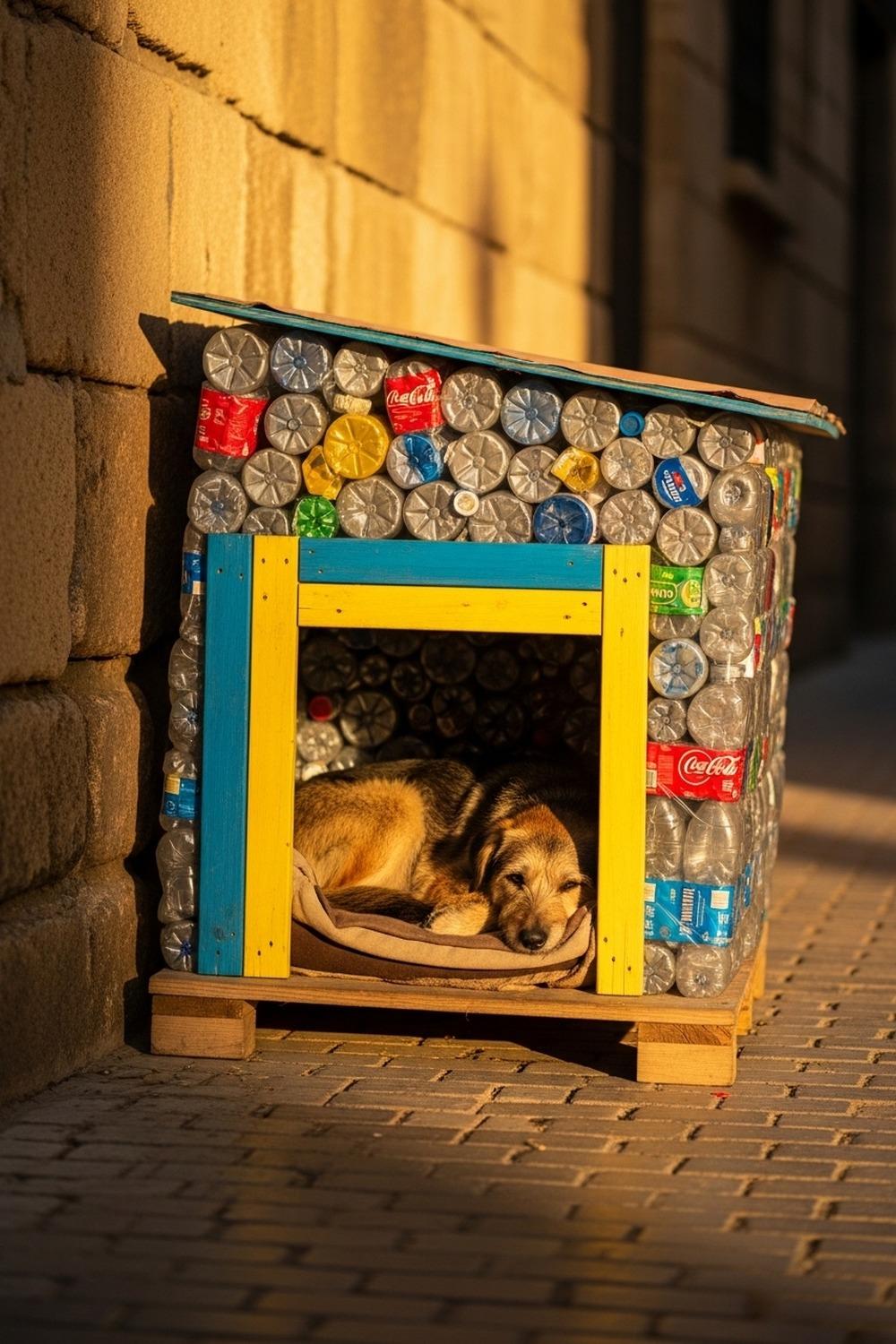
Raised floor — cold ground is one of the biggest killers for outdoor dogs at night. Lifting them even a few inches changes everything. Angled roof that sheds rain instead of pooling it. Bright paint that absorbs daytime sun and converts it to warmth. That’s passive solar design executed with garbage. He also watches where the dogs actually sleep — the familiar corners, the walls they already return to — and builds around their existing sense of home. It’s not construction. It’s empathy with a tape measure.
If you’re interested in humans solving impossible problems with zero budget, there’s a whole rabbit hole at this-amazing-world.com that I kept reading for another hour.
Spain’s Stray Dog Problem Is Quietly Catastrophic
Spain has between 100,000 and 150,000 abandoned dogs on the streets right now. The number spikes after summer — families come back from vacation and just… don’t bring the dog. Murcia’s winters don’t look brutal on a map, but overnight temperatures drop sharply. A dog on stone in those conditions isn’t just uncomfortable. It’s dying slowly.
Plastic bottle shelters don’t fix abandonment.
They fix tonight. For a dog that’s been outside for weeks, tonight is literally all that exists.
One teenager can’t build enough shelters for 150,000 dogs. He knows that. But here’s what’s strange about the math: he doesn’t have to. He just has to prove it’s possible, that the materials are free, that anyone can learn it, and that the problem is standing right there in every street corner.
What Happens When You Build Solutions From Trash
Ideas built from garbage travel light. A shelter made from recycled bottles costs nothing to copy. There’s no patent. The materials aren’t scarce. Once someone sees a photo — bright paint, a dog curled inside, clearly warm — something shifts in people’s brains.
Other teenagers in other cities started collecting bottles after seeing images online. Community groups in Portugal and Italy launched similar projects. The boy in Murcia didn’t mean to start anything. He just refused to keep walking past the problem.
This is what zero-budget innovation actually looks like when it works. It doesn’t ask for approval committees or funding rounds or nonprofit tax status. It sees bottles on pavement, a dog against a wall, and connects them. The result is ugly and perfect and warm.
By the Numbers
- Spain: 100,000–150,000 stray dogs, mostly from post-vacation abandonment spikes in August and September
- Layered plastic panels compressed to 10–15 cm thick achieve thermal resistance comparable to polystyrene insulation — at zero cost instead of significant expense
- A single shelter uses 200–400 recycled bottles. Those bottles would otherwise spend 450–1,000 years decomposing in a landfill where they sat for months before this kid picked them up.
- Hypothermia in dogs: can start at 7°C (45°F) when wet and windy — meaning even a “mild” Spanish winter night is an actual survival threat on bare concrete
Field Notes
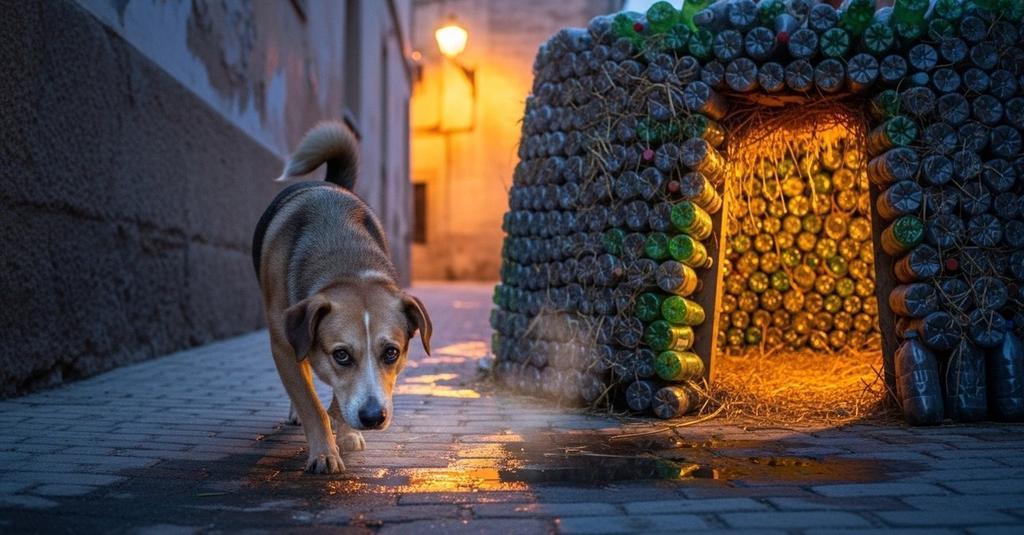
- Stray dogs establish territories. They return to the same sleeping spots every single night. This is why shelter placement matters more than you’d think — the dog has to recognize it as part of its existing home.
- Bottle-brick architecture has been used in human housing across South America and Africa for decades, producing full load-bearing walls that support roofs. Somehow this technique is still basically unknown in mainstream construction.
- Aerospace engineers use the exact same air-gap layering principle to insulate spacecraft components through temperature swings of hundreds of degrees in minutes. A teenager just replicated aerospace-grade insulation with bottles and stubbornness.
Why This Changes Everything
What matters here isn’t the shelters themselves. It’s what they prove: that most problems come with their own solutions lying nearby, waiting to be recognized. Plastic bottle dog shelters are the clearest argument against needing resources to make a difference. You need observation. You need refusal to walk past it. You need to see a bottle in the gutter and a dog against a wall and refuse to treat them as unrelated. That’s learnable. That’s teachable. That’s what spreads.
When one kid reframes waste as a resource and suffering as solvable, it’s not just about warmer dogs. It’s a proof of concept. Other people — kids with empty bottles and no money and too much anger at what they see — can actually follow this.
The boy in Murcia is out there right now, probably collecting bottles, probably counting corners and walls and dogs who’ll never know his name. He’s not waiting for permission. Not waiting for funding. Building with what’s already there. That’s the whole story. And it’s also the instruction manual. If this keeps you wondering, there’s more at this-amazing-world.com — and the next one is even stranger.
“
Frequently Asked Questions
Q: How do plastic bottle dog shelters keep dogs warm?
They rely on trapped air, one of the best insulators known, the same principle behind double-pane windows and thermos flasks. When bottles are packed tightly and sealed between outer layers, they create a matrix of dead air pockets that block heat loss through conduction and convection. Layered plastic compressed to 10 to 15 cm thick reaches thermal resistance comparable to polystyrene insulation, and the design includes a raised floor to lift dogs off cold ground.
Q: How many stray dogs are there in Spain?
Spain has between 100,000 and 150,000 abandoned dogs living on its streets at any given time. The number spikes sharply after summer, particularly in August and September, when families return from vacation and abandon pets they no longer want. In Murcia, overnight winter temperatures drop sharply enough that a dog sleeping on bare concrete faces a genuine survival threat, since hypothermia can begin at 7 degrees Celsius in wet, windy conditions.
Q: How many bottles does one dog shelter need?
A single plastic bottle dog shelter requires between 200 and 400 recycled bottles. Those bottles, collected from sidewalks where people discarded them, would otherwise spend an estimated 450 to 1,000 years decomposing in a landfill. The shelters cost nothing to build, there is no patent, and the materials are abundant, which is exactly why the idea spread quickly to other cities and countries once photos appeared online.
Q: Did the plastic bottle dog shelter idea spread to other countries?
Yes. After photos of the bright, dog-filled shelters appeared online, other teenagers in other cities began collecting bottles to build their own. Community groups in Portugal and Italy launched similar projects. The boy in Murcia did not set out to start a movement, but because the materials are free and the technique is easy to copy, the concept traveled fast as a proof of concept that anyone could replicate with bottles and effort.
Illustrations are AI-generated. Article fact-checked and human-edited. Our editorial standards.