Varna Gold Older Than Pyramids: The 6,500-Year Secret
You have probably seen the headline — Varna gold older than pyramids — and filed it under internet exaggeration. It isn’t. On the Bulgarian coast of the Black Sea, in a waterlogged cemetery dug up by accident in 1972, archaeologists found roughly six kilograms of worked gold that predates the Great Pyramid of Giza by about two thousand years. The gold is real, the dates are carbon-checked, and the story behind it is far stranger than the one about Egypt and Sumer we all learned in school.
Key Facts
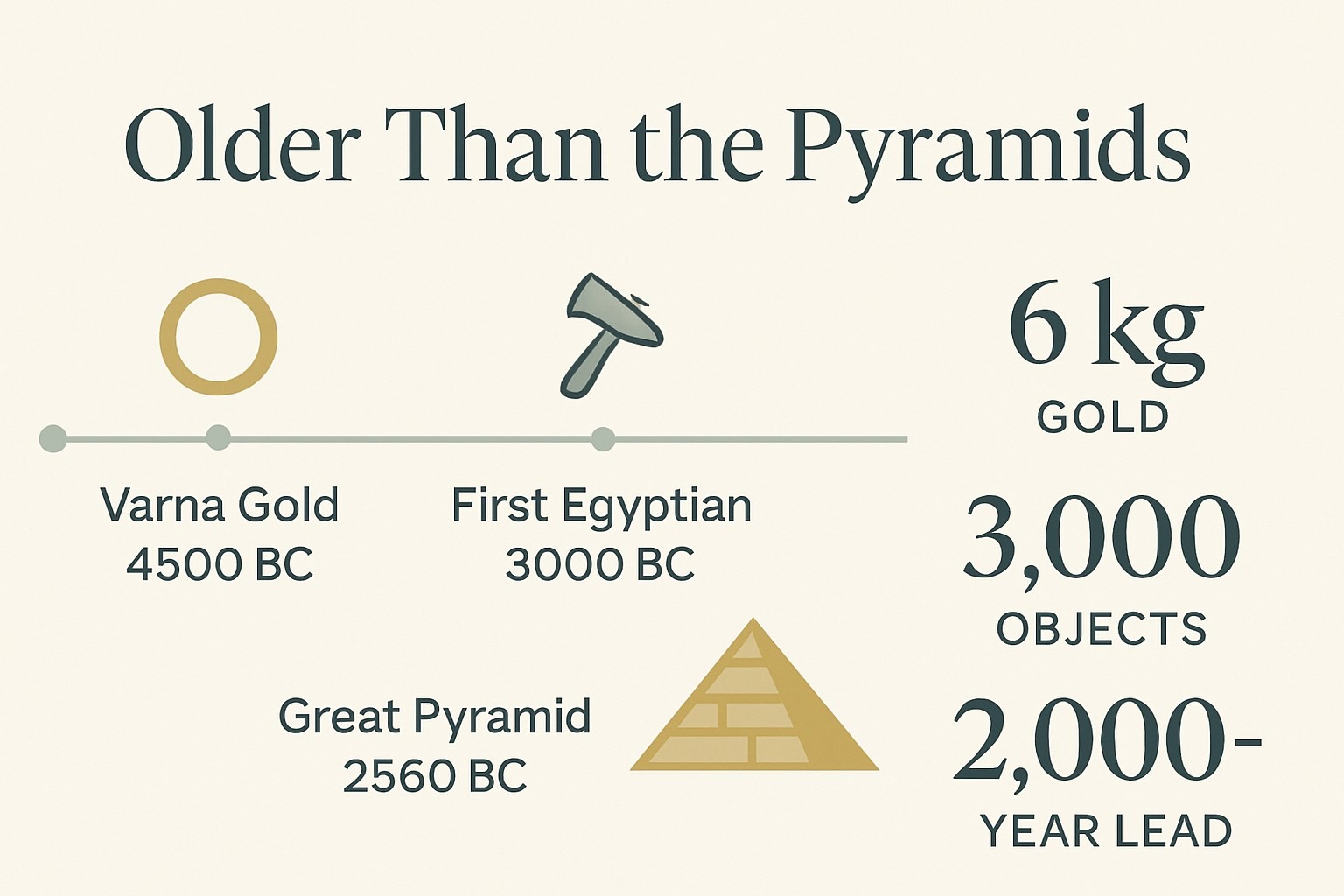
- The Varna Necropolis gold is radiocarbon-dated between roughly 4569 and 4340 BC, making it about 6,500 years old, re-confirmed by 2006 dating led by Tom Higham
- The Great Pyramid of Giza went up around 2560 BC, so the Varna gold is roughly 2,000 years older
- Excavator operator Raycho Marinov, aged 22, uncovered the first gold objects in October 1972 while cutting a power-cable trench
- Grave 43 held a man laid out with more than 990 gold objects weighing about 1.5 kilograms, the richest single burial of the period
- Archaeologists opened 294 graves and recovered around 3,000 gold artifacts totalling some six kilograms, with about one-third of the necropolis still unexcavated
In short: The Varna Necropolis on Bulgaria’s Black Sea coast, discovered by accident in 1972, holds around 3,000 gold artifacts totalling roughly six kilograms across 294 graves. Radiocarbon-dated to 4569-4340 BC, this deliberately crafted gold predates the Great Pyramid of Giza by about two thousand years.
A Lunch Tin, a Bulldozer, and a 6,500-Year-Old Secret
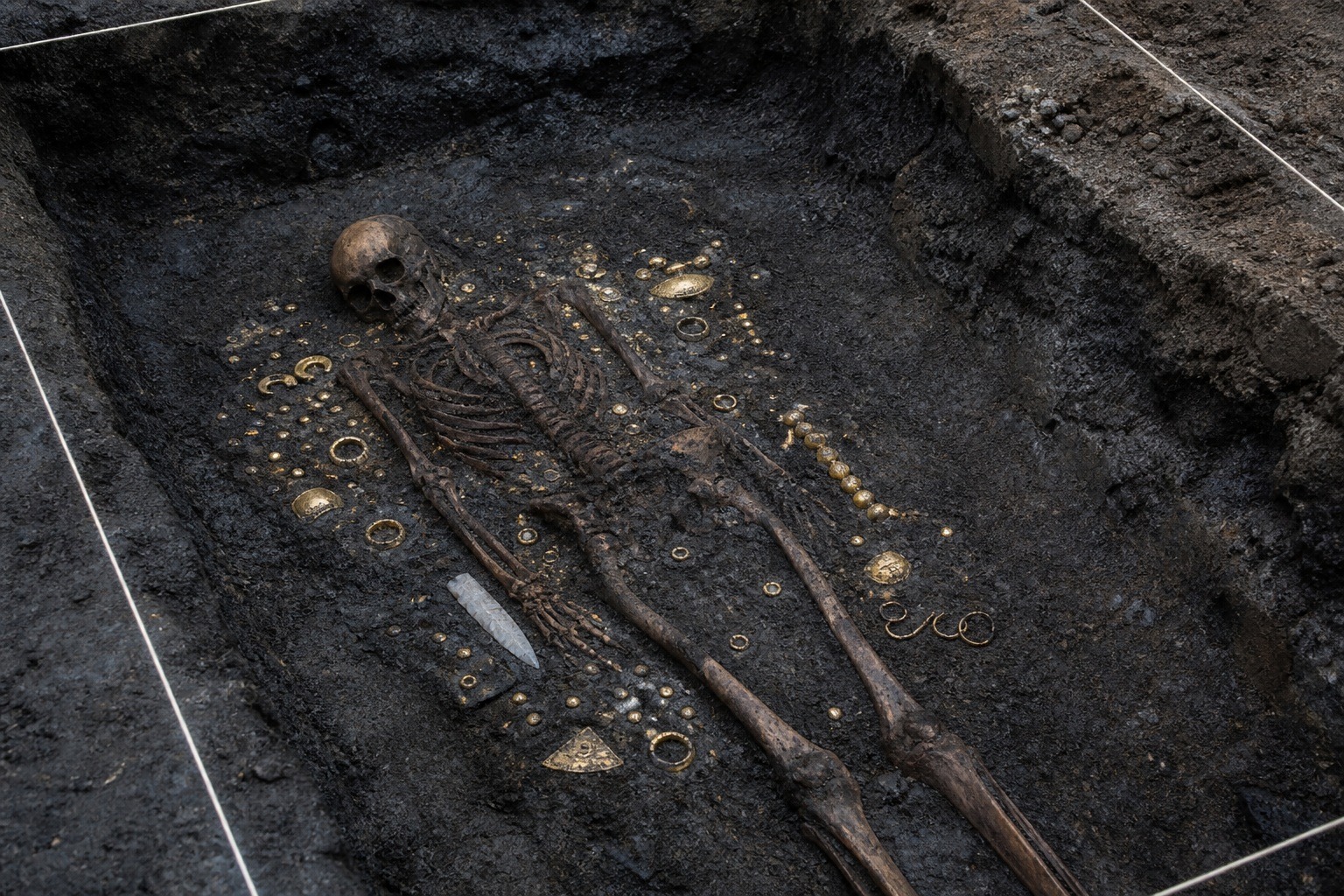
October 1972. A 22-year-old excavator operator named Raycho Marinov is cutting a trench for a power cable in the industrial zone west of Varna. His bucket bites into the soil and turns up a handful of small, heavy, yellow objects. He doesn’t call an archaeologist. He does what most of us would do — he pockets them, carries them home in his lunch tin, and gets on with his week.
Days later Marinov shows the pieces to someone who understands what he is holding. Word reaches the local museum, and the trench becomes one of the most important dig sites of the twentieth century. Turns out the “bracelets” were among the oldest crafted gold objects ever found. Over the following decades archaeologists opened 294 graves — and, crucially, they still haven’t finished. Roughly a third of the necropolis remains unexcavated to this day, which means the record it holds is not yet closed.
The excavation director Ivan Ivanov spent nearly twenty years on the site. What he uncovered wasn’t a royal tomb or a pyramid. It was a burial ground — ordinary in shape, extraordinary in what people had chosen to bury with their dead.
Varna Gold Older Than the Pyramids: What the Carbon Dates Actually Say
Here is where the “older than pyramids” line earns its keep. Radiocarbon analysis places the Varna Necropolis between roughly 4569 and 4340 BC, a range re-confirmed by a fresh round of dating in 2006 led by Oxford radiocarbon specialist Tom Higham and colleagues. That makes the graves about 6,500 years old.
Do the arithmetic and the comparison stops sounding like hype. The Great Pyramid of Giza went up around 2560 BC — so the Varna gold is roughly two thousand years older. The earliest worked gold from Egypt trails Varna by something like fifteen centuries. When these people were casting and hammering gold on the Black Sea shore, the pharaohs weren’t late — they hadn’t been imagined yet.
And this is genuinely worked gold, not raw nuggets picked off a riverbed. The Varna artisans hammered, cut, and shaped sheet metal into rings, beads, appliqués and bull figurines. That is the real superlative: not the oldest gold that exists, but the oldest gold humans are known to have deliberately crafted into objects of meaning.
{IMAGE_2}
A King in Grave 43 — or a Master of Fire?
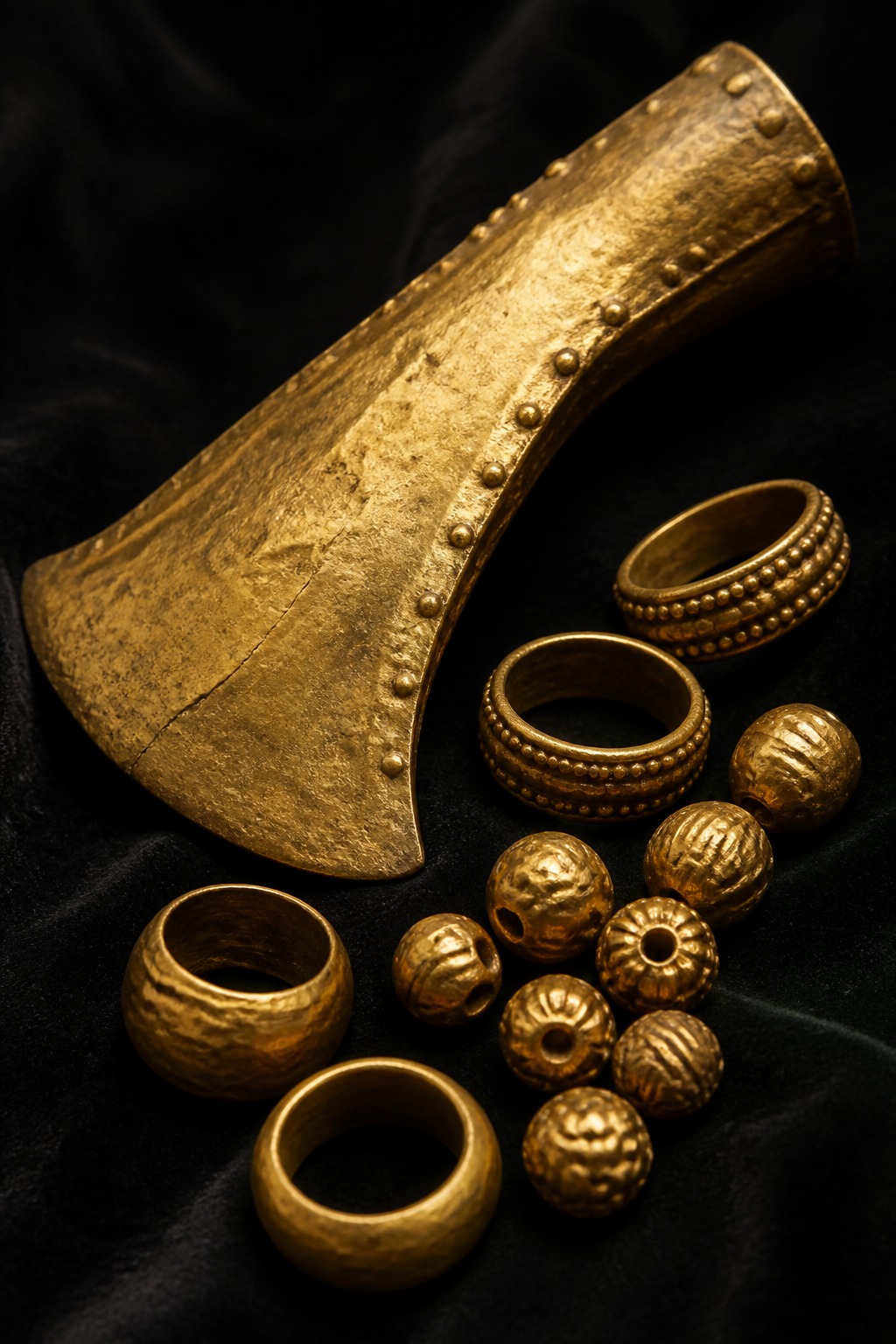
One grave dominates the site. Grave 43 held the skeleton of a grown man laid out with more than 990 separate gold objects weighing about 1.5 kilograms — more gold than in any other single burial known from the period. Gold rings stacked his arms. A gold-sheathed axe lay by his hand. And, unmistakably, a solid gold sheath rested over his genitals.
For half a century the museum labels and documentaries called him a prince, a chieftain, a king. It’s an easy story: most gold, therefore most power, therefore royalty. But a reappraisal led by Varna Museum archaeologist Vladimir Slavchev, working with Svend Hansen of the German Archaeological Institute, argues something more interesting — the man in Grave 43 was likely a master metalworker, not a monarch. The clue is in what he was buried holding: tools of the craft, not symbols of rule.
Think about what that inversion means. In a world just learning to pull metal out of stone with fire, the person who could turn ore into gold wasn’t a rich man — he was closer to a magician. Strip away the crown-and-scepter fantasy and Varna becomes a far more compelling place: a society that seems to have worshipped skill, not birthright. The reinterpretation is still debated (the scholars themselves flag the uncertainty), but the evidence for “smith” now reads at least as strongly as the evidence for “sovereign.”
Did Six Kilograms Really Outweigh the Whole World?
“Older than the pyramids” is the famous line. There’s a quieter statistic that hits harder. Across those 294 graves, archaeologists have recovered around 3,000 gold artifacts totalling some six kilograms — and that single cemetery holds more gold than every other site on Earth from the same era combined. In the centuries around 4500 BC, Varna out-glittered the whole rest of the planet, Mesopotamia and pre-dynastic Egypt included.
- ~6,500 years old — carbon-dated to c. 4569–4340 BC (re-confirmed 2006)
- ~2,000 years older than the Great Pyramid of Giza (c. 2560 BC)
- ~1,500 years older than the earliest known Egyptian gold
- ~3,000 gold objects, roughly 6 kg total, across 294 excavated graves
- Grave 43: 990+ objects, ~1.5 kg — the richest single burial of the age
- ~1/3 of the necropolis still unexcavated
Numbers like these reframe the whole question. The interesting thing about Varna isn’t that it had gold early. It’s that a Copper Age community on the edge of the Balkans concentrated more precious metal in one cemetery than the great river civilizations would manage for a thousand years — and then it slipped out of the textbooks entirely.
Salt, Shells, and Copper: Was Varna Europe’s First Trading Hub?
Where does a small Black Sea society get that much gold, and the wealth to spare it for the dead? Not in isolation. The graves are full of evidence of long-distance trade. Beads of Spondylus — a spiny Mediterranean oyster — turn up alongside the gold, meaning goods were moving up from the Aegean hundreds of kilometres away. The copper itself came from ore sources in the Sredna Gora mountains, smelted with real metallurgical skill.
So what did Varna sell in return? A strong candidate sits just inland at Provadia-Solnitsata, often called Europe’s oldest town, where people were boiling brine to mass-produce salt centuries before Varna’s necropolis peaked. Salt was preservation, currency, survival — and Varna sat perfectly placed to move it. The picture that emerges is a Black Sea hub where salt, copper and Mediterranean shells changed hands, and some of that surplus came back as gold.
This is the part most retellings skip. Varna wasn’t a lucky village that stumbled on treasure. It was a node in one of the earliest trade networks in Europe — the kind of connected, specialised economy we usually reserve for civilizations that came thousands of years later. If you’re drawn to how early “Old Europe” really was, the same surprise runs through the story of Göbekli Tepe, whose stone rings predate Varna by millennia.
Has an Older Bead Already Dethroned Varna?
Here’s a twist almost no popular account mentions. In 2016, at Tell Yunatsite near Pazardzhik in southern Bulgaria, archaeologist Yavor Boyadzhiev of the Bulgarian Academy of Science reported a tiny gold bead — about four millimetres across — that he dated to roughly 4500–4600 BC. “I have no doubt that it is older than the Varna gold,” he said, putting the bead perhaps two centuries ahead of it.
Does that dethrone Varna? Not exactly, and it’s worth being honest about the difference. A single 4mm bead is not the same league as six kilograms of crafted objects, and the “oldest” record depends heavily on how you date a lone artifact versus a whole sealed cemetery. Boyadzhiev’s claim is taken seriously, but it isn’t settled consensus.
What both finds agree on is the real headline, and it isn’t Egypt. The oldest gold-working we know of clusters in one place — the Balkans, on and near the Black Sea — a full two thousand years before the pharaohs. Varna may share its crown with a bead from Yunatsite. It doesn’t share it with the Nile.
Why Did They Vanish? Not an Invasion, but a Rising Sea
Around 4000 BC, this brilliant society simply stops. The graves end, the gold-working fades, the culture that anthropologist Marija Gimbutas grouped into her “Old Europe” — alongside the great Cucuteni-Trypillia settlements — goes quiet. For decades the default explanation, drawn loosely from Gimbutas herself, was invasion: horse-riding peoples sweeping in from the steppe.
The archaeology hasn’t been kind to that story. There is little sign of the violence a conquest should leave. The explanation now favoured by researchers including Slavchev and Hansen is environmental. Climate shifted, and the Black Sea rose — by an estimated 25 feet — swallowing the coastal farmland these communities depended on. Fields became seabed. People moved or dwindled. No army required.
It’s a quieter ending, and a more modern-feeling one: a wealthy, connected society undone not by swords but by a changing coastline. The record isn’t complete, and scholars still argue the details. But the drowned-farmland model fits the evidence far better than the old invasion narrative that documentaries keep repeating.
Common Misconceptions About the Varna Gold
“Egypt made the first gold jewellery.” No — the crafted gold of Varna predates Egypt’s earliest by roughly 1,500 years. The first great goldsmiths we can point to worked on the Black Sea, not the Nile.
“The richest grave belonged to a king.” Increasingly doubted. The reappraisal by Slavchev and Hansen argues the Grave 43 man was a master metalworker; his buried tools point to craft-power, not royal rule.
“Varna’s people were wiped out by invaders.” The evidence for conquest is thin. Rising Black Sea waters and lost farmland are the leading explanation for the culture’s collapse around 4000 BC.
“We’ve dug it all up.” Not close. About a third of the necropolis is still untouched, and the museum has targeted further excavation — so the “oldest” and “richest” claims could still shift.
In short: The Varna gold is the oldest deliberately crafted gold securely dated anywhere on Earth, buried by a Black Sea society that flourished two thousand years before the Great Pyramid — though a tiny bead from Tell Yunatsite may edge it out. Its richest grave probably belonged not to a king but to a master of metal, and its people weren’t conquered — they were drowned out by a rising sea.
Sources and Notes
- Higham, T. et al., radiocarbon dating of the Varna Necropolis, published in Antiquity (2007) — established the 4569–4340 BC dates re-analysed in 2006.
- Andrew Curry, “Mystery of the Varna Gold,” Smithsonian Magazine (2016) — Vladimir Slavchev (Varna Museum of Archaeology) and Svend Hansen (German Archaeological Institute) on the climate-collapse theory.
- Live Science and Slavchev & Hansen, “Rich metallurgists’ graves from the Varna I cemetery” — the reinterpretation of Grave 43 as a metalworker rather than a prince.
- Balkan Insight and Smithsonian reporting on the 2016 Tell Yunatsite gold bead, per Yavor Boyadzhiev, Bulgarian Academy of Science.
- Marija Gimbutas, The Goddesses and Gods of Old Europe (1974) — the “Old Europe” framework; excavation reports of Ivan Ivanov, Varna Museum archive.
The gold is on display today at the Varna Archaeological Museum on Maria Luiza Boulevard, with pieces also held at the National Historical Museum in Sofia. Stand in front of Grave 43 and the usual timeline quietly collapses: long before Egypt, long before writing, someone on this coast learned to make fire give up gold — and their neighbours thought that skill worth more than a crown.
Frequently Asked Questions
Q: How was the Varna gold discovered?
In October 1972, a 22-year-old excavator operator named Raycho Marinov was cutting a trench for a power cable in the industrial zone west of Varna. His bucket turned up small, heavy, yellow objects, which he pocketed and carried home in his lunch tin. Days later he showed the pieces to someone who understood their significance. Word reached the local museum, and the trench became one of the most important dig sites of the twentieth century.
Q: Why is the Varna gold called older than the pyramids?
Radiocarbon analysis places the Varna Necropolis between roughly 4569 and 4340 BC, a range re-confirmed by a 2006 round of dating led by Oxford radiocarbon specialist Tom Higham. That makes the graves about 6,500 years old. The Great Pyramid of Giza went up around 2560 BC, so the Varna gold is roughly two thousand years older, and it predates the earliest known Egyptian gold by around fifteen centuries.
Q: Was the man in Grave 43 a king?
For half a century museum labels called him a prince, chieftain, or king, since he held more than 990 gold objects weighing about 1.5 kilograms. But a reappraisal led by Varna Museum archaeologist Vladimir Slavchev, working with Svend Hansen of the German Archaeological Institute, argues he was likely a master metalworker, not a monarch. The clue is that he was buried holding tools of the craft rather than symbols of rule. The reinterpretation is still debated.
Q: Where did Varna get its gold and wealth?
The graves are full of evidence of long-distance trade. Beads of Spondylus, a spiny Mediterranean oyster, appear alongside the gold, meaning goods moved up from the Aegean hundreds of kilometres away. The copper itself came from ore sources in the Sredna Gora mountains, smelted with real metallurgical skill. A strong candidate for what Varna sold in return sits inland at Provadia-Solnitsata, pointing to salt as a likely trade good.
Illustrations are AI-generated. Article fact-checked and human-edited. Our editorial standards.